Meetings & Information


*****************************
****************************************************
MUST READ:
GET THE FACTS!


Sunday, August 21, 2016

Connecticut's casino racket is over; now we hurt mostly ourselves


Connecticut's casino racket is over; now we hurt mostly ourselves


Posted: Thursday, August 18, 2016

With its Indian casinos in Ledyard and Montville in the southeast part of the state, Connecticut started the gambling war that is engulfing the Northeast. For years Connecticut drew money from gamblers in adjacent states that had no casinos, but those states are getting into the casino business themselves and starting to fight back,
Massachusetts may be most notable among them, especially with the casino it has authorized MGM to build in Springfield to draw customers from northern and central Connecticut, who will be able to get to Springfield a lot faster than they can get to Montville and Ledyard.
So Connecticut has authorized its tribes, the Mashantucket Pequots and the Mohegans, to build another casino between Hartford and the state line in the hope of intercepting casino traffic to Springfield. But the interceptor casino probably won't have much effect unless it is as big as Springfield's, and disclosure of a proposal for a big casino at Bradley International Airport in Windsor Locks has made the neighbors nervous and angered MGM.
The situation raises two policy questions for Connecticut:
1) If casinos are going to be everywhere, who needs Indian tribes to provide them?
Connecticut's casino tribes have purchased their duopoly by splitting their slot machine revenue with state government. But that revenue has been declining steadily as casinos have sprouted in nearby states, and Ledyard and Montville are not strategically located. So state government probably would profit more by licensing and taxing new casinos, operated by anyone or even state government itself, at the several major traffic intake points on the state border -- not just north of Hartford but around Stamford, Danbury, and Stonington -- and ending the duopoly of the Indian casinos and forfeiting their slot revenue. This would eliminate the repugnant ethnic privilege on which the casino business in the state is now based.
2) When casinos are everywhere, who really benefits from them?
While the interceptor casino north of Hartford is purportedly meant to save jobs for Connecticut, such a result is not likely. Just as the MGM casino in Springfield will drain the restaurant and entertainment businesses for miles around, an interceptor casino, if it is big enough to compete with Springfield, will do the same in the Hartford area. An interceptor casino may particularly impair efforts to revive downtown Hartford, which already has been greatly weakened by the development of Blue Back Square in West Hartford, a town that, unlike Hartford, has a large middle class that can support all sorts of commerce. Further, as long as their number is strictly limited by government licensing, casinos only concentrate income and wealth, a result government tolerates because it gets a cut.
So it would be best if Connecticut realized that its casino racket is finished, that the days of casinos making more money from out-of-staters than in-staters are over, that the money state government earns from casinos comes too much from the poor, that casinos induce crime, but that if, because of government’s insatiability, we’re going to have them, everybody should be able to operate one.
* * *
-----
Chris Powell is managing editor of the Journal Inquirer.


N.J. couple admits leaving 3 kids in freezing car while gambling at casino in cold


Couple Left Young Kids in Car to Gamble at Pa. Casino: Police

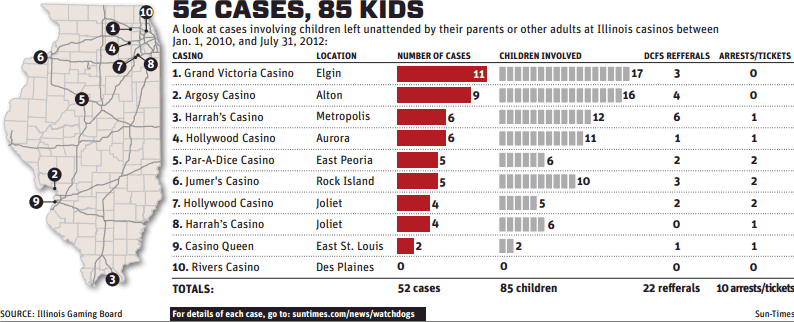
A New Jersey couple is behind bars after police say they left three young children in a cold SUV while they hit a Pennsylvania casino.
Police were called to the Parx Casino parking lot in Bensalem Saturday for a report of three children — ages 8, 3 and 1 — inside a vehicle, said Bensalem Police. Temperatures were hovering near freezing at the time.
Court records show 39-year-old Jarrett Evan Nelson and 30-year-old Ebony Walker, both of Newark, face charges including endangering the welfare of children.
Surveillance video showed the two entered the casino at 7:33 p.m. and returned to the SUV around 9:11 p.m.  The children weren't harmed and were released to other family members.
Walker and Nelson were sent to Bucks County prison after they were unable to post bail.
Online court documents don't list attorneys for Nelson or Walker.


N.J. couple admits leaving 3 kids in freezing car while gambling at casino in cold

By Kevin Shea | For NJ.com 
on August 19, 2016


BENSALEM, Pa. — A Newark, N.J. couple was sentenced to probation Friday for leaving their three children in a car in sub-freezing temperatures while they gambled at Parx Casino in January.
Jarrett Nelson, 40, and Ebony Walker, 31, pleaded guilty to misdemeanor endangering the welfare of children and recklessly endangering another person in in Bucks County Common Pleas Court in Dyolestown [sic].
Nelson, who spent two months in prison after his arrest, was sentenced to time served and 34 months probation. Walker was sentenced to 36 months of probation before Judge Rea B. Boylan, the Bucks County District Attorney's Office said in a statement.
The children, ages 8, 3 and 18 months, were not injured during the Jan. 2 incident.
They were unattended in 31-degree weather for more than 90 minutes, the office said.
Walker told the judge she was struggling for money, had recently been robbed and was desperate for rent money, the office said. 
She and Nelson, who was unemployed, said they won more than $700 playing the slots at Parx, which they put toward their rent.
But both admitted that leaving the children alone was wrong and dangerous, although Walker said she was in constant contact with the 8-year-old via cell phone.
"It happened, and it's the worst mistake I ever made," Walker said in court, the office said. "I made the money I needed, but I got incarcerated."
"No excuse at all," Nelson said. "It will never happen again, because I love my kids so much."
The district attorney's office said New Jersey child protective officials placed the children in Walker's mother's custody following the couple's arrests.
Walker suffers from bipolar disorder. She said in court she placed herself into an intensive counseling program in New Jersey following her arrest, which she still attends.
Nelson said in court the couple hopes to marry after they recover financially and regain custody of the children.
Boylan, the judge, told the couple the cold weather was not the only danger the children faced by being alone in a casino parking lot. They could have been abducted.
Surveillance video showed the couple entering the casino at 7:33 p.m. and returning to their vehicle at 9:11 p.m.
"There's so many things that could have happened to your children, not just being cold and scared," Boylan told the couple.


Gambling Addiction


He told how Galvin had a long-standing gambling addiction which he put above the needs of others. He added Galvin did “flash the cash” but sank ...

'Gambling mad' manager sentenced for swindling IPCC ... period to fund his gambling addiction has been given a suspended prison sentence.
Eakin said Rominger has undergone "rather intensive therapy" for his gambling addiction, which first gripped him in 2010. Also, she said, he has filed ...
MANY young teens are becoming addicted to online gambling before they can even legally place a bet, with experts saying sports betting campaigns ...


He told how Galvin had a long-standing gambling addiction, which he put above the needs of others. He added Galvin did "flash the cash" but sank ...


His former wife Kathy Murphy, who was with him, added that while he had sought help for his gambling addiction, nothing had worked. "I go into his ...


Stephen Isaacs, from Middle Touches, Chard, spared prison after stealing 47,000 from his partner's children's legacy


A GAMBLING addict who stole nearly £47,000 from his partner's childrens' legacy during a six-week spending spree has been spared prison.
Stephen Isaacs, 30, of Middle Touches, Chard, was in a relationship in January 2015 with a woman who knew he had gambled in the past and whose children had been left “about £50,000” by a relative, Taunton Crown Court was told.
He was handed a two-year prison sentence, suspended for two years.
He took her debit card and used it for on-line gambling which lasted for five or six weeks, during which he lost £46, 921, said Harry Ahuja, prosecuting. ]

As a result of his gambling “firing out of control”, he sent her an e-mail explaining what he had done and went to the police and was arrested, he added.
He gave a frank account, saying how he tried to get his losses back by gambling more and more, and had difficulties with his health due to how he was feeling while trying to get the money back, which culminated in self-harming, he said.
In a victim impact statement, the woman, Kate Hooker, said the theft had left her “absolutely devastated and an emotional wreck”.
The court heard that she was still in love with him and that in the past, she was aware he had gambled, but was not aware that he had such an addiction.
She described herself as being a caring person and still cared for the defendant.
The children had lost out as a result of him and she was having to re-build her life and having counselling sessions.
She wished the court to take into account that she did wish him to be punished with a prison sentence, and he had come to an arrangement with solicitors to repay £250 a month, he added.
In mitigation, Simon Cooper, representing Isaacs, said he admitted theft, was employed by a private organisation in a “challenging field” working with schoolchildren, and had not “initially known of the provenance of the money he was taking”.
He was repaying as much as possible and hoped to earn more and pay more in future.
Recorder Richard Stead said he had stolen “a very considerable sum” as a result of his addiction to gambling and “this was an offence to which I would sentence you to three years after a trial”.
To his credit, Recorder Stead said, Isaacs reported himself to police, made a full confession, had shown remorse and started to repay the money.
References and a pre-sentence report spoke highly of him and he had the support of his employer and had made efforts to cure his gambling addiction.
Isaacs was sentenced to two years, suspended for two years, and ordered to do 200 hours unpaid work and pay a victim surcharge of £140.


Could Bethlehem lose casino cash cow?


Could Bethlehem lose casino cash cow?


 Of The Morning Call
AUGUST 20, 2016

Pennsylvania lawmakers and casino executives have been squabbling for months about whether things such as online gambling or satellite casinos could help close the state's budget deficit, but another fight winding through the state Supreme Court could have a far bigger impact on Main Streets across the state.
Mount Airy Casino is asking the court to strike down the $10 million host fee most casinos pay to the towns where they are located, arguing it violates the state constitution by putting a much heavier tax burden on lower performing casinos.
If Mount Airy wins its case, it could eliminate a large chunk of the annual fee casino towns across the state use to pay for a wide variety of items.

"Our host fee is equivalent to the salaries of 100 police officers," said Bethlehem Mayor Robert Donchez. "That's a significant amount of money. That host fee is extremely important to our budget."
Sands Casino in Bethlehem is not contesting the fee it pays Bethlehem, but any decision issued by the Supreme Court likely would dictate how every casino must pay — or not pay.
A Mount Airy win would be a devastating blow to the budgets of most casino towns that collect the fee, but there's no need for those municipal leaders to panic, just yet. State legislators suggest they'd move quickly to alter the law to replace the fee — or at least they'd try. State legislators have spent much of the past year debating how to expand gambling to raise more money to balance the budget, but have not been able to reach consensus.
"I don't know exactly how we'd go about it, but given that this fee has been established for a decade, we're not just going to let this money be stripped from municipalities that rely on it," said Sen. Pat Browne, who chairs the powerful Senate Appropriations Committee.
Unequal tax
The case is being defended by attorneys from the state attorney general's office, which argues the tax scheme does not violate state law.
The case started in April 2015, when Mount Airy filed a legal challenge that argues the "local share tax" violates the uniformity clause in the state constitution, which requires that "all taxes shall be uniform, upon the same class of subjects." As a constitutional challenge to the gaming law, the matter was eligible to bypass lower courts and be filed directly to state Supreme Court.
The 2004 state gaming law imposes a 2 percent fee on gross slot machine revenues, to be paid to the municipalities where the casinos were built. However, the law also states that a minimum of $10 million must be paid. Therefore, the 2 percent would only really come into play once gross slot machine revenues for a casino went above $500 million.
Because that's never happened, the nine casinos affected by the law — SugarHouse Casino in Philadelphia and two resort casinos aren't subject to the minimum requirement — simply pay $10 million a year.

That creates an unequal tax that has some casinos paying a much bigger portion of their revenues to their host community. So, while the $10 million paid by Pennsylvania's most lucrative casino, Parx in Bensalem, was just 2.8 percent of the casino's 2014 gross slot machine revenue, the $10 million Mount Airy paid was more than 7 percent of its $140 million in revenue for 2014.
Each day, the Department of Revenue siphons 2 percent of all slot machine revenues from each casino and distributes it quarterly to the host community. At the end of the year, if that casino hasn't generated $10 million in fees then state regulators instruct the casino to make the payment needed to reach the $10 million minimum.
That "true-up" payment is what Mount Airy is contesting. For Mount Airy, the payment was $7.2 million for 2015, but even successful casinos have to write big checks. Sands, for example, had to pay $4 million to reach its minimum for last year.
In Sands' case, $3.2 million of that true-up payment went into Bethlehem's general fund and about $800,000 went to Allentown, under a deal struck between the cities before the gaming license was given to Bethlehem. It's a similar story in casino towns across the state, where casinos — depending on their revenue — pay end-of-year true-up fees ranging from Parx's $2.4 million to the $7.7 million paid by Presque Isle Casino, Erie.
"All we're asking for is uniformity and fairness, and that $10 million rate is neither," said Michael Sklar, the Atlantic City attorney who is co-counsel for the Mount Airy suit. "We think if the court strikes down the $10 million minimum, the 2 percent tax passes constitutional muster."
In addition to asking that $10 million minimum be struck down, Mount Airy is asking the court to award damages. While it doesn't specify how much, it has paid $57.4 million in true-up fees since it opened in 2007, second only to Presque Isle's $61.8 million.
Not a surprise
Part of Mount Airy's argument is not only that lesser performing casinos are unfairly burdened, but also that not every casino must pay the $10 million minimum. SugarHouse Casino in Philadelphia pays a straight 4 percent of its gross revenue. That consists of the same 2 percent all state casinos pay to their host county, plus another 2 percent that represents the local share, but without the $10 million minimum Mount Airy and other casinos pay.
Christopher Craig, a Pennsylvania Treasury attorney and former legislative counsel who wrote much of the gaming law, wouldn't predict how the court will rule, but he explained why the law was written the way it was.
The proposed Philadelphia County casinos in the law weren't given a $10 million minimum because the city was expected to be the only municipality that would have two casinos, therefore there was no need for a minimum. As it turned out, SugarHouse has been the only casino built so far, while the other gambling license has been delayed for years.
More to the point, Craig said the host fee is just that — a fee that every casino applicant was aware of when they applied for a gambling license in 2004. Though the Mount Airy suit repeatedly refers to it as a "Local Share Tax," it was actually called a "Local Share Assessment" in the law, Craig noted.
"A cost was identified for the impact gambling would have on a municipality and that cost was $10 million," Craig said. "In exchange for engaging in an activity that would otherwise be illegal, the licensee agreed to pay a minimum of $10 million."
That's how Sands Casino CEO Mark Juliano interprets it.
"We knew exactly what we were getting into when we applied for the license," Juliano said. "We're not trying to get out of it. We don't intend to join in the suit."
But two other casinos also have raised similar challenges. Harrah's Casino in Chester filed a similar suit last year and Rivers Casino in Pittsburgh filed a nearly identical suit in July. Harrah's suit was stayed while the Mount Airy case runs its course, and Rivers withdrew its case just a few weeks after filing it, presumably to wait for the Mount Airy decision.
Both sides have spent months filing preliminary objections and briefs, and oral arguments have already been made. There's no time limit on how long the court has to deliberate on the matter, so a decision could come any day, or it could be months away.
Analysts say the court could do everything from deny the challenge, to strike down the $10 million minimum requirement — or even strike down the entire local share fee altogether. It also will have to decide whether Mount Airy and the other casinos deserve a refund of any of the the more than $320 million in true-up payments they've made the past decade.
"This is one everyone is watching closely," Browne said. "There's a lot at stake."

AT ISSUE
• Mount Airy Casino is asking the Supreme Court to strike down the $10 million host fee most casinos pay to the towns where they are located.
• All casinos pay 2 percent of all slot machine revenues to the state Department of Revenue to be distributed to host communities. However, if that amount is less than $10 million annually, casinos are required to kick in the difference.
• That difference, a "true-up" payment, is what Mount Airy is contesting. In 2015, Mount Airy's true-up payment was $7.2 million.


Nothing good comes out of betting and gambling


Nothing good comes out of betting and gambling 
By David Oginde 
Updated Sun, August 21st 2016


Read more at: http://www.standardmedia.co.ke/article/2000212759/nothing-good-comes-out-of-betting-and-gambling


The rapid increase of lottery, gambling and betting companies in Kenya has caused alarm in several quarters. Billions of shillings are being wasted in this fledgling industry. Wasted, because gambling is not and has never been a legitimate business, or a valid source of income. To the contrary, in a recent study by the Australian government, it was found that the negative actions of one gambler affects the lives of between five to ten others — including friends, family and employers. The study further found that, though gambling is addictive and highly destructive, only around 15 per cent of gamblers seek help. This means many gamblers suffer quietly, with some getting into drugs and alcohol to drown their sorrows, while others simply commit suicide. That is why the Australian government has taken the bold move to not only control gambling but also offer help to those affected. Sadly, in our nation, few are taking this matter seriously. I personally know a few people whose lives have been totally ruined after losing their salaries month after month due to addiction to lottery.

It is therefore unfortunate that our National Assembly has been pussyfooted in setting up regulations for the betting and gambling industry in Kenya. Under the current regime, where betting is easily available online and on phones, it is quite easy for even minors to engage in this dangerous practice. 

In so doing we may soon end up with a generation of gamblers than a skilled workforce for the nation — a challenge that must be considered seriously. At the core of lotteries, betting, and gambling, is the fallacy that one can make lots of money purely by chance. This undermines the very core of our human dignity. God created us to find dignity in work. Every human being finds greatest fulfillment in utilising their talents, skills, or abilities in doing work — even if such duty is done free of charge. That is why many people would rather volunteer their services at a place of work, than sit idle in a comfortable couch at home. 

Likewise, few enjoy sitting idle at an empty desk with no work, even if they are being paid a handsome salary. It follows therefore that a nation that empowers its people to do fulfilling and rewarding work, is guaranteed a happy and productive citizenry. Nations that have committed to train and equip their people with a variety of knowledge and skills, and then create a conducive environment to utilise those skills; produce highly patriotic citizens and enjoy low crime rates. 

Conversely, nations or communities where people are brought up to depend on handouts, or easy money, produce people who tend to be idle, unhappy, and prone to crime. It can destroy a nation. 

Back in 1996, the love for easy money drove Albania into the trap of pyramid schemes — formed in collusion with top government leadership. Albanians sold their houses to invest in the schemes; farmers sold their livestock, and many abandoned legitimate work for easy money. Sadly, several banks played ball. Despite repeated warnings from the IMF and the World Bank, President Sali Berisha came to the defence of his people. Press and public reaction was also mostly negative, accusing the IMF of advocating the closure of Albania’s most successful firms that were trying to empower the poor — an argument I have heard from some Kenyans in defence of lotteries. But soon the collapse began and by March 1997, Albania was in chaos. The government was forced to resign. Two things can get us there easily — corruption and lotteries.

That is why it would be tragic if as a nation we seem to be training our people not to work. But that through corruption, connections, or the lottery, one can make easy money and live happily ever after. This spirit is already prevalent among many young people, especially young graduates who languish in poverty six to ten years after graduation, while their “well connected” counterparts make it in record time. It is a spirit that must be killed.

The truth is, wealth and riches that do not derive from legitimate work, are under God’s curse, and rarely results in true prosperity — a holistic well being in life. It often carries with it a leanness of heart. Because, God promises to bless the labour of our hands, not to provide luck for our lottery.


Read more at: http://www.standardmedia.co.ke/article/2000212759/nothing-good-comes-out-of-betting-and-gambling


Kingston: How Wyo. abused gov’t power


Kingston: How Wyo. abused gov’t power

  • By Tim Kingston


On May 8, 2016, my good friend Ed Atchison died. Though Ed had a long history of health problems, his death was unexpected, with only his dog at his side.
Ed was an Army officer in Vietnam, and after his service, he became a licensed counselor at the Cheyenne VA, including becoming the director of the Cheyenne/Fort Collins Veterans Outreach Center. Later, Ed moved to Las Vegas, where he counseled vets at the largest homeless shelter in the city.
When Ed moved to Las Vegas, he became concerned with the issue of gambling addiction, or “problem gambling.” He saw how gambling can take over people’s lives and cause them to lose their savings, home, family and even their lives.
He learned that suicide is a particular problem among problem gamblers. National studies show one in six problem gamblers attempts suicide.
He was particularly concerned with the issue of problem gambler suicide in Wyoming, because Wyoming has one of the highest suicide rates in the country. Ed became one of the very first nationally certified gambling counselors and was the only such counselor in Wyoming.
The Wyoming Legislature approved a lottery in 2014.
The legislation required that a percentage of gambling funds be used for the prevention and treatment of problem gambling.
The legislation also created a state entity known as the Wyoming Lottery Corporation to start up and run the lottery. During the startup phase, Ed worked with the Lottery Corporation on the issue of problem gambling and provided them his unique expertise and experience. However, Ed came to believe that the Lottery Corporation was not concerned with the issue of problem gambling and was not taking steps necessary to address the problem. The relationship between Ed and the Lottery Corporation became contentious, and there was a parting of the ways.
But Ed did not give up. He continued to push executives of the Wyoming lottery, including Jon Clontz, its executive director, on the issue. It is fair to say that Ed became a thorn in the side of the Wyoming lottery. He also wrote numerous letters to the editor and was interviewed by reporters and commentators, where he expressed his belief that the Wyoming Lottery Corporation was not doing anything close to enough to address problem gambling.
And this is the point of this piece. Instead of addressing Ed’s concerns, instead of trying to work with him, instead of adequately addressing the issue of problem gambling, the state of Wyoming, through the Wyoming Lottery Corporation, sued Ed Atchison for defamation.
I represented Ed in that case. I have had a lot of experience with First Amendment cases, and I can say that I have never seen, certainly not here in Wyoming, a governmental agency suing one of its own citizens for defamation. It was and is absolutely unprecedented.
For an entity of the state of Wyoming, armed with all of the resources and power of the state, to use that power to sue a private person for being critical of the state is an absolute travesty and should cause great concern to Wyoming’s citizens. The First Amendment to the United States Constitution absolutely protects everything Ed said and did with regard to the lottery.
Yes, Ed was difficult. Yes, he pushed hard and was critical of the Wyoming Lottery Corporation. But for a state entity to sue someone for being criticized flies in the face of everything we as Americans believe about our role in our own governance and government.
Without engaging in hyperbole, what the Wyoming Lottery Corporation did, what the state of Wyoming did to Ed, is what totalitarian governments do. Totalitarian governments crush dissent, and this is what the state was trying to do, crush the dissent of Ed Atchison.
I hope that this is the last time that the state of Wyoming and its entities engage in this kind of abuse of governmental power. We all must be vigilant to ensure that it never happens again.
Tim Kingston has been a Cheyenne attorney in general practice here and throughout Wyoming for the last 23 years. He represented Ed Atchison in the lawsuit referenced in the op-ed. Email: Kingston@rockymtnlaw.com.


Thursday, August 18, 2016

Gambling Addiction


LETTER: More needs to be done to fight gambling addiction

Published: July 29, 2016


Re: Seniors excited about proposed casino for Victoria (Gazette, July 27)

As a 75 year old senior, I am excited about another casino locating in Greater Victoria, but not for the reasons given in the article.

Don’t other seniors and the general public realize that the B.C. Treasury takes in over a billion dollars annually from gambling - more than comes in from forestry. And for the small indulgences and pleasures it offers a few of us seniors, it increases the number of confirmed addicts, including adults, children and grandchildren. And that costs us hundreds of millions of dollars to repair families and relationships damaged by this so-called benign pastime.

That my fellow seniors can’t appreciate that is beyond me.

Everyone connected to the gambling industry must confront the scope and magnitude of gambling addiction in this province. And all of us must demand that our politicians face this social disease and use our money for programs that enhance the family and community.

Otherwise we become party to turning our provincial government, including municipal governments, into the most insidious pimps ever known.

Dale Perkins
Victoria


Bingo can lead to gambling addiction, experts claim


Bingo players may be at risk of developing a gambling addiction

Read more at http://talkradio.co.uk/news/bingo-can-lead-gambling-addiction-experts-claim-1607292577#RwTu7Pkvl8CwawWv.99

Friday, July 29, 2016

As many as one in 10 bingo players are at risk of developing a gambling addiction, recent research shows.
The study, commissioned by the Resonsible Gambling Trust, revealed that 2.5% of regular players had already developed a gambling problem, with only a third of those telling family and friends about it and just 7% seeking professional help.
"All forms of gambling carry some risk of addiction," Iain Corby, director of operations at the Gambling Association, told Julia Hartley-Brewer. "That's been rising steadily since gambling was effectively made more legal in 2007. 
"When we asked people if they [wanted] to cut down where they would go for help, most of them didn't really know there was professional help available. 
"We'd encourage people to ask themselves some questions: whether they're feeling more stressed, or maybe lying about their gambling."
Listen to the full interview to find out more, and for information on where to get help if you are facing challenges with gambling


Has Boom In Gaming Industry Increased Gambling Addiction?


July 29, 2016

By Tracey Leong

VIDEO ON LINK


BALTIMORE (WJZ) — A new study will be looking into the booming business and the impact it has on people living in Maryland.

Since 2010, the state has seen a rapid growth of gambling, with a new one popping up almost every year, and a sixth on the way.

Researchers want to know if the booming fambling industry is also increasing gambling addiction.

“We know that gambling has an impact on things like suicide–highest suicide of any addiction–bankruptcy, domestic violence,” said Jeffrey Beck, a clinical director for the University of Maryland, focusing on gambling problems.

Having overcome his own gambling addiction, Beck knows the disorder all too well.

His concern is the accessibility of in Maryland.

“You can’t get hooked until you try it,” Beck said.

Experts say only five percent of gamblers are actually addicted, and there have been no studies that show casinos cause the problem.

While researchers are working to determine a casino’s impact on a gambling addiction, it’s clear they’re a huge economic boost for Maryland, bringing in a record revenue of more than $100 million a month.

But casinos are not the only way people can gamble.

“You can gamble on your cell phone, you can do it online, you can do it by phone. So there are so many means,” said Sharon Bolden, Institute for Behavioral Resources.

Bolden has an extensive background in treating those with a gambling addiction. She says the responsibility falls on the individual, not the industry.

“I don’t believe that they’re feeding off those with an addiction because I think they are being as responsible as they can be,” said Bolden.

Researchers hope to have the survey results of casinos impacting addiction available by the end of 2017.

For information on treating a gambling addiction, CLICK HERE.


Tracey Leong joined WJZ Eyewitness News in July 2014 as a general assignment reporter. Her journalism career began in Southern California, where she was born and raised. She worked as an intern at KABC and an editorial assistant at KNBC in Los...

http://baltimore.cbslocal.com/2016/07/29/new-study-will-look-into-impact-of-casinos-on-gambling-addiction/