Meetings & Information


*****************************
****************************************************
MUST READ:
GET THE FACTS!


Showing posts with label Responsible Gambling Programs. Show all posts

Sunday, September 6, 2015

Martin’s gambling addiction took steep toll


This story and many others defines the Gambling Industry's Propaganda when it pretends to fight Gambling Addiction. 

Please click on the link below to view a comprehensive report.


Posted: 12:00 a.m. Sunday, Sept. 6, 2015

Martin’s gambling addiction took steep toll


Staff Writer
Martin’s gambling addiction took steep toll photo
Former Tecumseh Superintendent Brad Martin looks back at his wife after he was sentenced in Clark County Common Pleas Court on Thursday. Bill Lackey/Staff


NEW CARLISLE — 
Former Tecumseh Superintendent Brad Martin has been diagnosed with a pathological gambling addiction, which records show led him to visit Ohio casinos nearly every day in the second half of 2014, betting hundreds of thousands of dollars and losing at least $45,000 last year alone.
Investigation records obtained by the Springfield News-Sun shed new light on the depth of Martin’s gambling problems. The same week he was sentenced to six months in jail for stealing from the district to fund his addiction, the state launched a new campaign to combat problem gambling.
To read the full story and see an immersive digital presentation of it, go here:projects.springfieldnewssun.com/reports/gambling-addiction-took-steep-toll/

In-depth investigation
I-Team Reporter Katie Wedell has investigated former Tecumseh Superintendent Brad Martin’s thefts since he was first placed on leave in December, including stories digging into gambling addictions and his falsified mileage reports.
By the numbers
$225,000: Total amount Brad Martin bet at Miami Valley Gaming in Lebanon in 2014, according to casino records
$17,000: Amount Martin lost at the Lebanon racino
$28,000: Amount Martin lost at Hollywood Gaming at Dayton Raceway from October to December 2014.
$24,000: Salary Martin was ordered to pay back to Tecumseh schools for the 300 hours he spent at casinos when he was supposed to be at work.
Need help?
Learn more about the “Be the 95 percent” campaign by visiting the95percent.org.
If you or someone you know is struggling with a gambling problem, the Ohio Problem Gambling Helpline is free, confidential and available 24-hours a day.
Call 800-589-9966.

Sunday, January 18, 2015

Corporate bookies controlling the game


Corporate bookies controlling the game

There will be a major ad campaign on the risks of gambling, sponsored by those who run the show


Declan Lynch

Published 18/01/2015 |
 
Cartoon by Jim Cogan
Next week, some of the biggest bookmaking chains in these islands, including Ladbrokes, William Hill, Paddy Power and Coral, will be launching the Senet Group, an "independent body" set up to promote "responsible gambling".


Before we go any further, let us pause for a moment's reflection on the genius of these people who, without missing a beat, can declare that a body set up by Ladbrokes, William Hill, Paddy Power and Coral is "independent".

Lesser men would simply say they are setting up a body, but the bookies, always looking for an edge, have to call it "independent".

In an attempt to see off any proposed legislation by the British government, there will be a major advertising campaign to highlight the potential risks of gambling - perhaps as a response to all the major advertising campaigns which have highlighted the potential risks of not gambling.

Not that they need to worry greatly about any legislation promised by parties running for election.

The corporate bookies are very much in tune with the spirit of the age, in which most governments, including the Irish one, are broadly in favour of anything which tends to facilitate large transfers of money from the weaker elements in society to the top people.

But the bookies are taking no chances anyway. They too are reading the papers in which, most weeks now, there's another story of personal catastrophe which has befallen some unfortunate punter who just lost his way in the labyrinth that is online gambling.

They too are noticing these Twitter accounts being set up all across the world with names like Re-Think Gambling, Stop Predatory Gambling, or just Compulsive Gambler, which are calling bullshit on the Byzantine PR campaign that is "responsible gambling".

So they are acutely aware of the need to control the situation, an awareness which was apparent in the days just after Christmas, when the papers ran a story about a man in Galway who had a €5 football accumulator that won him €421,000.

It was a great story indeed, a magnificent achievement by that man, and one that directed our attention away from the fact that the big Leopardstown meeting had turned into a kind of Armageddon for the punters, with several hot favourites down the glen.

A headline which honestly reflected the state of the betting world at that time would have read something like, "Hundreds of Men Annihilated in Scenes of Absolute Carnage."

Instead it went something like "One Man Dies And Goes to Heaven".

So the overall message which was conveyed by an acquiescent media was roughly the opposite of the truth - and there's a pattern here.

The corporate bookies, with their ruthless brilliance, tend not to be contented with the mere half-truth.

In Britain, for example, they seek to convey the impression that they are wholly committed to "responsible gambling", while in their offices they have machines with fixed-odds games such as roulette which are known not only to be monstrously addictive, but to take up to 100 quid a time.

Desperate men can be seen losing thousands in a few minutes, and yet the bookies have resisted obviously responsible suggestions that these machines should not be taking 100 quid every 20 seconds, they should be taking a maximum of maybe two quid.

This would work, even on those obviously rare occasions when the antennae of the staff somehow fail to pick up the signs that they may be in the presence of an addicted gambler - the companies acknowledge that some clients may have a problem, but they say it is only a small minority.

Therefore the vast majority of the punters pumping a hundred quid a time into those machines do not have a problem, they are just having a laugh.

Sometimes the disappointed players can be seen physically attacking these machines, demented with anguish, an image to keep in your mind as you watch various well-spoken industry leaders making apparently constructive suggestions that they will no longer be advertising "free-bet" or even "free money" offers on TV before 9 o'clock, so "responsible" are they.

As for the accusation that certain clients might be using those roulette machines or fixed-odds betting terminals for the grand old custom of laundering money through the bookies, well, that would be - and there is no other word for it - irresponsible.

The strategic purpose of this "responsible gambling" shtick was examined recently in a piece in The Guardian by Matt Zarb-Cousin, himself a recovering addicted gambler who wrote that "like other addictions, gambling addiction is the consequence of a complex interplay between an individual and a product. But while the betting industry would claim it would like to encourage responsible gambling, these semantics imply that those who become addicted to their products are entirely to blame, and that their products are not. The narrative... is one that seeks to absolve the industry of blame... this shifts the focus away from whether operators are behaving responsibly with the products they offer."

And the best of all narratives is that of the online punter in Swindon last Saturday who turned £20 into £16.5k in just over 20 minutes with a £10 each way fourfold on the Saturday racing.

He got it done "in the time it takes to throw together some oven chips and a couple of fish fingers".

Oh lucky man!
Sunday Independent


http://www.independent.ie/opinion/columnists/declan-lynch/corporate-bookies-controlling-the-game-30916051.html


Saturday, April 5, 2014

Casino giants’ problem gambling efforts are shoddy

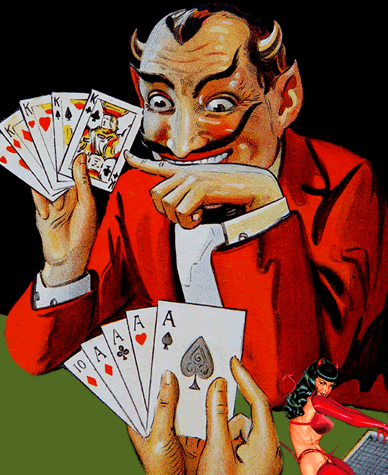
Great collage!

Casino giants’ problem gambling efforts are shoddy

Thursday, 3. April 2014
If you remember the ceos of big tobacco in front of congress swearing that the product they are selling is not addictive ( were they told this by the tobacco instutie ?) and the next year or so all the fedreal and state lawsuits popping up costing them millions +


Is the gaming industry being lead down the same road ??
Iets look at what some of the gaming people are saying and doing or not doing with


· · Casino giants’ problem gambling efforts are shoddy

The responsible gaming page on the Luxor website.
Steve Friess
Monday, April 25, 2011 | 2 a.m.
A few years ago during Responsible Gaming Education Week, every MGM Resorts employee was required to wear an orange wristband that read: “Keep It Fun.” At lunch with an MGM executive that week, I needled him about how ridiculous the gesture was, only to have him scold my skepticism. Plastic jewelry, he insisted, was important to raising awareness of problem gambling, and the company seriously wants to help problem gamblers.

That encounter sprang to mind this month after I strayed accidentally into the “responsible gaming” section of the Monte Carlo website, was quite appalled, and then took an extensive and damning inventory of how major casinos handle this matter online. Then, I watched with sadness as some of the Strip’s mouthpieces went into damage-control mode rather than soul-searching mode upon the April 14 release of a credible $3 million study that found gambling addiction is twice as common as alcoholism.

This is an era in which gambling — casino or otherwise — has never been easier. The shutdown in recent days in the U.S. of the world’s biggest poker websites amid a federal indictment will make playing online temporarily more challenging, but there’s also legislation in Carson City to allow mobile gaming devices to be taken to private places such as hotel rooms. So I find the industry’s sincerity questionable. They point to the “When the Fun Stops” brochures near the ATMs and the dough they give Harvard for addiction research, but for proof to how serious they are, consider what I found online:

• Click on the “responsible gaming” (RG) tab for Monte Carlo and you’re greeted with a headline that reads, “HIT THE CASINO.” There’s also a sexy video of hot babes winning at craps. Beneath all that is a copy block emphasizing how fantastic MGM Resorts is for training employees to spot problem gambling. Near the end is a hotline number.

• The “responsible gaming” sections of the Luxor and Mandalay Bay show hot blondes having fun.

• The Excalibur, Tropicana and Stratosphere’s “responsible gaming” sites show images of jackpot-hitting slots, a roulette ball landing on green, card players peeking at great hands. All Caesars Entertainment resorts feed to the same page showing, among other things, a royal flush.

• Both Caesars and Boyd Gaming force you to find their responsible gaming links in tiny print at the very bottom of each resort’s websites.

Theoretically, this material is on these sites so someone who thinks they’re an addict — or even someone who never thought of it before — can get help. Instead, in almost every case, the badly written information is surrounded by distraction and titillation, with links to the rest of the casino’s offerings. Would a site for potential alcoholics sport images of happy, sexy drinkers and links to the nearest saloon? Would a site on compulsive eating disorders boast pictures of hot fudge sundaes and jelly beans?

Only one company, in my judgment, does it right, and it surprised me: Las Vegas Sands. CEO Sheldon Adelson once told me gambling addiction doesn’t exist in Asia, but nonetheless each of the Las Vegas Sands sites links to a totally separate responsible gaming page where the hotline number stares you in the face. No alluring links compete for your attention; there’s a left rail providing several ways to find help and information. And the image atop the page is that of a despondent fellow in front of a blur of slot machines. You don’t want to be that guy.

It’s not that I hold casino owners responsible for eradicating compulsive gambling, but they’re out there tooting their horns about how terrific they are. Rather than patting themselves on the back for mandating wristbands one week a year, Strip resorts can actually make a difference by making the information they provide online easy to find, straightforward and devoid of both temptation and self-congratulations.

That’s when we’ll know they’re serious.

Steve Friess’ column first appeared in this week’s issue of Las Vegas Weekly, a sister publication of the Sun.

=======================

Study finds compulsive gambling more prevalent than alcoholism

After age 21, gambling problems are more common than alcoholism, the University of Buffalo’s Research Institute on Addictions found in analyzing data from two national studies.
By Liz Benston (contact)


Thursday 14 April 2011 2:01 a
Tony McDew not only recognized that he had a gambling problem, but set out to document it with his own video camera, hoping that sharing his experience could help others. When the jackpot hits, “It feels like you’re getting high.” And when it doesn’t? “You want to crucify yourself.”

For decades, researchers have said that alcoholism is more common in the U.S. adult population than compulsive gambling.

But last month the University of Buffalo’s Research Institute on Addictions published a surprising report concluding just the opposite.

After age 21, gambling problems are more common than booze dependence, the institute found in analyzing data from two national studies.

The study included all forms of gambling, such as lotteries, office pools, charity bingo, Internet gambling and raffles.

The results have drawn skepticism from some treatment experts in light of long accepted research that drinking problems are at least twice as common as gambling problems. Even the institute’s chief investigator, John Welte, was surprised by the results.

“I didn’t expect problem gambling to be more common than alcohol dependence for such a wide age range,” he said.

What might otherwise be an academic debate could have bigger consequences for the gaming industry, which has long fought criticism that gambling creates social ills that go unaccounted for in official statistics. Casinos are subject to high “sin” taxes in states where they are granted monopolies, with some tax money diverted to help problem gamblers. There’s still relatively little money for problem gambling treatment in the United States, in part because it has been viewed by academics and industry officials as rare.

Welte’s research found that the prevalence of alcohol problems peaks at a younger age and drops off significantly after age 21, a similar trend found elsewhere and possibly explained by the fact that young people tend to engage in risky behavior more than adults.

By contrast, the prevalence of gambling problems increases after 21, peaking at ages 31 through 40 and declining slowly until later adulthood, when it falls off significantly, the study found.

Welte’s findings show a significantly lower rate of alcohol dependence than previous studies, although his evidence that problem and pathological gamblers combined make up from 1 to 5 percent of the over-21 population is within the range of previously reported figures.

A state-funded study in 2002 found that from 2.1 to 6.4 percent of Nevada adults are problem gamblers or “probable” pathological gamblers likely to develop a problem — at least 75 percent higher than results for the rest of the country. That study hasn’t been replicated to determine whether the problem has worsened as the population and available gambling opportunities have grown, even as some locals with gambling problems stop or curb their gambling over time.

To compare gambling and drinking problems, Welte’s study ranked the percentage of survey respondents who answered “yes” to at least three questions on gambling addiction against the percentage who answered “yes” to at least three questions on alcohol dependence. The questions, which include whether a person has ever lied or stolen to feed his addiction, are taken from standard diagnostic manuals.

The study combined results from two national telephone polls conducted by the institute, including a survey of adults ages 18 and over in 1999 and 2000 and a survey of youth ages 14 to 21 from 2005 through 2007. All told, Welte’s group surveyed nearly 5,000 people in one of the largest research projects of its kind.

Welte found the greatest discrepancy between gambling and drinking problems from ages 31 to 40, with gambling problems peaking at about 5 percent of the population and at three times the rate of alcohol problems.

Robert Hunter runs the only nonprofit problem gambling treatment clinic serving the Las Vegas Valley. He’s one of the study’s skeptics.

Problem gambling is probably higher in Southern Nevada than it is elsewhere because of widespread gambling options, Hunter said. But drinking problems are believed to be more common because of the greater availability and consumption of alcohol, including in the home, he said.

That may be changing, Hunter said, as casino and Internet gambling spread nationwide.

“Conventional wisdom says you can get alcohol everywhere,” he said. “Theoretically, you can get gambling everywhere, too.”

Most of the Problem Gambling Center’s patients are 31 to 60, with the number of people in each decade about equally represented, he added.

Dr. Mel Pohl, medical director of the Las Vegas Recovery Center for the treatment of drug and alcohol addiction, is also not sold on the study’s findings.

Addiction experts generally believe that people who abuse alcohol make up 9 to 10 percent of the population, Pohl said. By contrast, Welte’s research found that up to 3 percent of adults have a drinking problem.
====================
Social and economic impacts of gambling

By Michael Tutton, The Canadian Press – HALIFAX — A draft report on the social and economic impacts of gambling that was shelved about 18 months ago by the Nova Scotia government should be released, says the province’s freedom of information review officer.
The government refused to provide the document a year ago, saying it wasn’t being released because of problems with its research techniques. The Canadian Press and an anti-gambling group appealed to the review officer in a bid to get the report released by the Department of Labour and Advanced Education.
In her report, Dulcie McCallum recommends the release of the full draft report.
She rejects the province’s argument that the document is exempted under the freedom of information law because it might provide advice, recommendations or draft regulations to a cabinet minister or public body.
The final draft of the report was submitted by a consultant in September 2009, a couple of months before his contract was terminated under the direction of the province’s NDP government. It was expected to delve into the costs to society of gambling addiction tied to video lottery terminals.
The consultant who wrote the report, Mark Anielski, has rejected criticisms of his methods, saying he suspects the study was killed because it focused on social problems linked to the use of VLTs and casino slot machines.
The province has said about $99.5 million of its $146 million in gambling revenues in 2009-10 came from VLTs.
McCallum says in her report that the province interfered with the rights of the applicants to information under the freedom of information act.
And the six weeks it took Labour to confirm that it had custody and control of the report slowed down the process, even though McCallum says her office had formally informed the province that the file should be “expedited” due to public interest.
She says the delays meant she couldn’t begin working on the final review until April 1, about a week after the province held a news conference announcing its plans for a new gaming strategy.
“The timing may be circumstantial but my observation is that as a result of the delay the applicants’ right to access information and to fully participate in policy formulation, government decision-making and being allowed to air divergent views, was interfered with and at odds with the purposes of the act,” wrote McCallum.
A spokeswoman for the Labour Department said in an email that the province is reviewing McCallum’s report and won’t comment until its formal response. The province has until May 8 to respond and after that it has 30 days to appeal the matter to the Nova Scotia Supreme Court.
In her report, McCallum rejects the government’s public statements that the document couldn’t be released because of errors in methodology.
“With respect, as I stated in a previous review, applicants are perfectly capable of discerning inaccurate information. If a public body believes information may be misleading, rather than withhold the record, under the duty to assist in the act, a public body should provide the record along with a further explanation.”
In the legislature on Wednesday, Liberal Leo Glavine asked Labour Minister
Marilyn More if she would table the report.
“This needs to be made public now. It should have been there before the most recent (gambling) strategy was put forward,” he said.
More said she will consider the recommendations and respond formally.
The province announced its new gambling strategy last month and maintained a moratorium on new VLTs. The original moratorium was introduced in 2005 by the previous Conservative government as part of a strategy that removed 1,000 machines across the province.

Nova Scotia regulates 2,200 VLTs, while about 600 more are operated through agreements with First Nations bands.
========================

books coming out this year
SAM SKOLNIK
High Stakes: The Rising Cost of America’s Gambling Addiction
This title will be released on July 5, 2011.


Natasha Dow Schüll
. ADDICTION BY DESIGN: Machine Gambling in Las Vegas, will be published by Princeton University Press in the fall of 2011.

Wednesday, October 30, 2013

Funding conflict cited on Connecticut problem gambling conference


Funding conflict cited on Connecticut problem gambling conference

By Joe Amarante, New Haven Register
Posted:
 

Sunday, October 27, 2013

N.H. advocate wants help for problem gamblers before possibility of casino


N.H. advocate wants help for problem gamblers before possibility of casino

Wednesday, August 21, 2013

Gambling addicts deserve more help from Illinois


Dimitrios Kalantzis: Gambling addicts deserve more help from Illinois

Aug. 20, 2013


Photo: Nicholas Holstein
Video gaming is a multimillion-dollar business in Illinois. And it shows no signs of slowing down. Here, patrons try their luck at a bar in Bradley.
More photos from this shoot


Video gaming is a multimillion-dollar business.

That was true even before the state dipped its paw in the honey jar. Just the other day in a bar in Manteno, a patron made a case for the "old machines." He told the bartender they paid out better. I don't know if that's true. It's probably an argument impossible to prove.

The point is this: People in this county and throughout the state had been pumping cash into bright, noisy boxes for years before they ever became legitimate.

So, when some readers commented on a recent story about video gaming, that the state should not be cashing in on the vices and vulnerabilities of problem gamblers, I couldn't help but think that some portion of that population already had been at risk.
Their lost wages just didn't make it into the state's coffers.

Still, gambling addiction counselors are calling video poker machines the "crack" of gambling. Addicts suffer from their inability to control their impulses. Placing bets, very similar to drinking or drugs, has a physical effect on people's brains.


Video poker satisfies those urges almost immediately and in relative solitude. There are no other gamblers at a table to scoff at your bad plays or a dealer to rush you along.

So these machines should be relegated to the black market, right?

Wrong. That hasn't worked. When I wrote a story last year about problem gamblers and the impact legalized video poker machines would likely have on them, I met a man who spent 15 years losing money he couldn't afford to lose.

You might not feel sorry for addicts, but a lack of sympathy can't undo the fact that they exist and their addictions adversely affect the public good.

One answer — but certainly not the answer — is increasing funding for addiction counseling.

The state does fund addiction centers, primarily on money lost by gamblers who tried to bar themselves from casinos but went anyway. But like everything else with mental health services, it just isn't much.

In 2011, nearly $1 million went to 15 counseling centers, numbers some advocates say are too small to start with.

So far this year, the state has taken in more than $33 million in taxes on people's lost bets. Taking even a fifth of that for counseling services would increase funding exponentially.

That's the least the state can do.

Dimitrios Kalantzis is a reporter and an award-winning columnist for The Daily Journal.


Sunday, July 28, 2013

Company blames Iowa casino, not employee accused of tax fraud

Responsible Gambling Programs are a sad joke!

What other business would be allowed to keep ill-gotten gains?

Company blames Iowa casino, not employee accused of tax fraud


UPDATED 10:39 PM CDT Jul 26, 2013

VIDEO TRANSCRIPT:

TONIGHT'S BIG STORY! TODD, ONE OF RICHARDSON'S FAMILY MEMBERS TOLD ME THAT SHE HAD A GAMBLING PROBLEM. THEY SAY THEY DIDN'T EVEN KNOW ABOUT, AND JUST WISH SHE HAD SAID SOMETHING TO THEM. TONIGHT, ADDICTION OR NOT, THE SARPY COUNTY ATTORNEY'S GOING AFTER RICHARDSON FOR MORE THAN 430-THOUSAND DOLLARS IN UNPAID TAXES... SAYING YES, IF THE MONEY'S STOLEN, UNCLE SAM STILL WANTS HIS CUT OF IT. CONSIDER IT UNUSUAL.("I think it's a really interesting case and not something you see everyday--") SARPY COUNTY ATTORNEY LEE POLIKOV WILL BE THE FIRST TO SAY THE ALLEGATIONS AGAINST CAROLINE RICHARDSON RISE TO THE LEVEL THAT FEW OF US RARELY SEE, AND MAY NOT UNDERSTAND.("I think it's interesting for people to know that stolen money is considered income and has to be reported on your income tax, and if you don't report it and don't pay it, you'll be prosecuted for it.") THAT'S THE CENTRAL ARGUMENT AS IT RELATES TO THE CRIMINAL CHARGES RICHARDSON FACES. POLIKOV'S OFFICE WON'T DETAIL THE FACTS, ONLY TO SAY RICHARDSON MISAPPOPRIATED MORE THAN FOUR-MILLION DOLLARS OVER THREE YEARS.. AS THE CONTROLLER.. FROM HER NOW FORMER EMPLOYER..COLOMBO CANDY AND TOBACCO.. NOW KNOWN AS M- L-B LOGISITCS. BUT IN A CIVIL FILING, IN WHICH RICHARDSON IS IDENTIFIED AS A "JANE DOE," WE LEARN MUCH MORE. COLOMBO CANDY LAYS OUT AN ARGUMENT THAT ACTUALLY PUTS THE BLAME LESS ON RICHARDSON, AND MORE ON AN IOWA CASINO. THE COMPANY SAYS THE CASINO KNEW THAT RICHARDSON WAS A PROBLEM GAMBLER... --AND "KNEW THAT PROBLEM GAMBLERS CAN AND DO RESORT TO LARGE-SCALE EMBEZZLEMENTS." AND THAT THE CASINO "INTENTIONALLY IGNORED ITS OWN POLICIES, AND INTENTIONALLY REFUSED TO TALK TO RICHARDSON ABOUT HER PROBLEM GAMBLING." ULTIMATELY, COLOMBO CANDY SETTLED WITH RICHARDSON. THAT'S WHERE SHE ADMITTED TO THE EMBEZZLEMENT AND WHERE THE COMPANY ACKNOWLEDGED SHE IS UNABLE TO REPAY THE FOUR- MILLION DOLLARS. SETTLEMENTS AND CIVIL FILINGS ASIDE, POLIKOV SAYS THAT'S NO BUSINESS OF HIS.("so the fact that they have an agreement with her, and they've settled, they feel, their issues with her. She still has issues with the state. And that's who I make decisions for.") COLOMBO CANDY DECLINED TO COMMENT ON RICHARDSON'S ARREST, OR THEIR CIVIL CASES WHICH THEY FILED áMONTHS AGO, WHICH ARE STILL WORKING THEIR WAY THROUGH THE COURT SYSTEM. RICHARDSON HERSELF ALSO DECLINED OUR REQUEST FOR AN INTERVIEW IN JAIL. IF CONVICTED OF THE ALLEGED TAX CRIMES, SHE COULD FACE UP TO FIVE YEARS IN PRISON, ON áEACH


PAPILLION, Neb. —The Nebraska Department of Revenue and the Sarpy County attorney have decided to pursue criminal charges against 54-year-old Caroline Richardson of Gretna.
 
Investigators have reason to believe that while employed as a controller for Colombo Candy and Tobacco Wholesale Company, Richardson misappropriated company funds totaling more than $4 million within a three-year period and owes $430,000 in unpaid taxes.
 
Sarpy County Attorney Lee Polikov said this is a case he doesn’t see every day.
 
“I think it’s interesting for people to know that stolen money is considered income and has to be reported on your income tax,” Polikov said. “If you don’t report it and don’t pay it, you’ll be prosecuted for it.”
 
In a civil filing where Richardson is identified as “Jane Doe,” Colombo Candy argued the blame should be less on Richardson and more on an Iowa Casino.
 
Colombo Candy said the casino knew that Richardson was a problem gambler and “knew that problem gamblers can and do resort to large-scale embezzlements.”
 
The filing also notes that Colombo Candy said the casino “intentionally ignored its own policies and intentionally refused to talk to Richardson about her problem gambling.”
 
Ultimately, Colombo Candy settled with Richardson after she admitted to the embezzlement accusations and the company acknowledged she was unable to repay the $4 million.
 
Polikov said settlements and civil filing aside, Richardson still has issues with the state.
Richardson is charged with three counts of income tax evasion and three counts of filing false income tax return.
 
If convicted, Richardson faces up to five years in prison, a $10,000 fine or both.
 
Nebraska law requires tax payable on income derived from sources within the state and requires a tax filing when gross income exceeds $8,750. The law has long considered stolen money as income.


Read more: http://www.ketv.com/news/local-news/woman-arrested-for-4m-tax-fraud/-/9674510/21182876/-/p3fq6jz/-/index.html#ixzz2aM6oxkYC


Monday, July 1, 2013

Massachusetts: Deluding Ourselves


Each year, Massachusetts' funding for Gambling Addiction is on the chopping block even though lottery funds were promised for treatment/prevention.

The Massachusetts Lottery targets, advertises, market and promotes their obscene array of products to Gambling Addicts, while patting itself on the back for a job well done returning blood money to cities and towns with no prevention effort.

We've all witnessed those least able to afford to purchase scratch tickets spending the rent money doing so.

Statistics reveal the poorest communities have the highest sales.

Legislators pretend that inviting Predatory Gambling into the Commonwealth, an Industry that derives the majority of its profits by creating New Gamblers and New Gambling Addicts can somehow be 'mitigated' even though programs around the country have failed.

Failed public policy by any name is the same and preying on others betrays us all. 

For additional information:
Slot Machines
Lotteries: Who Really Plays
Lottery Advertising


State prepares to fight gambling addiction
By Mike Gleason/Daily News staff
Posted Jun 30, 2013


Mark Vander Linden has a challenge ahead of him.
The Massachusetts Gaming Commission’s new director of research and problem gaming – who started his job this past week – must devise a regimen to prevent, mitigate and treat the problem of gambling addiction in the state before its new casinos open.
Vander Linden, the former executive officer of Iowa’s Office of Problem Gambling Treatment, said the way Massachusetts will combat the problem is what brought him to his new position.
"Massachusetts has something unique going on in terms of the expansion of its gaming," he said. "One of the things that drew me was how strong the legislation was – there are efforts to address the problem that I think are distinct."
Vander Linden said the state’s approach has been much more integrated and coordinated than what he has seen in other states.
"Whereas a lot of states look to add on something to mitigate the problem, it’s woven in here," he said.
State gaming commission Chairman Stephen Crosby said the issue of gambling addiction was in the DNA of the law that brought casino gaming to Massachusetts.
"The legislation that the governor and Legislature collaborated on singled out problem gaming as one of the most important issues that must be addressed," Crosby said. "Our primary tool of addressing it is a public health trust fund, which is assessed against the license holders."
Crosby said that amount, which includes a $5 million base fee and a percentage of revenue, is expected to range between $15 million and $20 million a year. This, he said, represents a serious commitment to preventing and treating the problem.
"The totality of the money spent in 2010 to address problem gaming was $58 million – that’s for the entire U.S.," he said. "We will have $15 million to $20 million to work with."
Margot Cahoon, a spokeswoman for the Massachusetts Council on Compulsive Gambling, said her organization was consulted when the law was written.
"When the legislation bringing casinos to Massachusetts was passed a couple of years ago, we worked with the Legislature," she said. "If you’re going to expand gambling, there are things that can minimize the harm."
Cahoon said the council worked to ensure some best practices from other states were adopted in Massachusetts.
"If there’s someone on the floor who is a trained social worker, that helps," she said. "There will also be signs on the machines."


This approach differs from other states. Mary Drexler, the executive director of the Connecticut Council on Problem Gambling, said, although 25 percent of the casino slot revenue goes to her state’s general fund, problem gaming treatment is paid for with lottery funds.
"About $1.9 million from the Connecticut State Lottery goes to the Department of Mental Health," she said. "Our council gets four-fifths of its funding from the casinos, but that’s voluntary on their part."
She said the council did see a spike in calls to its hotline when the casinos opened in Connecticut.
"Initially, when they started, we did get a lot of calls, but now the calls themselves have stagnated," she said. "We get between 500 and 600 legitimate cases a year through our helpline."
Drexler said, though, that those with gambling addictions could be availing themselves of the council’s other services, like its online chat program.
Though efforts to manage the problem are built into the Massachusetts legislation, the regulations that would implement the program have yet to be written.
Crosby said there are a number of ideas being considered, including training for casino personnel and increased support for already-existing programs.
"We’re even thinking about regulations on the machines themselves," he said. "The machines are designed to be attractive to people, and there’s certainly a school of thought that those should be looked at."
The first step, Vander Linden said, is looking at the current situation in the state.
"There’s a focus on research, on how to develop a response that will promote responsible gaming," he said. "As we launch, the primary focus will be a baseline study of gambling within the commonwealth.… Massachusetts has a unique window of opportunity, before the gaming expansion, to look at what gambling looks like. We will continue to monitor that over time, and look at how to develop strategies driven by research."
Another factor is developing strong partnerships throughout the state, ensuring that anyone with a gambling addiction can get some form of help.
"We have to make sure services are available across the state, not necessarily just in the metropolitan areas or host communities – that is where partnerships are important to us," Vander Linden said. "I understand the importance of state agencies and what their potential role is in mitigating problem gaming. I also worked at the national level, on the board of the National Center for Responsible Gaming, where I worked, consulted and talked with a number of other states that had gambling there. We spoke about strategies, pitfalls and things they would do differently."

For its part, the Massachusetts Council on Compulsive Gambling is preparing. Cahoon said the council is training more clinicians and readying to handle more calls on its hotline.
"We do know that we should expect more problems," she said. "We’ve spoken to the New York (problem gambling) council, the Rhode Island council and the Connecticut council, and they’ve all said that, yes, they’ve seen an increase."
Eventually, Vander Linden said, the hope is to create a program worthy of emulation by other states.
"We’re developing something specifically for Massachusetts, but I think we could be raising the bar and doing things other states could pick up on," he said.


Read more: http://www.metrowestdailynews.com/news/x853679676/State-prepares-to-fight-gambling-addiction#ixzz2Xmxwm36v
Under Creative Commons License: Attribution Non-Commercial
Follow us: @metrowestdaily on Twitter | MetroWestDailyNews on Facebook


Thursday, June 6, 2013

CT: Keno Should Come With More Help For Gambling Addiction

Creating more Addiction and shirking responsibility!

Keno Should Come With More Help For Gambling Addiction

7:17 p.m. EDT, June 4, 2013
Connecticut can't stop its addiction to gambling. The legislature is adding keno to a mix that includes lotteries, scratch games and off-track betting, not to mention the many offerings of mega-casinos Foxwoods and the Mohegan Sun.

Though this page has long opposed gambling as a government-enrichment scheme, we recognize that it's irresistible to a state facing an enormous budget hole and desperate for new ways to pay the bills.

If there must be keno, let there at least be antidotes to the pathologies it creates. No additional money has been budgeted for addiction programs, however.

Keno, a form of electronic bingo, will bring gambling into bars, clubs and even family restaurants, where children are naturally going to want to play. Its instantaneous results make it highly addictive, especially when alcohol is involved. The state should prepare for the social costs. They will be compounded by three new casinos coming to Massachusetts.

Keno was shunned by the Connecticut legislature just three years ago, but is welcome now because of the new competition on the casino front that will cut further into the state's shrinking take from slots at Foxwoods and Mohegan Sun. The state is betting keno will contribute up to $27 million annually.

Altogether, the state collected nearly $659 million in 2012 from casinos, off-track betting and lotteries, the Associated Press has reported. Yet problem gambling services got just $1.9 million. That amount hasn't changed in close to a decade.

Gov. Dannel P. Malloy had recommended last year devoting 1 percent of revenue from new gaming ventures toward fighting problem gambling. That would be a very small start.

http://www.courant.com/news/opinion/editorials/hc-ed-keno-gambling-addiction-20130604,0,632309.story


Saturday, May 25, 2013

Macau at odds over responsible gambling


Program called UNHELPFUL and SUPERFICIAL!

Macau at odds over responsible gambling

Macau's attempts to rein in problem gambling within its casinos may be a slow move in the right direction, but sceptics wouldn't bet on it
Friday, 24 May, 2013, 5:23am

Thursday, April 18, 2013

Addiction and Crime A Concern


By: James Whittaker | james.whittaker@cfp.ky

Addiction and crime a concern with casinos

GamblingAddict1
 
Gambling addiction is one of the downsides of casinos.
PHOTO: FILE

The potential for increased crime and social problems has been cited as a major downside of allowing casinos in the Cayman Islands.

Most experts acknowledge that casinos do bring baggage with them in terms of increased problems with addiction.

There are also cost implications for law enforcement in terms of oversight and policing connected to casinos, though a direct link to serious increases in crime has not been substantiated by studies.
University of the West Indies professor Ian Boxill, who produced a report on the potential impact of casino gambling in Jamaica, said: “The research in the US shows that certain types of crime may increase with the presence of casinos.

“However, other crimes may be reduced given the increased security with the coming of casinos, since there is tendency to increase law enforcement capacity in the casinos areas. It all depends on how the casinos are managed.”

He accepted that there were also concerns over addiction and divorce rates.

“A lot depends on what mechanisms are in place to address these issues and mandate owners and regulators to anticipate and deal with social problems associated with problem gambling that may result from increased gambling among the local population.”

A feasibility study in Bermuda on the possibility of legalising casino gambling estimated that total costs of dealing with crime, counselling addicts and setting up a Gaming Commission Board to regulate the industry could run as high as $7 million.

Though the report ultimately concluded these costs would be more than mitigated by revenues, the finding lends weight to the argument that there would be a social price to pay.

The report points out: “Based on the estimated incidence of problem gambling, the additional staff required will include certified gambling counsellors, a psychologist experienced with addressing pathological gamblers, additional addiction counsellors and a social worker.”

The report also suggests a gambling helpline would have to be set up, new auditors and regulators hired and an additional $1 million annually spent on policing.

No similar report has been done for the Cayman Islands and some, like Ellio Solomon, believe that sort of research would have to take place before the debate goes any further.

Mr. Solomon, a United Democratic Party legislator for George Town, said Cayman’s lawmakers needed to look carefully at the numbers.

“We need to get past feel good statements about revenues and get to some real maths. Everyone you speak to will say you can raise revenue, but ask them how much and what the expenses are and they can’t tell you.”

He said there were hidden costs, including the potential for increased reliance on state handouts from families affected by addiction.

Mr. Boxill said some of those concerns could be mitigated by having casinos for visitors only, as happens in the Bahamas.

But he said no government should proceed without doing due diligence on what would be required.

“The critical issue is for government to approach casinos cautiously and with the research, so that the structures are put in place to address possible problems that may occur.

“Often this is not done in the Caribbean and governments do things for short term gain, but they in turn create long term problems. 

“If approached sensibly, creatively and with correct information and expertise, casinos may be beneficial to the country that chooses to have them. The critical thing is for policy makers to understand what they are getting into and take the necessary steps to address all sides of the issue.”
The issue of direct casino-related crime is less clear cut.

The American Gaming Association cites several studies that have been conducted in the US as evidence that there is no link between casinos and crime.  [Frank Fahrenkopf learned his lessons well with the Tobacco Industry and has funded the lopsided research that's available. Statistics are available that readily refute AGA's claims.]

“While anecdotal evidence and popular myth have perpetuated claims by gambling opponents that the introduction of casinos causes a rise in street crime, recent studies, both publicly and privately funded, as well as testimony from law enforcement agents working in casino jurisdictions, refute this claim,” it says on its website.

Grant Stitt, a university of Nevada professor who co-authored a study on casinos and crime, said communities that had recently introduced casinos had seen negligible impact.

He said: “One of the things that people need to remember is that casinos are businesses and they are concerned about their image. They do everything they can to operate safely. They have really good security in their parking lots, the areas surrounding the casino and of course within the building.
Anyone who commits a crime inside a casino is an idiot, because big brother is always watching; there are cameras in the sky.”

http://www.compasscayman.com/caycompass/2013/04/18/Addiction-and-crime-a-concern-with-casinos/


Friday, March 29, 2013

NEO to host public policy forum on gambling addiction


NEO to host public policy forum on gambling addiction
Posted: Wednesday, March 27, 2013

Staff Reportsnews@miaminewsrecord.com
Miami News Record

Northeastern Oklahoma A&M College (NEO) will host a public policy forum entitled “Dealing with Gambling Addiction” from 2-3:30 p.m, April 2, in the Blue and Gold Room of the Bruce Carter Student Union on NEO A&M campus.
 
The NEO Social Sciences Department is sponsoring the event. This benefits anyone who may have a gambling addiction or knows of someone who may have a gambling addiction.

“We have an excellent panel assembled for this topic. We have Wiley Harwell, a counselor for the Oklahoma Association for Problem and Compulsive Gambling, Lori Kurtz, a counselor and psychology instructor at NEO A&M, Linda Percy, the director of human resources at Buffalo Run Casino, and Cathy Scott, the accounting supervisor at Buffalo Run Casino,” said Dr. Jeff Birdsong, chair of NEO’s social science department. “This should be a very informative and useful for the students at NEO and for the community.”

http://www.miamiok.com/news/article_653d6ea3-e2c9-5ff4-93ce-6eb93609544b.html