Meetings & Information


*****************************
****************************************************
MUST READ:
GET THE FACTS!


Showing posts with label Galaxy Gaming. Show all posts

Sunday, May 15, 2016

Macau Plans Oversight, Entry Capital Hike for Gaming Promoters


 Wed May 11, 2016 

Macau gambling industry review finds casino operators fulfilled all commitments

The government of Macau on Wednesday said all casino operators in its territory had fulfilled commitments agreed in initial contracts signed over a decade ago, marking the culmination of a year-long review into the impact of the gambling industry.
But the government said it would tighten regulations for junket operators - promoters that bring high-rolling gamblers to casinos - and that its regulator had started an investigation in February to ensure accounting compliance.
Macau is the world's largest gambling hub by revenue, and is the only territory in greater China where casinos are permitted. But it is so dependent on gambling - which brings in over 80 percent of government revenue - that it is trying to diversify.
Authorities have also increased regulation over the past two years, coinciding with a central government campaign against ostentatiousness among public officials. Over that time, gambling revenue has plummeted to five-year lows and monthly revenue has dropped by over half since the start of 2014.
The review was widely seen by analysts, investors and industry executives as a window into how authorities viewed the operators ahead of license renewals starting in 2020.
In the review, the government acknowledged the contribution to boosting economic growth by operators Sands China Ltd (1928.HK), Wynn Macau Ltd (1128.HK), Galaxy Entertainment Group Ltd (0027.HK), Melco Crown Entertainment Ltd (MPEL.O), SJM Holdings Ltd (0880.HK) and MGM China Holdings Ltd (2282.HK).
It said they each met commitments including creating upward mobility for employees and diversifying gaming revenue. The government said non-gaming elements generated income of 23.2 billion patacas ($2.90 billion) in 2014.
"Currently, total non-gaming spending of tourists in Macao is comparable to that of Las Vegas. However, the percentage is diluted as Macao's gross gaming revenue is far too high," the government said.
On junkets, the government said initial findings suggest increased awareness of compliance since the Gaming Inspection and Coordination Bureau (DICJ) began its investigation. It said the regulator had visited about half of junket operators - over 80 - and that the investigation will be completed in six months.
The regulator is also working with the industry to establish a central credit database to minimize credit risk. The industry is riddled with bad debt as there is no formal mechanism for claiming from gamblers in China as casino debts are illegal.

(Reporting by Farah Master; Editing by Christopher Cushing)

Macau Plans Oversight, Entry Capital Hike for Gaming Promoters


May 11, 2016

  • Gaming hub regulator prepares to set up credit database
  • Six casino operators' gambling licences to expire from 2020
Macau plans to raise capital requirements for gaming promoters and is preparing to set up a credit database to weed out risky gamblers as it increases oversight of the junkets business that brings in high-stakes players to the local casinos of Las Vegas Sands Corp. and Wynn Resorts Ltd.
Macau "intends to raise the entry threshold of junket promoters,” according to a government statement discussing its interim review of the city’s gambling industry since 20-year casino licenses were issued. No further details were given at a briefing Wednesday to announce results of the review. Bloomberg reported last month the city is working on rules including a proposal to hike capital requirements for new junket operators to 10 million patacas from the current 100,000 patacas.
The closely watched report is meant to help set policy direction for the $30 billion industry as local units of casino operators such as MGM Resorts International and Melco Crown Entertainment Group Ltd. struggle to cope with Macau’s two-year gambling downturn. The city’s top official in charge of its shrinking economy has said findings from the review could be used as thebasis to consider whether licenses for the six operators will be renewed when they start to expire in 2020.
“This document could be used as some sort of general framework upon which license renewals will be discussed over the coming years, although there’s nothing in the report that explicitly says this,” said Grant Govertsen, an analyst at Union Gaming Group. “We haven’t seen anything that suggests this will result in any changes to the status quo.”
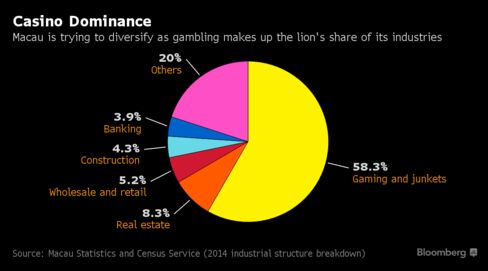


Macau casinos have been under pressure to attract more tourists after President Xi Jinping in December 2014 called on the city to diversify from gambling. Macau’s economy contracted 20.3 percent last year as casino revenue plunged amid China’s slowdown and the Beijing-led anti-graft campaign which scared off VIP gamblers.
Macau’s government is working to promote cross-revenue between gaming and non-gaming elements, according to the interim report, prepared by the University of Macau’s Institute for the Study of Commercial Gaming. It also highlighted that all six operators have fulfilled concessionary requirements. The junket industry of gaming promoters needs to contend with issues including custody of client’s money and credits, lax entry and exit of the market and excessive bargaining power towards gaming operators, according to the report.
Non-gaming business generated 23.2 billion patacas for Macau’s operators in 2014 and tourist spending away from the tables is comparable to that of Las Vegas’, the report found.

Licence Renewals

Current Macau concessions and sub-concessions which began in 2002 are set to expire in March 2020 for SJM Holdings Ltd and MGM China Holdings Ltd, and in June 2022 for the remaining four: Sands China Ltd., Wynn Macau Ltd., Galaxy Entertainment Group Ltd. and Melco Crown.
Secretary for Economy and Finance Lionel Leong said at Wednesday’s briefing that the government will also have to consider the quality of life for Macau residents when considering whether to renew casino licenses. The official had said last year the government will evaluate whether operators fulfilled commitments such as developing non-gaming facilities and providing staff with training and advancement opportunities.
The proportion of local employees holding managerial jobs or higher for the operators rose to 80 percent in 2014 from 60 percent in 2008, according to the report.
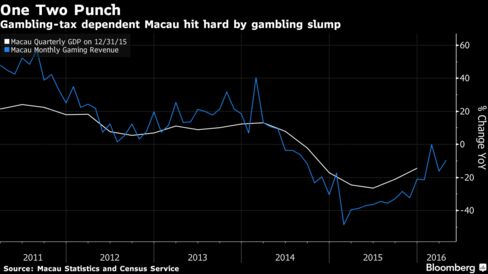


Bloomberg Intelligence’s index of Macau gaming stocks rose 16 percent in the first quarter after about $46 billion of market value was wiped out last year from the city’s six gambling houses.

Limit Growth

Macau wants to limit growth in the number of new gambling tables to not more than 3 percent per year through 2023, and also plans to raise the contribution of non-gaming revenue to the casino industry to above 9 percent from 6.6 percent in 2014, according to a May 6 statement posted on Macau’s government website, citing Leong.
The Chinese city, the only place in the country where casinos are legal, had 5,957 gambling tables at the end of 2015, an increase of 4.3 percent from a year earlier, according to Macau government data. Tax revenue from gambling contributed to 81.6 percent of Macau’s public revenue, the data showed.

Saturday, January 3, 2015

Chinese Gamblers See Macau As Bad Bet Amid Corruption Crackdown


Friday, January 2, 2015 - 12:45pm

Saturday, January 18, 2014

Macau to depend on MORE PROFITABLE LOW ROLLERS


Macau Gambling Tycoon's Net Worth Increases Eightfold


Tuesday, July 2, 2013

The Evolution of Organized Crime and Triads


Macau's gambling junket operators branch out

July 2, 2013

Macau — When junket operator Suncity opened its first high roller baccarat table at Steve Wynn's Macau casino in 2007 to lure China's wealthiest punters, the firm had fewer than 30 employees and no computers or equipment other than pen and paper.
Five years later, Suncity has emerged as the dominant junket in the Chinese territory. It is planning to open its own resort, independent of casino stalwarts such as Las Vegas Sands, and is expanding into everything from mining to films.
Macau's booming revenues that totaled $38 billion last year—six times that of the Las Vegas strip—are indebted to its unique VIP junket system, where licensed middlemen act on behalf of the casinos to attract "big whale" spenders by arranging their travel and accommodation and handle their gambling credit.
Now the transformation of the former Portuguese colony from a hotbed of crime into a playground for China's nouveau riche has spawned a new breed of junkets, eager to shed the industry's shady image and establish themselves as multinational conglomerates.
"Suncity is a young and very energetic corporate. There is a need to be diversified," said YM Choong, a senior executive at the company, in an interview with Reuters.
"For future investments we would look to expand in different areas, particularly property, finance and media. We would look to list other parts of the business."
The evolution of the junkets is welcomed by the authorities, who are eager to re-position Macau as an all-round international travel destination, but could shake-up the dynamics of the world's largest gambling market.
The junkets have traditionally worked for the casinos, which rely on them for more than two-thirds of their revenue. Now, leveraging their extensive customer databases and sophisticated resources, they could one day start competing with them.
"Macau's junket operators are fully aware that their network and database of high net worth VIPs is valuable," said Edmund Lee, a partner at PwC in Hong Kong who focuses on the gaming sector.
Suncity, headed by 39-year-old Alvin Chau, is one of more than 200 junket operators licensed in Macau, on China's southern coast, the only place in the country where locals are allowed to gamble in casinos.
The biggest operators, which include Neptune, Golden Group, Jimei and Dore, account for more than half the monthly junket turnover of $75 billion.
Despite robust mass market demand, a crackdown on corruption and pervasive graft has seen the supply of millionaire VIP players to Macau decline over the past year, prompting junkets to seek to diversify their income streams.
Suncity, which makes around HK$135 billion ($17 billion) in monthly gaming turnover, according to Choong, has expanded into mining with iron ore operations in Indonesia.
It has also branched out into financial services in Hong Kong with 24-hour securities, forex and commodities trading, real estate in China, food and beverage, film and media. The company has two listed arms, Sun International Resources Limited and Sun Century Group Limited.
Golden Resorts Group, headed by Hong Kong billionaire Pollyanna Chu, has been invested in financial services through listed arm Kingston Financial Group since 2011.
But the trend for larger junkets, flush with cash from the gambling boom over the past decade, to diversify as a hedge against the volatile VIP gaming sector has accelerated over the last year.
New image?
Large junkets such as Jimei, which operates casinos in the Philippines and hosts golf tournaments, have moved into wealth management and securities, which complement their VIP clientele base.
Neptune, which also uses the name Guangdong Group, sponsored a high profile poker tournament this month, while Dore Holdings announced it was buying a majority stake in a Chinese pawn loan business.
Macau's junket system was created in the 1970s with the rise of Stanley Ho, an influential local businessman who opened the gaudy egg shaped Casino Lisboa.
Ho gave the junkets control of the casinos' VIP rooms, sparking a turf war in the late 1990s as rival gangs fought to dominate.
Since the liberalization of Macau's casino market in 2002, which marked the entry of foreign players such as Las Vegas moguls Steve Wynn and Sheldon Adelson, the junket industry has been a subject of scrutiny from US regulators, who allege the operators have ties to organized crime and facilitate illicit money flows.
To combat this image, Emilie Tran, a professor at the University of Saint Joseph Macau, says junkets are trying to associate with more wholesome activities, such as organizing community and youth events.
"Working for a junket is now seen as respectable and a job like any other," said Tran.
The shift to sophisticated corporate entities with sizable business development, accounting and marketing teams is clearly visible. Shabby junket storefronts at the Hong Kong-Macau ferry terminal have been replaced with marble offices in prime business districts, while customized Hummer limousines owned by the operators are frequently seen parked outside Macau's newest casinos.
Big ambitions
Politics is the next phase of the junkets' makeover, says Tran, who cites the example of Suncity's Chau, who joined the Guangdong provincial committee of the Chinese People's Political Consultative Conference (CPPCC), China's parliamentary advisory body, this year.
Chau, with his dapper appearance is often likened as a famous Hong Kong movie star. An avid tennis player and gym-goer, he is frequently pictured in the local tabloids at parties.
Pollyanna Chu of Golden Resorts Group, ranked by Forbes as the 35th richest billionaire in Hong Kong, sits on the CPPCC national committee, while Hoffman Ma, deputy chairman of Success Universe Group sits on the Chongqing Committee of the CPPCC.
Manuel Neves, head of Macau's gaming body the DICJ, said junkets diversifying into other industries fitted into the government's attempts to wean the territory, home to 600,000 people, off the gambling industry that accounted for more than 80 percent of government revenues last year.
"For the government, when people talk about Macau, we want them to not talk about gaming. We are doing a very big effort to push the diversification. It's not an easy task," said Neves.
Despite the move to diversify, the role of the junket is likely to remain critical to Macau gaming sector over the coming years, as gambling debts are not legally enforceable in China. Junkets bring in gamblers from the mainland and then find their own ways to collect debts.
Suncity is massively expanding its gaming division, doubling its workforce to 1,200 over the past year and is still short staffed.
But as major junkets move from operating one or two VIP rooms in Macau's flashy casinos to owning their own properties, Macau's licensed concessionaires Sands, Wynn, MGM, Melco Crown and Galaxy may have to find new ways to lure the customer.
"I think everybody is fighting for the customer," said Francis Lui, head of Galaxy Entertainment. "We are doing the same thing, I am sure the junket would be thinking the same thing. We just have to offer more, a bit extra something new, something more creative to get them to come back again." — Reuters


Sunday, May 26, 2013

California Says No to Galaxy Gaming


California Says No to Galaxy Gaming, But Nevada Might Say Yes

Posted by Peter McCullough on May 25, 2013
 
There are several “rules of engagement” in Galaxy Gaming’s guiding principles that seem to conflict with a recent ruling made against the companies CEO Robert Saucier.
 
Administrative Law Judge Catherine Frink made no bones about her ruling deeming the CEO as “evasive and, in some instances, intentionally dishonest.”

The Las Vegas manufacturer of casino table games, was denied the right to doing business in California due to a lengthy and ongoing investigation calling into question several unsavory business practices that could have an unfavorable outcome of the companies Nevada gaming license.
Saucier is under scrutiny for misleading and misrepresentation of information regarding business ventures, signing unapproved licensing deals with California tribal casinos, lawsuits and even information that may have been false about his own personal past.

In 2002 Saucer applied for a gaming license with Tule River Tribe Gaming Commission, at that time the Commission began an investigation with the help of the Bureau of Gaming Control. The investigation uncovered that Saucier did not give full disclosure of very pertinent facts and what could be harmful business ventures that are very relevant to approval by the state of California.

According to the 2002 report Saucier list of information that was never disclosed included:
  • Failure to mention an order to pay a $1.5 million judgment to Sherron Associates, a creditor in a hotel-casino project.
  • Failed to reveal gambling taxes owed to City of Spokane in WA State by his Mars Hotel and Casino, a hotel that eventually failed.
  • Misrepresented his past drunk driving conviction stating it was dismissed
  • Failed to list a valid address. He filed his personal federal income tax returns in Washington, listed a condominium in Mexico as his home and had a license for a home-based business in Las Vegas.
  • Failed to disclose multiple businesses: Galaxy Gaming of Nevada, LLC; Galaxy Gaming of Oregon, LLC; Bonus Blackjack, LLC; Intergalactic; and others.
  • Failed to mention gaming licenses from other states, including Washington and Nevada.
  • Did not reveal that he pays child support.
  • Did not disclose his involvement in past lawsuits. For instance, he sued the Mars Hotel for $1.6 million in 1998. “In essence, he sued himself and received a default judgment,” Frink wrote.
  • Failed to mention a foreclosed house and two personal credit card bills that were sent to collections.
  • Had no Nevada business license, as required, from 2001 to 2004. He blamed the missing license on an “oversight by staff.”
  • Claimed to have graduated from UNR, but he did not.
“In a highly regulated industry such as gaming, the failure to be forthcoming with relevant information was inexcusable,” commented Frink.
Saucier’s case was assigned to the Attorney General’s Office in 2007 for prosecution and is still pending further investigation. Mired in lawsuits and controversy, it still seems as though that Saucier may not have to answer to his past when it comes to his Nevada.

Apparently different states in the US have vastly different laws and regulatory standards. Nevada’s Gaming Control Board chairman, Burnett stated,
“Other states sometimes have vastly different laws and regulatory standards than we do.” “There are cases when a ‘denial’ doesn’t mean the same thing as it does in Nevada. For example, in some states in the Midwest, there have been denial proceedings but they’re for various transactions and don’t necessarily relate to the integrity or the suitability of the company itself.”