Meetings & Information


*****************************
****************************************************
MUST READ:
GET THE FACTS!


Showing posts with label Melco. Show all posts

Sunday, May 15, 2016

Macau Plans Oversight, Entry Capital Hike for Gaming Promoters


 Wed May 11, 2016 

Macau gambling industry review finds casino operators fulfilled all commitments

The government of Macau on Wednesday said all casino operators in its territory had fulfilled commitments agreed in initial contracts signed over a decade ago, marking the culmination of a year-long review into the impact of the gambling industry.
But the government said it would tighten regulations for junket operators - promoters that bring high-rolling gamblers to casinos - and that its regulator had started an investigation in February to ensure accounting compliance.
Macau is the world's largest gambling hub by revenue, and is the only territory in greater China where casinos are permitted. But it is so dependent on gambling - which brings in over 80 percent of government revenue - that it is trying to diversify.
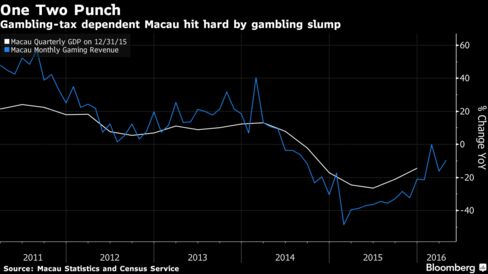
Authorities have also increased regulation over the past two years, coinciding with a central government campaign against ostentatiousness among public officials. Over that time, gambling revenue has plummeted to five-year lows and monthly revenue has dropped by over half since the start of 2014.
The review was widely seen by analysts, investors and industry executives as a window into how authorities viewed the operators ahead of license renewals starting in 2020.
In the review, the government acknowledged the contribution to boosting economic growth by operators Sands China Ltd (1928.HK), Wynn Macau Ltd (1128.HK), Galaxy Entertainment Group Ltd (0027.HK), Melco Crown Entertainment Ltd (MPEL.O), SJM Holdings Ltd (0880.HK) and MGM China Holdings Ltd (2282.HK).
It said they each met commitments including creating upward mobility for employees and diversifying gaming revenue. The government said non-gaming elements generated income of 23.2 billion patacas ($2.90 billion) in 2014.
"Currently, total non-gaming spending of tourists in Macao is comparable to that of Las Vegas. However, the percentage is diluted as Macao's gross gaming revenue is far too high," the government said.
On junkets, the government said initial findings suggest increased awareness of compliance since the Gaming Inspection and Coordination Bureau (DICJ) began its investigation. It said the regulator had visited about half of junket operators - over 80 - and that the investigation will be completed in six months.
The regulator is also working with the industry to establish a central credit database to minimize credit risk. The industry is riddled with bad debt as there is no formal mechanism for claiming from gamblers in China as casino debts are illegal.

(Reporting by Farah Master; Editing by Christopher Cushing)

Macau Plans Oversight, Entry Capital Hike for Gaming Promoters


May 11, 2016

  • Gaming hub regulator prepares to set up credit database
  • Six casino operators' gambling licences to expire from 2020
Macau plans to raise capital requirements for gaming promoters and is preparing to set up a credit database to weed out risky gamblers as it increases oversight of the junkets business that brings in high-stakes players to the local casinos of Las Vegas Sands Corp. and Wynn Resorts Ltd.
Macau "intends to raise the entry threshold of junket promoters,” according to a government statement discussing its interim review of the city’s gambling industry since 20-year casino licenses were issued. No further details were given at a briefing Wednesday to announce results of the review. Bloomberg reported last month the city is working on rules including a proposal to hike capital requirements for new junket operators to 10 million patacas from the current 100,000 patacas.
The closely watched report is meant to help set policy direction for the $30 billion industry as local units of casino operators such as MGM Resorts International and Melco Crown Entertainment Group Ltd. struggle to cope with Macau’s two-year gambling downturn. The city’s top official in charge of its shrinking economy has said findings from the review could be used as thebasis to consider whether licenses for the six operators will be renewed when they start to expire in 2020.
“This document could be used as some sort of general framework upon which license renewals will be discussed over the coming years, although there’s nothing in the report that explicitly says this,” said Grant Govertsen, an analyst at Union Gaming Group. “We haven’t seen anything that suggests this will result in any changes to the status quo.”
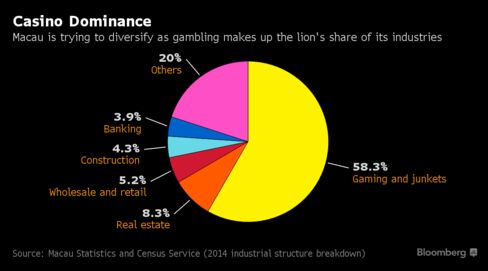


Macau casinos have been under pressure to attract more tourists after President Xi Jinping in December 2014 called on the city to diversify from gambling. Macau’s economy contracted 20.3 percent last year as casino revenue plunged amid China’s slowdown and the Beijing-led anti-graft campaign which scared off VIP gamblers.
Macau’s government is working to promote cross-revenue between gaming and non-gaming elements, according to the interim report, prepared by the University of Macau’s Institute for the Study of Commercial Gaming. It also highlighted that all six operators have fulfilled concessionary requirements. The junket industry of gaming promoters needs to contend with issues including custody of client’s money and credits, lax entry and exit of the market and excessive bargaining power towards gaming operators, according to the report.
Non-gaming business generated 23.2 billion patacas for Macau’s operators in 2014 and tourist spending away from the tables is comparable to that of Las Vegas’, the report found.

Licence Renewals

Current Macau concessions and sub-concessions which began in 2002 are set to expire in March 2020 for SJM Holdings Ltd and MGM China Holdings Ltd, and in June 2022 for the remaining four: Sands China Ltd., Wynn Macau Ltd., Galaxy Entertainment Group Ltd. and Melco Crown.
Secretary for Economy and Finance Lionel Leong said at Wednesday’s briefing that the government will also have to consider the quality of life for Macau residents when considering whether to renew casino licenses. The official had said last year the government will evaluate whether operators fulfilled commitments such as developing non-gaming facilities and providing staff with training and advancement opportunities.
The proportion of local employees holding managerial jobs or higher for the operators rose to 80 percent in 2014 from 60 percent in 2008, according to the report.


Bloomberg Intelligence’s index of Macau gaming stocks rose 16 percent in the first quarter after about $46 billion of market value was wiped out last year from the city’s six gambling houses.

Limit Growth

Macau wants to limit growth in the number of new gambling tables to not more than 3 percent per year through 2023, and also plans to raise the contribution of non-gaming revenue to the casino industry to above 9 percent from 6.6 percent in 2014, according to a May 6 statement posted on Macau’s government website, citing Leong.
The Chinese city, the only place in the country where casinos are legal, had 5,957 gambling tables at the end of 2015, an increase of 4.3 percent from a year earlier, according to Macau government data. Tax revenue from gambling contributed to 81.6 percent of Macau’s public revenue, the data showed.

Sunday, May 1, 2016

REPORT: MACAU CASINO JUNKETS SITTING ON $8B IN BAD DEBTS


CASINO NEWS

REPORT: MACAU CASINO JUNKETS SITTING ON $8B IN BAD DEBTS

macau-casino-junket-bad-debtMacau gaming regulators are conducting audits of licensed casino junket operators to determine the value of bad debts on their books.
In a report this week, public broadcaster TDM quoted Gaming Inspection and Coordination Bureau (DICJ) chief Paulo Martins Chan saying his office had tasked auditors with going over the accounts of licensed junkets to get a sense of the scale of their unrecoverable loans to high-rolling gamblers.
Late last year, the DICJ imposed new rules requiring junkets to submit monthly financial data in a bid to impose stricter accountability of the industry. The move was prompted by a wave of scandals, including internal thefts that left junket investors high and dry and led to the closure of many junket-controlled VIP rooms.
Chan told TDM that the DICJ was in uncharted territory as “we have never had this kind of information before.” Chan said he hopes to get a sense of just how bad the bad debt situation is by the end of 2016.
In December, the head of Macau’s Association of Gaming & Entertainment Promoters estimated that junkets were collecting only between 20% and 30% of their gambling loans. Many junkets were said to have been reduced to selling bad VIP debt at steep discounts to speculators.
Last week, a Daiwa Securities report claimed that junkets were “struggling just to break even” due to fewer mainland VIPs making the trip to Macau and rising bad debts, which the brokerage estimated amounted to at least HKD 30b (US $3.9b). The brokerage clarified that this total was a “very conservative estimate” and the real outstanding sum could be closer to HKD 60b.
Daiwa also suggested that Macau casino operators could end up sharing some of the junkets’ pain. Melco Crown Entertainment and Wynn Macau were fingered as “the most exposed of the operators to: 1) the riskier portion of the junket business, and 2) to premium-direct business.”

http://calvinayre.com/2016/04/30/casino/macau-casino-junkets-stuck-with-8b-bad-debt/


Tuesday, February 16, 2016

Macau: Gambling Related Crime increased 38%


Melco Crown is a gaming operator in Macau who recently announced efforts to step up security measures to try and thwart individuals who are banned from their properties from entering. City of Dreams and Studio City will implement the new technology which will mark the very first time an operator in Macau will be installing specialized facial recognition technology created by Cognitec for security measures.
The new system, titled FaceVACS-VideoScan, will detect the faces of individuals in live time with a video stream and then compare the faces found to features in photos of banned individuals, which are stored in data bases. If a match is found, the system will alert the security staff in real time. This extended security measure’s goal is to prevent losses on site as well as stop criminal activities quickly.
According to the software’s creator, Cognitec, the system has several capabilities including marking frequent visitors, people movement in regards to time and space, behavior of customers as well as demographical information. Stephen Meltz is the Cognitec managing director for the Asia-Pacific division, who stated that the system is the first of its kind to be used in casino setting.
Crime has been an issue in Macau, causing casinos to see less visitors than ever before. In 2015, crimes related to gaming increased by 38%. There were over 1,500 crimes related to gaming recorded in Macau last year and casinos are taking steps to try and cut down on such crimes as loan-sharking and illegal imprisonment, both of which took place inside casino venues.


Monday, May 4, 2015

China's Corruption Crack Down caused - 39% drop in Macau revenues


Clark Schultz, SA News Editor

  • A fresh report from the Macao Gaming Inspection and Coordination Bureau indicates gaming revenue fell off 39% in April to 19.17B patacas ($2.41B).
  • The drop was within the range forecast by analysts of a -38% to -40% decline.
  • Shares of Macau stocks are higher today after the worst-case scenario for April was avoided and following steep losses last week after Wynn Resorts slashed its dividend.
  • Gainers: Wynn Macau (OTCPK:WYNMF, OTCPK:WYNMY) +3.4%, Wynn Resorts (NASDAQ:WYNN) +3.8%, Galaxy Entertainment (OTCPK:GXYEF) +2.9%, Melco Crown (NASDAQ:MPEL) +0.7%, Las Vegas Sands (NYSE:LVS) +1.6%, Sands China (OTCPK:SCHYY, OTCPK:SCHYF) +5.5%, SJM Holdings (OTCPK:SJMHF) +6.4%.
Read comments


Focus Articles on WYNN


Clark Schultz, SA News Editor
  • MGM Resorts (NYSE:MGM) reports adjusted EBITDA slipped 3% Y/Y at U.S. resorts to $390M and 33% at MGM China to $148M in Q1.
  • A significant tail-off in the VIP business in Macau was a dominant theme of the quarter.
  • Revenue per available room in Las Vegas improved 1% to $136.
  • The contribution to income from both CityCenter and Borgata was higher this year than last year.
  • MGM -2.76% premarket to $20.81.
MGM price at time of publication: $21.40. Check MGM price now »

Focus Articles on MGM


Thursday, March 19, 2015

Chinese Corruption Crackdown Put Macau in Recession


Interesting connection between illegal money transfers, corruption and gambling.....

The Zacks Analyst Blog Highlights: Wynn Resorts, MGM Resorts International, Las Vegas Sands and Melco Crown Entertainment - Press Releases

By ,


No Respite for Casino Stocks as Macau Slump ContinuesIt seems that the situation in the gambling industry is going from bad to worse. Share price of leading casino companies were hit during the trading hours on Monday as economic data released by the Statistics and Census Bureau (DSEC) demonstrated weakness in Macau - a key operating region for these casino companies. Companies that were impacted by the release include Wynn Resorts Ltd., MGM Resorts International, Las Vegas Sands Corp., Melco Crown Entertainment Ltd.


What Led to the Decline in Macau?
Per analysts, as Macau started to grow, it focused on casinos, instead of diversifying into other areas. Since more than 80% of the government's revenues come from gaming, the economy is closely tied to the gambling industry.

As a result, when the Chinese government announced a crackdown on corruption in Macau in 2014, VIP gamblers either opted to refrain from gambling or tried their fortunes elsewhere. This lowered footfall at the local casinos, and thereby gambling revenues. Also, a cooling Chinese economy, political unrest and a smoking ban on mass market gaming floors compounded woes.

Read more: http://www.nasdaq.com/article/the-zacks-analyst-blog-highlights-wynn-resorts-mgm-resorts-international-las-vegas-sands-and-melco-crown-entertainment-press-releases-cm456126#ixzz3UpxhpFoh

Saturday, January 3, 2015

Chinese Gamblers See Macau As Bad Bet Amid Corruption Crackdown


Friday, January 2, 2015 - 12:45pm

Thursday, July 4, 2013

Ho plans Russian casino

The sucking sound of discretionary income being sucked up by Predatory Gambling is almost audible!


Ho plans Russian casino

July 4, 2013

Lawrence Ho, the co-chairman of Macau casino operator Melco Crown Entertainment, is planning a gambling resort on the outskirts of Vladivostok in Russia.
The planned casino will be built in Primorye, an eastern region bordering China and Korea, and is scheduled to open in the second half of next year.

Summit Ascent Holdings, a Hong Kong-based company that is 37 per cent owned by Ho, signed a preliminary agreement to invest in a “gaming and resort development project in the Russian Federation,” according to the company’s June 28 filing to the Hong Kong Stock Exchange.

The businessman, a son of gambling magnate Stanley Ho, has been expanding his casino business at home and overseas. In the Philippines, Melco Crown is partnering with Belle Corp, the company controlled by billionaire Henry Sy, to build a casino resort complex in Manila, the capital city of the south-east Asian country.

The Manila casino is expected to cost US$1bn. Melco Crown is also investing $2bn in developing a brand new casino resort in Macau, to be called Studio City, which is expected to open in the middle of 2015.

Summit Ascent’s preliminary agreement on the Russian casino is “subject to fulfilment of a number of conditions including legal, accounting and construction due diligence,” the company said in the June 28 statement. It also needs a definitive investment agreement on or before August 15, it said.

That announcement didn’t disclose the location of the proposed casino resort.

The planned casino will be built in Primorye, an eastern region bordering China and Korea, and is scheduled to open in the second half of next year. The casino will be one of the first in Russia after the country in 2009 banned casino gambling outside four special zones.


http://www.intergameonline.com/casino/news/9733/ho-plans-russian-casino


Sunday, January 27, 2013

High Rollers Decline


Casinos see high roller revenues decline in tough economy

Poker chips from the James Bond movie, Casion Royale displayed at Bonhams Auctioneers in London, England.

Poker chips from the James Bond movie, Casion Royale
displayed at Bonhams Auctioneers in London, England.
Credits: Bethany Clarke/Getty Images


Casino companies are feeling the heat of the tough economic scenario, according to StockCall.com, a financial website that provides research and opinions on stocks. “Most of the gambling companies have expanded their operations to Asian hotspots like Macau and Singapore,” StockCall.com said on Friday. “However, since the current economic scenario is gloomy across the globe, it is difficult for the gambling companies to come up with ambitious plans for the near future.” In the U.S., Nevada saw its gaming revenues decline by just over 11 percent in November.


Wynn Resorts

Wynn Resorts is going through some tough times as it is experiencing a decline in its high roller revenues. Its outlook for 2013 is still cautious, StockCall.com said. Since the gambling company is more reliant on its high margin top player segment, it is likely to report only modest growth this year. Due to tough economic times in the U.S. as well as in China, the luxury gambling segment will remain in the doldrums for the foreseeable future, putting extra pressure on Wynn's bottom-line.

Wynn derives more than two thirds of its revenue from Macau and the decrease in luxury gambling revenue in Asia is expecting to put a dampener on the company's fortunes. Another indicator that the company is going to take conservative approach this year comes from the expected delay in the commissioning of its new resort in Macau. Wynn was expected to open its Cotai resort in 2016. However, now the expected date has been pushed up to 2017. While Wynn Resorts caters to the upper segment of gamblers and has maintained distance from mass gambling, it is still likely to feel intense pressure from the growing presence of discount casino runners like Las Vegas Sands.

Melco Crown
Melco Crown primarily operates in Macau and the gambling haven reported 13.5 percent revenue growth for 2012. However, a bigger chunk of this growth came from mass gambling segment and Melco Crown reaped the benefits.

Melco, with its $11.20 billion worth of market capitalization, is one of the biggest players in the leisure industry. However, unlike Wynn and MGM, Melco is almost completely focused on the Asian gaming scene and thus is more open to macroeconomic factors in China and Asia. The gaming company is also planning to go ahead with its expansion plans as it inked a new $1.4 billion worth of financing deal to back its Macau Studio City venture. Melco is also well placed to grab a big slice of the pie as the economic situation in China eases up.

  • Nevada gaming revenues decline more than 11 percent in November
  • Mohegan Sun bid to build resort casino in Western Mass.
  • Application submitted for Hard Rock Hotel and Casino New England


  • http://www.examiner.com/article/casinos-see-high-roller-revenues-decline-tough-economy


    Monday, July 23, 2012

    Macau murder spate adds to casino industry worries


    Macau murder spate adds to casino industry worries
    Reuters
    July 23, 2012

    HONG KONG (Reuters) - In Macau, three murders in the past two weeks have raised fears that violent crime, for years a rarity in the world's gambling capital, is growing more common at the same time as the island's casino operators are struggling with slower growth.

    Police in the gaming and entertainment hotspot, a one hour ferry ride from Hong Kong, said a Chinese woman who also held a Japanese passport was found murdered last Thursday in a residential area minutes away from the cavernous gambling halls of Sheldon Adelson's Venetian casino.

    That came just days after two Chinese nationals were murdered at the five-star Grand Lapa hotel, and at the end of June a senior figure in Macau's junket industry was severely beaten.


    By contrast, only five homicide cases were recorded between June 2011 and May 2012, according to Macau police statistics.

    There does not appear to be an obvious link between the June and July incidents, but security experts and Macau residents say the recent outbreak of extreme violence has its roots among Macau's junket operators - the shadowy companies that help bring China's wealthiest to the gambling tables.

    "Macau is going through a period of instability," said Steve Vickers, chief executive officer of Hong Kong-based Steve Vickers & Associates, a corporate intelligence and security consultancy, referring to the recent attacks. "There seems to be a disturbance ... amongst the lower end of the junket community," he said.

    Incidents involving Chinese criminal gangs, also known as triads, have been infrequent in Macau since the late 1990s when Portugal ceded control of what was then a seedy port on the heel of China's southern coast.

    Triads are typically branches of Chinese criminal organizations based in Hong Kong, Macau, and Taiwan, and on the mainland. They are involved in crimes including extortion, money laundering, murder and prostitution.


    Macau, which like Hong Kong is a special administrative region of China, has boomed since the 1999 handover, with Las Vegas moguls including Adelson and Steve Wynn setting up glitzy casino hotels complete with fine dining restaurants, bars filled with glamorous girls, and luxury shopping outlets.

    That growth, however, has slowed significantly in the past three months, forcing junket operators into more aggressive debt-collecting tactics. Many of the smaller junket firms are struggling to stay in business.

    Though Macau's gambling revenues reached $33.5 billion last year and investment has continued to pour into the economy, Wynn reported worse than expected half year results last week as a result of declining revenue at its Macau and Las Vegas operations.


    Las Vegas Sands is due to post results on Thursday, while other casino operators Melco Crown and MGM Resorts are due to report earnings in August.

    (Reporting by Farah Master; Editing by Daniel Magnowski)

    Sunday, July 8, 2012

    Macau's gambling junkets risk losing their game


    Macau's gambling junkets risk losing their game


    MACAU (Reuters) - The shadowy companies that bring China's millionaires to the gambling tables of Macau are facing their toughest time since the 2008 collapse of Lehman Brothers, and some of the smaller players may soon drop out of the game for good.

    These junket operators, who extend credit to rich gamblers and then collect any debts in exchange for a hefty commission, bring in about 70 percent of gambling revenue in Macau, the world's most profitable gaming destination. They accounted for $22 billion in revenues last year when business was booming.
     
    Licensed in Macau, junkets help collect debts in China although their presence on the mainland is in a legal grey area. Part money lenders, part luxury concierge service, they often host China's elite in extravagant suites or palm-fringed pool villas owned by the billion dollar casino companies.

    When it comes to collecting debts, indelicate means are not unknown.

    But back-to-back months of disappointing Macau gaming growth show how China's slowing economy has hurt business in the only place in the country where Chinese nationals can legally gamble in casinos. China's surprise interest rate cut on Thursday may not be enough to turn the tide.

    Monthly turnover ascribed to China's super-wealthy VIP rollers contracted year-on-year in June for the first time since 2008.

    AMAX Holdings , once among the most profitable players in Macau's junket industry, warned investors on June 29 its financial health had deteriorated so badly that it could cast doubt on the company's survival.

    Five days earlier, AMAX's biggest shareholder was savagely beaten with hammers and sticks while dining at a restaurant in a Macau hotel where the company holds a 25 percent stake in its casino section.


    Although the attack did not appear to be related to the company's financial woes, it revived images of a violent gang-ridden past that Macau has tried hard to bury as it moves to transform itself into Asia's answer to Las Vegas.

    The health of the junket industry is critical for Macau's casinos, including those owned by U.S. gambling titans - Sheldon Adelson's Sands China and Steve Wynn's Wynn Macau . Macau's gaming revenues are six times that of Las Vegas.

    Macau, a 50-minute ferry ride from Hong Kong, has more than 200 registered junket companies, also known as VIP room operators. When the Chinese economy weakens and liquidity is scarce, they have a tougher time collecting debts and recycling the funds as fresh loans.

    "On average, repayment period is around 15 days. Now some gamblers are asking for 2-3 days longer. Only if it is a very special situation will we consider it," said Kenny Leong, chief executive of Nasdaq-listed Asia Entertainment and Resources Ltd , one of Macau's top ten VIP gambling room promoters.

    LESS ADEPT

    Smaller junkets are particularly affected by slower growth, industry experts say, because they're generally less adept at collecting debts.

    "(The larger players) keep your travel documents, passport or ID (identification cards) until you pay them. They essentially hold you in custody. If you don't pay, they will ask your relatives and friends to come and pay," said Macau-based political analyst Larry So.

    AMAX, controlled by Macau VIP room operator and attack victim Ng Man-sun, operates through profit-sharing deals with junkets. It is still battling to reclaim HK$1.9 billion ($245 million) it indirectly lent to high rollers at Melco Crown's Altira casino in 2007 and has relied on its investment in Macau's Greek Mythology casino for the bulk of its revenues since then.

    The Greek Mythology casino, which is owned by former Macau kingpin Stanley Ho's SJM Holdings , is located in the hotel at which Ng was publicly attacked last month.

    In a filing to the Hong Kong stock exchange on June 29, AMAX said its liabilities exceeded current assets by HK$9.9 million ($1.28 million).

    "This condition indicates the existence of an uncertainty which may cast significant doubt about the group's ability to continue as a going concern," the company said.

    One casino executive said junkets had already cut back on credit extension.

    "Junkets have stopped extending as much credit but could a situation like AMAX happen again? For sure," said the executive, who declined to be named due to the sensitive nature of the issue.

    BIGGER PLAYERS TO DOMINATE

    Hoffman Ma, deputy chairman of Success Universe Group which has a joint venture with casino king Stanley Ho's SJM Holdings to operate Macau casino Ponte 16, said smaller players would get swallowed into larger junkets rather than stop operations.

    "It will more likely be the big guys dominating," Ma said in an interview at Ponte 16's French-themed lounge.

    Neptune Group Ltd , the listed arm of one of Macau's biggest junkets, said in February it was looking to buy more VIP room operators in Macau and in other Asian countries.

    Leong, the CEO of big gambling room promoter AERL, said his company was hoping to take advantage of the deteriorating economic environment to acquire smaller junket operators within the coming year.

    Some junkets are eyeing capital markets to fund expansion, although that will entail shining a brighter spotlight on companies used to operating away from the public sphere.

    AERL said in May it was considering a listing in Hong Kong alongside its Nasdaq-traded shares. Other firms including Tak Chung Finance, an affiliate of one of Macau's biggest junket operators, and Sun Finance, tied to Macau junket SunCity, are also considering public offerings.

    (Editing by Emily Kaiser and Raju Gopalakrishnan)

    Saturday, April 7, 2012

    Is Las Vegas Sands Better Off Without Junkets?

    [See previous articles about 'triads' and Sheldon Adelson and Stanley Ho.]

    Is Las Vegas Sands Better Off Without Junkets?


    The Singapore government recently issued licenses to two junket operators, both of which happen to be agents of Las Vegas Sands' (NYSE: LVS ) rival Genting Singapore. Does this spell bad news for Sands?

    In the gambling haven of Macau, premium or VIP customers account for nearly three-quarters of the total gambling revenue, which highlights the significance of junkets. But, in Singapore, it's a different roulette game altogether.

    Junkets: a primer
    In the junket system, operators are like middlemen who drive high-net-worth players (read: people with loads of money to blow) to the casinos. They provide credit to these high rollers for an agreed-upon commission, which is usually pretty significant, from the casinos. The casinos encourage junkets because they help drive volume and also keep credit risk and default rates down.

    Some observers say the junket licensing deal in Singapore is an unfortunate blow to the profitability of Marina Bay Sands, the Singapore property that accounted for a significant 31% of Las Vegas Sands' revenue in 2011. So with two junket operators newly licensed to competition, is LVS truly in a disadvantageous position?

    Caveats to the doom theory
    I don't think so. Sure, these junkets may bring in more business for Genting, but that's not enough to pull Marina Bay Sands down. Here are two reasons why:

    1. Junket operators may find Singapore restrictive, given its rigid oversight and licensing rules. For one thing, the Singapore government won't permit profit sharing with other non-Singapore-licensed junkets. The fact that only two licenses have been issued, and will be heavily regulated, could make for smaller profits compared with Macau operators.

    2. Unlike peers Melco Crown Entertainment (Nasdaq: MPEL ) and Wynn Resorts (NYSE: WYNN ) , which prefer to focus on the VIP segment, Sands China operates in the mass-market area -- in part because the huge junket commission costs attached to the VIP segment drags down margins. And this mass-market policy has worked in Sands' favor. In 2011, LVS reported net margin of 16.6%, Wynn 11.6%, and Melco 7.7%.

    A Foolish conclusion
    Sands' performance in Singapore has been quite good so far without junkets. In the quarter that ended in December, Marina Bay Sands reported EBITDA of $427 million, higher than Genting's $307 million. I don't see junket operators negatively affecting Las Vegas Sands in a big way, but I am keeping a close eye on the developments. If you'd like to do the same, add Las Vegas Sands to your free Watchlist!

    Besides Las Vegas Sands, several other American companies are finding strong growth, thanks to savvy execution in the world's fastest-growing new markets. Motley Fool analysts have identified three big-name companies that are particularly well positioned to profit -- and you can learn more right now with our new free report: "3 American Companies Set to Dominate the World." It's completely free for Fool readers, but only for a limited time -- so grab your copy now

    Sunday, January 15, 2012

    Wynn Resorts stock drops on lawsuit

    Ahead of the Bell: Wynn Resorts drops on lawsuit
    Associated Press
    NEW YORK — Shares of Wynn Resorts Ltd. declined before the market open on Thursday after its vice chairman filed a lawsuit against the casino operator that an analyst said could scare off investors.

    Wynn Resorts shares fell $5.39, or 4.8 percent, to $106.50 in premarket trading.

    The lawsuit, which seeks financial records related to Vice Chairman Kazuo Okada's investments in the company, was filed in a Nevada court on Jan. 11, the company said in a regulatory filing. Okada is also the founder of Wynn Resorts' biggest shareholder, Universal Entertainment Corp., with a nearly 20 percent stake in the company.

    The high-profile lawsuit will hurt the stock, said Sterne Agee analyst David Bain in a client note.

    Okada alleges that even though he has made several written requests for the records he wants to see, Wynn Resorts has refused to give him access. He said that on Nov. 2, he had sought documents regarding Wynn Resorts' approximately $135 million donation to the University of Macau; its 2010 amendment to a shareholders agreement among Okada, company founder Stephen Wynn and Wynn's ex-wife, Elaine Wynn; and the use of $30 million that Okada gave to Wynn Resorts in 2002 to help develop a Macau casino project.

    Okada lists $380 million that he had invested in Wynn Resorts since 2000.

    Wynn officials issued a statement calling the lawsuit "preposterous and without merit," and saying they would defend the company vigorously.

    The analyst said that investors may pull their money out of Wynn Resorts because of the lawsuit and instead invest in rivals like Melco Crown Entertainment Ltd. or MGM Resorts International, which also operate Macau casinos.

    Macau is the only place in China where gambling is legal. Its fast growth has made companies with Macau properties more appealing to investors than casino operators that are only in the United States. U.S. casinos have not fared as well in the weak economy.

    MGM Resorts shares edged up 3 cents to $11.99 in premarket trading, while Melco stock gained 16 cents to $10.54.