Meetings & Information


*****************************
****************************************************
MUST READ:
GET THE FACTS!


Showing posts with label riverboat gambling. Show all posts

Sunday, March 27, 2016

Iowa: 'They suffer in silence;' stigma high with gambling addicts


'They suffer in silence;' stigma high with gambling addicts


Twenty-nine thousand Iowans struggled with a gambling addiction in 2015, but only 600 called the state's hotline, 1-800-BETS OFF.
That's a "huge disparity," said Eric Preuss, program manager for the Iowa Gambling Treatment Program through the Iowa Department of Public Health.
Preuss, who has worked in substance abuse treatment since the late 1980s, said the stigma surrounding a gambling habit is higher than other addictions. The rate of suicide is higher, too, he said.
"There is an extreme amount of shame and guilt," Preuss said. "They suffer in silence. These are people that are hurting. It takes courage to pick up the phone."
About 68 percent of Iowans, or 1.6 million people, have gambled in the past 12 months, statistics show. Of those, 85 percent stay within their means and very rarely or never exhibit problem behaviors.
"They seem to just have fun with it," Preuss said.
The 29,000 who struggle with a gambling addiction represent 1.2 percent of the state's population. Preuss said another 13 percent are considered "at risk," because they have exhibited at least one of nine criteria for determining problem gambling. That could include losing a large sum of money in one bet or lying to your spouse about where you were.
Blair Brown, a problem gambling counselor in Davenport, said where she often sees the addiction beginning to form is when the person is trying to duplicate the high he or she felt after winning the first time.
"They had a big win the first time gambling," Brown said. "They're chasing that high over and over again."
She is concerned that as gambling continues to become more available the risk of relapse will grow among those who already are struggling with the addiction.
Preuss shares the concern, too.
In 1991-92, the Quad-Cities went from zero to three riverboat casinos. Today, Iowa has 22 casinos and 2,400 Iowa Lottery outlets, and the state issues more than 2,800 social and charitable gaming licenses, such as for a church bingo event.
"Gambling has always existed," Preuss said. "Poker always existed. But now with the stuff you can do on smartphones, and there is talk of fantasy sports being legalized, what existed 25 years ago looks much different today."


Monday, May 11, 2015

Indiana riverboat casinos now allowed to build on land


Riverboat Casinos were sold to the public as a way to ensure that tourists gambled.

There's always an argument for expansion.


VIDEO ON LINK

Indiana riverboat casinos now allowed to build on land

Posted: May 09, 2015 9:32 PM EDT

HARRISON COUNTY, Ind. (WDRB) – Indiana's riverboat casinos will now be allowed to build new facilities on land.

"I think it goes to the issue of sustainability," said Indiana State Representative Ed Clere.

Clere said he opposed the legislation in its initial stages, but was unable to vote on the final bill.

The bill, which Governor Mike Pence said he would allow to become a law on Friday, allows for casinos to move inland on pieces of land that are already owned by the casino. However, some legislators like Clere say it's not enough to stem the tide of competition from neighboring states.

“I want them to be here and to be successful and provide the revenues we've come to depend at both state and local communities,” Clere said.

The bill also allows for horse track casinos which are currently in Anderson and Shelbyville to use live dealers for table games.

Proponents on the recent legislation say moving casinos inland could help combat the expanded competition.

But others are worried about the continued pressure and the possibility of much more, especially for Horseshoe.

“We're facing increased competition from states all around us with the exception of Kentucky,” Clere said. “And I think we have to consider the chance that Kentucky could have casino gambling in the not too distant future.”

Clere says if that happens, casinos like Horseshoe may have a problem, whether it moves inland or not.

“It's not Horseshoe's fault, its not Harrison County's fault,” Clere said.

Earlier versions of the legislation would have allowed the horse track casinos in Anderson and Shelbyville to add live dealers for table games such as blackjack, but that provision was dropped after legislative leaders said Pence objected. The new law will allow those casinos to seek permission for live dealers in 2021.


http://www.wdrb.com/story/29023572/indiana-riverboat-casinos-now-allowed-to-build-on-land


Thursday, July 31, 2014

Lawsuits still pending after Argosy closure


Lawsuits still pending after Argosy closure

Posted: Jul 30, 2014 7:38 PM EDT

Monday, June 16, 2014

New Study Shows Few Addicted Iowa Gamblers Receiving Help


New Study Shows Few Addicted Iowa Gamblers Receiving Help

Posted: Jun 14, 2014 1:03 AM EDT

Wednesday, April 16, 2014

Cops: Man shot, robbed after winning thousands at casino


Cops: Man shot, robbed after winning thousands at casino
Special to the Tribune
6:01 p.m. CDT, April 15, 2014
 
Palos Heights police officers investigate
Palos Heights police officers talk on the 7900 block of West 131st St. (Kevin Coyne, for the Tribune / April 15, 2014)
 
 
A man who won thousands of dollars at a casino Monday was shot and robbed this morning in his Palos Heights home, authorities said.

Palos Heights police are searching for two men in their 20s or 30s who entered the home through the back door, struck the victim with a blunt object and demanded his winnings from the riverboat casino.

Deputy Chief Dave Delaney said police were notified around 3:30 a.m. and dispatched officers to the 7900 block of West 131st Street.

“He had been at a gambling boat earlier in the night and had won a large amount of cash,” Delaney said. “It is believed that he was targeted due to his winnings at the boat.”

Scott Farrow, 51, was unable to recall the exact amount of money he had won at the riverboat but police estimate that his winnings were “several thousands of dollars.”

When Farrow refused to relinquish his winnings one of the men shot Farrow in the abdomen. Farrow fled to his neighbor’s house who then called police and medical personnel.

Paramedics took Farrow to Advocate Christ Medical Center in Oak Lawn, where he underwent surgery this morning. He was listed in serious but stable condition, Delaney said this afternoon.

“We are trying to talk to the victim, but he’s been in and out due to the pain medication,” Delaney said.

Crime scene tape encircled both Farrow and his neighbor’s home this morning while several police cars ushered traffic in front of both homes.

Local schools were notified of the incident but police believe there is no immediate threat to the community.

Police hope surveillance video from the casino where the Farrow was gambling the night prior to the shooting will help to identify the assailants. Farrow provided police with two riverboats and was unclear which one he attended Monday night, authorities said. Police said they are looking into both casinos before identifying them.

The shooting was the first in Palos Heights in at least 24 years, Delaney said.

“We haven’t had any shootings, outside of suicide, in the 24 years that I’ve been here,” Delaney said.

“The last homicide I can recall was at the Shell station in the early ’80s.”


http://www.chicagotribune.com/news/local/suburbs/palos/chi-palos-heights-shooting-robbery-20140415,0,6001541.story


Saturday, April 5, 2014

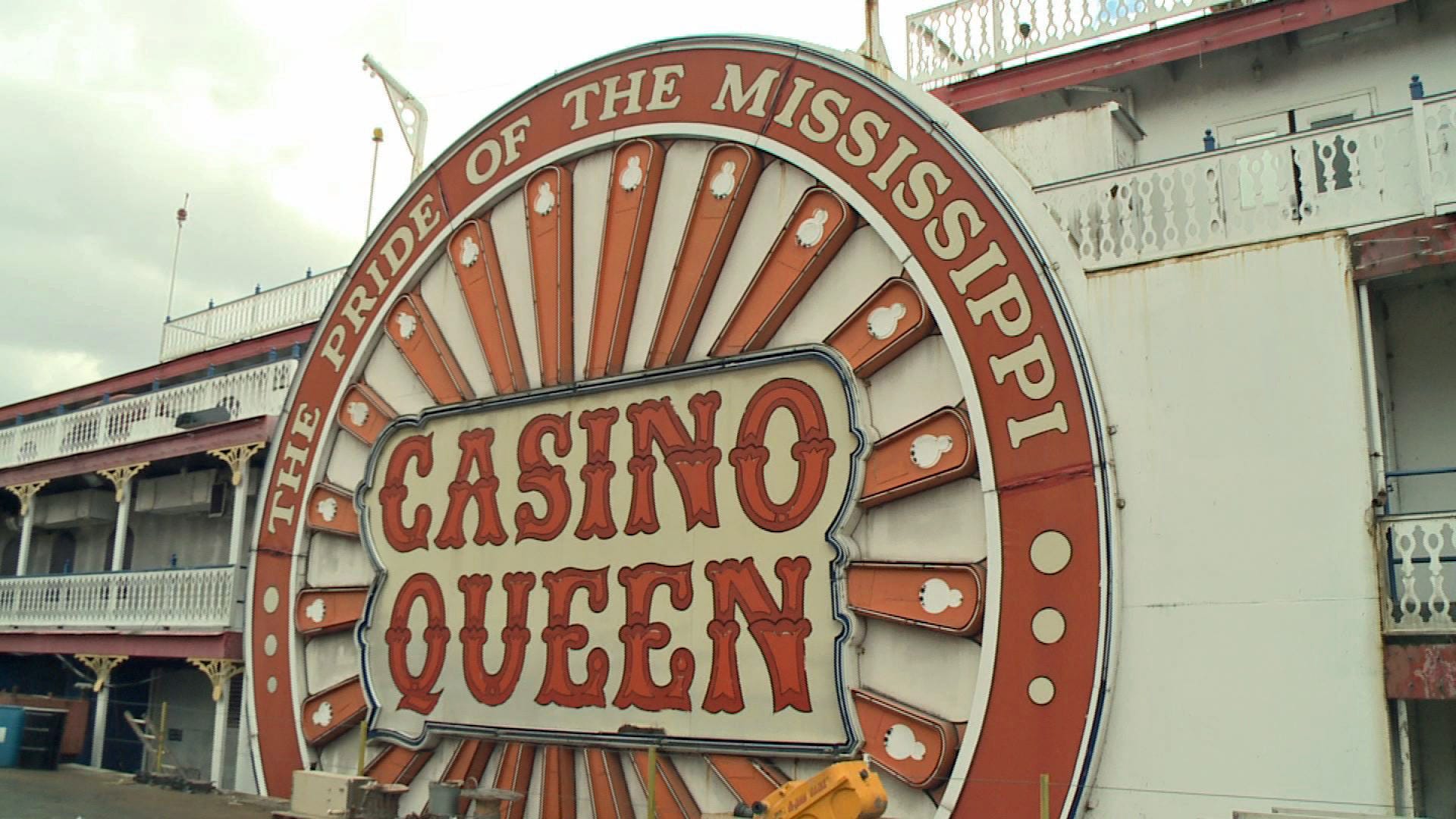
Old Casino Queen to be auctioned for debts


Old Casino Queen to be auctioned for debts


WOOD RIVER • The bright neon paddle wheel stopped beckoning gamblers to the East St. Louis riverfront years ago. The cacophony from slot machines fell silent.

The old Casino Queen riverboat, once a garish symbol of opportunity, is now stripped to its bones in a backwater boatyard, waiting for a little luck of its own.

Raccoons, mud swallows, sunshine and time have left the once-majestic vessel with tattered awnings, broken windows, rusted metal and peeling paint. It sits in Wood River, technically under arrest by U.S. marshals.

Today, they plan to auction the vessel to pay off its obligations and perhaps set it off on a new career.

Technically, it’s now called the White Star One. And after a federal lawsuit, an aborted auction and bankruptcy cases in two states, it is to be sold at 1 p.m.

East St. Louis was guaranteed a license when Illinois legislators authorized riverboat gambling to try to revitalize riverfront communities. In 1992, officials announced that a new, $13 million replica of a 19th-century sidewheeler was on the way. It would be the largest gambling vessel in Illinois and one of the biggest in the U.S.

The Casino Queen arrived the next year, stretching more than 400 feet at its mooring near the Eads Bridge. It held up to 3,000 passengers on three chandelier-accented gambling decks, plus a lounge on top.

The state required the boat to cruise the river, when conditions permitted, during gambling sessions. It last left the dock with passengers in 1999; regulators had relaxed the rules.

Further rule changes, in 2007, ended the boat’s career by allowing the gambling floor to be moved to a “boat in a moat,” a barge permanently anchored just inland.
The old Casino Queen went up for sale.

White Star Line LLC, managed by John Joslyn, bought it in 2008 for $2.5 million. The new owner moored it at Mike’s Inc., a boatyard in Wood River, at $200 a day, beginning Oct. 26, 2008.

In court filings, lawyers for Mike’s said it was supposed to stay only a short time.

Reached Thursday by phone, the Mike’s Inc., operations manager, Mike Marko Jr., said, “It seems like it’s been there forever.”

General Manager Amy Marko recalled that it arrived with carpet and other fixtures in place, and slot machine tokens scattered on the floor. Contractors eventually stripped the interior.
 
A TITANIC MUSEUM?
 
Mike’s workers heard that Joslyn, a Titanic shipwreck obsessive who has created Titanic museums in Branson and elsewhere, planned to turn the boat into another.

Joslyn is a former television producer who took a submersible to the Titanic wreck in 1986 and produced a documentary, “Return to the Titanic ... Live.”

But the museum plans apparently stalled.

White Star stopped making payments for a short time in the fall of 2010.

The rent went up to $300 a day on Jan. 1, 2011, $500 a day on Oct. 31, 2011, and $1,000 a day in
February 2013.

Lawyers for Mike’s Inc., filed an admiralty complaint in March 2013, claiming White Star Line and Joslyn failed to pay for almost $300,000 in mooring fees and other services since April 2011. The suit asked a judge to order that the boat be “arrested, condemned and sold,” with proceeds to first go toward bills at Mike’s.

Regions Bank then claimed that Joslyn and White Star owed $1.4 million on a $2.5 million promissory note from 2008.

ACF Property Management Inc. claimed that Joslyn and White Star owed it more than $1 million.
White Star and Joslyn asked for a delay in the proceedings, saying they were planning to move the boat elsewhere and obtain financing that would repay Regions Bank, ACF and Mike’s.

Joslyn, also in filings, said that the loans were personally guaranteed by himself and his wife, meaning that lenders would pursue them if sale proceeds don’t cover the debts.

In filings, White Star also complained about the price increases. But Mike’s responded that White Star did not protest at the time, nor move the boat.

A lawyer for White Star and Joslyn did not return a message seeking comment Thursday. Joslyn declined to comment, saying he had “nothing to say about it.”
 
AUCTION DELAYED
 
An auction was set for November, but was postponed when White Star filed for bankruptcy in Delaware. The case was later moved to the Southern District of Illinois, and in February the auction was given a green light.

An order by Bankruptcy Judge Laura K. Grundy noted that Joslyn decided not to attend a Feb. 13 hearing, as he had a “press conference in Tennessee related to a Titanic memorabilia display” and “made a strategic decision to put the interests of another venture ahead of the Debtor’s and not attend the trial.”

Neal Settergren, a lawyer for Mike’s, said that auction proceeds would be divided up by a federal judge.

During a tour for a reporter Thursday afternoon, Amy Marko said the old Casino Queen occupies more than one-and-a-half of the five end-to-end barges that make up the boatyard, which offers a drydock and a variety of repair and other services to river traffic.

She said it is hooked to electricity, so the boat doesn’t freeze up during extremely cold weather, and is regularly checked for problems. The once-iconic attraction, she said, receives little or no attention from passing river traffic.

Amy Marko said that from the outward appearance, the boat has experienced only the expected wear and tear.

Settergren, the lawyer for Mike’s, insisted that the hull and engines are sound. He said, “It’s not deteriorated or worthless.”


Robert Patrick covers federal courts and federal law enforcement for the Post-Dispatch. Follow him on Twitter: @rxpatrick.


http://www.stltoday.com/news/local/crime-and-courts/old-casino-queen-to-be-auctioned-for-debts/article_b254daae-d844-52dc-a098-db52c7003446.html


Tuesday, January 14, 2014

Stinky Penn National Deal


PENN NAT'L! STENCH!!! Sioux City nonprofit gambling group temporarily halts grants to local charities
 

Sioux City nonprofit gambling group temporarily halts grants to local charities

January 14, 2014 - 9:55 am
 
SIOUX CITY, Iowa — The nonprofit organization that holds the gambling license for the Argosy Sioux City riverboat casino has voted to stop sending grants to local charities and governmental bodies for now.
 
The Sioux City Journal reports (http://bit.ly/1d3kMl4 ) that lawsuits over which gambling operator has the right to run a casino in Sioux City has prompted the Missouri River Historical Development board to temporarily stop approving grants.
 
The board is the nonprofit holder of the gambling license for the casino operated by Penn National Gaming Co.
 
Iowa law requires casino operators to contract with and share a portion of their revenues with licensed nonprofit organizations such as the development board.
 
However, Penn National has withheld more than $900,000 from the board since May after Penn National filed a breach-of-contract lawsuit against the nonprofit.


Information from: Sioux City Journal, http://www.siouxcityjournal.com


Saturday, November 16, 2013

Debit Card Fraud at Mark Twain Casino.....

Politicians schemed to convince voters about the wonders of River Boat Gambling.....how interesting that this is one of the best known Mark Twain quotes....


Northeast Missouri casino reports debit card fraud


Published Friday, November 15, 2013

LaGrange, Mo. (AP) — Police are investigating several cases of possible debit card fraud at a Mississippi River casino in northeast Missouri.

WGEM-TV reports that police in Quincy, Ill., have received multiple reports of fraud from customers of the Mark Twain Casino in LaGrange. Police reports reviewed by the television station show that similar complaints have been filed by customers of casinos in St. Joseph as well as Osceola, Iowa. Affinity Gaming owns all three properties.

Authorities suspect a data breach at a third-party processing center used by Affinity Four Quincy banks reported losses totaling more than $11,000, and some of the fraudulent charges were traced to Maryland.

A statement from Affinity Gaming says the company's payment system is now "fully secured and our customers' payments are protected."


http://www.sfgate.com/news/crime/article/Northeast-Missouri-casino-reports-debit-card-fraud-4985198.php

Tuesday, May 21, 2013

Gambling With Cities - Desperation


Mega-developers like Sheldon Adelson want cities across the country---and the world---to build big new casinos. Unfortunately for many municipalities, that can be a losing bet.


http://live.huffingtonpost.com/#r/segment/when-casino-revenue-plans-go-bust/5196691802a76046fd000682

Sunday, April 28, 2013

Racing to the Bottom at Taxpayer Expense

Predatory Gambling was sold as 'RiverBoat Gambling' for Tourists, now they're docked.
Race Tracks were allowed Slot Barns to 'save racing,' then whined about taxes, now want expansion. [It was already acknowledged that the Massachusetts Slot Barn will add Table Games because it's a 'given.']

The Saturation of the Gambling Market by the Gambling Industry caused declining revenues and the state, any state bails them out.

When Government partners with the Gambling Industry, taxpayers foot the bill.

Indiana casinos win few gains from Legislature


The Indiana Legislature turned down most of the proposals meant to boost the state's casinos as they face greater competition from neighboring states.

The compromise that received final approval from the Senate early Saturday won't allow live table games such as blackjack and roulette at the horse track casinos near Indianapolis, where only electronic versions of those games are now allowed. It also won't permit the 10 riverboat casinos to build new inland facilities nearby.

Republican Sen. Phil Boots of Crawfordsville had sought those provisions and said he was disappointed he couldn't get an agreement from House Republicans who regarded them as a gambling expansion.

The bill does give some tax breaks by allowing the casinos to deduct up to $5 million a year in free gambling given in promotions.


http://www.ibj.com/indiana-casinos-winning-few-gains-from-legislature/PARAMS/article/41037

Tuesday, April 23, 2013

Iowa: Racing to the Bottom ASAP


Hard Rock Casino to be built in Sioux City, Iowa
April 22, 2013 9:30 AM by Staff & Wire Reports

Sioux City Entertainment will build a Hard Rock Casino in northwest Iowa’s Sioux City after the Iowa Racing and Gaming Commission awarded a gambling license Thursday to the group.

The commission chose from four proposals for land-based casinos in Sioux City after hearing proposals, meeting with developers and touring the proposed sites last month for casinos to replace the Argosy Sioux City riverboat casino. State regulators decided in 2011 to replace the Argosy with a land-based casino.


Gambling was sold in Iowa as RIVER BOAT GAMBLING to cater to 'TOURISTS.'
Then the boats docked. Now they're land-based. Gambling always escalates.

Penn National Gaming Co., which currently runs the Argosy, submitted two proposals for a casino — one just outside of Sioux City and one in downtown Sioux City that would have required the demolition of several buildings. Ho-Chunk Inc. also put in a bid to build the proposed Warrior Casino & Hotel, a $122 million project slated for the Davidson Building and Warrior Hotel.

But Sioux City Entertainment’s bid for the Hard Rock Hotel & Casino for $118.5 million was selected. It will be at the site of the historic Battery Building in downtown Sioux City.

“Obviously, we’re very happy with the decision,” said Bill Warner, president of Sioux City Entertainment and founder of the group’s Las Vegas parent company, Warner Gaming. “We had no idea how it was going to go until they announced it.”

The vote was not unanimous. Commissioners Greg Seyfer and Delores Mertz voted against awarding the license to the Hard Rock site, with Mertz earlier declaring the Ho Chunk proposal as her pick and Seyfer preferring Penn National’s downtown proposal. All five commissioners expressed difficulty in coming to a decision.

“I have never lost so much sleep,” Mertz said. “It has been really a wrenching decision.”

The winning Hard Rock proposal will see a casino with 800 slot machines and more than 200 gambling tables, Warner said. It will also sport an 800-seat venue for entertainment acts and concerts, several restaurants, a 60-room hotel and a “backyard” park setting around a small lake that can hold 3,000 people.

Construction is set to begin in July and is set to be complete by July 2014.

If the casino is not up-and-running by March 31, 2015, a fine of nearly $54,000 a day will be accessed against the casino’s developers until it opens.

http://www.gamingtoday.com/articles/article/41099-Hard_Rock_Casino_to_be_built_in_Sioux_City_Iowa

Thursday, January 24, 2013

Indiana: Addicted to Gambling

Because their neighbors are doing it, Indiana will rush to expand gambling.

Slot Barns, approved to 'Save Racing' will expand to table games on the pretext of 'job creation.'

River Boats, initially promoted to solely travel the river, now docked, will become land-based.


Don't kid yourselves. There are already plans in Massachusetts to expand.


Indiana considers gambling changes for racinos

Posted: Jan 23, 2013 6:13 PM EST


http://www.wthr.com/story/20662963/indiana-considers-gambling-changes-for-racinos

Saturday, December 22, 2012

Iowa: Sucking the last $$$ from residents


Lamberti: State getting close to 'critical mass' for casinos


JOHNSTON — The state may not be at “critical mass” for casino licenses, but it’s pretty close, the chairman of the state’s gaming regulatory board said.

Jeff Lamberti also said he’s watching what happens in Davenport “very closely” as the city makes moves to operate a casino there, but he doesn’t think other casino operators have to worry that the acrimony that erupted in Sioux City will spread to other casinos.

“That was just a very unique set of circumstances,” said Lamberti, a former state senator and attorney from Ankeny. “Licenses are privileges, they are not a right.”

Four partnerships are bidding for the Sioux City casino license held by Penn Gaming Co. which runs the Argosy Casino. The license was put up for bid after the nonprofit license holder pushed to replace the boat with a land-based casino.

Lamberti made his comments during a taping of Iowa Public Television’s “Iowa Press” show, which is scheduled for broadcast on Dec. 28 and Dec. 31. He was joined on the show by Wes Ehrecke, president of — and chief lobbyist for — the Iowa Gaming Association.

Iowa has 15 casinos, three race tracks and two Native American-run casinos. The 15 state casinos accounted for more than $1 billion in adjusted gross revenue in the 2012 fiscal year that ended this summer.

In Davenport, the city has proposed creating a city-appointed nonprofit board to run its casino, which would be a unique relationship for a city and gaming company in the state. Lamberti said he’s reserving judgment on the idea until he gets a specific proposal from the city, but he doesn’t like the idea of splitting casino operations between downtown Davenport and one near Interstate 80.

“I will tell you and I’ve told (city officials), I have some concerns about the location, because I believe an interstate location is the prime location there,” he said. “The difference is while we have to take into account what happens in the local community — that’s a big part of what we do — the commission represents the state of Iowa. We have to see what’s going on in the rest of the world, so to speak.”

Ehrecke said his clients also are watching what happens in Davenport with concern, especially if it leads to other municipalities wanting to take a larger role in their licenses.

“We’re certainly watching this with some interest, that whole idea of a municipality managing and running a casino, that would be unprecedented. It’s raised a lot of questions,” he said. “There’s a lot of unknowns right now. We just have members raising a lot of questions.”

He said the commission hasn’t taken a formal position on the situation in Davenport yet.
Ehrecke said casino operators also are watching whether the state will allow more licenses.

Cedar Rapids is the largest metropolitan area currently not served by a casino, but Linn County residents are set to vote on a May 7 referendum to gauge support for a Cedar Rapids casino. There also has been talk in other communities, such as Ankeny in Polk County, about possible gaming expansion.

Lamberti said “there is no moratorium” on licenses in the state and the commission will look at any proposal that comes before it. He did say, however, that the commission looks hard at if a new casino would eat into an existing customer base or draw in new customers.

“This is a pretty mature industry in Iowa,” he said.

http://globegazette.com/news/iowa/lamberti-state-getting-close-to-critical-mass-for-casinos/article_6bc37268-4bfd-11e2-9622-0019bb2963f4.html

Friday, November 23, 2012

Revenue leaking across state lines

Another state that believes Gambling Revenue is inexhaustible - Indiana!

The Solution? Why, of course: EXPANSION!

It's in the Gambling Playbook. Did you read it? They did.


Indiana gaming revenues continue to fall
By Staff reports
Posted Nov 23, 2012
 
HAMMOND, Ind. — A top legislative leader wants to make Indiana’s riverboat casinos more attractive so they can compete better with newer venues in neighboring states.
 
Indiana Senate President David Long, R-Fort Wayne, told the Times of Munster for a report Thursday that he wants the Indiana General Assembly to do something to reverse the decline in state tax revenues from casino wagers and admissions.
 
“There is an all-out assault on the system that Indiana has implemented, which was to take other people’s money. They’re out to get it back,” Long said, referring to neighboring states.
Ten of Indiana’s 13 casinos are in counties adjacent to other states. Most of the gamblers going to northwest Indiana’s five casinos come from Illinois or Michigan, The Times reported, but several tribal casinos have opened in southern Michigan near the Indiana border, and Illinois has proposed casinos for Chicago and its south suburbs. Two of Ohio’s four casinos will be in Toledo and Cincinnati, both near the Indiana border.
 
“They are going to resolve that (in Illinois), and they are going to build casinos probably one right on the Indiana border, according to my sources,” Long said. “So they will be trying not only to keep their residents there but to take some of ours over.”
 
Indiana casino tax revenue from wagers and admissions were 5.4 percent lower last year compared with 2008. Gaming taxes remain Indiana’s third-largest source of revenue after income and sales taxes but now make up just 4 percent of the state’s total revenue stream.
 
“There’s a lot of pressure on us as a very important source of revenue is going down,” Long said. “Gaming revenue is under assault right now.”
 
Indiana doesn’t need more casinos, just “more competitive” ones, Long said.
 
“That could mean a lot of things, so we’ll just have to see what the proposal is,” Long said. “Then we’ll have to run it past our caucus and see if there’s an appetite for doing anything about it.”
 
Attempts to win approval for moving Gary’s Majestic Star casinos inland from the Lake Michigan shoreline have foundered in the legislature in the past, in part because of Hammond Mayor Thomas McDermott Jr.’s efforts to protect his city’s Horseshoe Casino.
Long said he’s more open to a Gary casino deal now, but said any plan for gaming changes will need support from the entire northwest Indiana delegation.
 
State Sen. Earline Rogers, D-Gary, who sponsored the legislation creating casino gambling in Indiana and championed a land-based casino in Gary, was pleased by Long’s remarks.
 
“Just the recognition of the surrounding states and their impact on our gaming industry in Indiana, I think that’s the first step in terms of trying to move the idea of land-based casinos forward,” Rogers said.
She said she hopes a Gary-specific legislative proposal that includes a land-based casino and a teaching hospital with a trauma center and other economic development programs will have enough of everything that all lawmakers from the region will support it.
 

Saturday, October 20, 2012

Harrah's riverboat casino too costly to maintain


River Boat Gambling was a ploy to gain acceptance and pretend the Gambling Addicts would be tourists and not locals.

Such much for illusions!

Harrah's planning to close riverboat casino and move games inside its Council Bluffs hotel


COUNCIL BLUFFS, Iowa — Harrah's is planning to decommission its Missouri River riverboat casino and move the games inside its nearby hotel in Council Bluffs.

Harrah's general manager Bo Guidry told The Daily Nonpareil (http://bit.ly/RE0FAZ) that the aging boat costs too much to keep running.

Guidry says the hotel's main floor convention center would be turned into a casino with a new restaurant and bar. Around 20 table games and 600 slot machines would be moved from the boat to the new casino.

The plans are pending approval by directors of Caesars' Entertainment, which owns Harrah's, and the Iowa Racing and Gaming Commission.

Guidry says that, with their approval, reconstruction could begin in January and be finished by summer.
___
Information from: The Daily Nonpareil, http://www.nonpareilonline.com

http://www.therepublic.com/view/story/6f12184fd8e2452ab8801677959ecbb3/IA--Harrahs-Shore-Leave

Tuesday, September 11, 2012

Regulators want Penn National suits combined


Sept. 11, 2012

Iowa regulators wants casino lawsuits combined

 
The Associated Press
SIOUX CITY, Iowa —
The Iowa Racing and Gaming Commission wants a judge to consolidate two lawsuits filed against it by the owner of Sioux City's riverboat casino.

Penn National Gaming Co. has gone to court to overturn the board's decisions that put the gambling license up for bid for a land-based casino in Woodbury County and rejected a contract extension with its nonprofit partner to 2015.

Penn National claims the commission's actions were unconstitutional and beyond its authority.

The Sioux City Journal (http://bit.ly/OnR6tv ) says the commission filed a motion on Monday in Polk County District Court asking that the cases be held at the same. The board argues that consolidation would promote "judicial economy" by eliminating the need to address the same or similar issues in two separate actions.
___
Information from: Sioux City Journal, http://www.siouxcityjournal.com

Sunday, April 22, 2012

In Scott Farmelant's own words....


The Kraft/Wynn Slot Barn Cheerleader, Scott Farmelant offered these comments --

Illinois loses $6.7 million to casinos each year which otherwise would have been spent on local businesses. The sum does not include regulatory and infrastructure costs, or social costs.

In addition, the study found that areas closest to casinos suffered the most. The study also determined that riverboat casinos do not promote tourism, noting that 84 percent of Illinois gamblers live in-state. By comparison, Las Vegas attracts 85 percent of its gamblers from out-of-state.

Casinos: A Bad Bet
November 7–14, 1996

The League of Women Voters of Philadelphia (LWV) and Coalition of Philadelphia Neighborhood Associations (CPNA) will co-sponsor a Nov. 16 lecture on riverboat gambling. The mid-morning lecture will not tout floating casinos.

Terrence Brunner, director of the Better Government Association of Chicago, will deliver the main speech after an introduction by Inquirer columnist David Boldt. Brunner's group recently commissioned an economic impact report on riverboat casinos in Illinois which bashed casino gaming.

During their yearlong study, professors William N. Thompson and Ricardo C. Gazel of the University of Nevada, Las Vegas found that Illinois loses $6.7 million to casinos each year which otherwise would have been spent on local businesses. The sum does not include regulatory and infrastructure costs, or social costs.

In addition, the study found that areas closest to casinos suffered the most. The study also determined that riverboat casinos do not promote tourism, noting that 84 percent of Illinois gamblers live in-state. By comparison, Las Vegas attracts 85 percent of its gamblers from out-of-state.

Brunner's report is significant because Mayor Ed Rendell has long praised riverboat gaming as a potential cure for Philly's intractable economic woes. Rendell has also said that casinos would boost tourism and Convention Center business. On the Rendell front, Mayoral Deputy Chief of Staff Ted Beitchman reports that a long-awaited economic impact study of casinos commissioned by the Rendell administration is still not ready. Beitchman says the report, originally promised for release this past winter, won't be made public until a transportation component is finished.

"We still don't have a date," Beitchman says.

The LWV/CPNA event takes place at the Ethical Society, 1906 Rittenhouse Square, starting at 10:30 a.m. Reservations can be made by calling the LWV at 977-9488, or by writing to the LWV at 1617 JFK Boulevard, Philadelphia, 19103-1809.

— Scott Farmelant

Thursday, March 22, 2012

Louisiana: Bill would expand racketeering crimes

Bill would expand racketeering crimes
BY MICHELLE MILLHOLLON
Capitol news bureau

Without discussion, a Louisiana House committee agreed Wednesday that racketeering should target more white collar crimes in Louisiana.

House Bill 99 by state Rep. Cameron Henry, R-New Orleans, sailed through the House Committee on the Administration of Criminal Justice. The legislation moves to the House floor for consideration.

The bill would greatly expand the definition of racketeering in state law. More crimes would apply, exposing more offenders to lengthier sentences for criminal patterns.

Henry said he is seeking uniformity.

“It was brought to my attention that our state racketeering laws don’t mirror federal racketeering laws,” he said.

Henry said he is not trying to pick on what are known as white collar criminals who commit nonviolent crimes.

In Louisiana, 11 offenders are in state prisons for racketeering activity, according to the Legislative Fiscal Office.

Federal racketeering charges helped send former Gov. Edwin Edwards to prison for 10 years in a case involving riverboat casino licenses.

State racketeering charges generally are for more violent crimes such as murder.

The charges currently included as racketeering activity under state law are solicitation for murder, first-degree murder, solicitation for murder, second-degree murder, assault by drive-by shooting, aggravated kidnapping, second-degree kidnapping, aggravated arson, carjacking, extortion, theft, certain controlled dangerous substance violations, pandering, money laundering, simple kidnapping, simple arson, aggravated criminal damage to property, simple criminal damage to property, aggravated burglary, simple burglary, simple burglary of an inhabited dwelling, simple burglary of a pharmacy, unauthorized entry of inhabited dwelling, first-degree robbery, second-degree robbery, simple robbery and unlawful securities practices.

Henry’s bill would add 14 charges to the list: public bribery; corrupt influencing; public intimidation and retaliation; threatening a public official; terrorism; aiding others in terrorism; intimidating, impeding or injuring witnesses; injuring public records, filing or maintaining false public records; abuse of office; public salary deduction; public salary extortion; public payroll fraud; public contract fraud; and prohibited splitting of profits, fees or commissions.

E. Pete Adams, executive director of the Louisiana District Attorney Association, said Henry is focusing on corruption crimes as a way to establish a chain of criminal activity.

“It ups the ante,” he said.

Adams said racketeering gives prosecutors a way to enhance penalties by showing a pattern of criminal activity.

On Henry’s behalf, Adams outlined the bill to members of the House Committee on the Administration of Criminal Justice.

“There are no questions,” state Rep. Helena Moreno, D-New Orleans, said when Adams finished.

The Legislative Fiscal Office estimated the legislation could increase the state’s expenses by convicting people under new additions to the racketeering law.

“You broke the law, you go to jail,” Henry said after the meeting.

Sunday, March 18, 2012

Villa Park woman fights illegal gambling

Villa Park woman fights illegal gambling

Kathy Gilroy of Villa Park faces a frustrating legislative world where the odds are against her. Her complaints about charity events that she thinks are examples of illegal gambling often bounce from agency to agency.

As many suburbanites wade through their NCAA basketball bracket paperwork to see if anybody in their office pool has Norfolk State or Lehigh making the Sweet Sixteen tonight, Kathy Gilroy of Villa Park boasts her own mounds of paperwork.

The 62-year-old anti-gambling watchdog’s collection of zippered bags holds handwritten notes, legal decisions, email correspondence with public officials, faxes, newspaper articles, court transcripts, the Illinois criminal code from 1961, the latest legislation on video poker machines, and myriad copies of local ordinances, and state and federal laws spanning more than 20 years.

“I kind of consider myself an expert,” Gilroy says. She also doesn’t see anything cute in that story about the 11-year-old story Omaha, Neb. boy busted for running an NCAA tourney pool at his elementary school.

A native of Lost Nation, Iowa, where a park is named in honor of her relatives, Gilroy began her crusade against illegal gambling before the first Midwest riverboat casino opened in 1991 in Davenport, Iowa.

“I just knew it was Pandora’s box. I just knew it was going to be bad news,” Gilroy says. She tells of a farmer who gambled away the family farm, another who ended up broke because he gambled away all the profits after selling a truckload of hogs, and a childhood friend who threw away a marriage and tens of thousands of dollars chasing a gambling addiction.

Gilroy, an insurance agent who calls her watchdog duties “my second job,” devotes much of her energy to cracking down on charities that don’t follow the gambling rules in an environment where the lines often seem blurred.

“Is it charitable gambling, or is it gambling that is using, or abusing, a charity?” she asks.

Some critics dismiss her as a busybody, a quixotic character flailing at windmills. She’s seen her letters to politicians tacked up on bulletin boards identifying her as “our gambling pest.” A public official once told her to “Get a (expletive) life!” Gilroy says.

But she’s knocked down a few of those windmills she’s attacked. A volunteer with
stoppredatorygambling.org, her crowning achievement might be from her work to stop kids from gambling.

“In 2000, all four Naperville high schools were sponsoring casino nights, and I got them shut down,” Gilroy says.

The watchdog also sank her teeth in high-profile raffles sponsored by Chicago Bears Hall-of-Famers Walter Payton and Richard Dent, resulting in a law being changed. She shut down a fundraiser hosted by the grieving parents of a murder victim, and put the brakes on a motorcycle club’s raffle to raise money to send burn victims to a camp. She’s working now with legislators trying to crack down on charity raffles that use the Internet, phone and U.S. mail.

Ignoring violations of gambling laws simply because the proceeds go to a good cause is the same as ignoring an armed robber who is using his ill-gotten gains to feed his hungry children, Gilroy argues.

At a meeting of the Illinois Gaming Board, which oversees casino gambling and video poker, Gilroy sits near the front and takes notes.
When the board fines the new Rivers Casino in Des Plaines $25,000 after the casino revealed it violated rules by granting membership cards to seven problem gamblers on the state’s self-exclusion program list and gave cash advances to two gamblers who should have been barred from entering, Gilroy rolls her eyes. “I wonder how much money they lost at that casino,” she says of the problem gamblers.

State gambling regulators know Gilroy.

“I just wanted you to know you weren’t trying my patience,” says a smiling Mark Ostrowski, administrator of the gaming staff, who seeks out Gilroy after the meeting to discuss some of their recent email correspondence.

“I think it’s good that they (Gilroy and other watchdogs) are out there keeping the regulators and the industries on their toes,” says Gene O’Shea, director of the self-exclusion program and a spokesman for the gaming board.

One of the frustrations facing Gilroy is that “there isn’t one kind of gambling,” says Sue Hofer, a spokeswoman for the Illinois Department of Revenue, which has a division that regulates charitable gaming. The complicated tax rules for a charity that hosts a gambling event are different from those governing a “Sweet 16” birthday bash in a private home. The state lottery, the casinos and video poker, the race tracks, charity raffles and casino nights all fall under the jurisdiction of different regulating bodies with different rules, and deciding which agency has jurisdiction is tricky.

Gilroy says complaints often bounce from agency to agency and many times end up with local police. Generally not spending the effort to investigate her complaint, police often tell her to contact the local state’s attorney or even the FBI, she adds.

“Why should I have to do all the work?” she says. “Don’t they have people who are supposed to investigate that stuff?”

Her complaint about one suburban charity event was dismissed by a police department that has two officers helping to run the event, notes Gilroy, who did manage to get a poster advertising the event removed from the police department window.

She says many of the machines in kids’ arcades are basically roulette wheels and slot machines. Her rage against those machines often falls on deaf ears. She’s ticked that a company with mob ties was denied a license for video gambling devices in Illinois but still can put games of chance in kid arcades. It bothers her that older people can’t qualify for assistance if they give away all their savings to their kids, but can qualify if they lose it all at a casino.

“My main problem with all of this is the home parties and the underage gambling,” Gilroy says.

If senior citizens who grew up in an era when gambling was considered an evil racket run by the mob can become gambling addicts, today’s children might be even more susceptible, Gilroy figures.

“I worry,” Gilroy says. “They are growing up in a culture that accepts it.”

Gamble: Gilroy saw childhood friend lose everything to gambling addiction.

Saturday, March 17, 2012

Casino Robbers Convicted Of Similar Crimes In Ind.

Casino Robbers Convicted Of Similar Crimes In Ind.
Pair Faces Up To 50 More Years In Prison

RISING SUN, Ind. — WLWT.com

Two men convicted in Ohio of robbing casino winners were found guilty of similar crimes in Indiana.

Kenyatta Erkins and Ugbe Ojile were convicted Thursday in Ohio County of conspiracy to commit robbery resulting in serious bodily harm.

The pair faces up to 50 years in prison when they are sentenced April 13.

Ojile was sentenced in October to 35 years in prison and Erkins was sentenced to 30 years.

An accomplice, Amy Hoover, pleaded guilty and testified against both men. She did not take part in the Indiana trial.

The trio was accused of following winners home from Indiana riverboat casinos and robbing them at gunpoint, taking more than $100,000 in more than two dozen robberies.