Meetings & Information


*****************************
****************************************************
MUST READ:
GET THE FACTS!


Showing posts with label Detroit. Show all posts

Monday, January 2, 2017

Audit: 213 Detroit casino employees need more financial scrutiny for gaming license upgrades


Casino Gambling paved Detroit's streets with GOLD [just as they did in Atlantic City]!


Audit: 213 Detroit casino employees need more financial scrutiny for gaming license upgrades
An audit of three Detroit casinos released this week concluded that 213 employees were not licensed within guidelines of state gaming rules. The Michigan Gaming Control Board disagrees with the finding, which was one of three in the report that examines the state's regulation of the $1.37 billion Detroit casino industry.

Detroit Gaming

12/29/2016

article Michigan gaming regulator criticized over Detroit casino licensing protocols
(MICHIGAN) -- A new report from the Michigan Office Of The Auditor General has controversially concluded that the Midwestern state’s gambling regulator has been...

12/28/2016

article Audit: 213 Detroit casino employees need more financial scrutiny for gaming license upgrades
(MICHIGAN) -- An audit of three Detroit casinos released this week concluded that 213 employees were not licensed within guidelines of state gaming rules. The Michigan...

Thursday, September 1, 2016

Man accused of leaving kids in car, gambling in casino


Man accused of leaving kids in car, gambling in casino

August 30, 2016
Associated Press

DETROIT (AP) — Authorities say a father has been charged in connection with leaving his infant and toddler sons locked in a car in a Detroit casino parking structure while he gambled inside.
Twenty-five-year-old Montez Sistrunk of Ypsilanti was arraigned Tuesday afternoon on two counts of second-degree child abuse. He was issued a $75,000 bond and his next hearing set for Sept. 13.
Detroit police say officers were called to the MotorCity Casino parking garage Monday morning after the 5-month-old and 2-year-old boys were found by an employee and rescued by a security guard. Prosecutors say the children, who weren't hurt, had been left for about an hour.
It wasn't immediately clear if Sistrunk has an attorney.
The Detroit News reports the children are now with their mother. Child Protective Services is investigating.


Wednesday, January 28, 2015

Sucking every last $$$$ out.....


Massachusetts ‘GAMING’ Future
For those of you questioning why Gov. Christie would appoint someone from the bankrupt city of Detroit to help bailout Atlantic City casinos, here’s why. There are three casinos in Detroit, the MGM Grand, MotorCity and Greektown Casino. Since their inception back in 2000 they have been doing over a billion dollars annually. Now I don’t know about you, but I can’t imagine anyone wanting to casino gamble in Detroit, so I’m figuring most of the money is coming from those who live there or live nearby. Many say the auto industry going south is what caused the city’s demise, but the billions of dollars lost in the casinos by those who live there must have helped.
 
The Associated Press - January 22, 2014 - N.J. Gov. Christie appoints emergency managers for Atlantic City
ATLANTIC CITY, N.J. — Trying to dig Atlantic City out of "an enormous hole," New Jersey Gov. Chris Christie on Thursday appointed a corporate turnaround specialist as the city's emergency manager, and tabbed the man who led Detroit through its municipal bankruptcy as his assistant.
Corporate finance consultant Kevin Lavin will have broad but still-unspecified powers over Atlantic City's finances and operations. Kevyn Orr, who helped lead Detroit through a financial crisis, will serve as special counsel to Lavin. Christie issued an executive order appointing the men.


Friday, July 4, 2014

Fight over Detroit's casino revenue resurrected by appeals court


Fight over Detroit's casino revenue resurrected by appeals court

By Khalil AlHajal | kalhajal@mlive.comMLive.com
Follow on Twitter
on July 03, 2014

casino-greektown.jpgA casino sign in Greektown, Detroit. A federal appeals court ruling on Wednesday ordered the resurrection of a challenge to the protection of casino revenues in Detroit's bankruptcy case.


DETROIT, MI -- The U.S. 6th Circuit Court of Appeals on Wednesday ordered the resurrection of a challenge to the protection of casino revenues in Detroit's bankruptcy case.

The city in 2009 offered casino revenue as collateral in a series of borrowing deals made to help meet pension obligations, and bond insurer Syncora Guarantee Inc., since Detroit stopped making debt service payments before filing bankruptcy in the summer 2013, has been seeking to tie up those funds.

U.S. Bankruptcy Judge Steven Rhodes in August 2013 ruled that the casino revenues were city property protected by the bankruptcy process, and that Syncora had no legal standing to prevent the funds from reaching city coffers.

Syncora appealed to U.S. District Judge Bernard Friedman, who in April put the issue on hold pending a decision from the appeals court on whether Detroit was eligible to file for bankruptcy in the first place.

The city, meanwhile, has moved rapidly through the bankruptcy process and Rhodes is set to begin a confirmation hearing on its overall plan for addressing $18 billion of debt in August.
The appeals court on Wednesday ordered Friedman to revisit Syncora's appeal and make a ruling by July 14.

"The question presented in Syncora's appeal, whether a substantial revenue stream is rightly considered property of the bankruptcy estate, is precisely the type of issue that should be reviewed before the bankruptcy court confirms the plan of adjustment," wrote Judge Julia Smith Gibbons in the court opinion.

"Without a final decision on that question, the city will not know what amount its coffers will contribute to the bankruptcy estate, the creditors cannot know the size of the pie they are being asked to share, and the bankruptcy court cannot be confident that it is considering a legally and financially viable plan... The district court's stay threatens to deprive this court of an opportunity to consider the merits of Syncora's appeal."

Taxes collected from Detroit's three casnios brought the city $9.3 million in May.


http://www.mlive.com/news/detroit/index.ssf/2014/07/fight_over_detroits_casino_rev.html

Saturday, March 8, 2014

States' Addiction to Gambling Revenues....


Horseshoe Casino Cleveland sees slight bump in revenues, but still far behind last year's pace ...
Revenues at the Horseshoe Casino Cleveland jumped a bit in February, but they remain off the pace of last year, according to revenue records...
 
Deadwood gaming revenues continue to fall
Las Vegas Downtown Grand A Southern California man has sued a Las Vegas casino after he lost $500,000 on blackjack and pai gow over Super...
 
 
Maryland state revenues down in Q4 2013
THEY PROJECT LOSING $7 MILLION FROM CASINO REVENUES OVER THE NEXT TWO YEARS. AS LONG AS THE STATE INDOORS ...
 
Detroit Casinos' January Revenues Decrease from Same Month Last Year


The Michigan Gaming Control Board (“MGCB”) released the revenue and wagering tax data for January 2014 for the three Detroit, Michigan,....


Indiana casinos taking a hit from Horseshoe Cincinnati
But revenues have declined in all 13 Indiana venues, and none more so than the three southeastern Indiana casinos in the Cincinnati market..........


Sunday, December 22, 2013

Detroit: Hitching Wagon to Declining Gambling Revenues


Lower casino revenues could mean dwindling jackpot for Detroit

December 21, 2013

By JC Reindl

Detroit Free Press Business Writer
 
The City of Detroit’s financial lifeline for its bankruptcy restructuring — tens of millions in annual taxes from casino gambling — has been faltering as downtown gaming revenue is on pace for its largest annual decline since the first casinos opened in 1999.

Continued creep downward and loss of the tax revenue could mean less money for restructuring Detroit’s city services. Bill Nowling, spokesman for emergency manager Kevyn Orr, said the EM’s office is closely monitoring Detroit’s casino situation.

“If we need to make an adjustment in our (financial) assumptions as a result, we will.”

The fall in business could indicate a shrinking of the casino business market in Detroit and herald fiercer battles for market share of what’s left among the Detroit three — MGM Grand Detroit, MotorCity Casino Hotel and Greektown Casino-Hotel.

Brian Dickerson:Detroit has gone from being the Motor City to being the Casino City

Gambling revenue this year through November is down 4.3% to $1.2 billion. The state and city split up taxes from the three casinos. Roughly speaking, the state takes about 8% and the city from 10% to 12%, depending on the year and adjusted gross gaming revenue for each casino. The lower the revenue, the lower the tax receipts.

Orr this week called Detroit’s cut — $171 million in 2012 — one of the city’s most important revenue streams, representing about 14% of the total money coming in each year. But it has been sliding, down from $177 million in 2011.

“Without it, the city couldn’t operate,” Orr said Wednesday in bankruptcy court testimony.

Non-gaming revenue from hotel rooms, food sales and other sources at the three casino sites are not part of the equation.

Detroit’s lawyers are hoping to set aside a large portion of the taxes for improving dismal city services, if a federal bankruptcy judge allows a deal to go through that would release the casino tax revenue back to the city. The tax stream was pledged as collateral in 2009 for a massive city debt that came due.

To be sure, with $1.4 billion in total gambling revenues last year, the three casinos are still serious cash-generators and in no danger of closing. Still, their significant drop in revenue could have direct effects on the quality of Detroit’s amenities and resident services as the city aims to emerge from bankruptcy with sustainable finances.

Gambling industry experts and casino operators blame most of the decrease on the four new Ohio casinos, particularly Hollywood Casino Toledo, which let northwest Ohio residents gamble closer to home.

Another factor was the January expiration of the Social Security payroll tax cut, which was worth about $1,000 to a worker making $50,000 a year. The growing proliferation of casino gambling nationwide has also cut into gaming revenues for many regional-draw casinos nationwide such as Detroit’s.

Greater competition

It has been a down year for all three casinos.

Gambling revenues through November were 5.3% lower at MGM Grand than a year ago and 6.7% lower at Greektown, according to the Michigan Gaming Control Board.

MotorCity Casino had the smallest decline at about one-half of 1%. But it also paid for promotions and giveaways: Overall net revenues, which include food and beverage and hotel stays, were down 8% as of June 30, while the casino’s promotional expenses grew, according to figures compiled by BofA Merrill Lynch Global Research.

MotorCity also spent money this year on hundreds of new slot machines and to update the design of its gaming floors to draw in more gaming dollars.

“It’s definitely become more expensive to operate in the Detroit market, which happens whenever competition heats up, as it did with Toledo,” said Jenny Holaday, MotorCity’s senior vice president of operations.

Industry experts say revenues are down in regional-draw casino markets across the country, and especially so in areas such as Michigan and Indiana, where local properties have new competitors.

More casinos on way

There are now nearly 1,000 casinos within 41 states (including tribal lands) with more soon to open when Massachusetts becomes the 42nd state. The Kentucky state Legislature is debating whether to put legalized casinos on the ballot next fall.

Michigan has 22 tribal casinos within its boundaries, with FireKeepers Casino near Battle Creek the closest to Detroit.

New casinos lead to more new casinos. Just as the Windsor casino spurred efforts for Detroit’s casinos, officials often contend that their city or state must build its own casinos in response to neighboring casinos to recapture the gambling dollars (and potential tax revenues) that are flowing across their borders.

But each new property means less potential business for the others.

From an economics standpoint, communities hosting casinos want visitors from as far away as possible so that gambling proceeds are “new” money and not local dollars that would otherwise be spent elsewhere in the community.

“There are many markets where saturation has been reached or is close to being reached,” said Joseph Weinert, executive vice president of New Jersey-based Spectrum Gaming Group. “All things being equal, customers will chose to gamble at the casino closest to their home.”

The shine may already be wearing off Toledo’s new casino, which opened in spring 2012.

The casino’s third-quarter revenue was down 15% from a year earlier to $48.9 million, according to corporate filings by its owner, Penn National Gaming.

Caesars Entertainment does not give financials for Caesars Windsor in its filings, although the gaming company itself reported a $761-million third-quarter loss.

Hotels hurt profits

Insiders say Detroit’s casinos were most profitable in their early years when they operated in temporary facilities and before they took on debt to build large and expensive permanent digs.

Politics played a role in the grandeur and size of the properties, as each one was mandated to have conference space and no fewer than 400 hotel rooms to provide amenities thought to be lacking in the city at the time.

A deal negotiated by former Mayor Kwame Kilpatrick got the casinos out of an 800-room requirement in exchange for, among other things, $102 million cash to help balance Detroit’s budget.
“All of them were making a big profit before the permanent facilities, and all of them were in trouble when they went to the large, fancy facilities,” said Jacob Miklojcik, a Lansing-based gaming consultant.

Although none of the casinos discloses hotel occupancy rates, Miklojcik suspects that the 400-room hotel mandate was still too big and wouldn’t have happened if the casinos had a choice. “Some of those are pretty massive costs per key,” he said.

Both MGM Grand and MotorCity opened their temporary locations in 1999 and full properties in 2007 — just in time for the recession.

“The bottom fell out right when everyone’s permanent facilities came online,” said Holaday, the MotorCity executive.

Greektown was the last casino to open, in 2000, and did not transition to its full facility until 2009. It is the smallest property of the three.

Despite shedding $500 million in debt during bankruptcy, Greektown’s finances are still somewhat precarious, and the casino hasn’t reported an operating profit since emerging from Chapter 11 in 2010.

Quicken Loans founder Dan Gilbert bought Greektown this spring through his casino business, Rock Gaming, which has made management changes and plans “significant” renovations next year to the casino property. Rock Gaming owns two of the four Ohio casinos, in Cleveland and Cincinnati.

In an interview, Rock Gaming CEO Matt Cullen said he doesn’t believe Detroit’s casino market will continue shrinking.

“I don’t think we agree that the size of the pie has gotten smaller and will stay smaller,” Cullen said.

“There are a lot of people still that are rediscovering the city of Detroit and who are coming down here that haven’t come down here for a long time. And there’s still people that don’t come down here.”

http://www.freep.com/article/20131220/NEWS01/312200116


Friday, December 20, 2013

Detroit:...mother’s milk for survival...? Motor City to Casino City, the Ponzi Scheme

Detroit's spiral involves more than following the Fools' Gold of Predatory Gambling and Corruption, accepting dumb decisions of leaders...you can't hitch your wagon to sucking discretionary dollars from those least able to afford it. 

Failed Fiscal Policy that betrays the public trust is a Ponzi Scheme.


Brian Dickerson: Detroit has gone from being the Motor City to being the Casino City


December 20, 2013

By Brian Dickerson

Detroit Free Press Columnist

Scarcely 17 years have passed since Michigan voters authorized casino gambling in Detroit. This week, emergency manager Kevyn Orr told the judge overseeing the city’s bankruptcy that Detroit can no longer function without the licensing fees and tax revenue generated by its three casinos.

“Casino revenue is the single most stable source of revenue available to the city,” Orr testified Wednesday in a hearing before U.S. bankruptcy Judge Steven Rhodes.

“Without it,” he added, “the city couldn’t operate.”

Orr’s candid admission was occasioned by Rhodes’ curiosity about the generosity of a settlement that Orr negotiated with two banks that financed a disastrous credit swaps deal with the city during Kwame Kilpatrick’s first mayoral term.

Why, the judge wondered, had a bankrupt city with so few assets to satisfy its myriad creditors been in such a hurry to pay just two of those creditors, UBS and Bank of America Merrill Lynch, 75 cents on the dollar?

The answer, Orr and his attorneys explained, is that the banks’ loans to the city are secured by casino tax revenues on which Detroit depends for its day-to-day operations, the way a newborn depends on its mother’s milk for survival.

Ken Buckfire, an investment banker who has been acting as a consultant to Orr’s team, testified Tuesday that if the city challenged the legality of the swaps and lost, the banks could divert virtually all the city’s casino tax revenue for for three to four years.

Whether the original credit swaps deserve to be honored, and whether the deal Orr negotiated to discharge them is the best way to protect the city’s last, best source of operating revenue are questions we’re going to hear debated at length over the next few days.

But those who voted to authorize casino gambling in 1996 should also reflect on how that decision set the stage for what came after. How did a community of 700,000 souls become so utterly dependent on a revenue stream that didn’t even exist until 1999?

The short answer is that casino gambling did nothing to stop the hemorrhage of human talent that was well under way in the 1990s, and may even have accelerated it. I was hardly the only member of my generation who abandoned my last fantasy of urban homesteading when it became apparent that the city was mortgaging is future to a roulette wheel.

Even so, Detroit’s devolution (in the span of less than a single generation) from the Motor City to the Casino City is startling. It’s a transformation that Detroiters should keep in mind as they debate alternate visions of their community’s rebirth.


http://www.freep.com/article/20131220/COL04/312200021/Brian-Dickerson-Detroit-has-gone-from-being-Motor-City-being-Casino-City

Tuesday, October 15, 2013

Detroit Casino Revenue or Sucking Detroit Dry


Massachusetts ‘Gaming’ Future

So far this year, the losses in the three casinos of the bankrupt city of Detroit is over, ‘One BILLION DOLLARS.’ Now how much of that money lost do you think came from the citizens of Detroit?

Chicago Tribune - October 10, 2013 - Syncora appeals bankruptcy judge's order on Detroit casino revenue...


DETROIT, - Syncora Guarantee, which insured payments by Detroit on some of its interest-rate swaps, on Thursday appealed a bankruptcy court order that allowed Detroit continued access to casino revenue that the city says it needs to avoid running out of cash.

Read more:
http://www.chicagotribune.com/sns-rt-usa-detroitsyncora-20131010,0,3004460,full.story
See More


Syncora appeals bankruptcy judge's order on Detroit casino revenue


Reuters
October 10, 2013
DETROIT, Oct 10 (Reuters) - Syncora Guarantee, which insured payments by Detroit on some of its interest-rate swaps, on Thursday appealed a bankruptcy court order that allowed Detroit continued access to casino revenue that the city says it needs to avoid running out of cash.

Syncora had tried to block Detroit from accessing an estimated $11 million in monthly tax revenue from the city's three casinos, claiming it had a lien on the money, which had been used as collateral since 2009 to secure the city's interest-rate swap agreements. Detroit's emergency manager, Kevyn Orr, and one of his top consultants said in sworn depositions that the casino revenue is key to city's survival.

Syncora on Thursday filed an appeal in U.S. district court in Detroit of an Aug. 28 ruling by Bankruptcy Judge Steven Rhodes granting the city access to the casino funds.

Detroit filed the largest municipal bankruptcy in U.S. history in July, and it is struggling to overcome more than $18 billion in debt and other obligations.

Syncora is also one of several bond insurers and other creditors that are objecting to a deal Detroit struck with Merrill Lynch Capital Services and UBS AG to end interest-rate swap agreements.

Detroit wants to end the agreements at a discount and free up the contested casino revenue, which was used as collateral for the swaps. The city hopes to use the funds to arrange so-called debtor-in-possession financing that would allow Detroit to settle with the swap counterparties and make investments in the city.

Rhodes was scheduled to hold hearings on the proposed agreement last month but postponed them indefinitely at Detroit's request to give the city more time to negotiate with its bond insurers and other creditors. The hearings have not yet been rescheduled.


http://www.chicagotribune.com/sns-rt-usa-detroitsyncora-20131010,0,3004460,full.story

Monday, September 16, 2013

How Detroit went broke

Great article! Great research! Great graphs that clearly display Detroit's slide!

This is one article that needs to be read and carefully considered.


Casino fiscalism is when we as a people fail — or refuse — to make the tough economic and political decisions we need to secure a better future. This excellent piece of journalism by The Detroit Free Press reveals how the culture of casino fiscalism took over Detroit and led it to financial ruin.


How Detroit went broke: The answers may surprise you - and don't blame Coleman Young

Detroit is broke, but it didn’t have to be. An in-depth Free Press analysis of the city’s financial history back to the 1950s shows that its elected officials and others charged with managing its finances repeatedly failed — or refused — to make the tough economic and political decisions that might have saved the city from financial ruin.

Instead, amid a huge exodus of residents, plummeting tax revenues and skyrocketing home abandonment, Detroit’s leaders engaged in a billion-dollar borrowing binge, created new taxes and failed to cut expenses when they needed to. Simultaneously, they gifted workers and retirees with generous bonuses. And under pressure from unions and, sometimes, arbitrators, they failed to cut health care benefits — saddling the city with staggering costs that today threaten the safety and quality of life of people who live here. The numbers, most from records deeply buried in the public library, lay waste to misconceptions about the roots of Detroit’s economic crisis. For critics who want to blame Mayor Coleman Young for starting this mess, think again. The mayor’s sometimes fiery rhetoric may have contributed to metro Detroit’s racial divide, but he was an astute money manager who recognized, early on, the challenges the city faced and began slashing staff and spending to address them. And Wall Street types who applauded Mayor Kwame Kilpatrick’s financial acumen following his 2005 deal to restructure city pension debt should consider this: The numbers prove that his plan devastated the city’s finances and was a key factor that drove Detroit to file for Chapter 9 bankruptcy in July. The State of Michigan also bears some blame. Lansing politicians reduced Detroit’s state-shared revenue by 48% from 1998 to 2012, withholding $172 million from the city, according to state records. Decades of mismanagement added to Detroit’s fiscal woes. The city notoriously bungled multiple federal aid programs and overpaid outrageously to incentivize projects such as the Chrysler Jefferson North plant. Bureaucracy bogged down even the simplest deals and contracts. In a city that needed urgency, major city functions often seemed rudderless. When all the numbers are crunched, one fact is crystal clear: Yes, a disaster was looming for Detroit. But there were ample opportunities when decisive action by city leaders might have fended off bankruptcy. http://www.freep.com/interactive/article/20130915/NEWS01/130801004

Wednesday, September 11, 2013

U.S. casinos continued to struggle in August

When state governments become addicted to Gambling Revenues, the decline caused by Gambling Market Saturation is significant.....you can't GAMBLE your way to prosperity!

U.S. casinos continued to struggle in August

 
Thomas Ott, The Plain Dealer By Thomas Ott, The Plain Dealer


The U.S. gaming industry continues to struggle, based on a stream of August revenue reports.
A comparison of the month with the same period in 2012 shows:
  • Slots revenue fell nearly 4 percent in Pennsylvania, which reports slots and table-game figures in alternating months. Decreases were reported at nine of the 11 casinos open in 2012.
  • Revenue fell 3.5 percent at Detroit's three casinos. MotorCity's numbers rose 1.5 percent, but totals fell 4.8 percent at the MGM Grand and 7.7 percent at Greektown, recently acquired by Cleveland casino owner Dan Gilbert.
  • Northwest Indiana's five casinos reported taking in 3 percent less. Revenue for the first eight months was off 4.5 percent when compared with the same stretch in 2012.
  • Two of Atlantic City's 12 casinos reported double-digit increases, but, overall, revenue fell 5 percent. Atlantic City casino revenue was down during each month of the summer season.
  • Revenue declined at five of six St. Louis-area casinos. The market's revenue declined more than 3 percent overall, compared with the same month in 2012, but individual casinos saw decreases as large as 10 percent.
Ohio regulators released new monthly revenue figures last week. The three venues open for a full year all reported declines from August 2012: 17 percent at the Horseshoe Casino Cleveland, 15 percent at Scioto Downs Racino in Columbus and 9 percent at the Hollywood Casino in Toledo.


http://www.cleveland.com/metro/index.ssf/2013/09/us_casinos_continued_to_strugg.html

Wednesday, August 21, 2013

Detroit: Casino Capitalism


DETROIT BANKRUPTCY OBJECTIONS RAISE POSSIBLE BANK CRIMES RELATED TO POC DEBT AND CASINO TAX DEAL; HUNDREDS PROTEST BANKS IN DOWNTOWN DETROIT


City retirees and their supporters joined in protest called by AFSCME Council 25 outside federal courthouse where bankruptcy hearings are being held, on Aug. 19, 2013
- See more at: http://voiceofdetroit.net/2013/08/20/detroit-bankruptcy-objections-raise-possible-bank-crimes-related-to-poc-debt-and-casino-tax-deal-hundreds-protest-banks-in-downtown-detroit/#sthash.6xSXlAOX.dpuf


City retiree, pension funds object to “Forbearance Agreement”
Hearing set for Tues. Sept. 4 at 10 a.m. before Judge Rhodes
Hundreds protest banks’ role in devastation of Detroit Aug. 19
By Diane Bukowski
August 20, 2013

(Story on bankruptcy eligibility objections will be forthcoming shortly.)
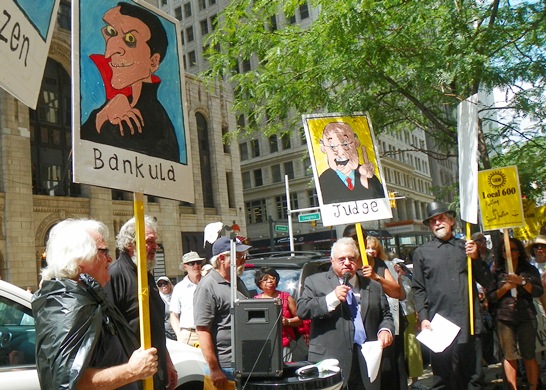
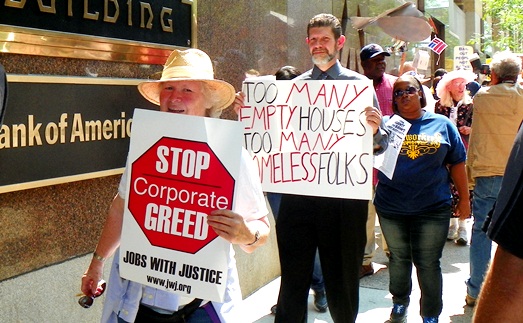
Hundreds protested outside Bank of America offices in downtown Detroit Aug. 19, 2013.. Protest included street theater: here "Judge" Jerome Goldberg convicts "Bankula" of crimes, sentences him to 150 years in prison.
Hundreds protested outside Bank of America offices in downtown Detroit Aug. 19, 2013.. Protest included street theater: here “Judge” Jerome Goldberg convicts “Bankula” of crimes, sentences him to 150 years in prison.


DETROIT – Eye-opening objections filed in the City of Detroit’s bankruptcy case Aug. 16 allege that Detroit creditors UBS AG, SBS Financial Services, and Bank of America may have been guilty of criminal activity related to the $1.5 Pension Obligation Certificates (POC) loans to the city in 2005 and 2006, and related interest swaps.

They also say those banks are continuing to rob the city through a “Forbearance Agreement” reached July 15, 2013, which is subject to approval by U.S. Bankruptcy Judge Steven Rhodes. Detroit Emergency Manager Kevyn Orr earlier boasted that this agreement will release the city’s casino tax revenue of $11 million a year, held as collateral to pay off the POC debt.

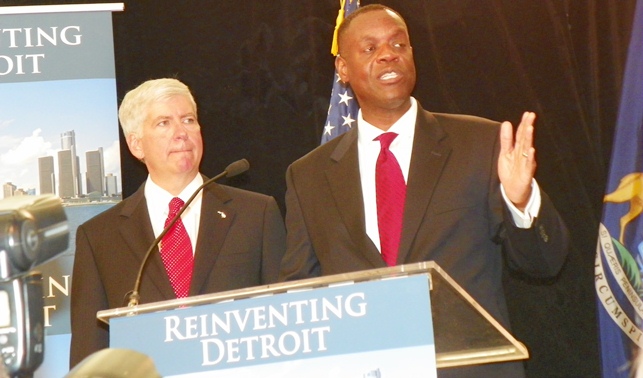
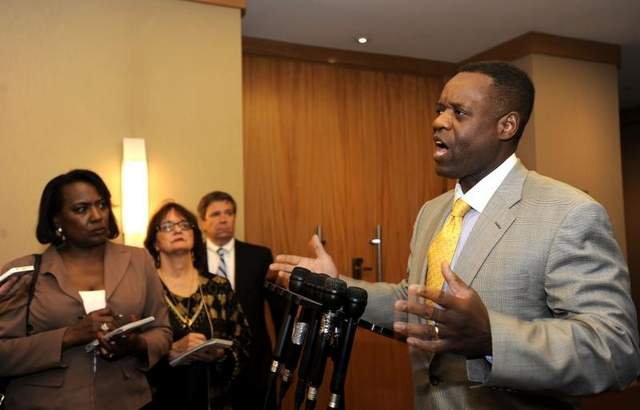
Gov. Rick Snyder, EM Kevyn Orr at press conference re: bankruptcy July 19, 2013.

“Detroit has been working its way to a level of insolvency for decades,” Detroit Emergency Manager Kevyn Orr said while announcing the bankruptcy filing July 18. “Part of the reason we’re here is that in 2005 and 2006, Detroit borrowed $1.5 billion to provide a solution for pension obligations, then hedged those with swap agreements for which we paid hundreds of millions.

We went into default on those agreements in 2009 so we doubled down and pledged the city’s casino revenues to support the agreements. For some time, Detroit has simply not been on a sustainable footing.”

Orr claims that debt is part of an outstanding $3 billion the city owes its pension systems, although they are not a party to the transactions involved and objected strenuously to the issuance of the POC bonds. Then City Councilwoman Sharon McPhail termed POC’s “one of the seven deadly sins of municipal finance.”


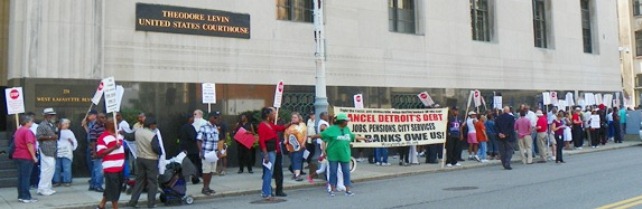
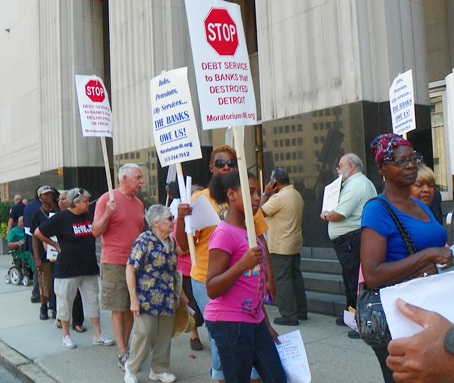
Protest outside federal courthouse against bankruptcy Aug. 19, 2013.

City retiree David Sole, the city’s pension funds, and other creditors including insurer Syncora, Inc., have filed objections to “the Forbearance Agreement,” which would allow the city to pay the banks involved 75 cents on the dollar on swaps related to the debt, in return for the “release” of $11 million a year in casino tax revenues held hostage to ensure the city’s payments on the POC debt.

A hearing on the objections is set for Tuesday, Sept. 4, 2013 in front of U.S. Bankruptcy Judge Steven Rhodes.

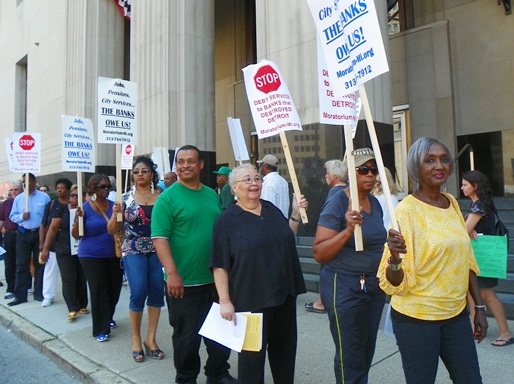
City of Detroit retirees came out in force for courthouse protest Aug. 19, 2013.

The objections by Sole and the pension fund allege that the agreement will cost the city hundreds of millions more than what the discount saves. Despite the bankruptcy’s stay on debts, the city has continued to pay UBS and its partners on the swaps, Orr earlier admitted during a press conference July 19.

“The Interest Rate Swaps on Pension Obligation Certificates entered into by the City of Detroit with UBS and SBS/Bank of America constitute a drain of hundreds of millions of dollars to the banks from the City’s budget with nothing positive for the City in return,” Attorney Jerome Goldberg writes in the Sole objection.

“Basically, the Interest Rate Swaps obligate the City of Detroit to pay UBS and Bank of America 6.323% interest on $800 million in bonds, when the actual rate on the bonds is only 0.6056%. The banks, who on information and belief presented this ‘deal’ as a beneficial one for the City, pocket the difference between the interest paid to them and the actual interest rate on the bonds, as clear profit, amounting to at least $45.1 million according to Emergency Manager Kevyn Orr’s May 12, 2013 Financial and Operating Report.”

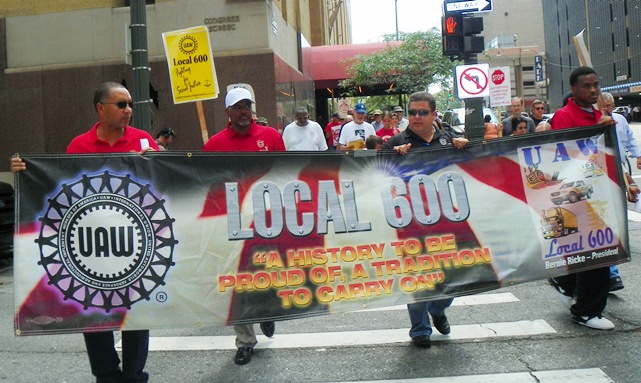
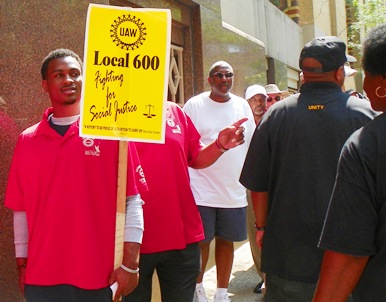
Numerous UAW members were part of protest at Bank of America Aug. 19, 2013.

The objection notes that UBS and Bank of America have both been charged with fraudulent practices related to municipal bonds, and are implicated in the global LIBOR and ISDAfix scandals. The two banks and many others allegedly rigged interest rates set by LIBOR (the London Interbank-Offered Rate panel) to benefit themselves and their clients. They have also been charged with rigging the ISDAfix, which affects calculations of termination fees associated with interest rate swaps.

Three UBS municipal bond executives were recently sent to prison, along with two others in LIBOR-related activities. A former Bank of America executive has also been indicated for municipal bond fraud.

UBS. Bank of America, others devastated Detroit with foreclosures, said protesters outside BOA Aug. 19, 2013.

“In addition, both Bank of America and UBS, as documented in countless lawsuits and consent judgments with the federal government and state governments including Michigan, and UBS were major subprime lenders and participants in the illicit mortgage activity that precipitated a virtual financial collapse in 2008, and that especially implicated cities with large African-American populations like Detroit,” Goldberg writes.

“The financial crisis that precipitated this Chapter 9 bankruptcy filing was in large part a result of the effects of predatory lending by the banks against the residents of Detroit, which resulted in tens of thousands of foreclosures in the city, a massive population decline and a precipitous decline in property values.”

All ages turned out for bankruptcy protest at courthouse Aug. 19, 2013.

The objection attaches a copy of a lawsuit filed by the Detroit Police and Fire Retirement System against financial institutions including UBS, “for losses suffered as a result of being sold allegedly fraudulent mortgage securities.”

Both Sole and the city’s pension funds, represented by Attorneys Robert Gordon and Shannon Deeby of Clark Hill, allege that the Forbearance Agreement includes no information necessary to assess its alleged benefits to the City.


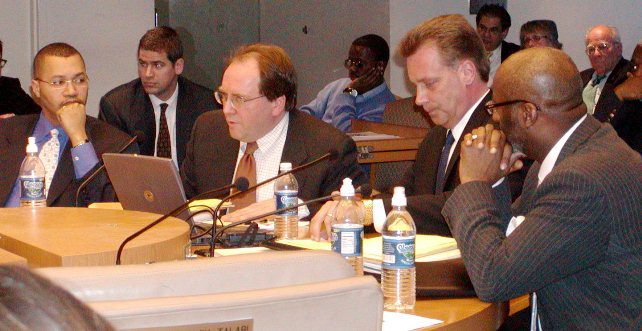
(L to r) Detroit CFO Sean Werdlow, SBS rep Bill Doherty, Joe O'Keefe of Fitch Ratings, Stephen Murphy of Standard and Poors, and Deputy Mayor Anthony Adams press for $1.5 POC loan at City Council table Jan. 31, 2005. Photo by Diane Bukowski
(L to r) Detroit CFO Sean Werdlow, SBS rep Bill Doherty, Joe O’Keefe of Fitch Ratings, Stephen Murphy of Standard and Poors, and Deputy Mayor Anthony Adams press for $1.5 POC loan from UBS, SBS at City Council table Jan. 31, 2005./Photo by Diane Bukowski

“. . .the Assumption Motion is devoid of material information necessary to assess the benefits of the Forbearance Agreement,” write Gordon and Deeby.

They say the motion fails to explain “(i) whether a valid termination event exists . . . .that necessitates the Forbearance Agreement in the first instance; (ii) whether the Swap Counterparties’ asserted prepetition liens validly extend to Casino Revenue generated postpetition; (iii) what claims, obscurely alluded to in paragraph 47 of the Assumption Motion, may exist to challenge the validity of the Swap

Contracts and liens, which claims are being waived; and (iv) by what means the City intends to obtain funds likely in excess of $200 million in the next roughly 2-6 months to effectuate an Optional Termination.”

"Summer of Solidarity," which is visting 13 cities across the U.S. to combine forces, participated in Bank of America protest Aug. 19, 2013.
“Summer of Solidarity,” which is visting 13 cities across the U.S. to combine forces, participated in Bank of America protest Aug. 19, 2013.

Paragraph 47 of the city’s proposed Forbearance Agreement says in part, “Further, while the City has examined whether there are viable actions to challenge the Swap Contracts or the City’s pledge of the Casino Revenue to secure its obligations to the Swap Counterparties, litigation would be protracted, expensive and, in terms of success, uncertain. The Swap Contracts and related documents are exceedingly complex, as is any determination of the amounts owing and the rights of the parties thereunder. While certain creditors have informed the City of their views on these arrangements, regardless of the merits of these positions, the issues are extremely complicated and, accordingly, subject to a high degree of uncertainty.”

An obscure sentence in Orr’s “Proposal to Creditors,” issued June 14, 2013 during a meeting at the Detroit-Wayne County Airport, also says, ‘The City has identified certain issues related to the validity and/or enforceability of the COPS that may warrant further investigation.”

VOD editor Diane Bukowski (second from left) questioned Orr after he presented Proposal to Creditors at airport June 14, 2013. WWJ's Vickie Thomas is at left.
VOD editor Diane Bukowski (second from left) questioned Orr after he presented Proposal to Creditors at airport June 14, 2013. WWJ’s Vickie Thomas is at left.

Asked by VOD during a press conference after the meeting whether he would investigate criminal actions by the banks related to the POC’s, Orr said he would instead investigate the pension funds.

The next week, he announced such an investigation.

“Party of Interest Sole believes that if the City of Detroit’s Emergency Manager exercised his statutory mandate under PA 436, Section 16, to conduct a criminal investigation of activities of the swap counterparties . . .the City of Detroit may have been in a much better position to negotiate with the banks to resolve the interest rate swaps which have cost the City tens of millions of dollars in desperately needed revenues and which will cost the City hundreds of millions more, even under the forbearance agreement which the City seeks to implement,” writes Goldberg.

UAW worker in protest outside Bank of America Aug. 19, 2013.

He suggests that Orr should invite the Securities and Exchange Commission (SEC) to investigate the City’s bonds with UBS and Bank of America, noting that UBS already entered into an SEC judgment “relative to illicit activity involving the City of Detroit Water Department bonds.”

“Emergency Manager Orr could also invite the SEC to intervene in this bankruptcy proceeding pursuant to Section 1109(a) of the Bankruptcy Code which is incorporated into Section 901. The SEC could bring the expertise and information gained by their extensive examination of illicit activity in the municipal bond markets into this Chapter 9 proceeding. Interested Party Sole and several other City of Detroit retirees have taken the initiative to enlist the support of United States Senator Carl Levin in prompting SEC involvement in this case,” writes Attorney Goldberg.

Attached to the motion is a letter sent by retirees to Levin, who headed a Senate Judiciary Panel in 2009 which reported massive fraudulent activity by the global banks, resulting in the economic collapse of 2008.

Syncora, Inc., which insured payment of the swaps, has also objected to the motion, claiming it was a party to the swap agreements but was not involved in negotiating the Forbearance Agreement. Syncora may have reached a settlement on its objections, according to news reports.

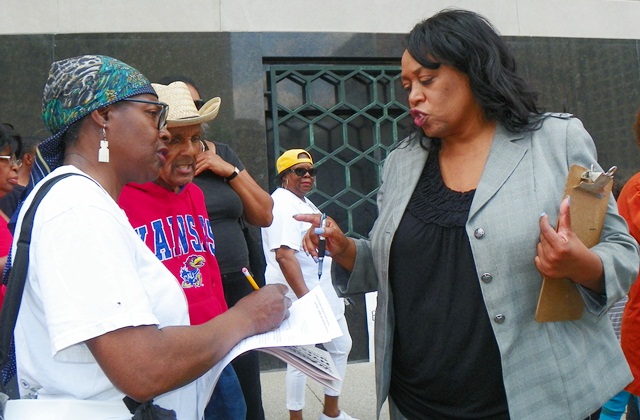
Former Detroit Corporation Counsel and mayoral candidate Krystal Crittendon distributed objections to bankruptcy for protesters to submit Aug. 19. The objections insist that lawsuits against constitutionality of the Emergency Manager law, PA 436, be heard prior to continue of bankruptcy proceedings.

Related documents:
Objection to forebearance DSole JG (exhibits follow below)
FA exhibit 1 Affidavit of David Sole
FA exhibit 2 to 4 UBS article; Senate report on bank crisis; PDD report on foreclosures
FA exhibit 5 DPFRS lawsuit re UBS
FA exhibit C POC debt docs
FA exhibit G LIBOR rate calculations; articles on UBS, LIBOR ISDAfix
FA exhibit L Articles on UBS, BOA executive jailings; SEC judgment against UBS in DWSD bonds
PFRS – City of Detroit – Objection to Forbearance Agreement – FILED (Pension funds objection)
Bankruptcy objection letter 2 (This is blank bankruptcy objection letter distributed by Krystal Crittendon Aug. 19. She advised that individuals should still file after eligibility objection cut-off date of Aug. 19 because letter alleges not enough time was allowed to file objections. According to Attorney John Philo, the judge in the Stockton bankruptcy case allowed nine months.)


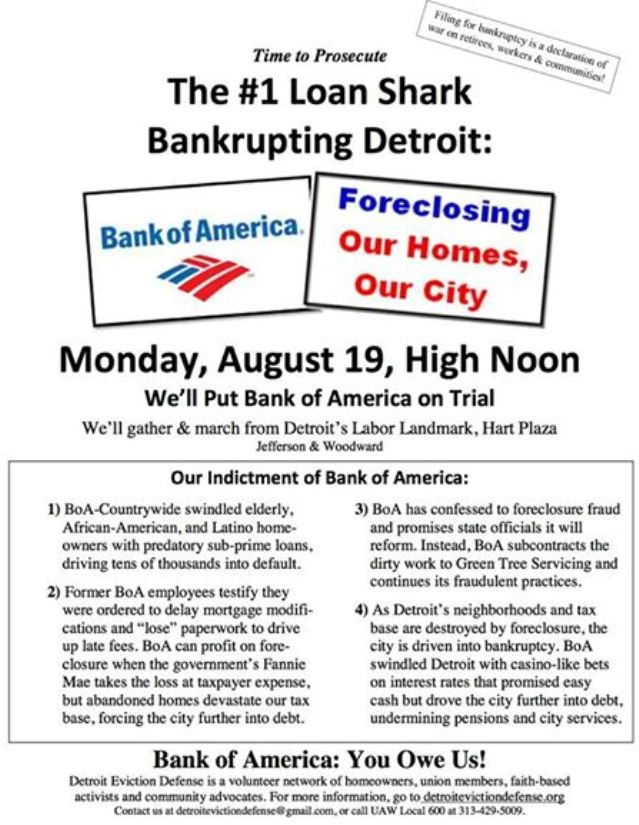
BOA indictment

Story is also forthcoming on Detroiters Resisting Emergency Management Forum held Aug 17, 2012. Above is a video showing a snippet of the conference: the people’s fighter Monica Lewis-Patrick speaking.
ONNAMOVE DETROITERS!

FOR MORE INFORMATION, CONTACT THE STOP THE THEFT OF OUR PENSIONS COMMITTEE (STOP) AT 313-680-5508; Moratorium Now at www.moratorium-mi.org; Detroiters Resisting Emergency Management at (313) 782-DREM (3736); Detroit Eviction Defense at http://www.detroitevictiondefense.com/, and numerous other groups.

- See more at: http://voiceofdetroit.net/2013/08/20/detroit-bankruptcy-objections-raise-possible-bank-crimes-related-to-poc-debt-and-casino-tax-deal-hundreds-protest-banks-in-downtown-detroit/#sthash.6xSXlAOX.dpuf

Monday, July 22, 2013

Detroit: Let's not excuse Predatory Gambling!


What portion of Detroit's problem were created by Predatory Gambling
sucking discretionary income from the local economy, increasing crime,
impoverishing neighborhoods?
Bernie Sanders added a new photo.

Sunday, July 21, 2013

Governments should get out of gambling


Governments should get out of gambling


http://www.ottawacitizen.com/opinion/columnists/Governments+should+gambling/8682371/story.html


Detroit: Bankrupting a City


Massachusetts ‘GAMING’ Future

Between the failing American auto industry, the ruthless mortgage bankers, the economy going south, and the introduction of casinos is it any wonder that the city of Detroit is broke.

The MGM Grand casino opened on July 29, 1999, Motor City Casino opened on December 19, 1999, and Greektown casino opened on November 10, 2000. These three casinos revenues totaled $1.4 billion in 2012. Let’s say, conservatively, that in the last 12 years these three casinos took in $10 billion in revenue. How much of that money LOST in the casinos do you think came from the citizens of Detroit?
...
Now I'm no rocket scientist, but with all the economic ill-effects that Detroit been facing, and then you take this kind of money out of its economy, I’m surprise they didn't bankrupt sooner.

CBS News - July 19, 2013 - Detroit's bankruptcy follows decades of decay

Read more: http://detroit.cbslocal.com/2013/07/19/detroits-bankruptcy-follows-decades-of-decay/
See More