Meetings & Information


*****************************
****************************************************
MUST READ:
GET THE FACTS!


Showing posts with label Kathleen Norbut. Show all posts

Thursday, April 10, 2014

Lets get our grassroots message out!

Please join with other acivists to protect ALL Massachusetts Communities!


Published on Apr 10, 2014
Citizen volunteers oppose casinos based on impacts and negative long-term economic drain of host regions. November 2014 ballot question to Repeal Casinos in Mass. www.repealthecasinodeal.org


Repeal Special Interest-Political Casinos in Mass


Published on Apr 10, 2014
PILOT - and we're not talking airplanes!
PILOT - Payment in Lieu of Taxes is a special tax classification for essential services like water, sewer, utilities and non-profit organizations such as faith-based groups. Multi-billion dollar casino monopolies want special tax breaks not allowed for regular businesses. We say casiNO way! www.repealthecasinodeal.org


Please support our efforts by donating what you can!


Friday, February 21, 2014

Massachusetts Gambling Commission: Out of Control!

There is simply no excuse for the excesses by the Massachusetts Gambling Commission nor its staffers!

Put a bunch of political hacks in charge of the $$$ and they run amok!


Dear sirs and madams,

I am appalled. Please see the BBJ article linked below.
Is this acceptable to you?  
 
How can legislators, Governor Patrick and candidates for office refuse to address these egregious abuses of the public trust? 
 
Every superfluous dime spent on and by the MGC is funding that is not going to support taxpayers and off-set the costs of the predatory gambling industry.
 
People, infrastructure, institutions are suffering and failing.  
 
These behaviors, excesses and wrong-headed government sponsored actions are inexcusable.
 
Some of you are directly responsible for setting this in motion and culpable for not intervening on the fiscal arrogance being demonstrated by the Mass Gaming Commission.

What will you do to stop this flagrant practice of expenditures that has no ethical or moral standing to be part of our government?

This is wrong. 
 
Kathleen


BBJ preview: How the Mass. Gaming Commission plays by its own rules


Managing Editor, Online & Research- Boston Business Journal
Email | Twitter

Airfare: According to gaming commission reimbursement and credit-card reports, the agency's staffers spent approximately $85,000 on flights in the U.S. and to destinations abroad between May 2012 and Jan. 1, 2014. In one example, a commission staffer took a one-way flight from Hong Kong to Boston priced at $7,257.


The Massachusetts Gaming Commission has left no stone unturned in its rigorous, years-long effort to hand pick the list of casino operators who will ultimately operate in the Bay State. Nor have the commission and its politically connected staffers spared many expenses while traveling near and far.

Tomorrow’s Boston Business Journal provides an in-depth analysis of credit card statements and reimbursement reports highlighting repeated instances of lavish employee spending since the commission’s inception two years ago. The expenditures, which have been criticized by a state watchdog and at least one casino-license applicant, include dozens of charges at luxury hotels and top-rated restaurants in major cities throughout the world.

And unlike other state agencies, the gaming commission has operated without formal guidelines on the amounts and types of personal spending and travel permitted among its employees.

Members of the gaming commission have defended the agency’s spending as necessary and proper.


In doing so, they emphasized the commission’s daunting mission and tight timeline to establish a new multibillion-dollar industry for the state. Those same officials also reiterated that a considerable amount of the MGC’s costs, some $15 million to date, have been reimbursed by casino operators.

Nonetheless, examples of the commission’s extreme spending are many; the accompanying slide show offers a summary of some of the the commission's documented spending to date.

The BBJ's full coverage of the gaming commission and its spending records will be available online and in print Friday, Feb. 21.


http://www.bizjournals.com/boston/blog/bottom_line/2014/02/bbj-preview-gaming-commissions.html?utm_source=ML+14%2F2%2F21&utm_campaign=20140221ML&utm_medium=email


Sunday, December 15, 2013

Regressive Tax Policies Defended By Beacon Hill

The more voters learn about Predatory Gambling, the more they oppose it.
In Massachusetts, communities are educating themselves and opposing the destruction of their neighborhoods.

Beacon Hill refused to consider the evidence around the nation and around the globe of increased crime, increased personal bankruptcies, increased domestic violence caused by Gambling Addiction.

The COSTS exceed the BENEFITS!

It's time to REPEAL THE CASINO DEAL!


Published on Dec 23, 2012
Politicians say that casinos create economic development. Here is the Revel Casino in Atlantic City, NJ. (Most media photos are from the interior of the casino looking out onto the beach and ocean.)


Published on Aug 9, 2012
Please click LIKE/SHARE. Venerable news anchorman Walter Cronkite hosts this in-depth look at the pervasiveness and effects of government's policy of promoting gambling on American culture. Broadcast in 1994 just as government began a massive expansion of gambling across the U.S, Cronkite explores questions like, is the lure of "easy money" replacing a strong work ethic in the attitudes of American youth, and is the funding of state and federal government through the proceeds of legal gambling a proper way of conducting government? Cronkite details the history of legalized gambling in America in an attempt to draw some conclusions about the impact gambling has had on the economic, moral, and social fabric of American society. The program features interviews with people from the average man on the street, to members of congress, to noted religious leaders.
****************************************­***************************************

Massachusetts faces $400 million fiscal hit if voters repeal casinos, automatic gas tax hikes


gas3.jpg
Outside the Statehouse in Boston in early October, Republican Rep. Geoffrey Diehl stood in the foreground, while Holly Robichaud, a Republican consultant, left, and Justin Thompson, a legislative aide, right, held a sign for repealing a law that automatically increases the gas tax to match inflation. A key lawmaker said that if voters approve the repeal, it would strip about $12 million a year that would be used on transportation improvements. (Dan Ring/The Republican)
 
Dan Ring, The Republican By Dan Ring, The Republicanmasslive.com
Follow on Twitter
on December 15, 2013


BOSTON -- State government will have less money for local aid, transportation and other services if voters approve planned ballot questions next year to kill casinos and annual increases in the gas tax, legislators said.

Organizers have each submitted more than enough certified voter signatures to place seven statewide questions on the ballot in November of next year including measures to repeal laws that legalize casinos and that automatically hike the gas tax to account for inflation.

Sen. Stanley C. Rosenberg, an Amherst Democrat, estimated that state government would face budget cuts if voters repeal the 2011 law that allows up to three casino resorts and a single slots facility.

stan.JPGStanley Rosenberg
 
Rosenberg said transportation funding would be hurt if voters revoke the law to increase the gas tax in accord with inflation starting in 2015.

The casinos and slots facility together could eventually generate $2 billion in gross gaming revenues each year. With a 25 percent tax rate on two commercial casino resorts, a 17 percent tax on a proposed Mashpee Wampanoag casino in Taunton, and 40 percent tax on the slots parlor, the state might eventually raise $300 million to $500 million a year, according to Rosenberg.

"If that money disappears, then there will be cuts," said Rosenberg, a key author of the casino law.
Rosenberg, the Senate majority leader, said about half the new casino revenues would be local aid for cities and towns and a sizable portion of the rest would go to transportation.

Rosenberg said he would personally vote against the ballot questions but he never tells people how to vote on ballot questions.

norbut.JPGKathleen Norbut

Kathleen Norbut of Monson, an original signer of the petition to revoke the casino law, said the state coffers will never see $400 million a year from casinos. She said casinos will be hurt by expansion of online gambling and declining interest from the public.

She also said legislators are failing to account for the social and other costs of casinos. Mitigation money does not cover the damage caused by casinos, she said.

"Let's get an independent cost-benefit analysis," she said. "You talk about the revenues. What about the costs?"

Norbut is a leading member of Repeal the Casino Deal, a coalition that collected about 73,000 certified voter signatures to make the ballot.

In order to make the ballot, the group may also need to persuade the state Supreme Judicial Court to overturn the attorney general's decision to ban the casino repeal question.

Beacon Hill is also worried about losing expected transportation dollars if voters approve a Republican-backed question to rescind the automatic increases in the state's 26.5 cent-a-gallon gas tax. The annual increases would begin in January of 2015.

Democratic Gov. Deval L. Patrick told reporters that the proposed ballot question is a mistake.

"Everywhere around the commonwealth people understand that we have got to invest in our transportation system in order to sustain and indeed accelerate growth," Patrick said. "While it was not my first choice, the Legislature ... selected the gas tax and a way not to have to come back to it every 15 minutes. And it hasn't been updated in many, many years. So I think the indexing is wise. I think it is fair and I think it was done in the right way ..."

Steven Aylward of Watertown, chairman of the Committee to Tank the Automatic Gas Tax Hikes, said history shows that legislators often divert tax dollars that are intended for a program such as transportation.

Aylward, a member of the Republican State Committee, said repeal of the law would put money where it belongs -- in the pockets of consumers.

Aylward said the "real issue" is that legislators should vote each year if they need revenues and want to raise the gas tax.

The provision for automatic increases is in a transportation financing law that raised the gas tax by three cents, starting July 31. The repeal effort received about 77,000 certified signatures.

Sen. Stephen M. Brewer, a Barre Democrat and chairman of the Senate Ways and Means Committee, said the provision would raise about $10 to $12 million a year.

Brewer said legislators should support the wishes of voters if they vote to repeal the law to index the gas tax to inflation.

Another ballot question with fiscal implications for state government is a proposed expansion of the state's 5 cent bottle deposit law to include additional containers such as water, flavored water, coffee-based drinks, juices and sports drinks.

The governor proposed a similar expansion, partly because he said it would generate about $25 million a year for the state including $5 million for recycling initiatives. The state receives money from unclaimed bottle and can deposits.

Christopher P. Flynn, president of the Massachusetts Food Association, which includes supermarkets and grocery stores, said the state already raises about $35 million a year from distributors who pay the nickel for each unredeemed container. There's something wrong when the state financially benefits from a law that fails because people don't return containers, he said.

"This is nothing more than a money grab," he said.

Janet Domenitz, executive director of the Massachusetts Public Interest Group, said advocates turned in about 106,000 certified signatures for the ballot question to expand the bottle deposit law.

If the law is approved, it would save about $6 million statewide for cities and towns, she said. The law would save on costs for litter and trash pickup, because it would increase redemptions, and therefore recycling, she said.

She said she is not using the argument that state government would get a boost from money from unclaimed deposits.

"I'm for this if 100 percent of nickels are redeemed," she said. "That's our goal."

Flynn said cities and towns would lose $15 million in annual payments for aluminum if the ballot question was approved. He said communities or their contractors are paid for the value of aluminum that is recycled.

Flynn said approval of the ballot question would require Massachusetts’ consumers and businesses to spend $58 million annually to operate an expanded redemption program.

Flynn said an expansion of the deposit law would be "counter productive." He said it costs three times as much to recycle bottles and cans by redemption than it does to recycle them by dropping them at municipal stations or by leaving them at the curbside for pickup.

"Folks are going to see through this," Flynn said of the proposed expansion of the bottle deposit law.

The secretary of state's office said backers of four other proposed statewide questions also collected more than the required 68,911 certified signatures to qualify for the 2014 ballot.

Two of those questions, if approved, would raise the minimum wage from $8 an hour to $10.50 an hour and would require that every worker in the state could earn up to 40 hours of sick time.

The Massachusetts Nurses Association also gathered more than enough voter signatures to put before voters two separate questions that would limit the number of patients who can be assigned to a nurse at one time and that would restrict CEO salaries and regulate the annual operating margins of hospitals.

Unless state lawmakers approve the proposed ballot questions by early May, supporters would need to gather an additional 11,485 signatures by early July to secure a spot on the ballot.


http://www.masslive.com/politics/index.ssf/2013/12/massachusetts_faces_400_millio.html#incart_river_default


Friday, July 20, 2012

The inside story of gaming agency hire


The inside story of gaming agency hire

Emails indicate no “public relations hit” was foreseen


BY: Colman M Herman

The Massachusetts Gaming Commission hired Carl Stanley McGee as its interim executive director on May 1. McGee, a Harvard Law School graduate, former Rhodes Scholar, and Gov. Deval Patrick’s point person in crafting casino legislation as assistant secretary for policy and planning, was seen as a perfect fit for the job. The only question mark was a 2007 arrest for allegedly sexually molesting a 15-year-old boy at a Florida resort.

Stephen Crosby is the Chairman of the state Gaming Commission.
Internal commission emails indicate officials believed any “public relations hit” from the 2007 arrest would be minimal because they believed McGee, who was never prosecuted and later resumed his job in the Patrick administration, had been accused of a crime he did not commit.

“Based on all I know, this can be managed, and . . . the risk to the agency is small relative to the benefit of hiring such a perfectly suited person for this slot," wrote the commission’s outside public relations consultant, Karen Schwartzman, in an email to the commissioners on April 30.

Schwartzman added, "Bottom line: I believe that the media will mention [McGee's Florida] history, but I also believe that I can appeal to their sense of fairness in making clear that Stan has already been though the ringer for a crime he didn't commit and that it would be grossly unfair to put him through it again. I think it likely that the media will feel that they have to mention this, but I think it will be no more than a paragraph deep into an otherwise extremely favorable story about Stan and what it is that makes him a quality candidate for this job."

Commissioner James McHugh, a retired appeals court judge, emailed Schwartzman, who was being paid $150 an hour by the commission, to ask whether McGee had entered into a civil settlement of any kind with the boy’s family.

“Stan did indicate to me that there was indeed a settlement, though he didn’t say, and I didn’t ask, how much money was paid,” Schwartzman responded. “He did say it was not a big number, but that it made him sick to pay anything at all. He said that he was advised by counsel that it was in his interest to make a settlement so as to end the nightmare as expeditiously as possible.”

In a recent interview, Schwartzman conceded that her advice to the commission was misguided because she did not have complete information. “I relied on what the governor's office told us about the sexual allegations against Stan. They said they did their own review and let Stan come back to his state job after the charges were dropped,” she said. “A lot of new information came out later in the press that I was not aware of. If I knew all these things before, I likely would have done things differently.”

About 400 pages of internal emails involving McGee’s hiring were unearthed through a request under the state’s Public Records Law. Another 15 pages of documents were withheld in their entirety, with the commission claiming numerous exemptions from the law as well as attorney-client privilege.

Taken together, the documents provide a behind-the-scenes look at how a reliance on incomplete information can embroil an agency in a vortex of controversy.

In an April 23 email, Gaming Commission Chairman Stephen Crosby asked Sydney Asbury, Patrick’s deputy chief of staff, whether the governor’s office would have any objection to the commission hiring McGee as an interim executive director.

Asbury raised no red flags, other than a concern that McGee might be too closely tied to the governor. “I don’t have any immediate concerns with Stan’s candidacy,” Asbury said in her email response.

A day after McGee’s hiring by the commission at the same $121,000 salary he was making as assistant secretary for policy and planning, the Boston Globe began preparing a story on him that focused on the incident in Florida. When the Globe contacted the commission for comment, Schwartzman responded: “For what it's worth and off the record, I think the Globe's decision to report the family's point of view or Wendy Murphy's [the family’s lawyer] view -- in the face of the facts which boil down to the lead prosecutor in [Florida] investigating thoroughly and finding no basis to bring charges -- is both irresponsible journalism and grossly unfair to Stan McGee."

But the Globe story, under the headline "Sex assault case haunts gambling director," revealed information Schwartzman had not been aware of. The article reported that the boy’s parents had complained to the Florida governor’s office about the state attorney dropping the case. That complaint prompted a review of the situation by the Florida Department of Law Enforcement, which recommended that the state attorney reconsider.

“I have been in law enforcement for over 34 years and investigated crimes against children exclusively for the past 25 years,” Inspector Terry Thomas of the state’s Crimes Against Children Unit wrote, according to the Globe. “And I have seen cases successfully prosecuted with less evidence than this case appears to have.”

Thomas recommended, according to the Globe, that the state attorney reconsider the prosecution of McGee for sexual battery and add in the offense of lewd and lascivious behavior. The state attorney declined.

Kathleen Norbut, the former president of United to Stop Slots in Massachusetts, complained in a May 3 email to Crosby about the hiring of McGee. “McGee? PR nightmare,” she wrote to him. “ I’ll be blunt. The GC did not get that one right. . . . I don’t think that this will be brushed aside.”

Crosby disagreed. In a response to Norbut, he wrote: “What we know is that the state attorney in Florida concluded that there was no corroborating evidence to the allegation to bring a charge. End of story. . . . We are lucky to have him.” A May 4 story in the Cape Cod Times reported that Crosby referred several times to McGee as a “superstar,” adding that the allegations against him were “wholly unsubstantiated” and have “zero substance."

On May 6, Schwartzman learned from a Globe article that, according to unnamed officials familiar with McGee’s employment history, the Patrick administration never conducted its own internal investigation of the Florida charges and instead relied on the findings of the Florida prosecutor. The Globe report was subsequently confirmed by the Patrick administration.

When Republican Rep. Daniel Winslow said he planned to hire a private investigator to investigate the Florida incident, McGee decided to call it quits. On May 9 – just eight days after he was hired as the gambling commission’s interim executive director and after only three days on the job – McGee abruptly quit.

Two days later, Patrick said he would welcome McGee back to his administration. “He is a very, very strong, very able, high-contributing member of our team, and I hope he will come back,” the Cape Cod Times quoted Patrick as saying.

But despite having Patrick’s public support, McGee never returned. After taking a leave of absence, he resigned from the Patrick administration in June.

http://www.commonwealthmagazine.org/News-and-Features/Online-exclusives/2012/Summer/003-The-inside-story-of-McGees-hiring.aspx

Tuesday, January 10, 2012

Crowd turns out for Milford casino discussion

A reminder --

Crowd turns out for Milford casino discussion
By Kendall Hatch/Daily News staff
GateHouse News Service

ASHLAND — About 75 people squeezed into the Ashland Library last night to talk about the effects a resort-style casino would have in the area.

Moderator and Framingham Selectman Dennis Giombetti said the forum was not a discussion of the merits of gambling, but rather an attempt to start the process of alerting state legislators to the concerns of local officials and residents before they start a debate on expanded gambling.

With Milford officials already beginning to lay groundwork for the proposed Crossroads Resort casino, local town officials are hoping to make their concerns known early on.

On Tuesday, the Milford Planning Board began preliminary talks on creating a zoning district in town that could accommodate the resort.

State Sen. Karen Spilka, D-Ashland, chairwoman of the Committee on Economic Development and Emerging Technologies, told the crowd of local town officials, state legislators, representatives from area planning committees and members of the public that legislators would be receptive to the needs of surrounding communities.

"I think this is a very complex and difficult issue and I do want to at least assure you that I want to be a partner with all of you - hearing what you have to say and hearing what your thoughts are," she said. "Collaboration, cooperation and coordination are the keys to almost everything we do."

She said she believes the House of Representatives is currently working on a gambling bill that will most likely come out in February or March.

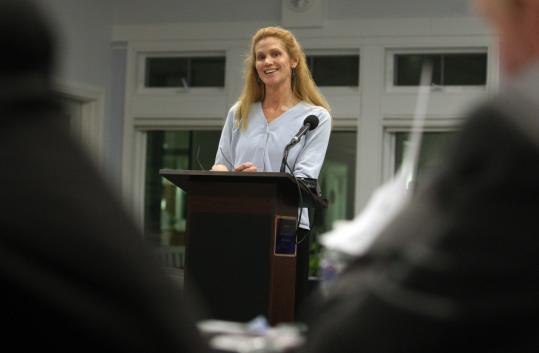
The forum panelists - Edward Harrison, chairman of the Western Massachusetts Casino Task Force, and Kathleen Conley Norbut, president of United to Stop Slots in Massachusetts, urged local officials to start on the municipal level and figure out what effects would be seen in their towns.

Harrison, a former Monson selectman, and Norbut, a current Monson selectman, have been researching the effects of casinos for a few years, since Mohegan Sun was looking at a potential location in Palmer, Mass.

"We really need to be driving this from the local level up versus what has happened in so many other states," said Norbut. "It's a matter of somebody taking the lead or a community taking the lead."

Harrison presented a list of 23 recommendations the task force sent to legislators last summer.

The list included:

Urging lawmakers to perform a comprehensive cost-benefit analysis of slot parlors and resort-style casinos


Establishing regional trust funds so towns surrounding the host town would receive financial assistance if a casino put strains on their public safety, public works, or other departments
Appointing local representatives to any gaming commissions or oversight committees.

The forum, organized by the MetroWest Growth Management Committee at the request of the Ashland selectmen and town manager, was also sponsored by the Metropolitan Area Planning Council, the Southwest Advisory Planning Committee and the 495/MetroWest Partnership.

Harrison encouraged local officials to use the task force's list of recommendations as a template and see how the items on the list, such as education, zoning, infrastructure and housing, would be affected in their towns.

"I think the categories we have identified are pretty universal to every region but I think it matters how you weigh them," he said, adding that officials should get to work as soon as possible.

"We only have one bite at the apple. When the legislation passes - if it passes - that's it," he said. "Partner with your local planning commissions, develop a list of concerns and share those recommendations."

Thursday, September 29, 2011

Top Robert DeLeo aide called casinos ‘fool’s gold’

Top Robert DeLeo aide called casinos ‘fool’s gold’
By Hillary Chabot And Chris Cassidy

A top staffer to House Speaker Robert DeLeo once warned that Bay State casino revenue would amount to “fool’s gold” that would cannibalize a successful state Lottery and would be an economic wash in which the commonwealth would “scarcely break even,” in a set of memos being circulated by critics of expanded gaming.

“It’s a great example of how, depending on who the speaker is, employees develop research that supports (the speaker’s) point of view,” said Tom Larkin, president of United to Stop Slots in Massachusetts.

James C. Kennedy — now DeLeo’s general counsel — blasted casino gambling in two memos while working for then-state Rep. Daniel Bosley, a high-ranking casino critic.

In the 21-page memo, which was written in 2004, Kennedy wrote: “In conclusion, the reemergence of the issue of expanded gambling can only be described as an unscrupulous move by the gaming industry toward exploiting our present fiscal vulnerability with the promise of ‘fool’s gold.’ ”

Despite the influx of gambling revenue, “we will, with a bit of luck, scarcely break even,” Kennedy wrote.

Another memo in 2006 claimed casino gambling would cripple the state Lottery in a chapter called “Killing the Goose that Lays the Golden Egg” and goes on to run counter to DeLeo’s assertion that casinos will boost the state economy.

“The reality is that expanded gambling does not lead to economic development and any tax revenue generated by expanded gambling is regressive and unstable,” wrote Kennedy.

A spokesman for DeLeo’s office did not return requests for comment.

“When we look at the turnstile in Massachusetts politics, including the number of rank and file legislators that have flip-flopped on this issue, it’s clear that it’s more than a trend, it is a toxic pattern of behavior on Beacon Hill, and that’s why citizens are disgusted,” said Kathleen Conley Norbut, a member of the anti-expanded gaming group Citizens for a Stronger Massachusetts.

Casino critics have dusted off and recirculated the memos in the weeks leading up to the debate in the state Senate, which wrapped up for a second day yesterday.

“I would just say that I think it’s important for all legislators to take a look at those memos,” said state Sen. Jamie Eldridge. “They’re still relevant today.”

Friday, August 26, 2011

Kathleen Norbut on MA casino proposal

Kathleen Norbut on MA casino proposal


(NECN) – If you like fast tracks, you’ll love watching the latest action on Beacon Hill.

On Tuesday, a House Committee caught everyone by surprise by reporting out a bill that would establish three resort casinos and one slots facility in Massachusetts.

And sometime Friday, just three days later, house leaders expect the bill to be approved for debate after Labor Day.

If all goes according to plan, it will be sent to Governor Deval Patrick for signing in October.

Broadside guest Kathleen Norbut, a spokesperson for United to Stop Slots in Massachusetts, hopes to put a stop to the legislative express train.

Saturday, March 20, 2010

The David-and-Goliath Story

For casino opponents, an unlikely ace in the hole
Small-town activist presses fight against industry


“If there’s a David-and-Goliath story, this is it,’’ said Kathleen Conley Norbut of Monson, an anticasino activist.


(Essdras M Suarez/Globe Staff)
By Michael Levenson


Her desk is her kitchen table. She cajoles legislators on the phone while folding laundry. At night, she works in her pajamas.

Kathleen Conley Norbut, a fast-talking 49-year-old mother, former selectwoman, and mental health counselor from Monson, has become the improbable public face of the opposition to expanded gambling, as founder of the group United to Stop Slots in Massachusetts.

From that perch, she is trying to stop a multibillion-dollar casino industry eager to break into Massachusetts, an army of well-paid lobbyists pushing the cause, and a growing number of lawmakers who believe gambling will bring much-needed jobs and economic development.

“If there’s a David-and-Goliath story, this is it, because that industry is predatory,’’ Norbut said in an interview. “They’ve got deep, deep pockets behind them. I’m small peanuts. I care about small businesses. I care about my communities.’’

Norbut is confident, though she knows what she is up against.

In the weeks ahead, as House Speaker Robert A. DeLeo readies his bill to license two casinos and slot machines at the state’s four racetracks, Norbut — who already spends 30 hours a week fighting casinos — plans to step up her campaign, with a focus on pushing for a new independent review of the costs and benefits of expanded gambling. DeLeo, Senate President Therese Murray, and Governor Deval Patrick all support casinos, though Murray and Patrick say they oppose slots.

“I’m not nervous or worried,’’ Norbut said. “I actually feel like the little people are being heard a little more, and I’m very excited about that.’’

She has made her presence felt. Since forming United to Stop Slots on the Fourth of July last year, Norbut has successfully pushed the state Democratic Party to adopt a resolution opposing slot machines, helped persuade the governor to endorse her call for a new economic analysis of gambling, and organized an anticasino rally at Faneuil Hall with former governor Michael S. Dukakis.

“She certainly has made an impact,’’ said state Representative Daniel E. Bosley, a North Adams Democrat and a leading casino opponent in the Legislature. “It’s hard to find people on both sides who aren’t reactionary. They have a moral objection to slots, or they’re very libertarian. She really has done her homework, and is really energetic.’’

In some ways, Norbut, who has not been active in prior fights over gambling, is an unlikely figure in the casino debate. She has no personal story of a family member addicted to gambling, nor moral qualms about gambling. She first got involved in the issue in 2007, she said, when the operators of Mohegan Sun Casino in Connecticut proposed building a casino in Palmer, which borders Monson, the town 30 minutes east of Springfield, where she has lived for 23 years and was serving on the Board of Selectmen. Norbut said she was concerned the casino would ruin the town’s rural character, drive up crime and addiction, and strain local services.


“I didn’t choose the cause,’’ Norbut said. “I really feel like this cause chose me to be the champion. I wasn’t looking for a hobby. I’m married. I have a 13-year-old. I have elderly parents. I have a career. It started by caring about the community.’’


As she began researching the issue, she became convinced that a casino was bad not only for Monson, but for the state because, she believes, casinos cannibalize other businesses and burden taxpayers with additional social and economic costs.

“It’s long-term economic drain,’’ Norbut said.

Supporters of expanded gaming counter that the state is missing out on thousands of jobs and millions of dollars as gamblers flock to out-of-state casinos.

The last time casinos were debated, in 2007, the group Casinofacts.org, led by residents concerned about a proposed casino in Middleborough, helped organize the opposition. Bosley, state Senator Susan C. Tucker, and then-House speaker Salvatore F. DiMasi helped galvanize opponents in the State House.

This year, prospects for a Middleborough casino have faded, Bosley and Tucker are preparing to leave the Legislature, and DiMasi, a powerful casino foe, has been replaced by DeLeo, a longtime supporter of expanded gambling whose district includes two struggling racetracks.

The changes have thrust Norbut into a newly prominent role in the ranks of the opposition, helping lead a nonpartisan, nonprofit group that includes partners such as the Massachusetts Family Institute, a socially conservative group.

In December, she and other members of the organization met with the governor for an hour. Afterward, Patrick sent a letter to DeLeo and Murray encouraging them to meet with United to Stop Slots and supporting Norbut’s call for a new economic analysis of gambling, which the state last conducted when the governor proposed licensing three casinos in 2007.

“She is a really thoughtful, energetic, smart organizer with a great head and a great heart,’’ said Patrick, who first met Norbut when she volunteered on his 2006 campaign.

She can also be polarizing. In a private briefing with lawmakers last week, Norbut hotly debated state Representative Kathi-Anne Reinstein, a Revere Democrat and ardent supporter of slot machines whose district includes Wonderland Greyhound Park.

“We’ve clashed heads, and the impression I get from her is that she’s not very fond of me,’’ Reinstein said. “I obviously disagree with a large percentage of what she says, and I feel like their side is using absolute fear tactics when it comes to this issue, and that’s not fair.’’

Norbut said it is the pro-casino crowd that has used fear to push its agenda.

“I’ve had retired police officers tell me to watch my back; I’ve had verbal threats from a top AFL-CIO official,’’ Norbut said. “Maybe it was a warning. He said, ‘If you ever run for office again, we’ll remember.’ ’’

“It’s not easy,’’ Norbut added. “I’m not a thick-skinned person.’’

Norbut, the third of six children of a Marine who fought in Iwo Jima, is tough, however. She and her husband, a carpenter, lived in a tent for six months while they cleared trees and built their home from scratch.

This fight, she says, will also require a lot of heavy lifting, but she has no intention of giving up.

“I have no issue with anyone who wants to get on a bus or a plane and go and do their thing,’’ she said, referring to gamblers traveling to casinos. “But it becomes my business when it impacts my property tax, my community, and the society that my child is going to live in.’’


Join us! At United to Stop Slots in Massachusetts. Add your name to the mailing list, sign the Petition for an Independent Cost Benefit Analysis and consider making a donation.