Meetings & Information


*****************************
****************************************************
MUST READ:
GET THE FACTS!


Showing posts with label Patchak. Show all posts

Friday, May 31, 2013

Land trust rule change may aid tribe


Mashpee tribe finds federal proposal encouraging
By Gerry Tuoti
Posted May 30, 2013


The Mashpee Wampanoag tribe says it is encouraged by a new federal proposal to change procedures for processing land-in trust applications.

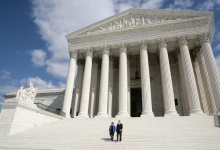
The proposed change specifically, according to the Bureau of Indian Affairs, addresses the Supreme Court’s 2012 Patchak decision. That court ruling expanded who has legal standing to challenge American Indian land decisions in court and effectively gave opponents a six-year statute of limitations to file a lawsuit.

“The principal purpose of this proposed rule is to provide greater certainty to tribes in their ability to develop lands acquired in trust for purposes such as housing, schools and economic development,” Assistant Secretary of Indian Affairs Kevin Washburn said in a statement. “For such acquisitions, the proposed rule will create a ‘speak now or forever hold your peace moment’ in the land-into-trust process.”

The Mashpee, who hope to build a tribal casino in Taunton but lack sovereign land, have a land-in-trust application pending with the BIA. The Mashpee insist they are on track to have land taken into trust and build a casino, named “Project First Light.” Many of their opponents, however, say the tribe does not meet the criteria to have its land application approved.

Washburn, who introduced the proposed changes on May 24, described the potential effects.

“If parties do not appeal the decision within the administrative appeal period, tribes will have the peace of mind to begin development without fear that the decision will be later overturned,” he said in a statement.

The rule changes would allow the federal government to take land in trust without a waiting period and place the burden on litigants to demonstrate harm, according to a BIA press release.

“We fully support the Obama administration’s plan to help tribes acquire land without the threat of delays or frivolous lawsuits,” Mashpee Wampanoag Tribal Chairman Cedric Cromwell said in a statement the tribe released Thursday.

“This change, once it is adopted, will speed up our land acquisition process and keep the development of Project First Light in Taunton on a very brisk pace so that we can create thousands of jobs for the southeastern Massachusetts region.”

The proposed rules will be available in the federal register at www.federalregister.gov/public-inspection. Public comments may be submitted to the Department of the Interior for 60 days following the proposed rule’s publication.


Read more: http://www.tauntongazette.com/news/x776198522/Mashpee-tribe-finds-federal-proposal-encouraging#ixzz2UrUbPPsf
Follow us: @enterprisenews on Twitter | EnterpriseBrockton on Facebook


Land trust rule change may aid tribe


By George Brennan
May 31, 2013

The Mashpee Wampanoag Tribe hopes a proposed rule change by the federal Bureau of Indian Affairs will speed up the process of land trust applications and limit the threat of lawsuits.

On May 24, Assistant Secretary for Indian Affairs Kevin Washburn filed the proposed change with the Federal Register, triggering a 30-day public comment period.

 
The proposal is in reaction to a U.S. Supreme Court ruling, known as the Patchak decision, which gives opponents to land decisions up to six years to file a lawsuit. Previously, the Bureau of Indian Affairs "self-stayed" its final decisions on taking land into trust to see if legal challenges would be filed.
 
The rule change requires that opponents exhaust remedies within the Department of the Interior, of which the Bureau of Indian Affairs is a part, before seeking judicial review, Washburn said in a press release.
 
"The principal purpose of this proposed rule is to provide greater certainty to tribes in their ability to develop lands acquired in trust for purposes such as housing, schools and economic development," he said. "For such acquisitions, the proposed rule will create a 'speak now or forever hold your peace moment' in the land into trust process."
 
The proposed rule clarifies that Washburn's decision on acquiring lands for Indian gaming is a final decision and allows him to take the land into trust with no waiting period. Because a simple change in ownership status itself is not an act that causes irreparable harm in many cases, it will place the burden on litigants to come forth and demonstrate such harm if they wish to prevent the trust acquisition from occurring, while not affecting the right to judicial review of the basic decision, the Bureau of Indian Affairs press release says.
 
The Mashpee tribe has applied to have 170 acres in Mashpee and 151 acres in Taunton taken into federal trust as an initial reservation. The land in Taunton would be used to build a $500 million casino.
 
Uncertainty surrounding that application prompted the Massachusetts Gaming Commission last month to open Southeastern Massachusetts to commercial casino bids, ending the tribe's exclusive rights in the region.
 
The tribe has said its application is on track to be completed by the end of this year or early in 2014, but opponents have said the hurdles are too great to overcome.
 
On Thursday, the gaming commission set a timeline to begin accepting applications for the first phase next week and set a deadline of Sept. 30 for them to be filed, spokeswoman Elaine Driscoll said. The first phase requires a $400,000 nonrefundable check, money that will be used to do criminal and financial background checks on the applicants, she said.
 
In a press release, tribal council Chairman Cedric Cromwell praised the proposed rule change, saying it would "help tribes acquire land without the threat of delays or frivolous lawsuits."
 
Public comments on the rule change can be made online at www.federalregister.gov/public-inspection.
 

Sunday, March 31, 2013

Tribes make most of Indian gambling law


Tribes make most of Indian gaming law


By George Brennan

March 31, 2013

The seeds of a $500 million casino in Taunton proposed by the Mashpee Wampanoag Tribe were planted in 1988 in the waning days of President Ronald Reagan's second term.

Reagan signed a law that allowed Indian casinos on reservation land, a direct reaction to a 1987 U.S. Supreme Court decision in California v. Cabazon that ruled states had no authority over Indian government activities, including gaming.

"The backdrop for all of this really predates the (Indian) gaming of the 1970s," Steven Light, an Indian gaming expert, said. "The true backdrop is a lot of poverty and few economic development opportunities for the rural, mostly reservation-based tribes, across the United States."

Light and Kathryn Rand are co-directors of the Institute for the Study of Tribal Gaming and Policy at the University of North Dakota and have co-authored two books on Indian gaming.

"Both Congress and the tribes were desperately looking for some means to build tribal economies," Rand said.

At the time, Indian gambling was a fledgling $100 million industry — mostly bingo halls — with little or no oversight. The 1988 law signed by Reagan, known as the Indian Gaming Regulatory Act, was considered a compromise aimed at providing federally recognized Indian tribes an opportunity for economic development and, with that, an opportunity for self-sufficiency for tribes facing serious poverty. At the same time, it provided federal oversight and an opportunity for state governments to cut a deal with tribes looking to offer gambling inside their borders.

One of the biggest misconceptions about Indian casinos is that tribal sovereignty means they are unregulated, Light said. "In fact, it is the most highly regulated form of gambling in existence in the U.S.," he said. "There is a regulatory role for the federal government, the state government and tribal governments — three levels of regulation. Commercial casinos — Trump's casino, Wynn's casino — are not regulated by three levels of government."

Few could have predicted that passage of the Indian Gaming Regulatory Act would make tribes synonymous with casinos. The new law opened the floodgates and paved the way for behemoths like Foxwoods Resort Casino and Mohegan Sun in Connecticut.

Today, Indian gaming is a $27.4 billion industry with 242 tribes operating casinos in 28 states as of 2011, according to the Indian Gaming Industry Report, an annual research report conducted by economist Alan Meister of Nathan Associates Inc. and published by Casino City Press.

"I think it's pretty clear now that Congress had no idea the Pandora's box it was opening when it created this law," said Robert Steele, a former congressman from Connecticut and author of "The Curse: Big Time Gambling's Seduction of a Small New England Town." The 2012 novel is based on Connecticut's experience with the Mashantucket Pequot tribe, which opened Foxwoods in Ledyard, Conn., in 1992. "It opened the door to tribal casinos, but also the spread of non-Indian commercial casinos as well."

game changer

Indeed, it was the 2007 acknowledgement by the federal Bureau of Indian Affairs of the Mashpee Wampanoag Tribe's existence that ignited the push for legalizing casinos in Massachusetts. Various proposals had languished for decades until the state Legislature agreed to a bill in November 2011 that provided for three casinos in the Bay State, including one that recognized the federal rights of Indian tribes, as well as a single slot parlor.

The Mashpee tribe has applied with the Bureau of Indian Affairs for an "initial reservation" under that 1988 federal law, an exemption that allows a tribe recognized after 1988 to open a casino on tribal lands. That application is still pending with the Bureau of Indian Affairs and faces a legal tangle.

Tribe leaders say it's that federal law that makes its casino in Southeastern Massachusetts "inevitable." Opponents say the hurdles tossed in the way by two U.S. Supreme Court rulings make a tribal casino highly unlikely. The Carcieri decision calls into question the authority of the Department of the Interior to take land into trust for tribes recognized after 1934. And the Patchak decision gives property owners opposed to a casino up to six years to file a lawsuit.

The Massachusetts Gaming Commission has been given a role under state law to determine whether a tribe casino is "inevitable" or "unlikely." It's a task that commission Chairman Stephen Crosby acknowledged is daunting at a March 21 public meeting on the topic.

"We know there are strong interests, strong rights, strong economic impacts, strong emotions on many sides of this issue," Crosby said during the meeting.

The tribe has estimated it could have shovels in the ground by the end of 2014. Opponents put the estimate at six to 10 years, if ever.

corruption concerns

With the onslaught of Indian casinos in the 1990s and 2000s came something else inevitable.

Rand said Congress had worried when it passed the law in 1988 that organized crime would infiltrate Indian casinos. That never materialized.

Political corruption, on the other hand, was rampant — much of it surrounding disgraced lobbyist Jack Abramoff.


Abramoff's misdeeds are well-documented — using political payoffs and influence to help tribes gain federal recognition that ultimately would lead to the right to build casinos.

The Mashpee Wampanoag had a leadership scandal of its own. Former tribal council Chairman Glenn Marshall pleaded guilty to political corruption and embezzlement charges in 2009 and served more than three years in federal prison.


Despite what happened with Abramoff and the Mashpee tribe, Light and Rand say the Indian Gaming Regulatory Act has by and large done what it was supposed to do. Most Indian gaming facilities across the country are not like the Connecticut giants, but are more modest facilities aimed at providing jobs for tribe members and a revenue stream for the tribe.

"Folks tend to think about Foxwoods and the Pequots as the example of Indian gaming," Rand said. "But out here in North Dakota, our tribes more typically have thousands of members, our tribes have more typically experienced generations of extreme poverty — 50 percent unemployment or more on our reservations."

That 50 percent matches the unemployment rate among the 2,600 members of the Mashpee Wampanoag Tribe, Chairman Cedric Cromwell said. The tribe's casino would not only provide much-needed jobs, but would boost health care outreach, housing and education, Cromwell said.

"We want to create a situation where our people can be lifted out of poverty," Cromwell said. Indian gaming will give the tribe the ability to provide self-determination and self-sufficiency by giving resources to a tribe that he said has been "underfunded" and "severely neglected" by the federal government. "It's very important for us to provide for our services to our people and lift our people — give them a hand up so they can have a better quality of life."

In recent days, after an Associated Press story on the tribe that owns Foxwoods receiving $4.5 million in federal grants over the past five years despite years of earning millions in casino cash, Indian casino opponents have pointed to that as galling.

Rand said while she understands the outrage, federal support for tribes is not need-based. "That's part of federal government's obligation to protect and assist tribes because of the long historical circumstances between tribes and the federal government," she said. "That responsibility exists regardless of the relative wealth of the tribe."

too many casinos?

Connecticut got hooked on the revenue it receives from Foxwoods and Mohegan Sun, Steele said. The tribes were in the right place at the right time and have had a nearly two-decade monopoly on the New England gambling market, he said.

Now with Massachusetts about to enter the game and New York expanding, the Connecticut casinos are hurting from the competition.

The proliferation of Indian and commercial casinos is reaching a saturation point, Steele said. Revenue from Foxwoods and Mohegan Sun to the state of Connecticut is down more than $130 million per year from its peak of $430 million, he said. Once Massachusetts casinos open and New York expands, the future doesn't look bright for the Pequot or the Mohegan tribes, he said.

"I keenly appreciate how enormously attractive and seductive these offers seem to be on the surface," Steele said of casino revenue. "You look at what's happening in Connecticut and if you were having the same debate again in Massachusetts about legalizing casinos, it's hard to believe you'd come to the same conclusion."

Both Light and Rand said that, back in 1988, there was no crystal ball to predict the explosion of Indian casinos across the country or the voracious appetite of consumers for gambling.

Tribes have proven they are capable of operating successful, complex enterprises like casinos and leverage them into fairly robust tribal economies. Ultimately, that's what the intent of the Indian Gaming Regulatory Act was all about, Rand said.

"There may have been an assumption that this wouldn't go very far because tribes didn't have the capacity to take it very far," Rand said. "But tribes have taken the opportunity of Indian gaming and used it to as full advantage as they possibly can for tribes and tribe members."


http://www.capecodonline.com/apps/pbcs.dll/article?AID=/20130331/NEWS/303310326/-1/NEWSLETTER100

Tuesday, September 25, 2012

Clogging the Courts


Experts Urge Congressional Carcieri Fix—Again


Jefferson Keel, the president of the National Congress of American Indians, urged Congress to support legislation that clarifies the Secretary’s authority to take land into trust for all federally recognized tribes.


More than a dozen lawsuits are clogging federal and state courts in what Native American Rights Fund (NARF) Executive Director John Echohawk called “a judicially-created crisis precipitated by the U.S. Supreme Court’s 2009 decision in Carcieri v. Salazar.”

echohwkCR11 e1347989557830 Experts Urge Congressional <i>Carcieri</i> Fix—Again
John Echohawk


Echohawk made a powerful argument to the Senate Committee on Indian Affairs (SCIA) for the quick passage of a “clean Carcieri fix” to affirm the Interior Secretary’s authority to take land into trust for all federally acknowledged Indian nations. The event was a SCIA oversight hearing called by Sen. Daniel Kahikina Akaka on September 13 on “Addressing the Costly Administrative Burdens and Negative Impacts of the Carcieri and Patchak Decisions.”

“Last year, NARF came before this Committee on two separate occasions to discuss the Carcieri crisis—a judicially-created crisis precipitated by the U.S. Supreme Court’s 2009 decision in Carcieri v. Salazar. Today, we are here because of the Supreme Court’s more recent decision in Match-E-Be-Nash-She-Wish Band of Pottawatomi Indians (Gun Lake Tribe) v. Patchak,” Echohawk said. “But make no mistake: the Patchak decision is direct evidence of the judicially-created Carcieri crisis. In other words, Patchak is but a symptom of the larger Carcieri problem—a problem which can only be solved by Congress.”

The high court’s 2009 Carcieri ruling has created chaos and uncertainty to both established and new trust land acquisition along with the glut of lawsuits that Echohawk lists in his written testimony. The Carcieri ruling held that the Interior Secretary is authorized to take land into trust only for Indian tribes that were “now under Federal jurisdiction” in 1934 when the Indian Reorganization Act was passed. No definition was given as to what “under federal jurisdiction” means. “We warned this Committee, and this Congress, that a significant number of cases are moving through the federal courts and the administrative process using Carcieri to harass Indian tribes and delay trust land acquisitions—many times in situations where there should be no question whether an Indian tribe was under Federal jurisdiction in 1934,” Echohawk said. But the claims are becoming even more insidious. “In addition to the question of whether a tribe was ‘under Federal jurisdiction’ in 1934, there are now challenges as to whether a tribe also had to be ‘federally recognized’ in 1934; whether the tribe even existed as an Indian tribe in 1934; or whether the tribe today is even ‘Indian’ and should have ever been federally recognized.”

The awfulness of the Carcieri ruling was augmented June 18 when the Supreme Court ruled that David Patchak has standing to sue the Interior Department for taking land into trust for the Match-E-Be-Nash-She-Wish Band of Pottawatomi Indians for it casino in Wayland County, Michigan, which opened in February 2011. Patchak’s original lawsuit is a Carcieri claim that Interior could not acquire the land in trust for Gun Lake because the tribe was not “under federal jurisdiction” in 1934. A federal court dismissed the lawsuit on the procedural ground that Patchak did not have standing to pursue it because the Quiet Title Act (QTA) protected Indian trust lands from legal challenges. An appeals court reversed that ruling and expanded the criteria for “standing,” which had required someone to be injured or affected by an action. Gun Lake and the Department of Justice petitioned the Supreme Court to review the appeals court decision. The Supremes’ ruling—an 8-1 decision with Justice Sonia Sotomayor dissenting—remanded the case back to the district court for a trial on the merits of Patchak’s Carcieri arguments. If Patchak prevails, Interior’s trust acquisitions could be challenged for six years after the department acquires trust land for an Indian tribe.

Because Congress failed to enact legislation fixing the Carcieri ruling, Patchak “has trampled over the sovereign immunity of the United States and eviscerated the once-broad protections for Indian lands under the Quiet Title Act,” Echohawk said. Patchak has also “barreled-open the court room doors” for Administrative Procedure Act challenges by any non Indian who claims to be “harmed” by an Interior decision that may benefit Indian tribes, he said.

DonaldLaverdure 270x179 Experts Urge Congressional <i>Carcieri</i> Fix—Again
Donald 'Del' Laverdure

Donald ‘Del’ Laverdure, acting assistant secretary of Indian Affairs, said the Carcieri and Patchak decision have forced the Interior Department and many tribes “to spend an inordinate amount of time” and money analyzing whether a tribe was “under federal jurisdiction” in 1934—only to face more costly litigation if Interior decides to acquire the trust land. “The Secretary’s authority to acquire lands in trust for all Indian tribes, and certainty concerning the status of and jurisdiction over Indian lands, touch the core of the federal trust responsibility,” Laverdure said. “A system where some federally recognized tribes cannot enjoy the same rights and privileges available to other federally recognized tribes is unacceptable.

Jefferson Keel, the president of the National Congress of American Indians, also urged Congress to support legislation that clarifies the Secretary’s authority to take land into trust for all federally recognized tribes.” Every time an Indian tribe acquires land, the tribe uses the land to build housing or a health clinic, to protect natural or cultural resources, or to pursue economic development that creates jobs for Indian people and their neighbors. Mostly importantly, restoring tribal lands helps to reverse centuries of federal policies that have prevented Indian Nations from reaching their potential,” he said.

Colette Routel, associate professor of law at William Mitchell College of Law in St. Paul, appeared before the SCIA for the third time in support of a clean Carcieri fix. She talked about the risk to tribes’ lands and economies brought on by the high court’s rulings. “Before Patchak, the Carcieri decision brought new trust acquisitions to a halt. After Patchak, tribes will be faced with a new wave of lawsuits seeking to take their land out of trust,” Routel said, noting that even projects financed and developed before the Carcieri decision are now at risk. Successful litigation against a trust acquisition could shift a tribe’s business or housing project outside of Indian country and subject it to state law that could prohibit its continued operation or require the payment of property, sales, and other state and local taxes, she said. Patchak will make it harder and more expensive for tribes to borrow money for new economic development because investors will be leery about potential challenges to land-into-trust decisions. “Will land lie fallow for six years after its acquisition? Or will tribes risk building a business on trust property that they could later be compelled to shut down if a lawsuit is filed years later?“ she asked.

Although the panelists urged Congress to move quickly on a clean Carcieri fix, most people believe that nothing is likely to happen before the November 6 elections. “Our best window of opportunity in 2012 will happen during the lame duck session from mid-November to mid-December,’’ Ernie Stevens Jr., chairman of the National Indian Gaming Association told Indian Country Today. Carcieri is not an Indian gaming issues, Stevens said. “It’s important to remind the congressional decision makers that the Carcieri case involved a housing development for [Narragansett Indian Tribe] tribal elders, not a gaming project. Most members of Congress understand that this is about jobs and about protecting tribal sovereignty. We have broad bipartisan support in the House, and Senator Akaka has made it one of his top priorities.’


 http://indiancountrytodaymedianetwork.com/2012/09/18/experts-urge-congressional-carcieri-fix-again-134595#ixzz27Wx1Gu1P

Tuesday, September 11, 2012

Senate Hearing on Carcieri, Patchak


Senate Indian Affairs Committee hearing on Carcieri, Patchak
Monday, September 10, 2012
The Senate Indian Affairs Committee will hold a hearing this Thursday to discuss two U.S. Supreme Court decisions that affect the land-into-trust process.

In Carcieri v. Salazar, the court ruled that tribes must have been "under federal jurisdiction" in 1934 in order to follow the land-into-trust process. The decision, which has already spurred new litigation, requires the Bureau of Indian Affairs to take extra steps to determine a tribe's eligibility.

In Salazar v. Patchak, the court opened the door to even more litigation. Just about anyone can sue over a land-into-trust decision and can do so even after land has been placed in trust.

The hearing takes place at 2:15pm in Room 628 of the Senate Dirksen Office Building. A witness list hasn't been published.

Committee Notice:
Addressing the Costly Administrative Burdens and Negative Impacts of the Carcieri and Patchak Decisions (September 13, 2012)

http://64.38.12.138/News/2012/007030.asp


Tuesday, July 3, 2012

Patchak: What does it mean for Indian casinos?

[Click on the link to view the pdf]

From: Stop Predatory Gambling:

Shared by a supporter: "Note in this discussion the distinction between a tribe that is “under federal jurisdiction” and “federally recognized” – I hadn’t appreciated that distinction before. Also note the reference to the Mashpee Wampanoag seeking an administrative determination – presumably a determination that the tribe was “under federal jurisdiction” prior to 1934. I don’t see how that can be demonstrated."Best,

Les Bernal
Executive Director, Stop Predatory Gambling

100 Maryland Avenue NE, Room 310 | Washington, DC 20002
o: (202) 567-6996 | stoppredatorygambling.org


http://www.jdsupra.com/post/documentViewer.aspx?fid=ee31a2ca-eede-4341-9308-5790e9014348

Gaming Legal News - June 29 2012 • Volume 5, Number 16: The Gun Lake Decision: What Does It Mean For Indian Gaming?

By this time, everyone with an interest in gaming, is aware of last week’s U.S. Supreme Court decision rendered in the case of Match-EBe-Nash-She-Wish Band of Pottawatomi Indians v. Patchak. The Tribe is commonly known as the “Gun Lake Band” and will be so known for the purposes of this article.

Certainly every recipient of the Dickinson Wright Gaming Legal News is fully versed in the decision by virtue of our Gaming Law Group’s collaborative effort to quickly and comprehensively report the decision only a few days after it was rendered. See “Supreme Court Allows Challenge to Gun Lake Tribal Casino to Proceed Forward,” Gaming Legal News, Vol. 5, No. 14 (June 14, 2012). In addition, the decision has been widely reported in both print and internet outlets, so the basic elements are well-known and need not be repeated here.


That said, many readers still do not understand what the Court’s ruling means to Indian gaming and this article will attempt to identify – and respond to – the questions that may remain.


Saturday, June 30, 2012

Patchak and Rohnert Park


Please forward this to your lists
We depend on you to spread the word!


Stop the Casino 101 Coalition

The Voice of the People
June 30, 2012


The Impact of Patchak on the Graton Rancheria Casino Lawsuits

On June 19, 2012, Fitch, a financial analysis firm, correctly asserted in a press release that the Graton Rancheria casino project in California could be impacted by the Supreme Court's decision in the Patchak case.
On June 20, 2012, Fitch released a claimed correction (they probably got a call from Station Casinos) and asserted that the Department of Interior's (DOI) land-into-trust approval for Graton Rancheria was authorized by Congress in the Omnibus Indian Advancement Act of 2000, and that puts the case outside the scope of the Patchak decision.
Fitch's correction reflects confusion on the significance of the Patchak case, and in fact contains the error.
While the underlying claim in the Patchak case is different from the underlying claims against the Graton casino, the Supreme Court decision this week does not concern the underlying claim but rather concerns procedural issues that arise in both cases.
In Patchak, the plaintiff challenged DOI's decision to accept title to land in Michigan in trust for the tribe, pursuant to its authority under the Indian Reorganization Act of 1934.
In Carcieri the Supreme Court had decided that the IRA allowed DOI to take land into trust only for tribes which exited in 1934, and Patchak asserts that the Gun Lake tribe did not exist in 1934.


[This is the same for both the Mashpee Wampanoag Tribe and the Aquinnah Tribe in Massachusetts.] 
The Federal government asserted two procedural impediments as precluding review of the case on the merits. The government asserted that the Federal government had sovereign immunity under the Quiet Title Act, and that in any event, the plaintiffs lacked prudential standing because the IRA was not passed to protect their interests.
The government commonly asserts these defenses in all cases challenging approvals for Indian casinos, whether concerning taking land into trust, approving management contracts or compacts, or making Indian land determinations.
In Patchak, the Supreme Court ruled on the procedural issues and ruled that the lower courts should consider the case on its merits.
The current litigation, Stop the Casino 101 Coalition v. Brown against the Governor's Graton Rancheria gaming compact, was brought in state court and challenges the ratification of the state gambling compact between Graton Rancheria and the state pursuant to Article IV, Section 19 of the California Constitution. That provision allows the state to enter into compacts with tribes for the operation of casino games on Indian lands in California.
Plaintiffs challenge that the subject land is owned by the Graton Indians but that they have no sovereignty over the land. If the compact is approved by the Bureau of Indian Affairs Secretary Donald Laverdure or allowed to go into effect, a second suit in federal court would follow under the same theory.
Prior to the Patchak decision, it would have been expected that the government and the tribe would assert that the same defenses considered in the Patchak case. Now assertion of those defenses have been precluded by the Supreme Court. Things have gotten easier, thanks to Patchak.
Stop the Casino 101 Coalition and area residents previously sued the Federal government to prevent the land from being taken into trust for the tribe on the grounds that acquisition of title would not change rightful sovereign authority over the land. The Courts essentially ruled that the case was premature.

STC101 was one of 25 California community groups that filed a joint amicus curiae brief in the Patchak case.


Rohnert Park's Stinky Deal with the Casino
Yes, the attorneys are already looking into things

Residents of Rohnert Park oppose the casino 4 to 1, but that's never stopped their city council from going boldly forth.

People want to know what's being done about the sewer agreement with the casino. Not to worry: our attorneys are already looking into it. Our goal? No sewer agreement with the casino!

The city council was so spooked by the thought of a new lawsuit, they actually went behind closed doors to vote at last Tuesday's meeeting!

But that shouldn't surprise any long-time Rohnert Park residents: their city council has always liked to operate behind closed doors, in the back rooms, and on the Q-T.

Remember this at election time....


Thursday, June 28, 2012

Patchak decision could have wide-ranging effect on tribes


Court decision could have wide-ranging effect on tribes, casinos
By Chris Sieroty
LAS VEGAS REVIEW-JOURNAL
Posted: Jun. 22, 2012
 
A lawsuit seeking closure of the tiny Gun Lake casino in Michigan could have a major effect on the nation's Indian casino market, an industry that posted $26.73 billion in revenue in 2010, according to the Indian Gaming Industry Report.

Analysts say this week's U.S. Supreme Court decision to remand the case to the U.S. Court of Appeals could make it more difficult to fund tribal casino projects or even delay some projects until the matter is settled. The $160 million resort targeted in the lawsuit is in Wayland Township, 20 miles south of Grand Rapids. It was developed and is managed by Las Vegas-based Station Casinos LLC.

"The decision has the potential to change how the federal government takes land into trust for tribes," said Steven Light, co-director of the Institute for the Study of Tribal Gaming Law and Policy at the University of North Dakota. "It's potentially a huge problem for expansion of gaming for recently recognized tribes."

Casino opponent David Patchak challenged the way the federal government took 147 acres in trust for the Match-E-Be-Nash-She-Wish Band of Pottawatomi Indians, also known as the Gun Lake Tribe, so it could build a casino.

The tribe announced plans for a casino shortly after being formally recognized by the federal government in 1999.

Patchak, who opposes the development because of its land use impact, argues the land could not legally be placed in trust under the Indian Gaming Regulatory Act of 1988 because the tribe was not recognized in 1934. Light said the high court's decision "lines up with the Carcieri (versus Salazar) decision of 2009," in which the Supreme Court held that only tribes "under federal jurisdiction" in 1934 are eligible to have land taken in trust on their behalf.

The federal government's ability to make land-in-trust decisions is crucial for tribal casino operations because if the land can't be held in trust, it's ineligible for Class III gaming that includes slot machines, blackjack, craps and roulette.

In a three-page report, Michael Paladino, senior director with Fitch Ratings in New York, wrote the ruling could have several key "credit implications for the gaming" industry. It's unclear how many casinos would be affected.

He said it is likely to result in increased challenges from anti-gaming interests regarding land-into-trust decisions as it lengthens the statute of limitations on judicial review to six years from 30 days. Casino operators faced with competition from tribal operations could benefit from a longer regulatory process.

"Raising capital for Native American casino projects could become more difficult (and) expensive as investors are likely to have heightened concern about potential challenges regarding land-into-trust decision," Paladino wrote.

Station Casinos executives declined comment on the high court's decision. The gaming company developed the 76,000-square-foot Gun Lake casino and manages it through MPM Enterprises LLC, in which Station Casinos is a 50 percent partner.

The company earns an annual management fee equal to 30 percent of net income over the seven-year contract.

Paladino noted that a separate $433 million tribal casino project between Station Casinos and the Federated Indians of Graton Rancheria in Northern California is not affected by the Patchak lawsuit.

The U.S. Department of the Interior's land-into-trust approval for that tribe was authorized by Congress in the Omnibus Indian Advancement Act of 2000.

A state compact that would allow the Graton Rancheria to operate the casino awaits Interior Department approval, though earth moving started Monday. The casino is on 254 acres in a affluent area of Sonoma County about 43 miles from San Francisco. Station Casinos expects construction on the 535,000-square-foot project to take 18 to 24 months. The 100,000-square-foot casino will operate up to 3,000 slot machines.

Station Casinos also has a development and management agreement with the North Fork Rancheria of Mono Indians, whose casino near Madera, Calif., was approved by federal officials last year and will be built on trust land. The deal requires Gov. Jerry Brown's support by Sept. 1 for planning to continue.

Light said it remains to be seen whether Patchak prevails in court.

"The growth of tribal gaming has been remarkable in the last 25 years," Light said. "There have been blips along the way. I wouldn't classify this as a blip. We don't know yet what will happen."

http://www.lvrj.com/business/court-decision-could-have-wide-ranging-effect-on-tribes-casinos-160063355.html

Monday, June 18, 2012

Patchak has a case!


COURTHOUSE NEWS
June 18, 2012
Casino Challenger Has a Case, High Court Finds
By BARBARA LEONARD
(CN) - A Michigan man can sue the government and an American Indian tribe over their plans to build a casino near his property, the Supreme Court ruled Monday.

David Patchak filed suit over the negative effects of a proposed casino that would occupy 147 acres of his rural farming community in Wayland Township, Mich., referred to as the Bradley Tract.

His complaint notes that the casino would bring an estimated 3.1 million visitors yearly, divert medical resources from residents, increase crime and contribute to air, noise and water pollution. Patchak further claims that the casino would destroy the area's rural character, diminish property values and sully the local scenery.

The government had taken the land into trust for a band of Pottawatomi, known as the Match-E-Be-Nash-She-Wish or Gun Lake Band, which owned the property and wanted to build a casino there.
Since the Gun Lake Band was not under federal jurisdiction during the Indian Reorganization Act of 1934, however, Patchak says the government's actions would violate the National Environmental Policy Act and Indian Gaming Regulatory Act.

A federal judge agreed that trust authority is limited to tribes under jurisdiction in 1934, but dismissed Patchak's suit on different grounds. The court noted that Patchak lacks prudential standing to challenge the authority of Department of the Interior Secretary Kenneth Salazar since his Patchak's interests "actively run contrary" to the Indian Reorganization Act. It also noted that the government may have pre-empted Patchak's claims under Quiet Title by taking the land into trust.
But in January 2011, the D.C. Circuit foundthat Patchak had a triable claim under the Administrative Procedures Act.
The three-judge panel noted that "it would be very strange to deny Patchak standing in this case."
"His stake in opposing the Band's casino is intense and obvious," Judge A. Raymond Randolph wrote.
The zone-of-interests test of the IRA is supposed to "weed out litigants who lack a sufficient interest in the controversy."
"Patchak is surely not in that category," the ruling states.
Since Patchak did not sue for monetary damages and filed a claim relating to the government's actions "under color of legal authority," the Administrative Procedures Act states that the government does not have immunity from the suit.
Randolph also found that the Quiet Title Act of 1972 cannot bar the suit since Patchak did not claim that he owned the land. This law "reflects a congressional policy of honoring the federal government's solemn obligations to Indians with respect to title disputes over Indian trust land," according to the court.
The Supreme Court affirmed Monday, having consolidated two related petitions over the case in December.

Judge Elena Kagan authored the court's lead opinion. Judge Sonia Sotomayor alone dissented.