Meetings & Information


*****************************
****************************************************
MUST READ:
GET THE FACTS!


Showing posts with label Glenn Marshall. Show all posts

Saturday, March 27, 2021

Indictment: Cedric Cromwell failed to report alleged bribes as income


Indictment: Cedric Cromwell failed to report alleged bribes as income


Jessica Hill Cape Cod Times
Published Mar 24, 2021 

BOSTON — Cedric Cromwell, former tribal council chairman of the Mashpee Wampanoag Tribe, has been charged with filing false tax returns on top of pending bribery and extortion charges. 

A federal grand jury in Boston returned a superseding indictment Monday with the new charges, acting U.S. Attorney Nathaniel R. Mendell announced in a statement Tuesday night, along with the Federal Bureau of Investigation and Internal Revenue Service criminal investigation divisions in Boston.

Cromwell, an Attleboro resident, was charged with four counts of filing a false tax return, bringing the total number of charges he faces to12. He is scheduled to be arraigned on the new charges on April 1 before Magistrate Judge Marianne B. Bowler in federal court in Boston. 

The superseding indictment alleges that between 2014 and 2017 Cromwell failed to report a total of $177,392 on his tax returns. That includes $39,000 of personal income in 2014; $57,374 in 2015; $26,884 in 2016; and $54,134 in 2017.
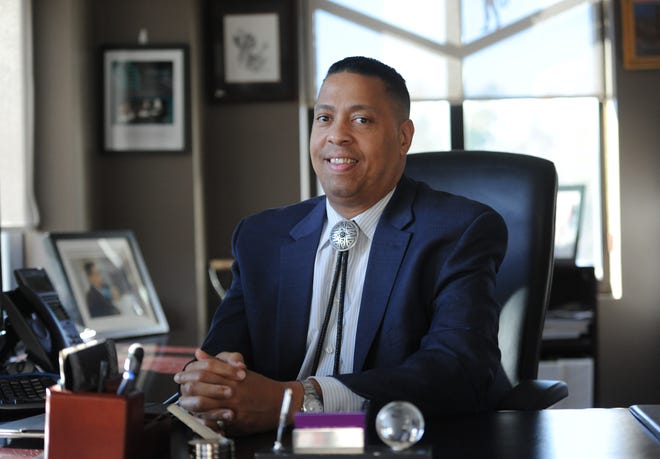
Cedric Cromwell

Cromwell's attorney, Tim Flaherty, said Wednesday that the "recent indictment relates to tax irregularities that have no overlap and no connection to the early allegations."

“Chairman Cromwell looks forward to presenting a vigorous defense to the extortion and bribery claims and continues to state his innocence," Flaherty said.

Cromwell was charged with bribery and extortion in November along with David DeQuattro, 54, the owner of a Rhode Island architecture firm, in connection with the tribe’s plans to build a resort and casino in Taunton. 

Cromwell, 55, and DeQuattro were each indicted on two counts of accepting or paying bribes as an agent of an Indian tribal government and one count of conspiring to commit bribery, according to Mendell's statement. Cromwell was also indicted on four counts of extortion under color of official right and one count of conspiring to commit extortion.

When Cromwell filed his personal income tax returns for tax years 2014 through 2017, he failed to report bribes that he allegedly received from DeQuattro’s company, Robinson Green Beretta Corp., which was contracted to serve as the tribe’s “owner’s representative” for the casino project, according to the superseding indictment. 

The indictment alleged that DeQuattro provided Cromwell with a stream of payments and benefits valued at about $57,549.37. In exchange, DeQuattro’s company was paid approximately $4,966,287.16 under the contract between July 2014 and February 2018. 

Cromwell did report receiving $180,377 in salary from the tribe in 2017 in his federal personal income tax returns, which he filed jointly with his wife, the indictment states. 

Cromwell is accused of failing to report payments for consulting services he performed for a company that developed and supplied forest carbon offsets. 

While being questioned in a civil lawsuit in 2018, Cromwell said he was a consultant/owner for three limited liability companies, and more specifically a “consultant on carbon sequestration and an Indian Country liaison to Tribal Carbon Forestry Markets,” according to the indictment. 

Cromwell was paid the consulting income through an intermediary identified as “P-Co.”, which was formed by a lawyer who was one of Cromwell’s business associates, the statement says. That associate was the only authorized signatory on a bank account identified as the “P-Co. Shell Company Account,” according to the indictment.

Cromwell also failed to report income made by his company, One Nation Development, which was paid through the P-Co. account and the bank account of a Florida limited partnership that originated with an investment holding company in Las Vegas, the indictment said.

On multiple occasions between December 2014 and January 2016, the Las Vegas investment holding company wired money to the Florida limited partnership, which wired money to the P-Co. Shell Company Account. P-Co. then wired money to the One Nation Development account controlled by Cromwell, the indictment alleges.

The only authorized signatory on the investment holding company’s bank account was the CEO of a Las Vegas-based architecture firm hired to be the architect for the tribe’s casino project, the indictment says. 

If found guilty, Cromwell could face up to three years in prison, one year of supervised release and a fine of $100,000,according to the statement. Cromwell and DeQuattro could have to forfeit any property constituting or derived from proceeds traceable to the offenses. 

Cromwell was first elected to the tribal council in 2009 and was reelected in 2013 and 2017.

When Cromwell was initially charged with extortion and bribery, the council voted to remove him from his post as chairman. But some tribe members had already been pressuring the tribal council for the previous few years to remove Cromwell.

Petitions bearing the signatures of 100 registered tribal voters were certified April 2019 calling for Cromwell’s resignation or removal, along with the removal of Treasurer Gordon Harris.

For several months before the indictment was returned, a grand jury subpoenaed the tribe multiple times for records from 2013 to 2020. Those records include Cromwell’s personnel records, the tribe’s financial records and expenditures, election records and internal communications between the tribe's Gaming Authority and its partners, including the Robinson Green Beretta Corp. and Genting Malaysia, the tribe’s financial backer that invested $440 million into the casino project.

In October 2020, another petition signed by 35 tribe members requested Cromwell's removal. 

"Cromwell’s conduct is a breach of public tribal trust and an abuse of authority," the petition stated. "Cromwell has been dishonest and exercises a lack of integrity by his unwillingness to be transparent about the $500 million dollars that was borrowed from the investors. He is and has been a target of a federal investigation and has not been transparent about it either."

Cromwell would not be the first tribal council chairman to be convicted of filing false tax returns if he is found guilty. The council's prior chairman, Glenn Marshall, was sentenced to 3½ years in federal prison after pleading guilty to embezzling nearly $400,000 from the tribe to pay his own bills, making illegal campaign contributions, filing false tax returns and fraudulently receiving Social Security benefits while holding a full-time job. 

“The new charges are extremely serious, and we are watching the proceedings closely,” Tribal Council Vice Chair Jessie “Little Doe” Baird said in a statement. “Of course, we will continue to work with the U.S. attorney’s office.” 


MIDDLEBORO REMEMBERS

Saturday, October 20, 2018

Lobbyists battle it out over casino plan


FOR A WALK DOWN MEMORY LANE ALSO SEE: 

REEL WAMPS

WampaLeaks 

Gladys Kravitz


Lobbyists battle it out over casino plan


By Tanner Stening
Posted Oct 19, 2018

MASHPEE — As a new chapter begins in the Mashpee Wampanoag Tribe’s legal fight for its land, a high stakes lobbying campaign in the nation’s capital is pitting powerful gambling interests against a foreign casino developer with the fate of the tribe’s 321-acre reservation hanging in the balance.
In a year marked mostly by setbacks for the tribe, notable attorneys and lobbyists — some working at cross-purposes —are converging on the halls of Congress in a struggle to win over lawmakers who may soon consider legislation that, if passed, would declare the tribe’s reservation lawful, reversing findings by the U.S. Department of the Interior and a federal court judge.
A bill sponsored by U.S. Rep William Keating, D-Mass., would do just that: settle the multiyear and so far successful legal challenge brought by neighbors of the tribe’s proposal to build a resort-casino in Taunton, effectively greenlighting the project and ending any question about the legality of the tribe’s trust lands.
The legislation is a pivotal piece in the tribe’s fight to protect its sovereignty. Mashpee Wampanoag Tribe Chairman Cedric Cromwell has urged support for the bill, emphasizing the grave and unprecedented threat facing the tribe, which spent decades pursuing federal recognition and trust status with the government.
“I’m asking people of goodwill and those concerned with justice for the indigenous people of this — the first Americans — to stand with us in calling on Congress to protect our reservation and ensure we don’t become the first tribe since the dark days of the Termination Era to lose its land,” Cromwell said in a statement after the Sept. 7 decision from the Interior, which said the tribe wasn’t under federal jurisdiction in 1934, the year the Indian Reorganization Act became law.
But in a deeply polarized political climate, getting the bill passed would require congressional Republicans to support the wishes of the all-Democrat Massachusetts delegation, and given the potential for an Elizabeth Warren presidential bid in 2020, its chances may be significantly affected. Warren is a co-sponsor of the Senate version of the tribal bill.
In addition, the Rhode Island congressional delegation has quietly come out in opposition to the bill to protect its gambling revenues. The tribe’s proposed casino, which is slated for fertile Region C ground, is not far from Rhode Island’s eastern border.
Lobbyists and their causes
Genting Malaysia, which is financially backing the tribe’s legal fight to secure its reservation and the casino project, has spent more than $1 million on various lobbying firms in 2018, three times more than it did in 2017, according to federal lobbying disclosures. The overseas developer was the third biggest spender on tourism/lodging lobbying in the U.S. this past year, according to the website Open Secrets.
The tribe’s overall debt to Genting, which also finances parts of tribal government operations, is roughly $426.3 million, according to a recent filing by the Malaysian casino developer. Genting said it is deliberating with the tribe to “review all options” concerning the recoverability of its investment, according to the filing.
Genting paid the law firm Dentons US more than $1 million to lobby on “casino development and land related issues” this year, according to filings. Dentons is the world’s largest firm by number of lawyers, according to its website.
Dentons, on behalf of Genting, in turn has spent between $130,000 and $150,000 on “Interior Department land decisions” through Gavel Resources LLC, according to filings.
Gavel’s lobbyists include, among others, Richard Pombo, a former member of the House of Representatives from California who was among the highest-paid beneficiaries of tribal lobbying and illegal campaign contributions when the tribe was seeking federal recognition in the 2000s.
That period of the tribe’s history was tainted by the legacy of its former chairman Glenn Marshall, who in 2009 was sentenced to 3½ years in federal prison for embezzling nearly $400,000 from the tribe to pay his own bills, making illegal campaign contributions, filing false tax returns and fraudulently receiving Social Security benefits while holding a full-time job. Pombo was unseated in November 2006 amid questions about his ties to Jack Abramoff, a notorious lobbyist who spent several years behind bars in connection with a wide-reaching federal corruption probe.
Pombo did not return a message requesting comment for this story.
‘Trump’s Washington’
In addition to the tribe’s more long-term lobbyists, including Delahunt Group LLC —which helps to, among other things, secure grants — and Akerman LLP, Genting recently contracted with Ballard Partners, touted as one of Washington’s most influential lobbying firms. 
The firm is run by Brian Ballard, who was President Trump’s Florida finance chairman for his 2016 campaign. Ballard, dubbed “the most powerful lobbyist in Trump’s Washington” by Politico, has given hundreds of thousands of dollars to Republican causes over the past two years, according to data from the Federal Election Commission’s website. Genting spent $90,000 on Ballard’s firm so far this year.
Given a perceived hostility on the part of the Trump administration toward prevailing Indian land policies — which many scholars and observers outside and within Indian Country have noted — Ballard may seem like an odd pick to represent the tribe’s interests, if Ballard’s work is, in fact, tied to the legislation.
“In some way Ballard Partners would be working at cross-purposes here,” said Ronald Shaiko, senior fellow and associate director of the Nelson A. Rockefeller Center for Public Policy at Dartmouth College. “At base, lobbyists should be pretty pragmatic (in) how they do business. Firms are getting bigger, buying other firms, so they can lobby both sides.”
Competing gambling interests arrayed against the tribe appear to stem from one commanding source, according to filings: Chicago-based casino magnate and billionaire Neil Bluhm, who is backing a proposed casino in Brockton through Mass Gaming & Entertainment, whose casino proposal was denied by the Massachusetts Gaming Commission in 2016.
But Mass Gaming is asking for reconsideration of its proposal, and its principal owner, Rush Street Gaming, has thrown hundreds of thousands of dollars behind an effort to influence lawmakers and regulators at the state and federal levels, according to filings — a large portion of which appears to be directed at thwarting the tribe’s casino effort, the pending legislation and garnering local support for the revival of Mass Gaming’s proposal.
It’s unclear precisely how much money, based on lobbying disclosures alone, is working against the tribe.
“This is not just about the Keating legislation,” said Joe Baerlein, a spokesman for Mass Gaming. “There are a whole host of other gaming-related issues that we’re dealing with.”
Rush Street also has casinos in New York, Philadelphia and Pittsburgh, Baerlein said.
At the state level, Mass Gaming has spent $210,000 on lobbying so far this year with respect to “issues related to expanded gaming,” according to state filings. Baerlein said that is tied to “outreach” across nine different communities, including boards of selectmen and town administrators.
Leadership in Taunton and Brockton have come down on opposite sides of the issue, with Taunton Mayor Thomas Hoye Jr. reaffirming support for the tribal proposal over the summer. Around the same, Brockton Mayor Bill Carpenter wrote to Interior Secretary Ryan Zinke, decrying the department’s “prolonged delay” in issuing a decision with respect to the tribal proposal, which has stymied prospects for development on the parcel of land where Mass Gaming wants to build.
Baerlein said the spending by Genting “dwarfs” the spending against the tribe, adding that the Massachusetts congressional delegation ought to “take a hard look” at the role the foreign company has played in influencing land decisions at the federal level.
More than casinos
Tribal representatives see it quite differently. Heather Sibbison, legal counsel for the tribe and a registered lobbyist for Dentons, said a tribe’s right to hold land has “profound historical and cultural meaning.”
“But for almost everyone else on the other side who is working to disestablish the tribe’s reservation, this is just a big, huge fight over casino market share,” she said. “If it loses its reservation, it loses its school, its ability to provide basic social services; it loses its fundamental right to have land on which it can engage in true self government.”
This year, Rush Street Gaming, formerly Rivers Casino, a gambling parlor owned by Bluhm, has spent $160,000 in lobbying fees through American Continental Group, citing “general gaming issues,” according to filings.
Manus Cooney and David Urban are listed as American Continental lobbyists working on behalf of Rush Street Gaming. Cooney is former chief counsel and staff director of the U.S. Senate Judiciary Committee, and Urban is cited as a “prominent Republican lobbyist” who joined the Trump campaign in its early days as an adviser in the Pennsylvania and Indiana primaries, according to the firm’s website.
But the firms cited as lobbying directly against the legislation include Locke Lord Public Policy Group LLC and Freemyer & Associates P.C.
Twin River Management Group — which owns casinos in Rhode Island — has spent $60,000 on Locke Lord specifically on the issue of the Mashpee Wampanoag Tribe Reservation Reaffirmation Act, according to filings, and Rush Street Gaming paid Freemyer & Associates P.C. $40,000 so far this year.
Lobbying the lawmakers
In addition, Locke Lord gave $7,500 to U.S. Rep. Robert Bishop, chairman of the House Natural Resources Committee, which is responsible for taking up the legislation, over the past year, according to contribution filings. Bishop was among Locke Lord’s top three highest-paid recipients over the past election cycle.
The firm has also supported Democrats, giving money to U.S. Rep. David Cicilline of Rhode Island and Keating. Cicilline’s political committee received $1,000 from Locke Lord earlier this year, and Keating’s political committee reported two $1,000 contributions from them — one on March 16 and another on March 19 — just days after he introduced the legislation.
Tribal lobbyists, with Dentons at the helm, have also targeted members of the House committee, most notably U.S. Rep. Doug LaMalfa, R-Calif., who chairs the subcommittee on Indian, Insular and Alaska Native Affairs. Dentons gave LaMalfa’s political committee $9,000 just days before Keating introduced the tribe bill.
Altogether, Dentons’ political action committee has given about $40,000 to lawmakers sponsoring the legislation throughout the 2017-2018 campaign cycle, filings show.
Incumbents typically receive more than challengers, and “well over half of their money comes from organized interests” instead of individual contributions, Shaiko said.
Shaiko said it’s typically wise for lobbying firms to give money to political candidates on both sides of the aisle; that way, if a congressional chamber flips, they can stay in business.
“It’s less ideological than it used to be,” he said.


Interior Department and Mashpee Wampanoag Tribe lobbying for 2018

For the tribe:
Genting paid Dentons US $1.1 million to lobby lawmakers and the Interior Department on “casino development and land related issues”
Dentons, on behalf of Genting, paid Gavel Resources LLC $240,000 to lobby lawmakers and the Interior Department on “Interior Department land decisions”
Genting paid Ballard Partners $90,000 to lobby the Interior Department on “gaming rules and regulations”
The tribe paid $60,000 to Delahunt Group LLC
The tribe paid $10,000 to Akerman LLP
Against the tribe:
Twin River Management Group paid Locke Lord Public Policy Group LLC $60,000 to lobby congress on “Mashpee Wampanoag Tribe Reservation Reaffirmation Act”
Rush Street Gaming, parent company of Mass Gaming and Entertainment, paid CSA Strategies LLC $50,000 to lobby lawmakers and the Interior Department on “issues related to casino development” and “issues related to licensing of Internet gaming/poker”
Rush Street Gaming paid American Continental Group $160,000 to lobby lawmakers and the Interior Department on “general gaming issues impacting Rivers Casino”
Rush Street Gaming paid Freemyer & Associates P.C. $40,000 to lobby lawmakers  and the Interior Department on “H.R. 5244 (the tribal bill)”

Saturday, October 11, 2014

Mashpee Wampanoag Disarray


CHECK OUT REEL WAMPS FOR ADDITIONAL INFORMATION


Tribal Leaders Respond To Accusations Of Financial Mismanagement
GEOFF SPILLANE
Friday, October 10, 2014


It has been a tumultuous three weeks for the Mashpee Wampanoag Tribe.

Two tribal council members, Carleton H. Hendricks Jr. and Laura E. Miranda, have publicly accused tribal leadership of accumulating massive debt from casino investors and paying themselves inflated salaries as full-time tribal employees. They also raised concerns that repayment responsibility of the debt amassed in recent years could be passed on to future generations of the tribe should a destination resort casino in Taunton not be realized.

The two tribal council members held a meeting last Saturday, October 4, at the Mashpee Wampanoag Rod and Gun Club to line up opposition support for the current administration. Paul E. Mills, a tribal elder, said that approximately 70 to 80 tribal members attended.

A Mashpee Enterprise reporter was denied access to the meeting.

In an interview on Tuesday morning, October 7, at the tribe’s community and government center, tribal chairman Cedric Cromwell and vice chairman Jessie (Little Doe) Baird addressed the accusations head-on.

Mr. Cromwell and Ms. Baird expressed concern and disappointment that the two tribal council members—as elected government officials—had violated tribal law by releasing confidential financial documents to the media and others.

“They are hurting the tribe,” Mr. Cromwell said, noting that it was too early to speculate as to whether the actions of Mr. Hendricks and Ms. Miranda would result in their removal from the tribal council.

They also said that recent tribal council meetings have become so contentious and out-of-order that many families, especially those who bring children because they do not have childcare, have stopped attending.

Mr. Cromwell and Ms. Baird, citing confidentiality agreements, said that they could neither confirm nor deny published reports that the tribe has to date borrowed $90 million at 16.5 percent interest from Genting Group, a Malaysia-based casino developer. They did, however, reference figures spent by Mohegan Sun and Wynn Resorts to prepare plans, hire professional consultants, and bid for a resort casino in the Boston area that were near or over the $100 million mark.

Mr. Cromwell also said that the two council members clearly know that, should a casino not be built in Taunton, the tribe is not obligated to pay back the funds borrowed from Genting. As for claims that there is a lack of financial transparency in the gaming arm of the tribe, he also noted that the two councilors are welcome to attend meetings of the Mashpee Wampanoag Gaming Authority, and were even asked to become members.

“We are developing a business and there is a provision in our agreement that should the business not be developed, then the tribe is not responsible for the debt. What they are saying is simply not the case. My children and their children will not be responsible for the debt. As councilors, they are given the meeting minutes. They know that we have no obligation to repay that debt if the resort does not get developed,” Ms. Baird said, further noting that as elected council members, she does not believe Mr. Hendricks or Ms. Miranda have the best interests of the tribe at heart.

Mr. Cromwell also stressed that the tribe continues to have a solid and sound relationship with Genting.

“We at the Genting Group remain extremely enthusiastic about the tribe’s resort casino project in Taunton, and we support the tribe in its effort to complete the project. We have met in person with the tribal council and the tribal membership on numerous occasions to present information about our role and the project, we have answered, and will continue to answer questions as necessary to ensure the tribe is fully informed,” Michael Speller, president of Resorts World Massachusetts, a Genting subsidiary, said in a written statement.

Mr. Cromwell and Ms. Baird also said that the accusations made against tribal leadership are politically motivated, with six council seats—including those of Mr. Hendricks and Ms. Miranda—up for grabs in the tribal election in February.

They also said that Mr. Hendricks and Ms. Miranda are closely aligned with the previous, scandal-ridden administration of Glenn A. Marshall. Mr. Marshall spent three years in federal incarceration on charges that he defrauded the tribe and the federal government. He was released from prison in 2012.

“There is an election coming up that will require candidates to stand on their record of accomplishment, and if you haven’t accomplished anything, you can only go on the offensive,” Ms. Baird said.

Mr. Hendricks and Ms. Miranda are among three of the 11 council members that are not employed full time by the tribe, nor are they required to work for the tribe, but Ms. Baird would like to change that.

“In most governments, if you’re elected to be a legislator it is a full-time job, so I have proposed an initiative that all council members should be full-time employees. The chairman can’t assign a duty to non-employees, so if you’re willing to sit on the council, you should be willing to sit in this building as an employee,” Ms. Baird said.

Mr. Hendricks did not respond to a request for an interview, but Mr. Mills, who supports the opposition movement against the current leadership, explained concerns of some of the rank-and-file tribe members and most of it involves a lack of transparency.

“Unfortunately the general public knows almost as much as we do. The machinations of our government have been secret for a while—not everything, but issues associated with the gaming authority. We don’t know what happens once the money is approved and borrowed from Genting. When we go to vote on the tribal budget in January, two-thirds of it will belong to the gaming authority. People are concerned because this was, in Cedric Cromwell’s words, supposed to be the most open and transparent administration ever,” he said.

Mr. Mills also said there is concern about the salaries of tribal leaders, which he believes are out of proportion to the tribe’s resources.

“We have very little income other than grants and casino backers. Our income is almost nil. Before the casino pursuit, most of our income came from the powwow, now we turn a loss at it. The tribal leaders have been very extravagant with a lot of things, and it is upsetting to other tribe members who are not doing as well,” he said.

According to Mr. Mills, there is also concern among the opposition that the 2009 Carcieri ruling is a “brick wall” facing the tribe’s casino hopes, and that the chances are remote that the tribe will have land placed into federal trust, not to mention that it is not the best time to enter the casino gambling business.

He also said that many members of the opposition speculate that there may be improprieties with the allocation of the Genting funds, but they do not have definitive proof.

Ms. Baird did note that while she feels that a majority of the tribal community is coming under attack from the recent allegations, she agreed that tribal leadership could be communicating better about progress being made on several fronts.

“Culturally we are not raised to pat ourselves on the back but as council members we are so ‘heads-down’ working that maybe we don’t stop enough to communicate. People could stand to hear more from us,” she said.

http://www.capenews.net/mashpee/news/tribal-leaders-respond-to-accusations-of-financial-mismanagement/article_87fba474-507d-11e4-8463-27fd4e088b8b.html


MASHPEE — Two Mashpee Wampanoag tribal councilors who spoke out about the tribe's growing casino debt face possible sanctions for speaking out, according to multiple tribe sources.
 
At a highly anticipated meeting of the tribal council Wednesday night, most of an executive session was about what council members Carleton Hendricks Jr. and Laura Etta Miranda said in an interview last week with the Times, sources said. The council then resumed its regular session with discussion of how to punish Hendricks and Miranda, according to multiple sources who were at the meeting.
 
In a story published Oct. 2, Hendricks and Miranda said they wanted to make fellow tribe members aware of the extent of borrowing and spending on a proposed $500 million casino in Taunton.
 
As of last week, the tribe had borrowed $90 million and was paying 16.5 percent interest on loans from affiliates of Genting Group, a Malaysian casino giant, Hendricks and Miranda told the Times.
 
Chairman Cedric Cromwell said in a response at the time that tribe finances are proprietary and called the reporting of them by councilors "irresponsible."
 
On Wednesday night, the tribe council voted to borrow another $9 million, taking $2 million off the top to pay interest on the loan, sources said. The vote was 8-2 with Miranda and Hendricks opposed, sources said.
 
Wednesday's meeting attracted an overflow crowd that sources estimated at 75 to 100 people with some watching on a screen in the building's gymnasium. By the time a vote was taken six hours later on whether to sanction Hendricks and Miranda, an estimated 15 tribe members remained in the audience, sources said.
 
After the executive session, the tribal council as a whole discussed how to punish the two elected tribal councilors, according to multiple sources who were at the meeting. But a motion made by tribe Secretary Marie Stone to expel them — seconded by Councilor Trish Kellinui — never made it to a vote.
 
"It was a charged atmosphere," a tribe source said. "The room went crazy." At one point members of the audience said, "Go ahead, expel them," and then vowed to oust tribal councilors who did so in an upcoming election, the source said.
 
Ultimately, the tribal council voted unanimously to support an amendment by Miranda to rescind Stone's motion to expel and instead meet with the tribe's traditional leaders — the chief and medicine man — to work together, sources said.
 
The press is not allowed into tribal council meetings. Though it is a government meeting, the tribe is a sovereign nation and is not subject to the state's Open Meeting Law.
 
Hendricks declined to comment Thursday and Miranda could not be reached. A source said the two councilors fear repercussions because of how close they came to being expelled.
 
Tribal Council Chairman Cedric Cromwell issued a statement Thursday declining to discuss details of the meeting and rejecting comments that leadership is attempting to silence dissent.
 
"As with any family there are differences of opinion, and we have a fair and open process for dealing with those differences, which includes calling on the wisdom of our elders," Cromwell said. "Of course, there are certain strategic details that are better kept in-house as we work toward goals that will enhance the economic prospects of each of our tribal citizens."
 
Several tribe sources contacted by the Times Thursday said they were shocked that Miranda and Hendricks could face sanctions for speaking out.
 
"That would have been a violation of their civil rights," one said.
 
In the days leading up to the meeting, Cromwell warned on the tribe's website that participants in Wednesday's meeting would be subject to the tribe's laws of decorum and anyone causing a disturbance would be removed by police.
 
The post was later taken down, but Wednesday's meeting began at 5:30 p.m. with a large police presence. Two marked police cruisers were parked near the entrance to the tribe's headquarters.
 
Inside, up to five police officers were present, said Police Chief Rodney Collins, who was there briefly.
 
Collins said the tribe hired two detail officers, but that he decided to deploy more after hearing from sources about potential trouble at the meeting. He said he also spoke with Cromwell during the day.
 
Police were there to diffuse any conflicts, Collins said. In one instance an officer, who is also a tribe member, was able to calm a family member, he said.
 
"I am pleased that there was no disturbance, no arrest and cooler heads prevailed compared to some reports of potential problems earlier in the day," Collins said.
 
Some tribe members complained that the police presence was meant to intimidate.
 
Cromwell defended the police presence. "Just as there are police officers at municipal government meetings everywhere, there is nothing untoward or unusual with public safety officers being present at our tribal council meeting," he said.


http://www.capecodonline.com/apps/pbcs.dll/article?AID=/20141010/NEWS/410100307


Monday, June 10, 2013

Middleboro: Always Good For Comic Relief!


Middleboro officials claim agreement with Mashpee Wampanoag tribe still valid
By Jennifer Bray
Posted Jun 09, 2013


It’s been a while since visions of crowded casino tables, a five-star hotel and endless buffets danced in the heads of Middleboro residents.

Meanwhile, in nearby Taunton, casino plans by the Mashpee Wampanoag tribe – which had courted Middleboro in 2007 – are moving forward.

At a recent meeting in Taunton, architectural plans were rolled out. Presenters showed off renderings of a 200-seat entertainment lounge, 400-seat buffet, two fine-dining restaurants and retail shops. Plus, a water park would be built as construction progresses.

According to officials, a casino in Taunton would support an estimated 2,560 permanent jobs and an $80 million annual payroll.

But at one time, Middleboro was in line to be the site for a Wampanoag tribe resort casino.

At one time, Middleboro hoped to put its townspeople to work building and staffing a casino. The town hoped it would garner the tax revenue flowing into local coffers from hosting a destination gaming resort.

That was six years ago.

Today, Middleboro has been left in the dust in the casino game, but insists it still has a pact with the tribe.

“We feel our agreement is still valid,” Town Manager Charlie Cristello said last week. “The terms under which they would build a casino we feel were never settled.”

In July 2007, a massive event was staged for Middleboro voters to weigh in on an $11 million-a-year host agreement that would have provided $250 million in infrastructure improvements for a tribal casino.

The town meeting took place on a scorching hot Saturday and brought 3,722 people out to cast votes under four huge tents set up on a 25-acre field behind the high school on Route 28.

The town provided bus service to shuttle voters in from satellite parking sites. Some 1,500 bottles of water were brought in to quench the thirst of townspeople.

It was the largest town meeting the state had ever seen. And when the votes were tallied, 2,387 voted in favor of the casino and 1,335 against. [In a non-binding question, when asked if townspeople wanted a casino, the response was overwhelmingly "NO!"]

Then, plans took a turn for the worse.

Glenn Marshall, council chairman for the Mashpee Wampanoag, came under fire for reports of a past rape conviction and misstatements about his military service. He stepped down in August 2007.

Cedric Cromwell took over for the tribe [After Shawn Hendricks] and initially the pact with Middleboro was honored.

But in 2010, the tribe announced it intended to open a casino in Fall River. That plan later fell through and the tribe turned to Taunton as a site.

Middleboro was left behind – but town leaders say they believe the pact with the tribe still stands.
According to town manager Cristello, the town has sent the tribe bills for $750,000, which he says haven’t been paid yet. The charges are for pre-planning involved in the casino resort plan.

The tribe disagrees, and in a March 2012 letter to selectmen, criticized the town for what it called “irresponsible, false and improper efforts to promote via the media a merit-less claim that the town somehow possesses legal rights against the tribe concerning the tribe’s pursuit of a destination resort and casino in Taunton.”

The town’s efforts “are also a transparent effort to try, improperly, to leverage financial concessions to which the town is not entitled,” said the tribe.


Read more: http://www.enterprisenews.com/news/x779478004/Middleboro-clings-to-casino-pact#ixzz2VoWNNzlX
Follow us: @enterprisenews on Twitter | EnterpriseBrockton on Facebook

Sunday, March 31, 2013

Tribes make most of Indian gambling law


Tribes make most of Indian gaming law


By George Brennan

March 31, 2013

The seeds of a $500 million casino in Taunton proposed by the Mashpee Wampanoag Tribe were planted in 1988 in the waning days of President Ronald Reagan's second term.

Reagan signed a law that allowed Indian casinos on reservation land, a direct reaction to a 1987 U.S. Supreme Court decision in California v. Cabazon that ruled states had no authority over Indian government activities, including gaming.

"The backdrop for all of this really predates the (Indian) gaming of the 1970s," Steven Light, an Indian gaming expert, said. "The true backdrop is a lot of poverty and few economic development opportunities for the rural, mostly reservation-based tribes, across the United States."

Light and Kathryn Rand are co-directors of the Institute for the Study of Tribal Gaming and Policy at the University of North Dakota and have co-authored two books on Indian gaming.

"Both Congress and the tribes were desperately looking for some means to build tribal economies," Rand said.

At the time, Indian gambling was a fledgling $100 million industry — mostly bingo halls — with little or no oversight. The 1988 law signed by Reagan, known as the Indian Gaming Regulatory Act, was considered a compromise aimed at providing federally recognized Indian tribes an opportunity for economic development and, with that, an opportunity for self-sufficiency for tribes facing serious poverty. At the same time, it provided federal oversight and an opportunity for state governments to cut a deal with tribes looking to offer gambling inside their borders.

One of the biggest misconceptions about Indian casinos is that tribal sovereignty means they are unregulated, Light said. "In fact, it is the most highly regulated form of gambling in existence in the U.S.," he said. "There is a regulatory role for the federal government, the state government and tribal governments — three levels of regulation. Commercial casinos — Trump's casino, Wynn's casino — are not regulated by three levels of government."

Few could have predicted that passage of the Indian Gaming Regulatory Act would make tribes synonymous with casinos. The new law opened the floodgates and paved the way for behemoths like Foxwoods Resort Casino and Mohegan Sun in Connecticut.

Today, Indian gaming is a $27.4 billion industry with 242 tribes operating casinos in 28 states as of 2011, according to the Indian Gaming Industry Report, an annual research report conducted by economist Alan Meister of Nathan Associates Inc. and published by Casino City Press.

"I think it's pretty clear now that Congress had no idea the Pandora's box it was opening when it created this law," said Robert Steele, a former congressman from Connecticut and author of "The Curse: Big Time Gambling's Seduction of a Small New England Town." The 2012 novel is based on Connecticut's experience with the Mashantucket Pequot tribe, which opened Foxwoods in Ledyard, Conn., in 1992. "It opened the door to tribal casinos, but also the spread of non-Indian commercial casinos as well."

game changer

Indeed, it was the 2007 acknowledgement by the federal Bureau of Indian Affairs of the Mashpee Wampanoag Tribe's existence that ignited the push for legalizing casinos in Massachusetts. Various proposals had languished for decades until the state Legislature agreed to a bill in November 2011 that provided for three casinos in the Bay State, including one that recognized the federal rights of Indian tribes, as well as a single slot parlor.

The Mashpee tribe has applied with the Bureau of Indian Affairs for an "initial reservation" under that 1988 federal law, an exemption that allows a tribe recognized after 1988 to open a casino on tribal lands. That application is still pending with the Bureau of Indian Affairs and faces a legal tangle.

Tribe leaders say it's that federal law that makes its casino in Southeastern Massachusetts "inevitable." Opponents say the hurdles tossed in the way by two U.S. Supreme Court rulings make a tribal casino highly unlikely. The Carcieri decision calls into question the authority of the Department of the Interior to take land into trust for tribes recognized after 1934. And the Patchak decision gives property owners opposed to a casino up to six years to file a lawsuit.

The Massachusetts Gaming Commission has been given a role under state law to determine whether a tribe casino is "inevitable" or "unlikely." It's a task that commission Chairman Stephen Crosby acknowledged is daunting at a March 21 public meeting on the topic.

"We know there are strong interests, strong rights, strong economic impacts, strong emotions on many sides of this issue," Crosby said during the meeting.

The tribe has estimated it could have shovels in the ground by the end of 2014. Opponents put the estimate at six to 10 years, if ever.

corruption concerns

With the onslaught of Indian casinos in the 1990s and 2000s came something else inevitable.

Rand said Congress had worried when it passed the law in 1988 that organized crime would infiltrate Indian casinos. That never materialized.

Political corruption, on the other hand, was rampant — much of it surrounding disgraced lobbyist Jack Abramoff.


Abramoff's misdeeds are well-documented — using political payoffs and influence to help tribes gain federal recognition that ultimately would lead to the right to build casinos.

The Mashpee Wampanoag had a leadership scandal of its own. Former tribal council Chairman Glenn Marshall pleaded guilty to political corruption and embezzlement charges in 2009 and served more than three years in federal prison.


Despite what happened with Abramoff and the Mashpee tribe, Light and Rand say the Indian Gaming Regulatory Act has by and large done what it was supposed to do. Most Indian gaming facilities across the country are not like the Connecticut giants, but are more modest facilities aimed at providing jobs for tribe members and a revenue stream for the tribe.

"Folks tend to think about Foxwoods and the Pequots as the example of Indian gaming," Rand said. "But out here in North Dakota, our tribes more typically have thousands of members, our tribes have more typically experienced generations of extreme poverty — 50 percent unemployment or more on our reservations."

That 50 percent matches the unemployment rate among the 2,600 members of the Mashpee Wampanoag Tribe, Chairman Cedric Cromwell said. The tribe's casino would not only provide much-needed jobs, but would boost health care outreach, housing and education, Cromwell said.

"We want to create a situation where our people can be lifted out of poverty," Cromwell said. Indian gaming will give the tribe the ability to provide self-determination and self-sufficiency by giving resources to a tribe that he said has been "underfunded" and "severely neglected" by the federal government. "It's very important for us to provide for our services to our people and lift our people — give them a hand up so they can have a better quality of life."

In recent days, after an Associated Press story on the tribe that owns Foxwoods receiving $4.5 million in federal grants over the past five years despite years of earning millions in casino cash, Indian casino opponents have pointed to that as galling.

Rand said while she understands the outrage, federal support for tribes is not need-based. "That's part of federal government's obligation to protect and assist tribes because of the long historical circumstances between tribes and the federal government," she said. "That responsibility exists regardless of the relative wealth of the tribe."

too many casinos?

Connecticut got hooked on the revenue it receives from Foxwoods and Mohegan Sun, Steele said. The tribes were in the right place at the right time and have had a nearly two-decade monopoly on the New England gambling market, he said.

Now with Massachusetts about to enter the game and New York expanding, the Connecticut casinos are hurting from the competition.

The proliferation of Indian and commercial casinos is reaching a saturation point, Steele said. Revenue from Foxwoods and Mohegan Sun to the state of Connecticut is down more than $130 million per year from its peak of $430 million, he said. Once Massachusetts casinos open and New York expands, the future doesn't look bright for the Pequot or the Mohegan tribes, he said.

"I keenly appreciate how enormously attractive and seductive these offers seem to be on the surface," Steele said of casino revenue. "You look at what's happening in Connecticut and if you were having the same debate again in Massachusetts about legalizing casinos, it's hard to believe you'd come to the same conclusion."

Both Light and Rand said that, back in 1988, there was no crystal ball to predict the explosion of Indian casinos across the country or the voracious appetite of consumers for gambling.

Tribes have proven they are capable of operating successful, complex enterprises like casinos and leverage them into fairly robust tribal economies. Ultimately, that's what the intent of the Indian Gaming Regulatory Act was all about, Rand said.

"There may have been an assumption that this wouldn't go very far because tribes didn't have the capacity to take it very far," Rand said. "But tribes have taken the opportunity of Indian gaming and used it to as full advantage as they possibly can for tribes and tribe members."


http://www.capecodonline.com/apps/pbcs.dll/article?AID=/20130331/NEWS/303310326/-1/NEWSLETTER100

Monday, December 31, 2012

Wampanoag court decisions now posted on Suffolk site


Wampanoag court decisions now posted on Suffolk site
 
MASHPEE — The Mashpee Wampanoag Tribe is giving the general public a window into something that, until now, has been kept behind closed doors because of the tribe's sovereign status.
 
Decisions made by the fledgling Mashpee Wampanoag Tribal Court are now being posted on a website hosted by Suffolk Law School, which offers courses specializing in Indian law.
 
The court, established in 2009, currently hears only civil cases and meets on an as-needed basis.
 
More than a half-dozen cases are posted on the Suffolk website, including a decision to find that former tribe leaders Glenn Marshall, Shawn Hendricks and Desiree Hendricks Moreno defaulted in a lawsuit filed against them.
 
According to the decision, all three were served by a court-appointed constable, but did not respond to the suit, which seeks to recoup money that current tribe leaders allege was stolen when the three were tribal leaders. Marshall, the tribe's former chairman, served a federal prison term for embezzlement, but neither Hendricks nor Moreno, both former tribe officers, were charged criminally.
 
Another court case provides a glimpse into tribal government. In January, tribal council secretary Marie Stone filed suit against the tribal council, which had suspended her without pay, according to the decision posted online. No reason for the suspension is given in the posted court documents and the decision centers on whether tribal council members are protected from suit because of the tribe's sovereign status.
 
"The Tribal Council may not use the claim of sovereign immunity to defeat claims by tribal members under the Tribal Constitution," tribal court chief justice Henry Sockbeson ruled.
 
The judge made no decision on the merits of the case, just on the claim by the other tribal council members that they are protected from suit, which Sockbeson denied.
Stone could not be reached for comment.
 
In September, Sockbeson dismissed an appeal brought by Nellie Ramos alleging irregularities during the 2009 tribal election. He ruled that Ramos filed three years too late.
 
"While she challenges the adherence of the Election Committee to the requirements of the Election Ordinance, she herself has totally ignored well-settled tribal law regarding the requirement to appeal election irregularities," the judge wrote in his decision.
 
Reached by phone Friday, Ramos questioned the impartiality of the judge and the court. "To me it's not a court. The tribe is not getting anything out of that judge," she said of Sockbeson. "I don't like the way he's treating the tribe."
 
The decisions are being made public in an effort to show the general public that the tribal court operates using the same parameters as state and federal courts, Rob Mills said.
 
"I think it's a great idea to make these decisions public," said Mills, who is an attorney with Wynn & Wynn in Hyannis. Mills is also a tribe member and is one of three judges who have heard cases since the court began operating in 2009, though his cases have been limited by his close relationships with tribe members, he said.
 
"It's already a challenge instilling confidence in public that this is a legitimate court system that operates like court systems they are familiar with — so the more public we can make it, the better for everyone," he said.
 
There could be instances in which the tribe would require a vendor doing business with the tribe to agree to have any disagreements heard in tribal court, Mills said. It's important that the tribe be able to demonstrate that its court makes reasoned decisions based on law and that it cannot be influenced by leadership, he said. Some of the rulings by the court already demonstrate that, he said.
 
The joint venture with Suffolk was announced in the December issue of the Mittark, the Wampanoag newsletter distributed to tribe members and posted on the tribe's website. According to that announcement, court judges will have the ability to seal some cases that involve either minors or other confidential information. "Cases involving juveniles, Indian Child Welfare Act cases, and cases involving involuntary commitment proceedings are also closed to the public," the announcement in the Mittark states.
 
The decision to partner with Suffolk was made because professors and students at the law school have offered pro bono services to help the tribe set up its rules for civil procedure, Mills said. The end result is a system that's much more user friendly than the federal system, Mills said.
 
The court also has judges with extensive experience both in and out of tribal court systems. Sockbeson was educated at Harvard Law School and Mills graduated from Boston College Law School. A third judge, Rochelle Ducheneaux, has experience in tribal courts across the country, Mills said.
 
"The public needs to know that the panel is impartial and fair and they can glean that from reading the decisions," Mills said.


Saturday, June 16, 2012

Disenrolled


Thousands of Native Americans are being kicked out of tribes across the US dis enrolled


Thousands of Native American Indians are illegaly being kicked off reservations and kicked out of tribes all over the US! http://www.NewsForNatives.com

Dis enrolled, Dis enfranchised, Exiled, whatever you want to call it, its happening to thousands of Indians across America. Apparently what the whites FAILED to do, money, or at least the love of it, is now accomplishing.

Thousands of Native Americans are being kicked out of their tribes. Many of these outcast Indians have proven beyond a shadow of a doubt through genealogy, historical documents and deeds and other documents that they are members of their tribe but all to no avail. These Indians without a tribe and without land are being kicked off of the reservations, kicked out of the schools, exiled and ostracized.

In some cases, the tribal councils own efforts to prove they are not of direct lineal decent have proven that the subjects ARE of enough blood to be a member, sometimes even more blood than the accusers.

What would cause entire families of Indians to be uprooted from their homes where they have lived their entire lives, some who even built the homes they lived in, to suddenly be kicked out? What would cause tribes all over the country to start kicking thousands of its own members out into the street with no recourse for appeal or even a trial of any type? according to the tribes, [its] Citizenship decisions are an integral and important process the tribe uses to preserve our lineage Critics say that it is all about money. Its simple math; The more Indians are kicked out, the greater casino allowance for the remaining tribal members.

One has only to look at Mark Macarro and the Pechanga conflict or Stanley Crooks and the Shakopee Mdewakanton Sioux to see clearly the amount of favoritism, injustice and Tribal Corruption that is running rampant all across the United States, or at least wherever there are casinos involved.

Members of some tribes make 30+ thousand dollars per month per person. Yes, that means a family of 8 would make $240,000 per month. But apparently thats just not enough, they have to make more and more and more so they start dropping the families with the least amount of pull, with the least say in affairs.

Many people might be thinking, "what has this got to do with me? Well, many of the Indians who were kicked out of the tribe are on government assistance plans, so YOUR taxes are paying for the food, shelter, education, medical, etc of Indians whose tribes make HUNDREDS OF MILLIONS OF DOLLARS per year!


When Mashpee Wampanoag elders tried to investigate former tribal chairman Glenn Marshall's abuses of Tribe finances - later convicted on multiple felonies for associated with illegal campaign contribution and other fraud associated with the... Tribe's early casino development efforts, the Tribal Council voted to shun them and kick them out of the tribe. Guess who was on the tribal council and voted to kick out the elders at that time? Current chairman Cedric Cromwell.

http://64.38.12.138/News/2007/000809.asp


Reservations are for the benefited of the members of the tribes, well, funny things is the smaller the tribe, the more beneficial it is to a very small few.

Wednesday, June 6, 2012

Glenn Marshall: Heee's baack.....

The release of convicted rapist Glenn Marshall from prison resurrects memories of current candidate for State Rep. Adam Bond's participation in forcing a Tribal Casino on Middleboro. Much has been said .... most recently, candidate Bond solicited others for 'dirt' on the incumbent, not that facts have ever mattered to Mr. Bond.   


....in 2007, [Adam] Bond dismissed the tribal elder’s warning and the writing on the wall as irrelevant. “We all have skeletons in the closet,” he said. “I still trust the man.”
The Book of Adam


Preparing our children: What’s in store for East Taunton Elementary School & Wampanoag casino?
There’s something about those deed restrictions
Send in your resumes !


Mashpee Wampanoag former chairman Glenn Marshall released from prison. Maybe he can help his former protege Cedric Cromwell managing the casino cash - at least Glenn could pass a credit check (if not the criminal background review) required to get a casino license.


Glenn Marshall released from federal prison


Top Photo
Glenn Marshall, the former chairman of the Mashpee Wampanoag Tribe, walks out of U.S. District Court in Boston Thursday, May 7, 2009 after his sentencing to prison.(AP Photo File/Elise Amendola)

Glenn Marshall has been released from federal prison, according to an online database for the Federal Bureau of Prisons.
Marshall, the former leader of the Mashpee Wampanoag tribe, was released after having served 3 years of his full 3 1/2-year sentence for political corruption and embezzling funds from the tribe.

For the past month, he was in a half-way house in Boston as a transition from his time behind bars, records show.

In March, Marshall's wife told the Times that she expected her husband to get an even earlier release from prison, but that never materialized.

Marshall plead guilty to charges that he stole nearly $400,000 given to the tribe by an initial investor and used the money as his personal slush fund spending the cash on things like groceries and vacations.

He was also convicted of making illegal campaign contributions in an attempt to gain favor for the tribe in its bid to gain federal recognition.
Now that he's out of prison, Marshall faces a lawsuit in tribal court where tribe leaders seek to recoup the money stolen from the tribe.


Marshall was forced to resign as leader of the tribe in 2007 after the Times reported that he had lied about his military service and had previously been convicted of rape.