Meetings & Information


*****************************
****************************************************
MUST READ:
GET THE FACTS!


Showing posts with label Seneca. Show all posts

Saturday, January 9, 2016

Gambling Giant Genting Gobbles Up Big Apple


Once upon a time, the article below appeared. 

The article was saved in its entirety. 

The site was hacked. 

When it was restored, the article was GONE! 

Kinda curious! 

When it comes to Predatory Gambling, it seems no one asks questions. 


Genting Connected to Islamic Extremists?


Genting is the current Gambling Investor supporting the Mashpee Wampanoag lifestyle.

Genting Connected to Islamic Extremists?

The money rush is on. A shady, but well-heeled Asian casino gambling giant swoops into town, buys an outdated office facility and valuable underlying real estate from the Miami Herald and launches a multi-million dollar campaign to approve non-Indian casino gambling in Florida and put a license on the former Miami Herald tract.

Kuala Lumpur-based Genting has multinational operations in tourism, resorts, gambling, plantations, power generation, and oil and gas. Genting’s market capitalization value, or net worth, reached $46 billion at the end of last year — making it one of Malaysia’s largest companies.

The Miami Herald suspends their normally skeptical eye, conducts no due-diligence on their new Chinese friends from Malaysia and their newspaper becomes a public relations machine for a client they don’t even really know.

Every glad-handing semi-corrupt politician in Miami-Dade and the City of Miami with their hand out will be jumping on the Genting gravy train. Genting is a target for every con-man lobbyist/political consultant/PR man which Miami-Dade County abounds with.

Recently a group of “Community Leaders” were flown to South East Asia including visits to Genting casinos in Malaysia and Singapore. Genting refuses to disclose the names of “Community Leaders” – including elected officials – who were flown to South East Asia in a private luxury jet and wined and dined at 5-Star resorts reserved for high-rollers in the Asian gaming world.

World Resorts Genting, also known as Genting Highlands, opened in 1965 and is the company’s flagship resort in Malaysia. The resort features Malaysia’s only land-based casino, six hotels, three theme parks, a convention center, and numerous restaurants and nightclubs, among other attractions.

Resorts World Sentosa, which opened last year in Singapore, features one of the world’s most expensive casinos, six hotels, a Universal Studios theme park and a Marine Life Park, among other features. The Florida Delegation visited both, reportedly racking up more than $790,000 worth of hotel, restaurant, spa and entertainment costs in both 5-Star resorts.

Genting has retained a team of slick lobbyists including Jonathan Kilman, with the law firm of Foley & Lardner. Kilman’s partner, Chris Kise, is under investigation for erasing email records generated during Governor Rick Scott’s Inauguration. The missing emails are thought to contain correspondence exposing the business dealings of Kise and Scott’s political adviser Enu Mainigi. Scott has ordered the FDLE review. Kise insists the emails were erased accidently. Foley and Lardner’s influence in the Governor’s office is not likely to be strong in 2012. 


Before it’s over, expect that Genting, their lobbyists, and other retainers, will lavish the Republican Party of Florida and other selected party redistricting vehicles with millions of dollars. They’ll even buy Governor Rick Scott a golden toilet seat for the Governors mansion is he wants!

Genting, the Asian casino giant, does not hold a casino gaming license in any U.S. jurisdiction that has serious regulation. New York State requires relatively little scrutiny in the contract Genting has with the State of New York to operate slot machines at Aqueduct Racetrack.

Genting made millions of dollars as the money-men behind two controversial Indian Casino gaming developments in the Eastern United States. In both cases, Genting operations were directed by G. Michael Brown, a former New Jersey Attorney General who was later charged with embezzlement and cocaine use in the Seneca Tribal Court.

Brown was charged with putting various mistresses on the casino payroll and using casino funds to pay for luxury condominiums, imported sports cars and expensive jewelry for them. Brown famously drove a 4-door sedan owned by the Seneca Tribe through the picture window of a Niagara Falls resident while driving drunk.

Genting was the financier of the Seneca Niagara Casino Hotel in Niagara Falls, New York. Genting charged the tribe an exorbitant 28 percent interest rate, potentially in violation of the Indian Gaming Regulations under the Bureau of Indian Affairs. Genting also stayed in the deal for almost 15 years when they were legally limited to five. Seneca Tribal Council members have testified that armed Chinese thugs showed up to collect Genting’s money when tribal lawyers pointed out that Genting was violating the law.
All of this became known to the U.S. Senate Select Committee on Indian Affairs, which held hearings and launched an investigation into corruption in the Indian gaming industry in the United States. But what the Senate Committee found out about Genting was even more disturbing: an apparent pattern of multi-million dollar payments to Islamic extremist organizations in Malaysia who most definitely are not friends of the United States of America.

U.S. Senate Special Committee records regarding Genting and their financing of multiple Islamic-based organizations in Malaysia are classified. Some U.S. Senator needs to launch an investigation to determine whether Genting has relationships that would make their holding a casino license in Miami (a money machine) inappropriate. U.S. Senate staff investigators should get a firm understanding of Genting’s questionable relationships in Malaysia and China.

Genting executives told Senate investigators at the time that the millions of dollars funneled to various Islamic extremist organizations known to finance jihad were made under direst and viewed as a cost of doing business for a Chinese businessman in heavily Islam-run Malaysia. Investigators had reason to be skeptical when photos of K.T. Lim and North Korean dictator Kim Jong-il surfaced. The Senate investigators also obtained photos of Lim socializing with at least two Islamic figures wanted by the United States for terrorist activities.


Senate investigators were also interested in K.T. Lim’s relationship with Stanley Ho, the Asian casino magnate who has been identified as a member of the Chinese Triad, the Chinese crime organization, by the U.S. Justice Department and by the Royal Canadian Mounted Police. Ho has been denied a casino license in every jurisdiction except in Macau and North Korea. Genting has refused to address their business dealings with Ho and his company Shun Tak Holdings Ltd.

While the Miami Herald is telling us that Genting boss K.T. Lim is a brilliant businessman, he could be one of the largest funders of Islamic terrorist activity in Asia. Instead of giving press conferences to the Miami Herald, perhaps K.T. should be interrogated under subpoena by U.S. Senate lawyers.

The Miami-Dade politicians who suck up Genting’s food, drink and accommodations and support Genting’s development will jump off of them like rats when they learn where a substantial portion of Genting’s profits in Florida may be going. Just because Genting has a lot of money doesn’t mean that they are suitable to operate casinos in the United States based on their associations and business practices.

Neither Governor Rick Scott, nor Senate President Mike Haridopolos will agree to casino gaming without a local county referendum. Perhaps Miami’s Cuban voters should decide whether they want to approve a casino for a foreign company who could be financing Al-Qaeda and the Taliban.

Nothing short of full disclosure of all the finances and holdings of Genting should be required under Florida casino regulation. If they deny ties to radical Islam only full disclosure will verify this claim, a protection the public requires.

New Jersey Casino Control law is considered the toughest in the country and is the model for casino regulation in the rest of the country. Nevada’s regulations are similar, but the process in that small state is “more political.” Florida’s casino regulation must not and cannot be lax. We need to know far, far more about Genting and their friends before they get a casino license in Florida.


http://middlebororemembers.blogspot.com/2011/09/genting-connected-to-islamic-extremists.html



Genting Malaysia Big Apple acquisition for possible new U.S. projects


The Genting Group’s investment holding and management company, Genting Malaysia Berhad, has acquired full equity interest in Big Apple Regional Center LLC from YMCMHB LLC, a foreign limited liability company, for US$150,000.
The 100 percent stake in the currently dormant company, formed in Delaware in 2013, “is intended to assist with potential financing for possible future development projects in the Northeastern region of the United States,” according to Genting’s press release (pdf) on Monday. While the filing failed to give specifics for which the Big Apple acquisition might be used, it coincidently follows Empire Resort Inc. being granted a full gaming license on December 21, 2015 for the $1.3 billion Montreign Resort Casino in upstate New York. Empire Resorts Inc.’s controlling shareholder is Lim Kok Thay’s investment company, Kien Huat Realty of Malaysia, one of Malaysia’s most prominent casino developers and part of the Malaysian conglomerate, Genting Group.
Proposals for two new casino projects by another unit of Genting Malaysia, RW Orange County LLC in upstate New York, were turned down by the New York State Gaming Facility Location Board in December 2014.
Genting Malaysia develops, operates and manages casinos and integrated resorts all over the world, including the United States, Australia, Malaysia, the Philippines, Singapore and United Kingdom. It operates Resorts World Casino New York City, Resorts World Bimini in the Bahamas, Resorts World Casino Las Vegas, and Malaysia’s only casino resort, Resorts World Genting. Genting Malaysia also runs Resorts World Birmingham in the U.K., which officially opened on October 21, among others.
The conglomerate is also tied to investments in the U.S. through the Kien Huat Realty for the Foxwoods Resort Casino in Connecticut, Seneca Niagara Casino & Hotel in Niagara Falls and the Monticello Raceway. Genting also funded casino development and lobbying expenses for Massachusetts Region C’s Mashpee Wampanoag’s Project First Light, according to Wikipedia.


Thursday, December 24, 2015

A Deeper Look Into The Genting Group


One the right side of this page is a CATEGORY LIST. 

There are large numbers of articles about GENTING available, their generous campaign contributions and much else. 


Genting was the financier of the Seneca Niagara Casino Hotel in Niagara Falls, New York. Genting charged the tribe an exorbitant 28 percent interest rate, potentially in violation of the Indian Gaming Regulations under the Bureau of Indian Affairs. Genting also stayed in the deal for almost 15 years when they were legally limited to five. Seneca Tribal Council members have testified that armed Chinese thugs showed up to collect Genting’s money when tribal lawyers pointed out that Genting was violating the law.


Genting Connected to Islamic Extremists?


A Deeper Look Into The Genting Group


Friday, May 2, 2014

How come the Predatory Gambling Industry NEVER argues about the FACTS?


Group Claims Casinos Bring Higher Taxes and Crime
Alex Crichton

The group No More Casinos Coalition has released details of analysis of property tax and crime data released by Freedom of Information Law requests to the cities of Niagara Falls and Salamanca.
Former Rochester Mayor Bill Johnson, speaking for the group, says the initial data show taxes went up 17 percent and 16 percent in Niagara Falls and Salamanca, respectively, from the period before the casinos were built there to 2012.

Certain areas of crime also increased, according to Johnson.

That includes a 22-percent increase in theft-related crimes over the same period.

WXXI tried to reach Niagara Falls mayor Paul Dyster for verification, but he was unavailable.
Gates Town Supervisor Mark Assini, who favors the idea of a casino at Rochester Tech Park in his town, says the issues of higher taxes and crime rates and casinos are unrelated.

He says pressures that force higher taxes or crime in urban areas have nothing to do with a single business, casino or otherwise, going into an urban center.

Johnson says it's clear that Seneca-run casinos aren't a panacea for local problems, and while residents in Henrietta have said "no" to the idea, it's still the subject of talk in other towns, including
Greece and Gates, and Irondequoit.

He says any community that is considering a casino should question whether a deal with the Seneca Nation to build would be a benefit for the long term, based on analysis of the data.

Johnson urges residents to bring up the issue with Monroe County lawmakers at their May 13th meeting.

Assini argues a casino would have several benefits: it will bring [LOW WAGE] jobs to region [THAT WILL REPLACE LOCAL BUSINESSES - CANNIBALIZATION], and if the town of Gates received the same offer that went to Henrietta, residents would no longer have to pay town property taxes, and Gates residents support the proposed location, Rochester Tech Park
Assini points out that the No More Casino Coaltion is funded by Batavia Downs and Finger Lakes Gaming and Racetrack, which don't want competition from Seneca run casinos.

How come the Predatory Gambling Industry NEVER argues about the FACTS?


http://wxxinews.org/post/group-claims-casinos-bring-higher-taxes-and-crime

Anti-casino coalition releases study


Anti-casino coalition releases study

Sunday, April 6, 2014

‘The New Senior Centers’


As Seniors Gamble for Fun, Some Find Only Trouble

Part 1
As Seniors Gamble for Fun, Some Find Only Trouble
Buffalo News/New America Media , News Feature, Melinda Miller , Posted: Apr 05, 2014

BUFFALO, N.Y.--After skipping doctor’s appointments for months, Gina’s father was diagnosed with Stage 4 cancer in January. That’s when she realized he had other problems, too.

While helping arrange her dad’s medical care, Gina obtained power of attorney to manage his finances during his hospitalization and recovery.

Parkinson’s Drug Feeds
Gambling Addiction


The study of Parkinson’s disease, and how the brain sends signals for movement and mood, also is shedding light on the physiology of gambling.

When patients being treated for Parkinson’s developed gambling addictions, it didn’t take long to find the link.

“There are many groups of dopamine receptors in the brain,” explains Jian Feng, a neurologist and professor in the University at Buffalo’s School of Medicine & Biomedical Sciences: “One type controls locomotion, one controls the normal cognitive state - when that is not working right, you might see schizophrenia - and the third group affects reward behavior.”

Parkinson’s results from the death of dopamine neurons in areas associated with locomotion. The illness is commonly diagnosed when people are in their 60s, Feng said, although its onset could be earlier.

Drugs called dopamine agonists, such as pramipexole (brand name Mirapex) and ropinirole (Requip), help restore connections in those receptors, calming the tremors associated with the illness and giving the patient more movement control.

But they affect the entire brain, not only the locomotion areas, which is why, Feng said, they can have unwanted side effects on personality.”

Feng said that when a person experiences an unexpected reward, like a $50 slot machine win, dopamine triggers a pleasure response. The brain wants to repeat that experience, so it signals the impulse to keep gambling. The very randomness of the reward is what heightens the pleasure, and medication that enhances a patient’s reception to dopamine heightens that pleasure even more - it can make him crave it.

“It’s addictive behavior,” Feng said. “The other aspect is gambling itself. It is basically an addictive thing.”

Mayo Clinic researchers in 2011 estimated that more than 20 percent of patients on Parkinson’s medications also experienced problems with impulse control - including a sudden, compulsive urge to gamble. (Other problems could be hypersexual behavior, binge shopping or overeating.) Indications are that the higher the dose of medicine, the greater the chance a patient will experience the side effects.

--Melinda Miller


Gina’s full name is not being used to protect her father’s privacy.

“So, I’m going through his papers and his bank accounts,” Gina said, “and I see he has $18 in the bank, and ATM withdrawals showing he was going to the casino every three or four days.”

Risked Income—and Home

In one week in January, her 83-year-old father gambled away his entire monthly income from Social Security and a small pension.

And that still wasn’t the worst of it. It looks like he will lose his home.

“He hadn’t paid his mortgage payments for 16 months, and his house had gone into foreclosure,” Gina said.

Gina doesn’t know when her father started casino gambling. She gets no answers from him, she said.

“He just fluffs it off.”

Problem gambling, while affecting a small percentage of total gamblers, is growing among people age 60 and older, a key customer base of the burgeoning casino gambling industry in Western New York. With bus trips from senior centers and casinos opening not just here, but across the country, gambling is easier than ever for retirees to pick up and, for a vulnerable minority, a hard habit to quit.

Seniors may not be more likely than other age groups to have a gambling problem. A 2012 study in Ontario indicated seniors are somewhat less likely to get addicted than younger gamblers. But they are not immune, and as more casinos create more gamblers, they also create more problem gamblers of all ages.

“Not everyone develops a problem, but for those who do, it can be quite devastating,” said David M. Ledgerwood, a researcher at Wayne State University and a clinical psychologist who has seen firsthand the harm of gambling gone wrong with several casinos in the Detroit-Windsor, Ont., area.

“And a big factor I’ve found is bereavement. An older gambler who has lost a loved one might play for hours so they don’t have to think a lot. It’s soothing, in a way.”

‘The New Senior Centers’

Some people refer to casinos as “the new senior centers,” and a visit to the Seneca Buffalo Creek Casino might show why.

It was a recent Wednesday afternoon, but the casino was so full you might have thought it was a busy Saturday night.

The gambling tables were buzzing and the rows of slot machines were chiming as the credits rang off. Almost all of the folks at the slots and half those at the tables would qualify for AARP membership.

When asked, many seniors say they would like to win but don’t count on it. One after another, they say they go to the casinos for “something to do” and a chance to have a little luck.

But they also make grim jokes about what the casinos take.

At the Seneca Niagara Casino and Hotel, the morning gamblers – almost all seniors – pile into the lunchtime buffet and say they plan to “eat up” their losses. A gray-haired woman whose jacket bears the casino’s logo laughs when asked if it was free.

“Ha! Free! I’d say I only paid about the price of a car for it over the past two years,” she said.

In 2008, Wayne State researchers found the prevalence of problem gambling in 10.4 percent of people older than 60 in the Detroit-Windsor area, where they have easy access to four casinos. The study concluded that gambling could become a serious health problem for seniors, particularly those who are alone and have incomes below $20,000.

“With the recently retired, or those in their late 70s, there are a few things that stand out as risks,” Ledgerwood said. “One, exposure to gambling, which happens as more casinos open; two, they may or may not have things to fill the free time of retirement; three, if there is a decline in health, going to a casino and gambling is easier than other activities.”

What’s more, medications may also increase the propensity for gambling. Some medications for Parkinson’s disease – mostly prescribed to seniors – can trigger obsessive behavior, including gambling addiction, in 10 percent or more of those who take it.

No Refunds Allowed

Losses can be hard to comprehend for consumers accustomed to legal protections when they overspend. Laws give people a “cooling off” period to back out of contracts, and stores let shoppers with buyer’s remorse return their purchases.

There is no procedure allowing a gambler to get a refund from a slot machine.

“They don’t realize that you can spend a lot more money than you think you’re spending, very easily,” said Renee C. Wert, a Buffalo therapist who treats addiction problems of all kinds.

Most clients she sees thought they were just having a little fun before their gambling habit went south, she said.

But when they do overspend, regret kicks in, and the hole keeps getting deeper the more they dig.

“A lot of people think, ‘If I just keep going, I can win the money back,’ ” Wert said. “And they might win it back and then walk away thinking, ‘OK, that’s how to do it!’

“But the next time, and the time after that, it doesn’t work.”

Admitting to gambling away money you couldn’t afford to lose is never easy, and for seniors it can be especially hard. The players can feel like losers personally as well as financially.

“It can be difficult to ask for help. They’re pretty embarrassed about it,” Wert said. “For all their lives, they’ve been responsible and handling their money, and all of a sudden they find themselves in debt because of gambling. It can really sneak up on them.”

Only Did Scratchers Before

That’s what happened with Gina’s father.

“He was a mechanic his whole life,” Gina said. “He worked until he was, like, 70. He didn’t gamble. Just scratch-off tickets. I would see those sometimes.”

Her parents divorced when she was a child, and Gina didn’t see her father often, but she tried to stay in touch. Recently, he was making that harder, not answering his phone, not wanting her to visit.

When she forced the issue around the holidays, she found out why. His life revolved around gambling. His house was unkempt, he had no food, and he had a pile of overdue bills.

“He never told me anything about this,” Gina said. “Anytime I called, he said everything was fine.”

That first doctor’s visit in January was only the beginning, Gina said. Her father was ignoring other health problems, too. She found overdue bills for medical co-pays and presumes her father was avoiding doctors because he didn’t want to pay the $45.

“He would rather spend it at the casino,” she said.

This is Part 1 of a series. Melinda Miller wrote this article for the Buffalo News with support from a MetLife Foundation Journalists in Aging Fellowship, a program of New America Media and the Gerontological Society of America.


http://newamericamedia.org/2014/04/as-more-seniors-gamble-for-fun-some-finding-only-trouble.php


Saturday, March 8, 2014

Casinos Rolling the Dice on Expansions


Casinos Rolling the Dice on Expansions

March 7, 2014


By Elizabeth Carey
 
 
Gambling Spree. That's the cover story in today's Business First. It shows how WNY casinos are spending millions to expand and upgrade. The stakes are high and so is the competition as casinos go after millions of visitors who patronize gambling venues.
 
The report says, in recent years, casinos from Niagara Falls, Ont., to Canandaigua have invested nearly $300 million in renovations and additions. That's more than the combined cost of HarborCenter, the Hotel Lafayette and the Tishman and One Canalside buildings.
Seneca gaming says casinos in Salamanca, Niagara Falls and Buffalo, combined, attract 16 million patrons a year. 26 percent of them are from outside Western New York.

You can read more about the investments in today's Business First.


http://www.wkbw.com/news/Casinos-Rolling-the-Dice-on-Expansions--248986271.html


No More Casinos Coalition


No More Casinos Coalition

Henrietta Town Board to oppose proposed casino

Tuesday, January 21, 2014

Growing Casinos Opposition!


More Joining Bandwagon Against Casinos


Ali Touhey


A new Indian-run casino would be bad for business in Monroe County- that is the message of the No More Casinos coalition.

Sharon Dupler works at the Finger Lakes Gaming & Race Track in Farmington. She worries about what a new Seneca casino would mean to the area.

"It will not only cost us our business customers, but ultimately our jobs are at stake," she said.

Dupler is part of the "No More Casinos Coalition," a group of business owners and community leaders against any new Indian-run casinos in western New York. The group held a press conference Tuesday expressing their concerns over building a Seneca casino in the community. Former Rochester mayor Bill Johnson is siding with the coalition against that possibility.

"This is not anti-casino. What we are saying is there's enough," he said.

Currently, the Senecas are allowed to operate three casinos in western New York under a gaming compact with the state. The group fears Governor Cuomo could allow the Senecas to expand. Johnson says any new Indian-run casino in our area would only hurt the small business community and economic development, among other concerns.

"The Seneca Nation is an autonomous nation. It's not a part of the United States. So therefore, it doesn't adhere to state, federal, or local laws; and that's the real issue here. That's the big issue," Johnson said.

Both Irondequoit and Henrietta have been floated as possible locations for a new casino in Monroe County. Johnson is urging people to voice their disapproval. He says the Senecas would not be able to go into any community where there is public opposition.

"We have to host community meetings and go into these towns and villages and have an understanding of what the impact of such a development is," he said.

We have reached out to the Seneca Nation and the Governor's office for comment. Neither have responded yet. To learn more about the opposition, click here.
 
http://www.rochesterhomepage.net/story/more-joining-bandwagon-against-casinos/d/story/WR8jJsW2TkSkYPmJnuB_AA


Sunday, October 27, 2013

Residents of NY casino town: Not much has changed

The COSTS to Host Communities -----

A consultant's 2004 projection that Salamanca would need to spend about $9.4 million getting ready for the casino was accurate, Vecchiarella said, noting the need for upgrades to electrical and wastewater systems and purchase of a ladder truck for the fire department, which, until the 11-story casino hotel, hadn't needed anything with such reach.


Residents of NY casino town: Not much has changed


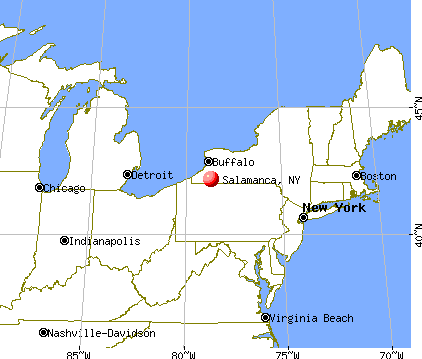
SALAMANCA, N.Y. — Tucked in the foothills of western New York's Allegany Mountains, Salamanca doesn't appear to have changed much in the last 100 years — let alone the last 10 since the Seneca Indian Nation opened a major casino on the edge of town.

With New York about to vote Nov. 5 on a casino proposal that's being promoted as a driver of economic growth in small upstate communities like theirs and the state as a whole, residents here say that while the casino has delivered jobs, the bustle and din of 2,000 slot machines and an average of 8,000 daily visitors, its effect is barely evident outside the gleaming gambling palace walls.

"When the casino came, I thought, 'Great, the town's going to perk up,'" Barbara John said as she worked in a consignment shop near the casino, which towers from the landscape off Interstate 86. "I expected more."

There have been no spinoff restaurants or attractions to keep casino patrons in town, and existing business owners say that except for two hotels, the fast-food chains in the casino's shadow seem to be the biggest winners of any spillover business. Nevertheless, with more than 900 workers, it has become a go-to employer, several residents said, and with its on-site restaurants and concert hall, another option for a night out in a place that lacks even a movie theater.

"In Salamanca, you can't even go buy socks and underwear. There's no place to buy it. There's no stores," said Mayor Carmen Vecchiarella, who described economic development in the community of 6,000 as "stagnant" since the casino.

He hopes that will change with the city's $3.2 million purchase of a 200-acre plot near the casino that is currently landlocked and not serviced by utilities. Salamanca will use casino proceeds to build roads to the site with the goal of accommodating tax-paying developers. There has been talk of locating a water park or shopping plaza there.

"Whatever we can get, it will drive economic development," Vecchiarella said.

If New Yorkers approve four more casinos upstate, an idea pushed by Gov. Andrew Cuomo for more than two years, two communities with harness track racinos — the tiny town of Nichols on the Pennsylvania border west of Binghamton and the booming city of Saratoga Springs — are considered likely contenders. So are several sites in the once-vibrant resort area in the Catskills, including the former Nevele and Grossinger's resorts.

The Seneca Allegany Casino opened May 1, 2004, in this Cattaraugus County city, which is positioned almost entirely on an Indian reservation. It is one of three western New York casino complexes operated by the Seneca Indian Nation under a revenue-sharing agreement with New York state.

The tribe turns over 25 percent of slot machine revenues to New York, which shares a quarter of that with the host communities to help pay their casino-related expenses, make up for lost tax revenues and, with what's left over, undertake new projects.

Salamanca, after expenses are paid, is left with an average of $2 million a year for economic development, said Vecchiarella, who only recently received the last four years of casino payments following resolution of a dispute between the state and Senecas that held up their delivery.

Still, he believes the casino has been good for the community about an hour's drive south of Buffalo.

"It brought employment, activity to Salamanca," he said. "Anything that you bring into an area is a positive because there's something there, something to do."

A consultant's 2004 projection that Salamanca would need to spend about $9.4 million getting ready for the casino was accurate, Vecchiarella said, noting the need for upgrades to electrical and wastewater systems and purchase of a ladder truck for the fire department, which, until the 11-story casino hotel, hadn't needed anything with such reach.

Consultant Rodney Hensel's projection of a 30 percent increase in ambulance calls was low: Town statistics show about a 50 percent increase in emergency medical calls from 2003 to 2012. Vecchiarella said the volume of speeding tickets and other traffic infractions written by police also has grown. On the plus side, there has been no noticeable increase in serious crime, the mayor said, an observation confirmed by statistics.

In 2003, before the casino opened, the town recorded 68 violent crimes, including three rapes, three robberies and 62 assaults, records from the state Division of Criminal Justice Services show. In 2004, violent crime peaked at 99, before falling by nearly half in 2005 and half again in 2006 and leveling off. Last year, there were 25 violent crimes, including three robberies and 22 assaults.

Unemployment in Cattaraugus County, meanwhile, hovers around the statewide average of just over 8 percent, while Salamanca's average rate from 2006 to 2010 was about 10 percent, according to a state comptroller's office report.

It is hard to measure the casino's effect on the city's property taxes because more than 60 percent of Salamanca parcels are tax exempt, a number that grows with each purchase on reservation land by a Seneca Nation member.

Even so, resident Barbara Dexter said the casino has done more harm than good, saying that while she enjoys the casino's buffet and steakhouse, she feels for the problem gamblers who cannot keep away from the slot machines and table games.

"When they're blowing all their money, it's terrible," she said while getting her nails done at a Main Street salon that was empty except for one other patron.

Rachael Ferguson, a casino cook who recently opened a bakery on Main Street, said the casino was not part of her decision to start a business and supplies only the occasional customer.

But she said it is good for the town because it brings people who otherwise might not come.

Fellow casino cook and business partner Carol Bryant agreed. She moved to the Salamanca in February.

Said Bryant: "It's the first place I went to get a job."

http://online.wsj.com/article/AP14d9608f72ac4159a8563c2cb61f45da.html

Saturday, June 8, 2013

Reality Doesn't Change

New York State introduced OTB parlors into low income neighborhoods, driving up crime, chasing out local business. Now Gov. Cuomo seeks to expand the failures of community destruction, as if the evidence of the slums of Niagara weren't adequate.

The Addiction is politicians incapable of job creation and economic development that mirrors the fantasy of Massachusetts.


Seneca leader in Albany calls Cuomo a “bully”

on June 4, 2013 - 3:12 PM
 
ALBANY – The head of the Seneca Nation of Indians on Tuesday took his cause to protect the tribe’s casino developments to legislative leaders in Albany.

Seneca President Barry Snyder Sr., twice calling Gov. Andrew M. Cuomo a “bully,” said his meetings with top Democratic and Republican lawmakers were aimed at persuading them to honor the tribe’s exclusivity deal for gambling rights in Western New York.

“He’s a bully. I’ll say it again – he’s a bully,” Snyder said in an interview with The Buffalo News.
Snyder’s visit to Albany came as Cuomo has privately told officials he is readying a casino expansion bill that would open the way for one new, non-Indian casino in Western New York. He has already floated the idea of putting a casino in Niagara Falls near the Seneca Nation’s casino and hotel.

Cuomo officials don’t believe the Senecas will be serious about making a deal with the state in the dispute over the Seneca’s withholding of casino-revenue sharing until the state formally seeks to cut a real deal with a private developer for a non-Indian Niagara Falls casino, according to individuals close to the talks.

Cuomo administration officials declined to comment on Snyder’s remarks.

One lawmaker who met with Snyder said the Seneca leader made clear his frustrations in dealing with the Cuomo administration and raised doubts about being able to strike a deal with the governor before the legislative session ends June 20.

Snyder said his meetings Tuesday with lawmakers were intended to persuade them not to locate a new casino in Western New York.

“Just honor the compact,” he said he told legislative leaders.

“We don’t care where they build [casinos] as long as they don’t build in our exclusivity area. We don’t care. They can build all over the state,” Snyder said.

Still, Snyder sought to downplay concerns about Cuomo’s threat to locate a new casino in Niagara Falls.

“It doesn’t worry me. We’ve been here for 10 years. We’ve built up our customer base … I like the McDonald’s concept. McDonald’s moves in, then Burger King, then Pizza Hut. Everybody moves in the same area, and we get all the customers. I like the concept. I’m really thinking competition may be good for us. We’re not afraid of it.”

Snyder said his presence in Albany on Tuesday showed the Seneca Nation is interested in finding a solution to the dispute with Cuomo.

“We’ll do what we can, but it has to be equitable to the nation. It can’t be any other way,” he said.

The Seneca leader bristled at Cuomo’s recent suggestions that the Seneca casinos might have to close down in 2016 when the nation’s compact expires, if there is no deal with the state to resolve the $600 million dispute over unpaid revenue-sharing from the Seneca casinos. He noted the tribe’s casinos will soon employ close to 6,000 people, many of them non-Indians.

He noted that a majority of casino employees are non-Native. “They pay taxes and own homes and do all the good things for the state, so why would you want to jeopardize that if you’re a good leader?” Snyder said.

http://www.buffalonews.com/apps/pbcs.dll/article?AID=/20130604/CITYANDREGION/130609661/1010

Economics and job growth most important factors in casino licensing

Friday, June 7, 2013
Economic activity and business development are the most important criteria for any application to get a license to operate a live-table casino in New York.

Gov. Andrew Cuomo's siting plan for three upstate non-indian casinos says the "decision by the [state resort gaming facility location board] to select a casino license facility applicant shall be weighted by sixty-five percent" based on economic factors. Those factors include nine points, such as, creating the most high quality jobs and maximizing revenues received by the state and localities.

This also includes "offering the fastest time to completion of the full gaming facility," which should benefit competing racinos. Because the racinos have most of their infrastructure in place, they would only need to expand their gaming space to hit this mark.

The full text of the bill is available HERE.

Twenty percent of the decision is based on "local impact and siting factors." These include local support for the plan, partnerships with local businesses and mitigating potential negative local effects of the casino.

Support can be demonstrated with passage of local laws or public comments.

"Workforce and societal enhancement factors" make up the remaining 15 percent of the board's decision.

The potential impact of Cuomo's legislation on the Saratoga Casino & Raceway's chances to get live-table games remains to be seen.

http://www.dailygazette.com/weblogs/capital-region-scene/2013/jun/07/economics-and-job-growth-most-important-factors-ca/


Governor Cuomo Releases the Upstate NY Gaming Economic Development Act

Thursday, June 6, 2013

Niagara's Addiction to Gambling Revenues

Just as in Massachusetts, in desperation, Niagara Falls' leaders failed to consider the community destruction caused by Predatory Gambling ----


June 4, 2013

State audit raises concerns over Niagara Falls' budget practices

Niagara Gazette — An audit released Tuesday by the New York State Comptroller's Office raises serious concerns about the city's finances, including a "pattern of structural deficits" due to a lack of incoming casino revenue and budgetary decisions made by city officials in recent years.

The audit suggests matters were "worsened significantly" as a result of the continued inclusion of unrealized casino revenues in annual budgets and a reliance on what auditors described as revenue "one-shots" drawn from fund balance and surplus capital project funds.

“Niagara Falls has nearly exhausted its resources to avoid a fiscal crisis," state Comptroller Thomas DiNapoli said in a statement accompanying the audit. "City officials cannot continue to walk a financial tightrope for much longer."

The audit describes the lack of incoming casino revenue since 2008 as one of the reasons recurring revenues have not been sufficient to fund recurring expenditures. The situation, according to auditors, resulted in a general fund annual budget gap averaging $12.4 million during the audit period from Jan. 1, 2009 through Jan. 9. The audit indicates that city officials balanced budgets using fund balance and an estimate for casino revenue averaging $5.3 million annually.

"While the dispute over gaming revenue is significant, the city’s budget challenges also stem from a number of socio-economic factors including population loss and a high unemployment rate," DiNapoli said. "The mayor and the city council are actively trying to manage their considerable hurdles, but getting on firmer financial footing will require a resolution of casino gaming issues and likely even greater assistance from the state."

The audit suggests Dyster's administration should have removed casino revenues from annual budgets during the casino cash dispute to better protect the city's overall financial position. Auditors also said the city should have developed more formalized multi-year plans for eliminating accumulated deficits.

"The city has funded these structural deficits by relying on "one-shots" such as fund balance and surplus moneys remaining in the capital project fund," the audit reads. "This approach has negatively affected the general fund's financial condition. The controller indicated that the general fund ended the 2012 fiscal year with an unassigned fund balance deficit of approximately $5.2 million.

Therefore, over this four-year period, fund balance decreased by about $21.6 million."
Auditors concluded that while it "might have been prudent" for the city to account for incoming casino revenues when the gaming revenue squabble started in 2009, as the dispute "dragged on without resolution," it should have removed those revenues from its financial plans. Instead, as of Dec. 31, 2012, the audit notes that the city incurred, in the aggregate, $23.4 million in expenditures intended to have been funded with casino money, that it has not received.

Dyster declined comment when reached by telephone Tuesday morning prior to the audit's formal release, saying he could not discuss what was at the time considered a "draft" report.
In a letter of response attached to the final audit, Dyster's administration indicated that it budgeted casino revenues to "support" the state's long-held position on the dispute itself.

"This situation is virtually unprecedented in the history of New York state, and almost beyond the control of the city of Niagara Falls," Dyster wrote. "The city has been forced to choose among largely bad options with little guidance as to what constitutes best practice under often unique circumstances. Given the state's degree of involvement and responsibility in this matter, we find it somewhat ironic that an agency of the state of New York would now find itself in a position to critique our attempts to deal with a crisis in which the state itself has been a central actor."

In their report, auditors noted that although the city's fund balance had been depleted, it continued to budget for what they described as "one-shot revenues," including in the 2013 budget which relied upon $2 million in unavailable appropriated fund balance, $2.9 million in transfers from the capital projects fund, $850,000 in debt service fund transfers and $1 million in property sale revenues. As a result, auditors concluded that the city's 2013 adopted general fund budget has a structural deficit of $12 million.

"Therefore, if the city does not receive any or an insufficient amount of casino revenue in 2013, it will have a revenue shortfall of approximately $7.2 million, representing the budgeted casino revenues and the unavailable appropriated fund balance," the audit reads. "Moreover, even with a resolution of the casino revenue impasse that would positively impact the city, the council and mayor will still need to take action to address the structural budget deficits affecting the city."
In its letter of response, the Dyster administration takes exception to auditors' reference to "one-shot" revenues.

"The report goes on to take issue with the city funding certain structural deficits by relaying on 'one-shots,'" Dyster wrote. "The city's strategy should not be characterized in this way. Large fund balance surpluses remaining on capital projects, as well as from the general fund, have been used time and again (year after year) in order to close deficits. Had the city not used those surpluses, they would have sat on the books and accomplished no purpose."

DiNapoli's office also suggested the city should have been more diligent in closing out completed capital projects and ensuring that all unexpended funds are transfered to the debt service fund and used only for "payments on all related debt." While the report notes that a "substantial amount" of unassigned fund balance in the capital projects fund was accounted for by Controller Maria Brown's office, it estimates that additional funds - ranging from $1 million to $1.4 million - may remain in other projects that could be returned to the general fund.

Reached by telephone on Tuesday, Brown said her office is not in a position to closely monitor all capital projects, including such things as road repair or construction jobs. She suggested the work was more in keeping with the duties of the city engineer, a position that has been in flux at various points under the Dyster administration.

"I repeatedly asked for a list of closed projects from engineering to no avail," she said. "I send reports on a continuous basis to the mayor and the city administrator informing them on the status and funds for projects and encouraging them to find out when, and if, projects closed," she said.
Brown said the city has maintained multi-year plans for various accounts in recent years and that, although not required to, the city was asked by state auditors to maintain those plans in a different form recommended by the state.

Brown noted that auditors took a look at "thousands and thousands" of transactions as part of a six-month review and did not identify anything improper.

"Everything was in order," she said. "Everything required of my office was in place."
The draft audit predicts "significant cash flow shortfalls" for the city in 2013 and a need for the city to issue short-term debt to address cash flow problems late in 2013. It also notes that the city's credit rating has been downgraded several times in recent months and may be reduced further in the future, possibly preventing the city from being able to issue debt or to do so at a reasonable cost.

"The biggest thing is the lack of casino funds and I don't want people to lose sight of that," Brown said. "It all boils down to the lack of casino funds that put us in the situation we are in."

FALLS AUDIT DiNapoli's office recommended that the city take the following corrective actions in the release; • Establish policies and procedures for access controls to restrict financial software permissions to only those functions that are necessary for employees' job duties • Designate someone independent of the city controller's office as the city's financial system administrator • Ensure that logs for the financial system are maintained and periodically reviewed • Establish policies and procedures for data backup and storage, and comprehensive guidelines for disaster recovery

http://niagara-gazette.com/local/x1465637714/Audit-takes-Falls-to-task-State-audit-raises-concerns-over-Niagara-Falls-budget-practices