Meetings & Information


*****************************
****************************************************
MUST READ:
GET THE FACTS!


Showing posts with label Oxford Casino. Show all posts

Sunday, August 21, 2016

Maine’s Harness Racing Industry Struggling Despite Influx of Slots Revenue


Maine’s Harness Racing Industry Struggling Despite Influx of Slots Revenue

  AUG 17, 2016
More than a decade ago, Maine voters gave the green light to slot machine gambling in the state. In making their case to voters, supporters vowed that some of the revenues would prop up the state’s ailing harness racing industry. But recent data show that since then, more than $100 million dollars in slot machine proceeds have gone to the industry in Maine — and it’s still struggling.
Back in 2003, lawyer, horse farmer and sometime racehorse driver William Childs spent a lot of time in Augusta, trying to convince the Legislature to approve slot machines in Maine.
“It would revitalize harness racing,” he said at the time. “We pretty much race for the same purses now that my grandfather raced for in 1970, and of course the costs haven’t remained the same.”
Childs and others viewed slots as a way to revive the beleaguered harness racing industry, keep pastures from getting paved over with parking lots, blacksmiths busy shoeing horses, breeders buying feed and trucks.
Voters bought in, and the referendum they passed required slots to be linked with commercial tracks in Scarborough and Bangor.Profits would go to the state’s general fund and to a cascade of other programs, including the harness racing industry.
Slot revenues have boosted purses, helped the state’s 26 agricultural fairs and made direct payments to Bangor Raceway and Scarborough Downs — no strings attached.
The horses are still trotting at Bangor Raceway, a few hundred yards from Hollywood Casino, which became the state’s first legal gambling venue in 2006. But Scarborough voters refused to authorize slots at their track, and horsemen say that was a big setback.
Still, state records show that more than $100 million has been sluiced from gamblers’ pockets to Maine’s harness racing industry and agricultural fairs. But has it done the trick?
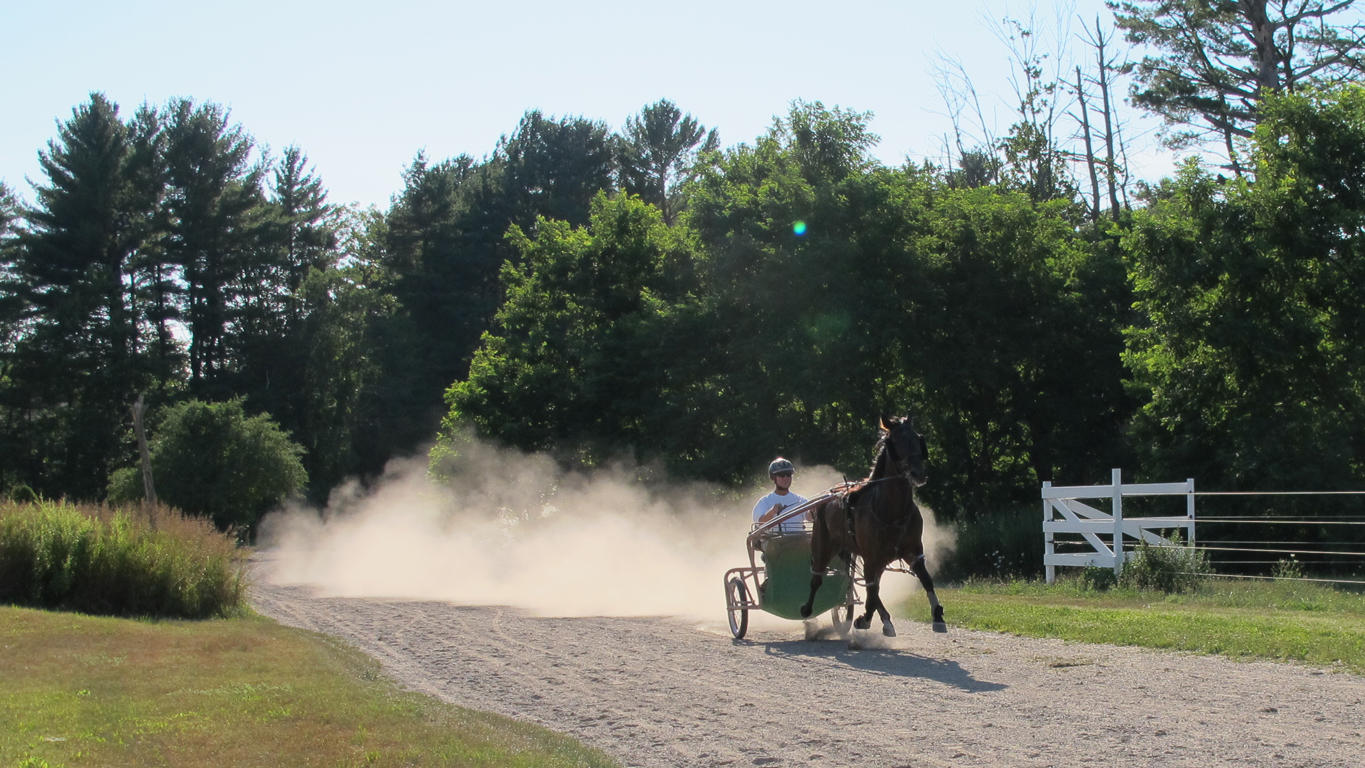
To try to find out, I recently visited Childs’ horse farm, a 30-acre bit of rural bliss in Westbrook. Race Me Stables is an active place where horses are trained and boarded, lessons are given, and equestriennes can practice their paces. Childs prepared one of his racing pacers, RaceMeAndroid, for a run around a half-mile training track.
More than a decade ago, Maine voters gave the green light to slot machine gambling in the state. In making their case to voters, supporters vowed that some of the revenues would prop up the state’s ailing harness racing industry. But recent data show that since then, more than $100 million dollars in slot machine proceeds have gone to the industry in Maine — and it’s still struggling.
Back in 2003, lawyer, horse farmer and sometime racehorse driver William Childs spent a lot of time in Augusta, trying to convince the Legislature to approve slot machines in Maine.
“It would revitalize harness racing,” he said at the time. “We pretty much race for the same purses now that my grandfather raced for in 1970, and of course the costs haven’t remained the same.”
Childs and others viewed slots as a way to revive the beleaguered harness racing industry, keep pastures from getting paved over with parking lots, blacksmiths busy shoeing horses, breeders buying feed and trucks.
Voters bought in, and the referendum they passed required slots to be linked with commercial tracks in Scarborough and Bangor.Profits would go to the state’s general fund and to a cascade of other programs, including the harness racing industry.
Slot revenues have boosted purses, helped the state’s 26 agricultural fairs and made direct payments to Bangor Raceway and Scarborough Downs — no strings attached.
The horses are still trotting at Bangor Raceway, a few hundred yards from Hollywood Casino, which became the state’s first legal gambling venue in 2006. But Scarborough voters refused to authorize slots at their track, and horsemen say that was a big setback.
Still, state records show that more than $100 million has been sluiced from gamblers’ pockets to Maine’s harness racing industry and agricultural fairs. But has it done the trick?
To try to find out, I recently visited Childs’ horse farm, a 30-acre bit of rural bliss in Westbrook. Race Me Stables is an active place where horses are trained and boarded, lessons are given, and equestriennes can practice their paces. Childs prepared one of his racing pacers, RaceMeAndroid, for a run around a half-mile training track.

“We’re still here,” he said, soon after a blacksmith finished re-shoeing the horse. “Without the referendum, without the racino in Bangor, Bangor would not have survived, Scarborough Downs I don’t think would have survived. The fairs would have been severely impacted — The industry would have folded up.”
Childs said the purse supplements have boosted his winnings enough to help him keep the stable’s doors open, at a time when prices - for hay and grain, for veterinarians and taxes - all keep going up.
“Without it this would be house lots,” Childs said. “It still may be house lots.”
The industry did see a bump after the 2003 referendum, with more owners, racehorses and breeding horses coming on the scene. But the longer-term trend is in the other direction. Between 2007 and 2015 the number of Maine-registered harness racing stallions, for instance, that were available for breeding declined by more than half, from 73 down to 30. The number of foals has declined to just 83 last year.
“We still have people that want to buy horses,” said Dianne Perkins, president of the Maine Standardbred Breeders and Owners Association. “Our goal right now is to find mares, get people to breed mares. We need horses.”
Perkins said its important to understand that the numbers were affected by the closure, for the owners’ personal reasons, of two of the largest breeding outfits. There’s also the black eyes the industry gets when horse doping cases come to light, a bad trend she says has been rising.
And then, she says, there’s something else.
“OK I am going to say right now,” she said, “there’s a little bit of lack of interest, OK?”
Some owners, she says, are having a tough time finding appropriate races to enter in Maine, and they are shipping their stock out of state, often to Amish buyers.
And at Scarborough Downs, the center of the state’s harness industry, times are a little tough.
“There is an issue with horse supply right now,” says Mike Sweeney, spokesman and track oddsmaker at Scarborough Downs, which has canceled six race days this summer after failing to secure commitments for some 400 horse entries needed to fill out the race cards.
Like many in the industry, he says the rejection of a slots facility at Scarborough really hobbled the industry’s revival efforts. And even at Bangor, he said, the decision to locate the new gambling hall several hundred yards away from the track bypassed an opportunity to raise interest in racing among a new generation of gamblers — who have so many gaming opportunities not just at proliferating casinos, but online too.
In some other states, Sweeney says, some tracks have flourished when located right next to slots parlors.
“That’s never happened here in the state of Maine, and I think that’s one of the reasons the industry really is in a state of decline right now,” said Sweeney, president of the Maine Standardbred Breeders and Owners Association.
Scarborough and Bangor don’t publish attendance records, but here’s another indicator of where things are headed: Since 2006, the amount of money bet each year on races in Maine has fallen by more than half, from $68 million to $33 million last year.
State Rep. Louis Luchini, an Ellsworth Democrat who co-chairs the Joint Committee on Legal and Veterans Affairs, which has oversight of Maine’s gambling sector, sees the industry’s benefits to the state, but he points out that there are more pleasure horse owners than racehorse owners in Maine, and that they also benefit the economy.
“And we don’t give them any money from the casino,” he said. “[The horsemen’s] argument makes sense. They do have a big impact with agriculture, with the veterinarians, farming. But if you’re giving $100 million to something, you really have to make sure that it works.”
If Luchini is re-elected, you can bet he’ll be taking a close look at slot machine funds in the next legislative session.
Scarborough, meanwhile, will be asking for permission to reduce the number of race days it holds, while holding on to the $1 million-plus annual stipend it gets from the slots.
And members of the harness racing industry? Look for them to find ways to try to breathe new life into a pastime they hope still has a future in Maine.

Saturday, March 22, 2014

WARNING: CLYDE BARROW IS A SHILL FOR THE GAMBLING CASINO INDUSTRY

Ssssshhhh! Don't tell CLYDE! He'll threaten to sue again!


Old news worth re-visting....


The voice of the people
 

Thursday, October 2, 2008

WARNING: CLYDE BARROW IS A SHILL FOR THE GAMBLING CASINO INDUSTRY

PORTLAND – The proponents of Question 2, the Oxford County casino, have enlisted the aid of Clyde Barrow, a political scientist at the University of Massachusetts Dartmouth, to make the case for their casino. An article by Barrow defending the Oxford County casino appeared in the Portland Press Herald last week, and Barrow is scheduled to meet with the Oxford County Commissioners next week along with the proponents of Question 2.

Barrow is well known in casino circles for his pro-casino findings. His “research” is controversial, to say the least. Editors, reporters and members of the public should be aware of Barrow’s background and dealings, such as:

Although Barrow talks at length about the economic impacts of casinos, he is not an economist. His degree is in political science.

Barrow is the director of the Center for Policy Analysis, which studies casino gambling in New England. He purports to be an independent analyst, but his conclusions always favor the casino industry and questions have been raised about his impartiality.

In 2006, Barrow received $20,000 from the Rhode Island Buildings Trade Council, which was supporting a Harrah’s casino for that state, for a study showing the positive impacts of a Harrah’s casino. Records show that at the same time Barrow received payment from the union, Harrah’s donated $25,000 to the Trade Council. Greg Mancini of the building trades group told the Boston Globe that he went to Barrow to add “intellectual heft” to the pro-casino position. “We went to Clyde Barrow and asked him to prove it from an academic point of view,” Mancini said. “He said, ‘Yeah, I can do that. But it’s going to cost money.’”

Lincoln Almond, the former governor of Rhode Island, called Barrow “one of Harrah’s paid consultants” who lives in a “fantasy world” of illusive casino benefits.

In 1999, Barrow’s group received funding from the Visions Group, a business group then pushing for a casino in Salisbury, MA. Other communities and groups in favor of a casino have also hired Barrow, and he has been a paid spokesperson at conferences sponsored by the casino industry.

A casino developer who controls land in New Bedford and Palmer, MA partially funded one of Barrow’s “studies” that supported a casino in that area of the state.
Barrow’s “research” often shows how states are losing money to casinos in neighboring states. But his numbers are based on flimsy research and often don’t add up. For example, during last year’s debate over plans for three casinos in Massachusetts, Barrow claimed that his research showed that 35% of the patrons at Foxwoods hailed from Massachusetts. He reached that conclusion by hiring students to record license plates parked at Foxwoods over a five-day period. However, Foxwoods officials said based on their own analysis of license plates, credit card receipts and other data, the number of Massachusetts patrons regularly visiting Foxwoods is actually much lower.

Rep. Dan Bosley of Massachusetts told the Globe that Barrow's studies are speculative, rely on a sample of casino patronage that is too small, and assume values for calculating total spending that cannot be verified. “Given Dr. Barrow's flawed research, it's a little embarrassing that he is a tenured professor at a public university,” Bosley said.

In an editorial in May, SeaCoastToday.com took issue with Barrow calling complaints by casino “skeptics” as “rhetoric.” “By labeling opponents ‘skeptics’ and their words ‘rhetoric,’ Dr. Barrow goes beyond describing the poll results,” the editorial stated. “He casts a negative light on anyone who would oppose or even question (those pesky skeptics!) the idea that Massachusetts should welcome casinos. Unfortunately, Dr. Barrow is starting to look more like a lobbyist — and less like someone whose research happens to receive private funding.”

· Nevertheless, in an e-mail to Oxford County Commissioners, the backers of Question 2 describe Barrow as “one of the most respected” experts of casino gambling in the country. He sure is respected by the casino industry.


http://rumfordfreepress.blogspot.com/2008/10/warning-clyde-barrow-is-shill-for.html


Sunday, September 8, 2013

What are we seeing when we see "successful" casinos?


What are we seeing when we see "successful" casinos? We're seeing how much money people lost to gambling.

Casinos don't add to the economy or to the community, they merely redistribute money, with a huge cut leaving the state in the pockets of the investors. The handouts to the host community aren't earned, and haven't come from a revenue stream that supports the consumer economy.

See more at:
http://bostonherald.com/news_opinion/national/northeast/2013/06/new_maine_casino_has_65m_in_1st_year_revenues#sthash.InwweiyL.dpuf

New Maine casino has $65M in 1st-year revenues


Monday, September 2, 2013

Subsidies for Maine horsemen shrink this summer


Subsidies for Maine horsemen shrink this summer


By DAVID SHARP

Monday, September 2, 2013

In this Thursday, Aug. 29, 2013 photo, harness race horses cross the finish line at the Windsor Fair in Windsor, Maine. The state's casinos were supposed to help harness-racing tracks by funneling some of the proceeds to them, allowing them higher payoffs to keep horsemen from leaving the state. Instead, race tracks are struggling more than ever because wagering on horse races has fallen off as patrons migrate to casinos. Photo: Robert F. Bukaty

PORTLAND, Maine — Slot machines have helped Maine's harness-racing industry by funneling millions of dollars to horsemen, breeders and tracks. But declining slot machine revenue at Bangor's Hollywood Casino and other factors, including fewer spectators, have led to a double-digit drop in purses this year.

Jay Burns of Topsham, who co-owns a racing horse, said he was shocked last spring to learn that a race that once paid $4,000 would now pay $3,500, and that's been the trend all summer.

"There's no way to make up the money," he said, pointing to his fixed costs of food, supplements, veterinary care, trainer, driver, stable and transportation costs.

Casino funding available for purses through the end of July was down 22.5 percent from the previous year, corresponding to a drop in slot revenue at the Hollywood Casino, according to Henry Jackson, executive director of the Maine Harness Racing Commission. That led to a 15 percent cut in purses, he said.

Industry officials say the opening of Oxford Casino siphoned away customers and revenue from Hollywood Casino. But there are other factors at play. Different contribution formulas for the two casinos, fewer spectators placing bets at tracks, unregulated online gambling and a weak economy are taking a toll, officials say.

It all makes for an uneasy feeling in the industry.

Mike Graffam, a horse farm owner in Falmouth, said he can't help but be concerned for the industry's long-term outlook when he sees a decline in spectators at tracks.

"It's sad to go to the races and not have the public there like we used to," said Graffam, who owns a 52-acre farm and bales hay on 100 more acres. "I almost feel like a dying breed."

Slot machines at the Bangor casino, which opened in 2005, were supposed to give a boost to harness racing and they've done just that with subsidies currently accounting for 80 percent of purses, officials say. Subsidies also go to breeders, track operators and off-track betting parlors.

Harness racing perseveres, with about 1,400 horses available for racing in Maine and 300 others used for breeding. Racing continues at two commercial tracks and at local fairs.

But there's been a dramatic change since the opening of Oxford Casino, which cut into Hollywood Casino's revenue but provides far less subsidies to horsemen and race tracks. The introduction of table games at Hollywood Casino further cut into slot revenues, but none of the table game income goes to the racing industry.

Of its gross slots revenue, Hollywood Casino is required to donate 10 percent to live-racing purses, 4 percent to harness-racing tracks, 3 percent to breeders, 3 percent to agricultural fairs and 1 percent to off-track betting parlors. Oxford Casino provides just 1 percent each to breeders, purses and agriculture fairs and nothing to commercial tracks.

"What we picked up from Oxford in new money won't fill the hole from the money that was lost from Bangor from the decline in revenue," said Don Marean, a state lawmaker and horse farm owner in Hollis.

Ed MacColl, an attorney for Scarborough Downs owner Sharon Terry, said the harness-racing track in southern Maine is being choked by the larger casinos.

"The largest gaming businesses in Maine used to be these racetracks. They were owned locally by people who'd been here a long time. They were neatly woven into the fabric of our fairs and the agriculture part of our economy. We're just replacing that with casinos that are owned by publicly traded, out-of-state mega firms," he said, pointing to out-of-state ownership of the two casinos in Oxford and Bangor.

The state has put a hold on any further gambling until a 20-member commission can study its impact.

The commission, which meets this week for a second time, aims to create a competitive bidding process for future casinos and slot machine licenses. Scarborough Downs and the Passamaquoddy tribe in eastern Maine both want to operate casinos.

For now, the fair season will soon draw to a close with the Windsor Fair on Labor Day, followed by fairs in Oxford, Farmington and Fryeburg. Harness racing at the commercial tracks in Bangor and Scarborough continues until later in the season.

Wendy Ireland of the Maine Harness Horsemen's Association said she believes the weak economy is mostly to blame for troubles and the industry is holding its own.

Back in Falmouth, Graffam said that while he sees warning signs, he remains hopeful about the future because of the passion of those who work in the industry.

"I still have owners who are hooked on horses. That's been my thing, too. Once you experience owning a horse and doing what we do, it gets stuck in your blood and it's hard to walk away from it," Graffam said.

http://www.fosters.com/apps/pbcs.dll/article?AID=/20130902/NEWS22/130909889/-1/FOSSPORTS


Wednesday, July 10, 2013

Fox Guarding Hen House in Maine


Gambling board questions independence of casino overseer that wants to buy slot machine distributor


Monday, July 1, 2013


File photo
Scientific Games, which holds a state contract to track real-time slot machine revenues at Hollywood Casino in Bangor and Oxford Casino and report it to the state, announced its plans earlier this year to acquire the gaming company WMS Industries. WMS is one of five slot machine distributors authorized to do business in Maine.


AUGUSTA — The company that tracks slot machine revenues at Maine’s casinos and warns the state’s gaming regulators if anything is amiss is acquiring one of the five slot machine distributors authorized to do business in Maine.

Scientific Games, which holds a state contract to track real-time slot machine revenues at Hollywood Casino in Bangor and Oxford Casino and report it to the state, announced its plans earlier this year to acquire the gaming company WMS Industries. The two companies expect to complete the deal by the end of the year.

Once the $1.5 billion transaction is complete, Scientific Games would be keeping track of the revenues generated by machines manufactured by its subsidiary and four other distributors and letting the Maine Gambling Control Board know of any malfunctions. Scientific Games is also responsible for shutting down slot machines and informing the control board if any machines fall out of compliance with the state’s standards for the slot machine software.

The five-member Maine Gambling Control Board won’t be required to issue a new distribution license to the combined company, but the board will have to determine if the reconfigured company meets the requirements of its current license, said Patrick Fleming, the control board’s executive director.

Fleming said he’s preparing an analysis for the board to assess whether Scientific Games can continue its independent oversight role for the state’s slot machines when the company owns one of slot machine manufacturers.

“They’re pretty independent at this point from what I can see,” he said.

The control board quizzed a Scientific Games vice president about the acquisition at an April board meeting.

“We rely on you to monitor our slot machines, and we’ve relied on you since Day One,” said Timothy Doyle, the board’s chairman. “How do you segregate the duties such that the monitoring system and the machines, they maintain the integrity that the state expects?”

Brennen Lawrence, senior vice president and general manager for Scientific Games, said the company is obligated by the terms of its contract with the state to perform what’s known as central site monitoring for slot machines.

“Your requirements of Scientific Games are very specific for the data that we acquire,” Lawrence told the control board. “Although we might have tons of data points, none of it is accessible, and none of it is allowed for Scientific Games’ use for any other purpose than providing it to the state.”

Doyle suggested the company set up a management structure that isolates central site monitoring from slot machine sales and distribution. “I think the board will be looking at that with a sharp eye,” he said at the April meeting.

Doyle declined to comment further on Monday, saying he shouldn’t prejudge a matter before the Gambling Control Board. Aimee Remey, a Scientific Games spokeswoman, said Maine is one of 14 North American gambling jurisdictions that allow central site monitors to also own machines.

Scientific Games has performed central site monitoring for Maine slot machines since 2004, before Hollywood Slots opened its doors in Bangor. All slot machines at Maine’s two casinos are connected to a Scientific Games system that collects real-time revenue figures. Scientific Games makes sure the machines are reporting the numbers correctly and reports those numbers to the state.

The casinos submit revenue figures separately, and Maine Gambling Control Board auditors confirm the figures are accurate.

Under its contract, which expires in 2017, Scientific Games collects 0.88 percent of net slot machine revenue, Fleming said. That amounted to more than $5 million in 2012, according to Maine Gambling Control Board figures.

The company also has a separate contract to operate much of Maine’s state lottery.
WMS Industries is one of five distributors authorized to sell slot machines in Maine and is one of the largest gaming manufacturers in the country.

I. Nelson Rose, an expert in gambling law and a professor at Whittier Law School in Costa Mesa, Calif., said he wouldn’t be surprised to see a state in Maine’s situation put its central site monitoring contract back up for bid in order to avoid a conflict.

“The state is going to have to decide whether the companies are still going to be independent enough to trust,” he said, “and they have to worry about reputation, so they may very well require that the contract be put up for bid again.

“It’s not a good image to be self-regulating, even if it’s common.”


http://www.sunjournal.com/news/0001/11/30/gambling-board-questions-independence-casino-overs/1387252

Saturday, March 30, 2013

Maine: Broken Promises! They Told You So!


Maine's Oxford Casino Sold to Multi-State Gaming Company
03/29/2013
Reported By: Patty B. Wight Oxford Casino


The Oxford Casino is being sold to an out of state company. The news comes less than a year after the casino opened, and follows a voter approval campaign in 2010 that touted local ownership as a major selling point.


Oxford casino 3


The price tag for the Oxford Casino is a cool 160 million dollars in cash.

"Well, we're all Maine business people, and running casinos is not our expertise," said Suzanne) Grover one of the Oxford Casino's seven owners.

Grover said the search for a buyer started about six months ago, and has culminated in a deal with Kentucky-based Churchill Downs, the company that runs the Kentucky Derby.

"Maine is a beautiful area, so it's a very appealing property," said Churchill Downs spokeswoman Courtney Norris.

Maine is also appleaing, said Norris because it is gaming-friendly. She said Churchill Downs is diversifying, adding to its holdings of two casinos in Mississippi, as well as racinos in Florida and Louisiana. Gambling opponents said they're not surprised by the pending sale.
"I told you so," said Dennis Bailey is executive director of Casinos No! "I hate saying that."

He said Mainers have been hoodwinked by casino proponents.

"They sold themselves as local business people" Bailey said "Local owners. Maine-based with a real commitment to the area. That's really why they won. That was their message over and over again."

Mark robinson, a PR consultant who worked on the pro casino campaign said the sale is a surprise to him.

"Well the news runs contrary to everything I was told as I was being recruited to be the spokesperson for the effort," he said.

Promises of local ownership aside, Oxfords' Susan Grover said she and other owners have delivered on their promises.

Oxford casino 4"We uh, won the campaign we put up a beautiful facility," said Grover. "We are employing and they will continue to employ 400-plus people from the state of Maine, and they will continue to move forward with exactly what we were planning to do."

Norris said her company always looks to improve their guest's on-site experiences, and they'll evaluate expansion plans once the sale is complete.

"The company is familiar with the original master plan, and the vision they have for the development of the hotel and other amenities at the property," Norris said.

Oxford Town Manager Michael Chammings said he's fine with the news, and predicts the sale will create even more jobs.

"I think the advantage of what they have, the group that's taking this over, is that they've done this in other areas, and they'll be able to move more quickly on the development of it," said Chammings.

Bailey agrees that's possible, but he said that without a local stake in the casino, there's just as good a chance that Churchill Downs will pull out if the facility isn't making enough money.

The sale is expected to be complete at the end of this year, so long as the Gambling Control Board gives its approval.
Photo by Susan Sharon.

http://www.mpbn.net/News/MaineNewsArchive/tabid/181/ctl/ViewItem/mid/3475/ItemId/27135/Default.aspx

From:   CasiNO!


Get Involved


The gambling industry isn't giving up on Maine, and neither is CasinosNO!The indisputable facts are that casinos breed crime, lead to increased poverty, broken families, spousal abuse and suicides, drive traditional retail businesses and restaurants into bankruptcy, bring more traffic and congestion, and ultimately snare our political leaders and democratic institutions in a web of corruption.
Here's what you can do to give us a fighting chance to keep Maine's future bright.


Media
Mike Peters, Former Member, Maine Gambling Control BoardClick Here to view video [mpeg 4.0MB]

Friday, March 8, 2013

Solving the Problem Government Created: Gambling Addiction


Gambling Addiction: Maine Seeks Solutions as Gambling Expands
03/07/2013 Reported By: Jay Field


As many as nine million Americans will have a gambling problem in a given year, according to statistics on the Web site of the National Council on Problem Gambling. With the expansion of new casinos and other forms of gaming in Maine comes the risk that more people here will become addicted. In Waterville today, the state held its first ever conference on problem gambling. Jay Field paid a visit.
 
 
In late January, problem gambling got a new definition in the DSM. That's the book put out by the American Psychiatric Association to disagnose mental health conditions. For 33 years, the DSM defined problem gambling as an impulse control disorder, before finally re-labeling it a behavioral addiction.

It's a more accurate description of the problem Lesa Desmore struggled with. Densmore, who's in her early 40s now, started gambling as a kid, growing up in the Gardiner area. "You know, maybe playing some penny poker around the kitchen table, some basic scratch off tickets here and there," she says. "And then it progressed into very intense bingo for me."

Densmore eventually relocated to upstate New York, where she built a fitness, nutrition and wellness counseling practice, and discovered what she calls the crack cocaine of gambling addiction: video poker.

"I would work maybe a few hours and then I would - I would go - I would go to a casino somewhere," she says. "And I would spend my entire day there. I would lIve in my car, in the parking lot at the casino, and I would go in with the same clothes the next day."

Densmore's business fell apart. She lost her house, had two cars repossessed and ended up living in a tent for eighth months.

"I'm lying more. I'm manipulating more, and feeling out of control and not good as a person - a loser, incapable, weak, morally weak," she said. "I'd been thinking about ways to end my life for a little while, waking up the next day, and it hadn't happened. I went back to the casino."

With the help of family and friends, Densmore eventually made it into a residential treatment program for gambling addiction. She's a professional recovery coach now, counseling gambling addicts. She also travels the country, speaking at conferences. On Thursday, she traveled home to Maine to address the state's first inaugural conference on problem gambling in Waterville.

"So this is National Problem Gambling Awareness Week, so our effort is to try to get the information out this week," says Christine Theriault, who organized the conference. She's a behavioral health manager with the state's Office of Substance Abuse and Mental Health Services.

After a lengthy presentation by Densmore, a crowd of around 50 listened as a panel debated steps Maine should be taking to address problem gambling. The group included representatives from the Gambling Control Board, the Bureau of Alcoholic Beverages and Lottery Operations and the Hollywood and Oxford Casinos.

Theriault says that, so far, the casinos have been good partners on the issue of problem gambling.

"We have monthly conference calls to talk about what eachother's doing. We've collaborated on responsible gaming week, which is usually happening in August. They've promoted our 'Safe Bet' campaign by using our 'Safe Bet' napkins, which have information on the napkins that talk about how people can gamble responsibly," she says.

In addition to the napkin campaign, Oxford Casino has lots of brouchers through out the facility that alert patrons to the dangers posed by problem gaming. Tricia Johnson is the casino's point person for making sure Oxford follows all state and federal regulations.

"One of my roles is to train all of our employees. We have over 400 employees," she says. "So we touch upon problem gambling and making them aware of the addictive behaviors, in case they see it within their own families or within gamblers at the casino."

And Johnson says the casino is also working with Healthy Oxford Hills, a community health agency, to raise awareness through out the Oxford Region.

http://www.mpbn.net/News/MaineNewsArchive/tabid/181/ctl/ViewItem/mid/3475/ItemId/26736/Default.aspx
 

Friday, October 12, 2012

$3-billion casino plan unveiled for downtown Toronto


$3-billion casino plan unveiled for downtown Toronto


OXFORD PROPERTIES GROUP ILLLUSTRATION
This illustration, provided by Oxford Properties Group, shows a proposed casino development along Front St. W., in place of the current Metro Toronto Convention Centre.

Robyn Doolittle
Urban Affairs Reporter

A proposed $3 billion overhaul of the Metro Toronto Convention Centre that includes a hotel, sprawling urban park, two new office towers and a casino will generate $50 million in annual property tax revenue, plus millions more in profit-sharing, said an Oxford Properties Group official.

But a company executive warned that without a casino, the deal is dead.

“(The casino) allows us to privately fund the new convention centre and all of the new public amenities that this project includes. If the casino disappears, it’s back to the drawing board for us,” ^^^^^
Michael Kitt, the company’s executive vice president in Canada, said Friday, hours after Oxford released its proposal.

Officials at
MGM and Caesars both of which have expressed interest in building an “integrated resort” in downtown Toronto, gave the plan high marks, but observers outside of the gambling world were less enthusiastic.

As the tempting details of the plan circulated at city hall — a 2.2-hectare park over the railway tracks lined with cafes and shops, three floors of Eaton Centre-like retail, a modern convention centre and ballroom, office towers likely to include residential units — councillors grappled with that one important question: is it worth it?

Even right-wing councillors have been torn over whether it’s wise to bring a casino to Toronto to raise revenue. The Ontario Lottery and Gaming Corp. has selected the GTA as one of five sites to be awarded a new gaming facility. Downtown Toronto is the preferred site, but OLG chair Paul Godfrey says the corporation won’t force a casino on a community that doesn’t want it.

Council is expected to formally debate the issue early next year, with the vote expected to be close. So far, it seems the Oxford proposal hasn’t swayed any minds yet.

“We need to be open-minded. There are some positives …The question is: In order to get the hotel rooms, the entertainment, the restaurants, the bigger convention centre, do we need to add a casino to it? I’m not convinced yet,” said centrist Ana Bailão, who represents Davenport.

Said Parkdale Councillor Gord Perks: “It doesn’t matter how much lipstick they put on it. A casino is still a pig.”

Don Valley West Councillor Jaye Robinson, a member of the mayor’s executive committee, said she is waiting for a city staff report expected in November before making her decision.

“I know there are a lot of people on executive right now who are really struggling with this issue,” she said.

“I’m not sure I’m going to sell Toronto out in order to have a park. For me, it’s a pragmatic approach — what are the benefits to Toronto and weighing those against the cons that come with a Toronto casino.”

On Friday, Mayor Rob Ford told reporters he wants to see a casino built on municipally owned land — the Oxford property is privately owned — so the city can collect rent. Ford estimates a casino-hotel entertainment complex built at Exhibition Place or in the Port Lands could mean $100 million in annual revenue for the city.

“But if someone can come up on private land with the same amount, I’ll entertain that as well,” he told reporters.

Oxford, which is owned by the Ontario Municipal Employees Retirement System (OMERS), thinks it can.

No matter where the casino lands, Toronto will have negotiated compensation from the OLG. The slots at Woodbine bring in $15 million annually. Since 2000, the city has received nearly $182 million from those revenues.

Kitt says that, in addition, the new office, retail and hotel businesses would generate $50 million in property tax. Two office towers that currently pay $10 million in tax would be torn down during construction, he said, but that temporary loss in revenue would be mitigated by a staggered redevelopment schedule.

Furthermore, Kitt promises a huge injection into the local economy from an enlarged and updated convention centre.

“Bottom line is: we believe the city makes more money here,” Kitt said.

It is unclear where Ford came up with the $100 million annual revenue figure. Councillor Mark Grimes, chair of the Exhibition Place board, said a lease amount has not been discussed and he couldn’t make a guess as to what it might come to.

Under Oxford’s proposal, the real estate company would handle building the hotel, retail, park and office towers. An outside bidder would be sought to work on the design and build the hotel and casino — provided the OLG approves the site.

OLG spokesperson Tony Bitonti said Toronto City Council must make its decision first. If councillors decide they want a casino, the OLG will issue a request for proposals from interested parties — which is when Oxford would be welcome to apply.

MGM initially turned away from the convention centre site as its first choice because of traffic concerns.

With files from Paul Moloney

Friday, August 31, 2012

Maine: What they don't tell you....


New Maine casino nets nearly $10M in 1st 2 months

By Clarke Canfield
Associated Press / August 30, 2012
 

PORTLAND, Maine—Maine's newest casino had revenues of nearly $10 million in its first two months of operation, while revenues at the state's other casino in Bangor have fallen since the new casino opened.
Oxford Casino opened June 5 in the western Maine town of Oxford and had net revenues -- the amount lost by gamblers [local Maine residents] -- of $9.8 million in June and July combined. It paid nearly $4.1 million in taxes, according to the Maine Gambling Control Board.
 
Those numbers are strong, and revenues from the casino's table games are nearly double what was projected, said Clyde Barrow of the Northeast Gaming Research Project at the University of Massachusetts-Dartmouth. In July, the casino was winning an average of $2,471 per table game per day.


[When it is said that each Slot Machine permanently removes +1 job from the local economy, this is why. Clyde ignores the COSTS.]

"We had originally projected them to start out at about $1,300 per table per day and gradually ratchet up to $1,700," Barrow said. "Those numbers are comparable to Atlantic City."

[This tells you that Clyde's projections are merely guesswork - sometimes he's right, sometimes he's wrong.]


Oxford Casino is planning to add 10 more table games and hundreds more slot machines in October, said spokesman Scott Smith. It now has 529 slots and 12 table games including blackjack, craps and roulette.

"We're off to a very a good start," Smith said.

Net revenues at Bangor's Hollywood Casino, about 120 miles from Oxford, totaled $5.5 million in July, down from $5.9 million the same month in 2011. Hollywood Casino has 923 slot machines and 16 table games.

Some of the fall-off can be attributed to the opening of Oxford Casino, said General Manager John Osborne. This July also had fewer weekend days, the busiest days of the week, than 2011.

There's a lot of curiosity about Oxford Casino, but it's too soon to determine its long-term effect on the Bangor facility, he said.

"We believe long-term customers will still frequent their casino of choice, and we hope that will be Hollywood Casino in Bangor," he said.

It would be surprising if Hollywood Casino didn't feel any effect of the Oxford opening, Barrow said.

"That was always projected to be the case because they were going to siphon off some of the convenience gamblers in the immediate area around Oxford," Barrow said. "For a small facility,

Hollywood draws people from much further distances that would normally be the case, but that's because people don't have any alternatives. Once alternatives are presented to them, convenience gamblers will go to the closest facility."
 
Members on the Gambling Control Board are interested in seeing the impact the Oxford facility will have on Hollywood Casino, said Patrick Fleming, executive director of the board.

"We are looking at those numbers and will be making some comparisons, but we don't have a whole lot of data at this point," Fleming said.


http://www.boston.com/news/local/maine/2012/08/30/new-maine-casino-nets-nearly-months/vF2sZtnq7zqcjXCBRfaHoK/story.html


What they don't tell you --


There are + 40 articles about Maine HERE. [Click on 'Older Posts' to see additional.]

From: Casinos kill more jobs than they create


...surveys show that more than 95 percent of the patrons at Hollywood Slots are Maine residents, not tourists.

In other words, that money was already in Maine's economy, nothing was added. Instead of spending it downtown at retail shops, restaurants, car dealers and other businesses, people just ended up losing it in the slot machines.

That’s not economic development; that's just a shell game. Economic cannibalism.

To illustrate this, it would have been worth pointing out that between 2005 — the year Hollywood Slots opened — and 2009, consumer retail spending in the Bangor region declined, according to the state Planning Office.


 Biddeford is doing better economically without a casino than Bangor is with one.

As for the increase in crime, the story mentions a single case of embezzlement — a woman who stole $40,000 from her employer and lost it all playing the slots. But it fails to mention an even bigger case just a few weeks ago — a Holden woman who was convicted of stealing $400,000 and losing it all at Hollywood Slots. Or the apartment manager in Portland who stole more than $200,000 in rent collections and gambled it away at the Bangor casino.

There are other cases too, and probably many others that we don’t know about. Do the public officials who gloat about all the revenue the city collects from the casino feel good about the fact that a sizable portion of it comes from stolen money?

The Bangor police chief is correct that over the past 20 years, Bangor’s crime rate has gone up and down. But what is important to note is that the nearly 40 percent increase in Bangor’s crime rate between 2005 and 2009 — the highest increase of any community in Maine — occurred at the same time that the crime rates in other Maine cities — Portland, Lewiston, Auburn — declined.


Monday, July 23, 2012

Maine: When Gambling Owns Government

It doesn't matter what state. People lose their voice when the Gambling Industry moves in.

Massachusetts says it all!


Maine casino future in doubt after permit ruling
July 23, 2012

PORTLAND, Maine — The immediate future of Maine's newest casino is in doubt.

Department of Environmental Protection officials and the Attorney General's Office were meeting Monday and discussing what course of action to take after a judge nullified a development permit for the Oxford Casino less than two months after the casino opened in the western Maine town of Oxford.

In a 10-page decision, Justice Michaela Murphy agreed with the Androscoggin River Alliance, which argued the DEP wrongly granted the permit last year after considering just the first phase of the three-phase project. Murphy ordered that the permit application be sent back to the DEP for further consideration.

Attorney Stephen Hinchman, who represents the alliance, said Murphy's decision vacates the casino owner's development permit. Without a permit, the casino — which opened June 5 — isn't licensed to operate and must close, he said.

"They went forward at their own risk and now they're going to have to pay the price," Hinchman told The Associated Press. "It was a gamble. It was a bad gamble."

David Van Slyke, an attorney representing casino owner BB Development LLC, disagreed that the casino has to shut down. The ruling, he said, deals only with the technical aspects of one permit.

He told the Sun Journal of Lewiston, which first reported the court ruling on Monday, that he and his client were evaluating Murphy's ruling.

"We disagree with the decision both legally and factually and, obviously, we're still evaluating it at this time," he said.

Maine voters approved the casino in a statewide vote in November 2010. In March 2011, the DEP approved BB Development's application for the first phase of the casino project. The following month, the Androscoggin River Alliance and a group of 18 year-round and seasonal residents appealed the decision to the Board of Environmental Protection, arguing that the DEP did not consider all three phases of the development as required by law in granting the permit for the first phase.

After the BEP denied the appeal, the alliance last August filed a lawsuit challenging the decision.

Murphy's decision was signed last Wednesday and delivered to parties in the suit over the weekend.

Hinchman said the casino's location, on top of a hill, doesn't have adequate sewage facilities to handle any expanded development and jeopardizes groundwater supplies and surrounding ponds and streams.

"We've always said this was the wrong place for a development of this magnitude. It didn't matter if it was a hospital, a church, a school or a casino, this is the wrong place for development," he said. "Because the department and the board never looked at the impact of full build-out, they never answered the question of can this site sustain the level of sewage disposal when the project tripled at full build-out."


DEP Commissioner Patricia Aho was meeting Monday morning with staff from the Attorney's General Office to determine what Murphy's ruling means and what the next steps might be, said DEP spokeswoman Samantha DePoy-Warren.

Patrick Fleming, executive director of the Maine Gambling Control Board, said the board will probably follow the lead of the DEP.
http://www.cbsnews.com/8301-505245_162-57477879/maine-casino-future-in-doubt-after-permit-ruling/?tag=socsh

Saturday, November 6, 2010

Oxford County

Recount Considered as Oxford County Casino Wins by a Hair

The gubernatorial vote was not the only nail-biter in this week's state elections. Question 1--the proposal to build a casino resort in western Maine--won approval by a margin of barely one percent. That's about 6,500 votes separating the winners from the losers. The vote was so close, in fact, that opponents say they might ask the state to look again at the numbers.

"This is one of the closest votes that we've seen, at least in my memory in the state of Maine, so I think that we owe it ourselves and also to Maine voters to explore the possibilities of a recount," says Dan Cashman, spokesman for Citizens Against the Oxford Casino, a coalition representing a number of interests, including Maine's Hollywood Slots in Bangor, a combined harness racing and slot machine facility, known as a "racino."

If a recount doesn't happen, Cashman says there are other plans to try to alter the proposal, which he believes is unfair to Maine's existing gambling industry.

"If it does go forward, looking at working with the Legislature to make this a fair bill, because otherwise it just sends a poor message to people from out-of-state and people in-state, that certain industries are not welcome to do business here and those that are here will be treated differently," Cashman says.

Citizens Against the Oxford Casino complain that the proposed gambling and hotel complex would create a monopoly, since it would be the only place in the state licensed to allow table gaming. They also point out that the bill gives the Oxford casino a lower tax rate than the Bangor racino, while another provision would not allow other gaming operations within a 100 mile radius.

"In any other industry this wouldn't make any sense, to have two facilities, and one of them is given a better set of rules to operate with than the other one," Cashman says.

Question 1's other main opponent is also considering the possibilty of a recount. "We're going to wait and see what the final numbers are before we make that decision--we've got five days to make that decision," says long-time anti-gambling advocate Dennis Bailey, who heads up Casinos No!

Bailey says casinos are accompanied by damaging social and economic effects for their host communities. If a recount is not pursued, Bailey says the group may be challenging the proposal in other ways. "We've always felt that the way the law is written raises some, perhaps, legal issues, constitutional issues, that we may want to examine as well."

Bailey, who helped defeat casino proposals in Oxford in 2008 and in Sanford in 2003, admits that the Question 1 proponents "got their act together" this time. They also outspent opponents by a margin of about ten-to-one, shelling out more than $3 million promoting the casino.

Both Dennis Bailey and Dan Cashman say one factor, especially, was instrumental in persuading Mainers to vote in favor of the Oxford County casino. "The economy and jobs was obviously a key issue," Bailey says.

"One of the major points that the "Yes" side bought forward was jobs, and of course everybody wants jobs," Cashman agrees.

"I say vote Yes for the Casino, I need the job," says Oxford County resident Winnie Bryce, who says she has to work two jobs--both of them outside her home town of Norway--to make ends meet. "I work at Walmart and I work at a place in Lewiston. So I work two jobs and I can't get two jobs in this area at all," Bryce says. "In the last 20 years I've seen at least eight places go down. Countless jobs leave, but none come in."

Another local resident, Dustin Kendall, also voted Yes on 1. In an area with a jobless rate of well over 10 percent, he says people are desperate for work. "There's nothing around here. Everything has gone away, with Burlington Homes closing down there's not enough jobs and we need more jobs and we need to bring people here, and if we had thought of another way to do it, I think they would have."

"The people listened to the message that we had about jobs, taxes and tourism. and I think we had a good position on all of those," says Rob Lally of Black Bear Entertainment, the investment group behind the planned casino. "We talked a lot about the good jobs that we'll create in Oxford and the entire state, the millions of dollars in tax revenue that will be generated from this program."

While opponents say a casino would suck money and jobs out of the economy, Rob Lally says the $165 million casino and resort, will support more than 2,700 jobs and bring in more than $60 million in tax revenue. Construction is expected to begin shortly.

$3 Million = 4,636 votes

Biddeford voters say ‘yes’ to racino

BIDDEFORD — By a large majority, Biddeford voters showed their support for the proposed Biddeford Downs Racino at the ballot box Tuesday.

With a turnout of 58 percent, voters endorsed the plan for a slot machine parlor and harness racing track by a margin of nearly 3-2. The plan still requires a contract with the city and regulatory and legislative approvals.

“I’m very pleased,” said Mayor Joanne Twomey, who threw her support behind the proposal. “I’m pleased for harness racing, and I’m pleased for Biddeford.

“People need jobs,” she said, “that’s what resonated.”

City Manager John Bubier, who also advocated for the development, said, “I think it certainly goes to the point that people are concerned about the economy and concerned about jobs.”

Bubier said he was pleased that a large majority approved the issue. The vote was 4,636 to 3,244 in favor of the racino. With a smaller approval rate, said Bubier, it might have been more difficult to move forward with the racino proposal.

He credited the mayor’s support and her hard work on the issue as a major reason voters approved the racino question. The proposal calls for building a facility to include a racetrack, entertainment complex, hotel and slot machines. The proposed site is a 71-acre city-owned parcel on the Andrews Road.

It was in August, without public discussion, that the City Council approved putting the racino question on the November ballot.

Proponents said that a racino would bring needed jobs and revenue to Biddeford and was vital to preserving the harness racing industry in Maine.

Opponents said they were concerned about the rush to decide the issue and wanted more details. They also raised environmental concerns and questioned what the effect would be of a racino on the city’s downtown mill district.

Ocean Properties is partnering with Scarborough Downs on the proposed Biddeford Downs Racino.

“We will be creating more than 500 good-paying, full-time jobs, hundreds of construction jobs and millions of dollars in revenue to the City of Biddeford and the state of Maine, while creating a wonderful destination that will celebrate Maine’s equestrian history,” said Tom Walsh, founder of Ocean Properties.

Scarborough Downs’ owner Sharon Terry said, “Partnering with Ocean Properties and the City of Biddeford on this project will save Maine harness racing and keep our industry robust. In addition, this project and harness racing are important in preserving open space and working family farms.

“I know I speak for thousands of Mainers on family farms associated with harness racing when I say, thank you to the residents of Biddeford.”

Twomey said this approval by city proposals is only the beginning. Negotiations will take place over contract details. Review by the Planning Board and regulatory approvals are also needed.

In addition, changes to state laws governing racinos are necessary.