Meetings & Information


*****************************
****************************************************
MUST READ:
GET THE FACTS!


Showing posts with label Republican. Show all posts

Friday, April 5, 2013

Adelson: Preying on others.....


Casino king testifies in Vegas in contract suit
Posted: Apr 04, 2013

By HANNAH DREIER
Associated Press
LAS VEGAS (AP) - Casino mogul and GOP super-donor Sheldon Adelson spent a rare afternoon in the public eye Thursday defending his decision to turn his back on a Hong Kong businessman who says he is owed $328 million.

The 79 year-old multibillionaire testified as the lead witness in a breach of contract case playing out for the second time in a Las Vegas court.

Adelson blazed a trail of casino riches in Asia after doing the same thing in Sin City as CEO of Las Vegas Sands.

In recent years, a series of former business associates have sued Sands for a portion of the geyser of profits from the Chinese gambling enclave of Macau.

One such businessman, Richard Suen, claims he made it possible for the casino company to win a license in Macau by arranging meetings between executives and Beijing officials in 2001.

On Thursday, Adelson said those meetings didn't help the company and noted that licenses are distributed by officials in Macau, not on the mainland.

Less than an hour after he took the stand, Adelson pulled out a handful of pamphlets put together by his convention business in the 1980s to illustrate his qualifications to enter the gambling enclave.

That prompted a call from Suen's attorneys for a mistrial.

"We have a witness who is attempting to take over this courtroom," Suen attorney James Pisanelli said.

He said Adelson had stacked the multicolored brochures in a "dramatic fashion" that made an unforgettable impression on the jury.

Judge Rob Bare said the while the evidence was improperly introduced, none of the lawyers appeared to be at fault, and he would not declare a mistrial.

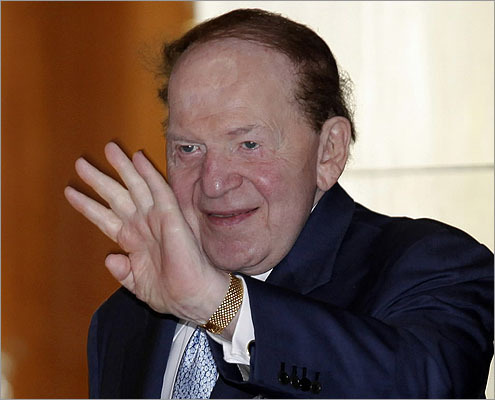
Adelson arrived at the Las Vegas courthouse wearing a suit and white shirt with his initials SGA embroidered on the cuff. The longtime supporter of Israel and the Republican Party made headlines last year when he became made the biggest political donation ever - nearly $100 million with his wife to help GOP candidates.

His wife, Miriam, led him into the courtroom but he approached the witness stand using a marble-handled cane. Suen's legal team had argued allowing a family member to take him to the stand would sow undue sympathy among the jury.

Sands' lawyers sought to limit media access to the mogul's testimony. They argued unsuccessfully to bar video and still photography from the proceedings, and later complained about the clicking noise made by a camera shutter.

Adelson's testimony was expected to last at least two days.

It's the second time Suen and Sands have faced off in court over the contract issue. In 2008, a jury awarded $58.6 million to Suen, but the Nevada Supreme Court overturned the verdict in 2010.

That court said the district judge shouldn't have allowed hearsay statements during the trial, and should have told the jury to assume Chinese officials were following local laws.

Buoyed in large part by his successes in Macau, Adelson has become the ninth-richest person in America, worth an estimated $26.5 billion, according to Forbes.

Asked on Thursday how many casinos he owns, Adelson paused and counted eight on his fingers. He later amended that to nine. When he met Suen, he owned just one casino - The Venetian on the Las Vegas Strip.

Suen, a former business partner of Adelson's brother, now seeks more than three times the amount he demanded in 2008.

He said he and his company were promised a $5 million success fee and 2 percent of net casino profits in exchange for helping Sands open its first casino in Macau, now the world's biggest gambling market.

On Thursday, Adelson agreed that those were the terms but said Suen never fulfilled his part of the deal: to deliver a gambling license.

The case hinges on the role that personal relationships, or "guanxi," play in Chinese culture.
Suen's team argues that Sands needed to cultivate influence. But the casino countered that Suen is demanding a success fee for setting up a single 40-minute meeting with the mayor of Beijing.

On the stand, Adelson frequently pleaded memory loss when asked about executive decisions, business strategy and meetings.

"I'm not very good at Chinese names. I'm not always so good at English names," he said.

He also offered that he plans to come back in his next life as a Chinese person because "the Chinese always look 20 years younger than they are."

The trial judge twice asked Adelson to focus his answers.

Among other things, Suen claims that Adelson used his influence over Republican members of Congress to reassure Beijing's mayor that a nonbinding resolution denouncing Beijing's bid for the 2008 Olympics would be killed. Suen says he set up that meeting.

Adelson - who joked about his short stature, confessed to being a "hotdog fiend" and described himself as a "kid from the slums" - said he was too humble of a man to have pulled off such a stunt.

"How does one little guy from a poor family in Boston have some influence to affect the Chinese government's lobbying with other governments for the International Olympic committee?" he said.


Simple!


http://www.myfoxal.com/story/21884105/casino-mogul-testifies-in-vegas-in-contract-suit


Sunday, March 3, 2013

GOP For Sale: Change the law because I broke it....?

Late last year, Adelson reportedly held meetings with at least one House GOP leader to discuss “possible changes to the Foreign Corrupt Practices Act,” arguing that he had been the target of federal investigations under the Act as retribution for his strong support for Republican candidates. 


GOP’s Largest Campaign Contributor Admits To Bribing Foreign Officials


“[T]here were likely violations of the books and records and internal controls provisions” of the Foreign Corrupt Practices Act, the company said in its annual regulatory report published on Friday.

Late last year, Adelson reportedly held meetings with at least one House GOP leader to discuss “possible changes to the Foreign Corrupt Practices Act,” arguing that he had been the target of federal investigations under the Act as retribution for his strong support for Republican candidates.

The Las Vegas Sands Corporation is suspected of improperly and in some cases illegally bribing Chinese government officials to expand its business in China. The company may have violated the Foreign Corrupt Practices Act with a $700,000 payment to a Chinese associate and worked with organized crime gangs to drive business from mainland China to their Macau casino.

Since the election, Adelson said that plans to double his contributions to Republican candidates and with an estimated net worth of almost $25 billion, he could theoretically spend $500,000 on every single Republican House and Senate nominee for the next 186 years.

http://thinkprogress.org/justice/2013/03/03/1664321/gops-largest-campaign-contributor-admits-to-bribing-foreign-officials/

Saturday, March 2, 2013

Las Vegas Sands says it 'likely' violated U.S. corruption act


Las Vegas Sands says it 'likely' violated U.S. corruption act

Las Vegas Sands Corp said it "likely" violated the federal Foreign Corrupt Practices Act, which outlaws the bribery of foreign officials, according to a Securities and Exchange Commission filing on Friday.

The filing marks the first disclosure by the casino operator, controlled by founder and billionaire Republican donor Sheldon Adelson, that is was under investigation.

Among the company's properties is the Sands Casino Resort Bethlehem.

The SEC subpoenaed company documents in February 2011 relating to its compliance with the antibribery act while the U.S. Department of Justice also advised Sands it was conducting an investigation, the company said in its annual report filing.

"There were likely violations of the books and records and internal controls provisions of the FCPA," the company said.

Sands spokesman Ron Reese said on Saturday he had no additional comment beyond the SEC filing.
Reuters reported exclusively in August that Sands allowed a man identified by the U.S. Senate as an organized crime figure to move a $100,000 gambling credit from a Las Vegas casino to one of its Macau casinos.

The company's findings are related to deals in mainland China led by executives no longer employed at Sands, the Wall Street Journal reported, sourcing a person familiar with the matter.

Sands, in the filing, said the issue would have no material impact on the company's financial records and that it would not need to restate any past financial statements.

- See more at: http://www.mcall.com/news/breaking/mc-las-vegas-bethlehem-sands-investigation-20130302,0,7436494.story#sthash.0eu3pwrE.dpuf

Wednesday, September 26, 2012

Adelson's Sticky Fingers


Adelson's lavish Gambling revenues reveal his sticky fingers in Israel as he dictates policy and public discussion.

History reveals the efforts of right-wing extremists destroying freedom of the press as means of control, just as has occurred in the US.


Iconic Israeli newspaper on the verge of collapse


In This photo taken on Thursday, Sept. 20, 2012, Israeli journalists and employees of Maariv daily newspaper demonstrate against their dismissals in Tel Aviv, Israel. Throughout much of Israel's history, the Maariv daily was known as the "country's paper," the newspaper with the highest circulation and a cornerstone of Israeli media. Now it is on its last legs, the victim, some say, of the Jewish-American billionaire who is a leading donor to Republican presidential candidate Mitt Romney.(AP Photo/Oded Balilty)

By ARON HELLER
Associated Press
September 26, 2012

JERUSALEM (AP) — Throughout much of Israel’s history, the Maariv daily was known as the ‘‘country’s paper,’’ the newspaper with the highest circulation and a cornerstone of Israeli media.

Now it is on its last legs — the victim, some say, of a Jewish-American billionaire who is a close friend of Prime Minister Benjamin Netanyahu.


Casino mogul Sheldon Adelson launched his free ‘‘Israel Hayom’’ or ‘‘Israel Today’’ daily five years ago. The tabloid has steadily gobbled up market share since then. Handed out by ubiquitous distributors clad in red overalls at busy intersections, it has become the most read newspaper in Israel.

The 64-year-old Maariv has suffered in the fallout. The newspaper was sold this month by its cash-strapped owner to a rival publisher. Most of its 2,000 employees are facing likely dismissals.

The iconic newspaper has been hemorrhaging money for years and its downfall is linked to the struggles facing print media around the globe, with the emergence of online news sources and a steep drop in subscribers and ad revenue rendering the traditional newspaper economic model untenable.

But against the backdrop of a perceived anti-media blitz by the hard-line government, Maariv staffers believe their final blow was delivered by Israel Hayom.

Adelson’s paper recently passed Yediot Ahronot as the top-read daily in Israel, leaving Maariv in third place, according to a survey by TGI, a leading Israeli polling company.

Besides its flattering coverage of Netanyahu and questionable political agenda, critics charge that its cheap ads and deep pockets are running everyone else out of business.

‘‘We can’t compete with a machine that prints money and hands out papers for free,’’ said Avi Ashkenazi, Maariv’s veteran crime correspondent. ‘‘We are the first ones to enter the slaughterhouse but we likely won’t be the last. It’s only a matter of time.’’

Israel Hayom’s success has raised questions about whether a wealthy foreigner has bought power and influence on behalf of the prime minister. Adelson also has contributed $30 million to super PACs supporting Republican candidates and has attended major fundraising events for U.S. presidential candidate Mitt Romney.

Israel Hayom denies the accusations and says its economic model is simply more effective.

‘‘(We) won’t apologize for our success, the readers prefer us and we thank them,’’ the paper said in a statement.

The loss of Maariv would leave Israel, a country of nearly 8 million people, with three national Hebrew newspapers: Adelson’s Israel Hayom, Yediot and Haaretz, a small but influential publication popular with Israel’s dovish elite. A number of smaller niche publications, including the English-language Jerusalem Post, also exist.

Other newspapers have announced layoffs and popular TV station Channel 10 is struggling to stay on the air as it awaits a request to the state to defer its crippling debts. The station says the government, which has deferred debts for other struggling companies, is using a technicality to eliminate a pesky source of criticism.

Critics also charge the government of making political appointments to Israel’s public broadcasting system, sidelining prominent critics on state radio and passing anti-libel legislation meant to stifle investigative reporters.

Comments by Finance Minister Yuval Steinitz, a Netanyahu confidant from his hawkish Likud Party, captured on tape at a recent party function highlight the animosity.

‘‘We are dealing here ... with a media that is not only against the Likud — it is true, it mostly prefers the left and is not entirely objective — but beyond that it is a media that has lost respect for one small, simple word — the truth,’’ he told a group of Likud activists.

Ben Caspit, Maariv’s leading political columnist, has written that Maariv’s blood is on Netanyahu’s hands.

‘‘The man who wanted to go down in history as the man who destroyed the Iranian nuclear threat could go down as the one who destroyed the free media in his country,’’ he wrote.

In his first comments on the issue, Netanyahu told the Israeli economic paper Globes that Maariv’s plight was due to the ‘‘dramatic technological changes that are affecting the written press’’ all over the world. He said he has no intention of getting involved.

‘‘On the one hand I'm told ‘leave the media alone,’ and on the other hand I'm told ‘intervene to save this outlet or another.’ There’s a contradiction here,’’ he said.

Dalia Dorner, a former Supreme Court Justice who is president of the Israel Press Council, said that in France, for instance, the government intervenes with subsidies and encourages youths to read newspapers. But in the hostile Israeli climate it is unlikely the government will lend a helping hand to the struggling industry.

‘‘I hope something can be done. For there to be good journalism, we need journalists,’’ Dorner said. ‘‘For there to be democracy, we need a free and varied media.’’

Israeli businessman Nochi Dankner, whose IDB holding company is wobbling under a pile of debt, this month sold Maariv to Shlomo Ben-Tzvi, the publisher of a hard-line religious publication, for $21 million.

Ben-Tzvi has indicated he will fire all 2,000 employees and rehire between 300 and 400. It’s not clear whether he will incorporate them into his Makor Rishon daily or keep Maariv alive in a limited capacity.

On Sunday, a Tel Aviv district court handed Maariv a temporary lifeline, appointing two trustees who will try to revive the paper and ensure employees’ rights. The court cited a ‘‘heavy public interest in saving Maariv’’ and froze the transfer of ownership for a month.

Maariv editor-in-chief Nir Hefetz made a front page plea the following day asking the government and advertisers to help and for everyday Israelis to purchase subscriptions.

‘‘If everyone contributes their part, if everyone joins the effort, together we can save Maariv,’’ he wrote.

Hagai Matar, head of the Maariv journalist’s union, said that just as the government has assisted struggling factories, it should do the same to save the newspaper. ‘‘Only massive public pressure will convince the government that it is a public interest to save Maariv,’’ he said.

Matar is leading the battle to keep the paper alive and lobbying hard for adequate severance and pension if he and others are sent home.

Last week, he led about 1,000 people through the streets of Tel Aviv, blocking a major junction.

Following the court order, the union dropped its threat to strike, which would have stopped publication Tuesday for the first time ever.

Established in 1948 three months before Israel gained independence, Maariv prided itself as a beacon of quality journalism and beholden neither to political parties nor media moguls. It was the nation’s No. 1 paper until it was overtaken by Yediot in the 1970s.

The newspaper has evolved from broadsheet to tabloid and its ownership has passed hands among a series of wealthy businessmen, including the late British media mogul Robert Maxwell.

Yuval Karniel, a law and communications expert at the Interdisciplinary Center Herzliya, a college near Tel Aviv said Maariv’s near-collapse reflected the evolution of Israeli society.

‘‘Maariv has declined along with its readers. When we look at Maariv, we look at ourselves ... it is an Israeli story,’’ he said.

http://www.boston.com/news/world/middle-east/2012/09/26/iconic-israeli-newspaper-the-verge-collapse/qElH9WQQy3rpoGvC0k700O/story.html

Tuesday, September 25, 2012

Adelson: Hubris and Whining


Casino mogul Adelson: Federal bribery investigation is political

Saturday, September 22, 2012

Washington Times? You're kidding?


The Washington Times is the Moonie newspaper, heavily used by the Bush/Cheney Administration to circulate inaccurate information. Although the accuracy of this article is questionable, it deserves to be included.


Obama campaign blasts pro-Romney casino developer Adelson
By David Hill - The Washington Times


The Obama campaign is calling out one of Mitt Romney's wealthiest donors in an effort to paint the Republican presidential nominee as beholden to the rich.

The president's campaign sent an email Friday to its donors, citing recent reports that billionaire casino owner Sheldon Adelson — who has pledged to spend $100 million on getting Mr. Romney elected — could see $2 billion in savings under Mr. Romney's proposed tax plan.

A report this week from the Democratic-leaning Center for American Progress Action Fund speculated that Mr. Adelson could save as much as $2 billion under a Romney plan that could cut income tax rates, maintain the current low tax rate on dividends, repeal the estate tax and eliminate taxes on foreign profits such as Mr. Adelson's Asian casinos.

The email, attributed to Obama campaign adviser David Axelrod, argues that Mr. Adelson's support for the GOP nominee comes "not out of love for Mitt Romney," but as "highly cynical but straightforward calculation."

"We don't have Sheldon Adelson, and with all due respect, we don't want him," Mr. Axelrod wrote. "We're relying on 3 million grassroots donors, who are giving an average of $58."

The Romney campaign has frequently dismissed claims that its policies would favor the rich, arguing that Mr. Romney would preserve existing tax cuts for upper- and middle-class households.


Read more: Obama campaign blasts pro-Romney casino developer Adelson - Washington Times http://www.washingtontimes.com/blog/inside-politics/2012/sep/14/obama-campaign-blasts-pro-romney-casino-developer-/#ixzz26UpBZjDJ

Monday, September 10, 2012

Risky Ties to Revel


Hedge fund's risky ties to Revel casino shine light on N.J.'s investing habits


Published: Sunday, September 09, 2012
By Jarrett Renshaw/Statehouse Bureau

Revel Casino at 3 months

Revel Resort in Atlantic City on Saturday, July 14, 2012

TRENTON — Gov. Chris Christie isn’t the only one betting on Revel.

A hedge fund that manages $200 million in New Jersey public pension money also has a financial stake in Revel, Atlantic City’s newest and sleekest casino hotel, a Star-Ledger review of records from the state Division of Gaming Enforcement and Treasury Department shows. It’s a gamble that has put a share of public workers’ retirement income at risk if the struggling resort fails.

Industry analysts say the prospect of Revel failing is not far-fetched. Last month, the $2.4 billion resort that opened in April was forced to seek $100 million from lenders amid disappointing gambling profits and complaints from vendors and builders that it was not paying its bills.

Andy Pratt, a spokesman for the Treasury Department, said the investment in Revel posed little threat to retirees and the $69.9 billion pension fund. He said the $200 million from the hedge fund represents less than 1 percent of the state’s total investment portfolio, and that the funds were sufficiently positioned to absorb any Revel loss.

The exposure to retirees from Revel is nearly impossible to determine from public records because hedge funds are not required to divulge their investments, and the state signed non-disclosure agreements with the firms.

"Even in a worst-case scenario, the risk exposure is minuscule," Pratt said.

But while the risk to retirees is minimal, the investment underscores how New Jersey and other states are increasingly reliant on alternative investments like hedge funds and private equity vehicles as an antidote to rising pension costs and shrinking investment returns.

The state’s investments in Revel — some of which came a few months after Christie pledged $260 million in tax incentives to restart the idled hotel project — helps pull back the curtain on the relationship between the casino and a group of hedge funds that will play a crucial role in how the resort navigates the choppy financial waters.

Canyon Capital Advisors, a California-based firm, is among a group of funds that stepped in and helped rescue the half-completed Revel when Morgan Stanley walked away from its $1.3 billion investment in 2010.

New Jersey began investing in Canyon Capital in 2007 with a $75 million commitment. In July 2011, the state Investment Council approved putting an additional $100 million in Canyon Capital, about five months after the hedge fund made its bet on Revel, and in the same month the state approved an incentive package to jump-start the project.

Pratt rejected any suggestion that the timing of the investment was significant. He said the council was unaware of the hedge-fund involvement in Revel, and added that the decision was based on Canyon’s track record, which included a 31 percent return on the state’s 2007 investment.

HIGH STAKES
 Gaming Enforcement records show nine hedge funds, including Canyon Capital, have provided $304 million in financing for Revel in exchange for a hefty 12 percent rate of return and the power to assume up to 90 percent ownership of the casino after three years. Records from the state agency show the group was also given two seats on the casino’s five-member board.
Revel resort and casino preview
 
Revel, a 6.3 million square foot beachfront resort in Atlantic City, features 1,898 guest rooms, all with ocean views, 14 restaurants, a 31,000-square foot spa, retail shops, two theaters, two nightclubs, 10 pools, and a 130,000-square foot casino. Revel will begin welcoming guests April 2 for an 8-week preview, and the complete resort will premiere on May 25. Revel is located at 500 Boardwalk, between South New Jersey and South Connecticut avenues. Staff photo by Lori M. Nichols/Gloucester County TimesRevel resort and casino preview gallery (51 photos)
The $304 million investment in Revel carries a high reward for the hedge funds, but significant risk as well. According to public documents, the hedge funds are considered second-lien debt, meaning they would be among the last to get repaid if the casino filed for bankruptcy or liquidated its assets.
The investment caught the attention of the local casino workers’ union, UNITE HERE Local 54, which has fought Revel, a non-union shop.

"At the time of this deal, we couldn’t understand why any rational investor who relied strictly on financial considerations would put money into Revel," Bob McDevitt, the union president. "Now, as Revel’s revenue numbers disappoint month after month and more interest payments come due, will there be pressure for another bailout?"

The state Attorney General’s Office made it more difficult for the public to learn the identities of the hedge funds by granting a Revel request that they be exempt from public scrutiny on the ground that the funds didn’t hold enough of the casino’s debt. The Star-Ledger learned the identities of the hedge funds through filings with Gaming Enforcement, however.

POLITICAL TIES

Without the exemption, the hedge funds would be barred from making political contributions in the state. A review of campaign finance records shows that some individuals involved in the hedge funds have contributed to Christie and other politicians — though before the firms invested in Revel.

Gaming Enforcement documents and campaign finance records show John Sette Jr., the son of John Sette, the Morris County Republican Party chairman, works at Anchorage Capital Group, one hedge fund that has invested in Revel.

The younger Sette donated $3,650 to the 2009 primary and general election campaigns of Christie, who got his start in politics in Morris County and still lives there. Sette did not return e-mails or telephone calls asking what role, if any, he played in the Revel investment.

Larry Buchalter is a managing partner of Chatham Asset Management, a New Jersey hedge fund and also Revel investor, according to Gaming Enforcement. Campaign finance records indicate his wife, Robin Buchalter, contributed $2,000 to Christie and $2,000 to the Senate Republican Committee in 2009.

According to two officials at the Economic Development Authority who requested anonymity because of the sensitivity of their positions, the hedge funds refused to invest in the project until the state agreed to provide the $261 million tax incentive for improvements to the surrounding neighborhood.

A recent report by the Willshire Trust Universe Comparison Service shows more than half of the nation’s largest public pension plans — with more than $1 billion in assets — have at least 15 percent of their money in alternative investments like hedge funds and private equity funds, the highest ever and up 9.2 percent from June 2011.

New Jersey’s $69.9 billion pension fund saw a return of 2.3 percent in the fiscal year that ended in June, far less than the 8 percent the state anticipated. The state plans to increase its alternative investments to 30 percent of its portfolio from nearly 23 percent. In the first five months of 2012, it increased its alternative investments by nearly $4 billion.

"No investment portfolio of $69 billion can meet acceptable standards for risk reduction without expanding beyond stocks and bonds," Pratt said.

http://www.nj.com/news/index.ssf/2012/09/hedge_funds_risky_ties_to_reve.html

Sunday, September 9, 2012

Growing Opposition in Spain


Casino Mogul Sheldon Adelson Plans To Turn Madrid Into The Next Las Vegas


LAS VEGAS (AP) — Casino giant Las Vegas Sands Corp. has chosen Madrid over Barcelona for a multi-billion dollar gambling resort project dubbed "EuroVegas."

The Spanish capital, the country's largest city, emerged as the company's best choice for the development, Las Vegas Sands Chairman and CEO Sheldon Adelson said in a statement released late Friday in Las Vegas.

"The regional government of Madrid has been a strong advocate for this potential development, and we are appreciative of the energy they have brought to this process," Adelson said.

"Barcelona is an outstanding tourism destination, and choosing Madrid over Barcelona was not an easy selection," he said.

The decision was highly anticipated in Spain, where a high jobless rate and a shrinking economy make the prospect of thousands of construction and service jobs attractive to project supporters. But critics predict that gambling will attract criminals and say positions as hotel maids, waiters and blackjack dealers aren't a recipe for success for young people badly in need of jobs.

Adelson has said he wants to invest about $22 billion in the project. The company statement made it clear Las Vegas Sands will allocate no more than 35 percent of that amount.

Adelson has also said he wants Spanish laws changed to let gamblers smoke inside the casinos and new zoning regulations allowing him to send buildings soaring above the skyline.

Company officials called picking a location an important first step toward building a project that is expected to be built in phases over about 10 years. Plans have called for six casinos, 12 hotels featuring 36,000 rooms, a convention center, three golf courses, shopping centers, bars and restaurants.

But not everyone is thrilled about the idea of Spain hosting a European Sin City that could attract prostitution and mafia gangs — and add gambling addiction to the woes of already desperate Spaniards.

Las Vegas Sands Corp. surpassed Caesars Entertainment Corp. last year as the world's largest casino corporation, posting profits of $1.27 billion in 2011. It owns the Venetian and Palazzo resort casinos on the Las Vegas Strip and the Marina Bay Sands in Singapore.

Through its majority-owned subsidiary Sands China Ltd., the company also owns the Venetian Macao and Sands Macao casino resorts, the Plaza Macao hotel, restaurant and shopping complex, and the Sands Cotai Central resort with three hotels and two casinos.

The company's entry into the casino market in the former Portuguese colony near Hong Kong spawned legal battles in Macau and Las Vegas.

A Hong Kong businessman won a $43.8 million verdict in a civil lawsuit filed in Nevada in 2004 claiming he was denied a $5 million "success fee" and 2 percent of net casino profits for helping the company win its Macau gambling license. The Nevada Supreme Court in 2010 ordered a retrial. That case is pending.

A bruising lawsuit filed in 2010 by Sands Macau's former top executive, Steven Jacobs, has drawn interest in the company from U.S. Justice Department and Securities and Exchange Commission investigators for possible violation of the Foreign Corrupt Practices Act. The law bars U.S. companies from paying foreign officials to "affect or influence any act or decision" for commercial benefit.

Jacobs accuses the company and Adelson of breach of contract and of pushing him into illegal activity in Macau. Adelson and the company deny wrongdoing and are vigorously defending the case. No charges have been filed.

Adelson also is a prominent philanthropist and political donor to U.S. Jewish and Republican causes and candidates. He gave $10 million in support of former presidential hopeful Newt Gingrich during his bid for the GOP nomination and has pledged $100 million to Mitt Romney's GOP campaign for the White House.


Read more: http://www.businessinsider.com/sheldon-adelson-madrid-vegas-2012-9#ixzz25ywGoErT

Tuesday, September 4, 2012

National GOP at Odds With Local Republicans Over Online Gambling


National GOP at Odds With Local Republicans Over Online Gambling
   
A new GOP platform adopted at the party's national convention in Tampa, Fla., last week encourages a ban on online gambling.
Reporter: Associated Press

LAS VEGAS (AP) - A new GOP platform adopted at the party's national convention in Tampa, Fla., last week encourages a ban on online gambling and is at odds with the positions many elected Nevada Republicans take.

The plank in the platform is listed under the heading "Making the Internet Family-Friendly" and links online gambling to gambling addiction.

The official party statement comes as many major players in Nevada's casino industry ask Congress to legalize Internet poker nationally. Experts believe Nevada could be the center of a regulated Internet gambling market.

Republican Gov. Brian Sandoval tells the Las Vegas Review-Journal Nevada has set the gold standard in gambling, and will continue to work on a a secure online gambling arena.

http://www.kolotv.com/localnews/headlines/National-GOP-at-Odds-With-Local-Republicans-Over-Online-Gambling-168370476.html

Monday, September 3, 2012

GOP Hoax: Sale to the Highest Bidder


Let's not pretend the GOP platform represents any sensible protection for Americans.
It's all about Democracy for Sale to the highest bidder.


GOP platform urges ban on online gambling
Sunday, September 2, 2012

LAS VEGAS (AP) — A new Republican party platform adopted at last week's GOP national convention in Florida opposes online gambling, putting it at odds with the position many elected Nevada Republicans take.
 
Democracy For Sale
 
The plank in the platform — listed under the heading "Making the Internet Family-Friendly" — links online gambling to gambling addiction.
 
"We're not going to agree on everything," Gov. Brian Sandoval told the Las Vegas Review-Journal (http://bit.ly/PQQOK0). "Nevada has always set the gold standard in gaming, and online gaming is the next frontier for the industry. Our state supports online poker and will continue to work to ensure a secure online gaming environment."
 
Many major players in Nevada's casino industry are asking Congress to pass legislation that legalizes and regulates Internet poker nationally. Experts believe Nevada could be the center of a regulated Internet gambling market.


While it's not the first time the party's platform has spoken out against Internet gambling, this year's statement mentions recent changes in the U.S. Justice Department's interpretation of the Federal Wire Act of 1961, which governs betting over wires or electronic means.
 
In December, the DOJ reversed its decades-old interpretation of the act, saying the law only encompasses sports wagering. Legal experts say that clears the way for individual states to allow online poker and other games, as long as the gambling doesn't cross state lines.
 
"We support the prohibition of gambling over the Internet and call for reversal of the Justice Department's decision distorting the formerly accepted meaning of the Wire Act that could open the door to Internet betting," the platform stated.
 
Some online poker proponents fear the platform could stymie legalization efforts in Congress.
 
"The 2012 GOP platform on Internet gambling is grossly out of touch with the opinions of the party's own elected officials," said John Pappas, executive director of the Washington D.C.-based Poker Players Alliance. "Instead of broad political statements, now more than ever, Americans expect Congress to finally put the political posturing aside."
 
Other proponents, including Marco Valerio, who hosts poker-related programming on QuadJacks.com, downplayed the role of the platform.
 
"The online gaming climate has changed so much in the last six years," Valerio said. "For one thing, online poker was largely friendless back then at virtually every level. Today you have much stronger support from big gaming and key legislators."
 
In Washington, D.C., Senate Majority Leader Harry Reid, D-Nev., and Sen. Jon Kyl, R-Ariz., agreed this summer on a framework for online poker legislation. The bill would also strengthen bans on sports wagering and other traditional casino games on the Internet.
 
Reid said the bill needs Republican support to make it through Congress, and has asked fellow Nevada Sen. Dean Heller to round up GOP votes.
 
Heller's campaign spokeswoman, Chandler Smith, downplayed the role the platform will play.
 
"Regardless of any language contained in a document voted on back in Florida, Dean Heller will always do what is in the best interest of Nevada," Smith said.


Read more: http://www.sfgate.com/news/article/GOP-platform-urges-ban-on-online-gambling-3834988.php#ixzz25PcoEHCv


Not content with enormous profits, sucking discretionary income from local economies and destroying communities, the Predatory Gambling Industry always seeks MORE. What better way than allowing you to bankrupt yourself from home? And the Gambling Industry avoids the cost of employees, physical structures and can reach more Gambling Addicts.


Saturday, July 21, 2012

Adelson's Lawyers Fight Prostitution Accusations

So....a man who earned his millions preying on others, promoting Gambling Addiction somehow has a moral line to draw????

How curious that amoral Sheldon Adelson is forced to support an amoral Republican candidate to "Get Out of Jail Free" ?

Watch out what you say! Here comes the threat of lawsuits - a favorite tactic for Mr. Adelson!


July 19, 2012

Adelson's Lawyers Fight Prostitution Accusations


Lawyers for casino mogul and Republican campaign donor Sheldon Adelson this week went on the offensive to combat what they said is a false portrayal of him as a supporter of prostitution at his Macau casinos.

In a filing in Nevada District Court in Las Vegas made public Wednesday, attorneys for Mr. Adelson, chief executive of Las Vegas Sands Corp., said that a former top executive of the company's operations in Macau "had blatantly mischaracterized the facts" when he alleged last month that Mr. Adelson had approved a "prostitution strategy" at the casino operator's Macau properties.

The executive, Steve Jacobs, ...


http://online.wsj.com/article/SB10000872396390444330904577535982971919236.html


Jul 19, 2012

Democratic Congressional Campaign Committee Reviewing Sheldon Adelson’s Lawsuit Threat

Elicia Dover
By Elicia Dover

Las Vegas Casino billionaire Sheldon Adelson has threatened to sue the Democratic Congressional Campaign Committee (DCCC) if it does not immediately retract and apologize for what Adelson’s lawyers call defamatory statements, “falsely accusing Mr. Adelson of encouraging and profiting from prostitution.”

ABC News obtained a copy of the letter sent to the DCCC, which claimed articles posted on the DCCC’s website are “outrageous and completely untrue.”

While Adelson’s lawyer would not comment on the threatened lawsuit, first reported by the Las Vegas Sun, a spokesman for Adelson told ABC News that he believes the letter and a related legal document “very clearly” speak for themselves.

The DCCC picked up an Associated Press article from June that reported an estranged former executive of the Las Vegas Sands Corp. in China alleged in court documents related to a lawsuit that Adelson approved and knew of prostitution at the casino’s Macau location.

Adelson’s spokesman denied the claim after the AP report surfaced, and his spokesman repeated today the assertion that the prostitution claims are false.


DCCC spokesman Jesse Ferguson told ABC News that the DCCC just received the letter from Adelson’s legal team, will be internally reviewing it and did not immediately have a response.

Because Adelson is one of the most influential donors in the Republican Party, the DCCC asked on its website in regard to the prostitution claim, “What will Speaker Boehner, Leader Cantor and House Republicans do with their Chinese prostitution money?”

In a separate post, Ferguson is quoted saying, “It’s past time for House Republicans to reject the support of these groups funded by foreign money from a Chinese prostitution strategy.”
Adelson’s lawyers claim the DCCC’s statements were “widely repeated” online and caused “serious and irreparable injury to Mr. Adelson and his family.”

http://abcnews.go.com/blogs/politics/2012/07/democratic-congressional-campaign-committee-reviewing-sheldon-adelsons-lawsuit-threat/


Billionaire Adelson Under Fire For Macau Dealings

July 16, 2012
July 16, 2012

Robert Siegel talks to Lowell Bergman about a ProPublica investigation into billionaire and Republican political contributor Sheldon Adelson. There are concerns that Adelson may have violated the Foreign Corrupt Practices Act in his payments to a Macau lawyer who represented his firm's interests in the booming gambling capital. Bergman co-reported the story with Stephen Engelberg and Matt Isaacs for the Investigative Reporting Program of the University of California at Berkeley and PBS Frontline.
 

AUDIE CORNISH, HOST:

It's ALL THINGS CONSIDERED from NPR News. I'm Audie Cornish.

ROBERT SIEGEL, HOST:

And I'm Robert Siegel.

The independent investigative nonprofit, ProPublica, reports today on the federal investigation into Sands China Limited. That's the Macau operation of Las Vegas Sands. The big hotel and casino company is controlled by billionaire and multimillion dollar Republican political contributor Sheldon Adelson.

According to the story, which is by Lowell Bergman, Matt Isaacs and Steve Engelberg, federal investigators are looking at whether payments the company made to a Macau lawyer, who is also a local legislator, violate the Foreign Corrupt Practices Act. That law makes it illegal for an American company to pay a foreign official to affect or influence any act or decision of that official in his official capacity.

The story also cites company emails and other documents which show that concerns were raised within Adelson's own company about payments to the Macau lawyer.
Lowell Bergman joins us now from New York. Welcome to the program once again.

LOWELL BERGMAN: Thanks for having me.

SIEGEL: First, who was this Macau lawyer named Leonel Alberto Alves?

BERGMAN: Well, he is Macau lawyer who also still to today is the out-of-house attorney for Sands
China, the subsidiary of Las Vegas Sands. He holds the three political positions in China: one with a national consultant of Congress, another as a legislator, and another as part of the inner circle or the executive advisory board of the chief executive of Macau. At the same time, he's an attorney, so in that capacity he represents them in a number of outside issues including discussions with the government.

SIEGEL: Can you tell, from the Sands documents that you've seen, how much Mr. Alves was paid and what he was paid for doing?

BERGMAN: Well, we have documents that show at least five to $600,000 in U.S. in payments for what looks like a four-month period. And we have one document that says that in total it comes to approximately $700,000. Now, the figure for someone like Mr. Adelson, who's estimated to have $25 billion in net worth, is not a large figure. But it was much larger than what he was supposed to be paid according to the internal emails.

And because of that, the most significant part of the documents that we have, the general counsel of Las Vegas Sands based in Nevada wrote an email saying this runs the risk of violating the Foreign Corrupt Practices Act.

SIEGEL: Now you're talking about, I guess, Al Gonzalez is the general counsel?

BERGMAN: Right, his full name is J. Alberto Gonzales-Pita.

SIEGEL: Question about the Foreign Corrupt Practices Act, the FCPA, and the relationship between Sheldon Adelson's company and this lawyer from Macau. If Mr. Alves was both a lawyer and a local council member and held two other positions in China, does the act in fact permit someone to pay him if it is not in his official capacity? If he's got a law firm, can you say, look, I represented him in his other private capacity, not in his official capacity?

BERGMAN: It does allow for that and there are instances of that happening. And in some of the people we quote in the story, and others we consulted, the description goes something like this. If you're going to hire a public official to work for you as an attorney, for instance, in another country outside of whatever your immediate business is - so he's not directly dealing with his counterparts in the government. And say he's an expert on bankruptcy law, that's fine.

And usually what the government likes, the federal government likes, they like to have an arrangement where the company makes it clear what the limits are in what this person is going to do and how they're going to get paid, et cetera.

In this case, to date at least, and in the documents we've seen in reporting we've done, we know of no attempt by the company to do that. That is, for Las Vegas Sands to have some transparency with the federal government about their attempts to hire a public official to work for them.

SIEGEL: Is Las Vegas Sands obliged to tell the federal government every payment it's making to every lawyer in every country it operates?

BERGMAN: Under the Foreign Corrupt Practices Act it is obligated to keep complete and accurate books, so that they would have to report that. It would be accessible initially by the FCC.

SIEGEL: I think our image of bribes paid by American companies are all about, you know, suitcases filled with stacks of hundred dollar bills that are being delivered somewhat surreptitiously. This is retaining a lawyer. This is - he invoices the company for money and he's paid the money. Is that the same thing?

BERGMAN: I mean, we don't know whether any bribes were paid here. All we know and all we are reporting on is the state of the investigation. And there are certain parts of that investigation that appear to be curious. For example, an email that Alves sends - which was never acted upon, but suggesting that $300 million be paid in order to settle both a administrative sort of legal dispute that the company was having with the government, as well as outside litigation. That didn't go through.
But when you see an email like that, your eyes widen and you wonder how could he be making such a proposal? So there's smoke here and that seems to be what the government is after - is whether there is a fire behind it.

SIEGEL: How big a chunk of Sands business nowadays does Macau represent? Do we know?

BERGMAN: We know it's at least two-thirds of their income. And that's true of almost all the U.S. publicly traded gaming companies that are operating in Macau. It is the mother lode for gaming operations internationally.

SIEGEL: Lowell Bergman of ProPublica, thank you.

BERGMAN: Thank you.

SIEGEL: Lowell Bergman of the Investigative Reporting Program at the University of California, Berkeley and also PBS's "Frontline." He's been talking with us about the investigation into Sands China Limited. The story he co-reported was published today on the Web site ProPublica. For its part, Las Vegas Sands denies any wrongdoing.

http://www.npr.org/2012/07/16/156869012/billionaire-adelson-under-fire-for-macau-dealings

Monday, June 25, 2012

Romney: The Get-Out-Of-Jail-Free Candidate


What Sheldon Adelson Wants

By The New York Time | Editorial
24 June 12

o American is dedicating as much of his money to defeat President Obama as Sheldon Adelson, the casino magnate who also happens to have made more money in the last three years than any other American. He is the perfect illustration of the squalid state of political money, spending sums greater than any political donation in history to advance his personal, ideological and financial agenda, which is wildly at odds with the nation's needs.
Mr. Adelson spent $20 million to prop up Newt Gingrich's failed candidacy for the Republican nomination. Now, he has given $10 million to a Mitt Romney super PAC, and has pledged at least $10 million to Crossroads GPS, the advocacy group founded by Karl Rove that is running attack ads against Mr. Obama and other Democrats. Another $10 million will probably go to a similar group founded by the Koch brothers, and $10 million more to Republican Congressional super PACs.

That's $60 million we know of (other huge donations may be secret), and it may be only a down payment. Mr. Adelson has made it clear he will fully exploit the anything-goes world created by the federal courts to donate a "limitless" portion of his $25 billion fortune to defeat the president and as many Democrats as he can take down.


One man cannot spend enough to ensure the election of an unpopular candidate, as Mr. Gingrich's collapse showed, but he can buy enough ads to help push a candidate over the top in a close race like this year's. Given that Mr. Romney was not his first choice, why is Mr. Adelson writing these huge checks?

The first answer is clearly his disgust for a two-state solution to the Israeli-Palestinian conflict, supported by President Obama and most Israelis. He considers a Palestinian state "a steppingstone for the destruction of Israel and the Jewish people," and has called the Palestinian prime minister a terrorist. He is even further to the right than the main pro-Israeli lobbying group, the American Israel Public Affairs Committee, which he broke with in 2007 when it supported economic aid to the Palestinians.

Mr. Romney is only slightly better, saying the Israelis want a two-state solution but the Palestinians do not, accusing them of wanting to eliminate Israel. The eight-figure checks are not paying for a more enlightened answer.

Mr. Adelson's other overriding interest is his own wallet. He rails against the president's "socialist-style economy" and redistribution of wealth, but what he really fears is Mr. Obama's proposal to raise taxes on companies like his that make a huge amount of money overseas. Ninety percent of the earnings of his company, the Las Vegas Sands Corporation, come from hotel and casino properties in Singapore and Macau. (The latter is located, by the way, in China, a socialist country the last time we checked.)

Because of the lower tax rate in those countries (currently zero in Macau), the company now has a United States corporate tax rate of 9.8 percent, compared with the statutory rate of 35 percent. President Obama has repeatedly proposed ending the deductions and credits that allow corporations like Las Vegas Sands to shelter billions in income overseas, but has been blocked by Republicans.


Mr. Obama's Justice Department is also investigating whether Mr. Adelson's Macau operations violated the Foreign Corrupt Practices Act, an inquiry that Mr. Adelson undoubtedly hopes will go away in a Romney administration. For such a man, at a time when there are no legal or moral limits to the purchase of influence, spending tens of millions is a pittance to elect Republicans who promise to keep his billions intact.

http://readersupportednews.org/opinion2/277-75/12078-focus-what-sheldon-adelson-wants


Martin Bashir | Aired on June 18, 2012

Sheldon Adelson: GOP’s million dollar man

Bloomberg View columnist William Cohan joins MSNBC’s Martin Bashir to discuss Sheldon Adelson, the man who reportedly has spent or pledged $71 million to Republican candidates and causes, and where his money and interests lie.


http://video.msnbc.msn.com/martin-bashir/47864344#47864344