Meetings & Information


*****************************
****************************************************
MUST READ:
GET THE FACTS!


Showing posts with label SEC. Show all posts

Friday, April 8, 2016

Las Vegas Sands Antes $9M to Settle Corruption Case With SEC


Las Vegas Sands Antes $9M to Settle Corruption Case With SEC


MICHAEL LIEDTKE, AP BUSINESS WRITER

LAS VEGAS — Apr 7, 2016

Las Vegas Sands is paying a $9 million fine to settle a regulatory investigation that painted an unflattering picture of the casino owner's expansion into a gambling mecca in China.
The resolution announced Thursday closes a Securities and Exchange Commission probe that began more than five years ago.
The corruption case revolved around Las Vegas Sands' efforts to become a major player in Macau, an enclave in China that has turned into a gold mine for U.S. casinos.
The SEC penalized Las Vegas Sands for its dealings with a consultant paid $62 million to serve as a "beard" for some of its business in Macau and Beijing. The inquiry concluded some payments weren't properly authorized or documented.
Las Vegas Sands Corp. neither admitted nor denied any of the SEC's findings. The company, controlled by billionaire Sheldon Adelson, had conceded in its 2012 annual report that it had probably violated the book-keeping and controls provisions of the Foreign Corrupt Practices Act that prohibits overseas bribery.
Although the SEC didn't accuse Las Vegas Sands of resorting to bribery, its conclusions depicted a company willing to go to extreme lengths to establish itself in China. The company now generates most of its revenue in Macau, a former Portuguese colony where Las Vegas Sands operates four casinos and a variety of hotels.
The SEC alleges Las Vegas Sands violated anti-corruption laws shortly after it connected in 2006 with an unidentified consultant claiming to be a former Chinese government official.
The next year, Las Vegas Sands used the consultant to conceal its purchase of a Chinese basketball team to play in an arena located in one of Macau casinos in hopes of luring more gamblers to its casino, according to the SEC. The agency alleged Las Vegas Sands needed a "beard" to buy the team because the Chinese Basketball Association prohibited its franchises from being owned by gambling companies.
Some of the payments made to the consultant for the basketball deal were initially recorded as "bank charges and loan," the SEC discovered.
Las Vegas Sands employed the same consultant to buy a large building in Beijing that was supposed to be turned into a business center with a "men's club" in the basement, according to the SEC. Las Vegas Sands planned to name the center after its CEO and open it in time for the Summer Olympics that were held in Beijing in August 2008. Adelson sent a letter inviting then-President George W. Bush to attend the building's ribbon-cutting ceremony in early 2008, according to the SEC.
The building purchase raised red flags with the SEC because Las Vegas Sands did the deal without any research into whether there was a need for a business center and various payments to the consultant who handled the negotiations were mischaracterized as fees for property management and "arts and crafts."
The Adelson Center project was abandoned in September 2008.
In its statement, Las Vegas Sands acknowledged the consultant worked with company executives who weren't "sufficiently monitored." The company later received a $44 million refund from the consultant as part of a settlement.
In the SEC settlement, Las Vegas Sands will submit to reviews by an outside consultant during the next two years to ensure its record-keeping and internal controls adhere to U.S. law.
"We understand that running an industry-leading compliance operation takes time, resources and the full support of senior management. I'm proud to say our company has exactly that," Adelson said Tuesday.


Monday, May 26, 2014

CHIEF RISK OFFICER & SENIOR PARTNER at Deloitte & Touche EMBEZZLED to feed ADDICTION [maybe from Harrah's, now Caesars] + MORE!


May 23, 2014

SEC: Accountant Bet Client’s Money at Client’s Casino


"Auditor independence is critical to the integrity of the financial reporting process," but hoo boy is it boring. It's the idea that, if an accounting firm signs off on a company's financial statements, it must keep itself utterly pristine and uncontaminated by any other contact with that company. The specifics are tricky, and, accountants being accountants, they tend to break the rules in stunningly dull ways, such as "providing prohibited non-audit services such as bookkeeping and expert services to affiliates of companies whose books they were auditing." They love accounting so much that they do forbidden bookkeeping!

So you might expect that a senior partner and chief risk officer at Deloitte LLP would find a particularly arcane and nerdy way to violate auditor independence rules but nope nope nope nope nope:

More On Legal & Compliance

from The Advisor's Professional Library
  • The Few and the Proud: Chief Compliance Officers CCOs make significant contributions to success of an RIA, designing and implementing compliance programs that prevent, detect and correct securities law violations.  When major compliance problems occur at firms, CCOs will likely receive regulatory consequences.    
               
  • The New and Improved Form ADV Whether an RIA is describing its investment strategy in advertisements or in the new Form ADV Part 2, it is important the firm articulates material risks faced by advisory clients and avoids language that might be construed as a guarantee.
An SEC order finds that certified public accountant James T. Adams repeatedly accepted tens of thousands of dollars in casino markers while he was the advisory partner on subsidiary Deloitte & Touche’s audit of a casino gaming corporation. A marker is an instrument utilized by a casino customer to receive gaming chips drawn against the customer’s line of credit at the casino. Adams opened a line of credit with a casino run by the gaming corporation client and used the casino markers to draw on that line of credit. Adams concealed his casino markers from Deloitte & Touche and lied to another partner when asked if he had casino markers from audit clients of the firm.

That's not even the best part; the best part is:1

On December 16, 2009, Adams drew markers, $110,000 of which remained outstanding. On January 13, 2010, D&T removed Adams from the Casino Gaming Issuer 2009 audit engagement, for reasons that were not based on his use of casino markers. Adams subsequently defaulted on the $110,000 of outstanding markers that he drew on December 16, 2009.

It's an enumerated violation of auditor independence to have "Any loan (including any margin loan) to or from an audit client," but never mind that! Adams took $110,000 from his client and never gave it back! (Allegedly! It's a neither-admit-nor-deny sort of settlement.) That seems like some sort of ... I don't know, conflict of interest? Bad idea?

Also, I mean, he retired from Deloitte as a senior partner in May 2010, after 36 years there.2 The fact that he couldn't afford to pay back the $110,000 in gambling debts that he incurred in one day at his client's casino is, in itself, troubling.

I cannot emphasize enough that he was the chief risk officer of Deloitte. Normally you want your chief risk officer to be a boring,anonymous sort who tries to steer clear of risk. If your chief risk officer borrows six-figure sums from clients to bet -- and lose -- on blackjack, and then lies about it and refuses to pay back the money, then ... I don't know. There's no then. That's just amazing. James T. Adams, I salute you. You ended your accounting career in pretty much the most outrageous possible way. You know, for an accountant.

1 The SEC doesn't name the "Casino Gaming Issuer," but it does say that it filed a 10-K on March 9, 2010. A Bloomberg CFS search suggests that it was probably Harrah's (now Caesars).

Incidentally. This is sort of terrible, but I can kind of understand it? I spent some time lightly covering gaming clients and pretty much every meeting occurred at a casino. Adams' role as "advisory partner" on the audit was basically glad-handing the audit committee, not ticking and tying numbers; if you think of him as a relationship guy in the gaming space then it seems natural that he'd spend a lot of time hanging out in casinos and probably playing a few hands or rolls or whatever.

And then maybe losing a bit of money, as one does. And then the next thing you know, etc. etc.

2 So his two-year suspension from practicing public accounting doesn't seem particularly onerous. And the SEC doesn't seem to be fining either him or Deloitte for this violation, or even making him pay the client back.


http://www.thinkadvisor.com/2014/05/23/sec-accountant-bet-clients-money-at-clients-casino?t=risk-management

Friday, September 14, 2012

Las Vegas Sands [Sheldon Adelson] hid evidence


Las Vegas Sands hid evidence in former executive's lawsuit-court


SAN FRANCISCO, Sept 14

(Reuters) - Las Vegas Sands deceived a Nevada court in an attempt to stall a lawsuit by the former head of its Macau operations, a state judge ruled on Friday, fining the casino operator and abridging its right to object in a fight over key evidence.
 
The ruling gives former Sands China Chief Executive Steve Jacobs new room to pursue his wrongful termination case, which has become a public fight over the leadership and business methods used by Sands Chief Executive Sheldon Adelson.

Adelson is a prominent Republican Party donor, as well as one of the richest men in the world, who led U.S. casinos into Macau, a gambling market which dwarfs Las Vegas.

Jacobs contends Adelson directed him to investigate officials in the Chinese gambling haven for information to use against them and that Adelson told him to hire a Macau government official in a potential conflict of U.S. anti-bribery law.

The U.S. Department of Justice, Securities and Exchange Commission and Nevada casino regulators have all launched investigations in the wake of Jacobs' charges.

Sands has denied Jacobs' claims and says the former executive exceeded his authority and conducted "improper acts" before he was fired in 2010, the year after he was hired.

At issue are emails and other electronic data sought by Jacobs. Sands China, a subsidiary of U.S.-based Las Vegas Sands Corp, told the court the data could not be removed from Macau due to a local data protection law.

"The transferred data had already been copied; the copy removed from Macau; and reviewed in Las Vegas by representatives of Las Vegas Sands," District Court Judge Elizabeth Gonzalez wrote in a ruling published on Friday.

Sands' repeated inaccurate statements over several months showed an intention to deceive the court, and the purpose appeared to be to stall the discovery process, she wrote.

"The Defendants concealed the existence of the transferred data from this Court," she concluded.

As punishment, she said the casino company could not use the Macau data privacy law as a defense against producing documents, a clear procedural win for the fired executive.

She also fined Sands $25,000 and some plaintiff's attorney fees. The ruling came after three days of testimony this week.

Neither Sands nor Jacobs' attorney immediately responded to a request for comment.

http://in.reuters.com/article/2012/09/14/lasvegassands-lawsuit-idINL1E8KEHFO20120914

Monday, September 3, 2012

The Mitt Connection


Steve Wynn credits Michael Milken with making him a wealthy man and
financing a few disasters in Atlantic City.

The New Jersey Gam[bl]ing Commission, under the chairmanship of Steve
Perskie turned a blind eye to the fraud, approved licenses for insolvent
operators and endorsed unviable deals.

Michael Milken helped make casino investing respectable.

Great book, well worth reading --


These were complex transactions the destroyed investors that regulators
ignored.

Maybe what was done wasn't illegal, but was it moral?

Mitt and the junk bond king

Mitt Romney in Orlando, Fla. on June 21, 2012. The presidential hopeful teamed up with junk-bond king Michael Milken at the height of the 1980s buyout boom.
Mitt Romney in Orlando, Fla. on June 21, 2012.
The presidential hopeful teamed up with junk-bond king
Michael Milken at the height of the 1980s buyout boom.
(Charles Dharapak/AP Photo)
 
Globe Staff / June 24, 2012
 
It was at the height of the 1980s buyout boom when Mitt Romney went in search of $300 million to finance one of the most lucrative deals he would ever manage. The man who would help provide the money was none other than the famed junk-bond king Michael Milken.
 

What transpired would become not just one of the most profitable leveraged buyouts of the era, but also one of the most revealing stories of Romney’s Bain Capital career. It showed how he pivoted from being a relatively cautious investor to risking his reputation for a big payoff. It is one that Romney has rarely, if ever, mentioned in his two bids for the presidency, perhaps because the Houston-based department store chain that Bain assembled later went into bankruptcy.


But what distinguishes this deal from the nearly 100 others that Romney did over a 15-year period was his close work with Milken’s firm, Drexel Burnham Lambert Inc. At the time of the deal, it was widely known that Milken and his company were under federal investigation, yet Romney decided to go ahead with the deal because Drexel had a unique ability to sell high-risk, high-yield debt instruments, known as “junk bonds.”

The Obama campaign has criticized the deal as showing Romney’s eagerness to make a “profit at any cost,” because workers lost jobs, and challenged Romney’s assertion that his business background best prepares him for the presidency. Romney, meanwhile, once referred to the deal as emanating from “the glorious days of Drexel Burnham,” saying, “it was fun while it lasted,” in a little-noticed interview with American Banker magazine.

The “glorious” part, for Romney at least, was that he used junk-bond financing to turn a $10 million investment into a $175 million profit for himself, his partners, and his investors. It marked a turning point for Romney, according to Marc Wolpow, a former Drexel employee who was involved in the deal and later was hired by Romney to work at Bain Capital.
 
“Mitt, I think, spent his life balanced between fear and greed,” Wolpow said. “He knew that he had to make a lot of money to launch his political career. It’s very hard to make a lot of money without taking some kind of reputational risk along the way. It’s just hard to do. It doesn’t mean you have to do anything illegal or immoral, but you often have to take reputational risk to make money.”

So it was that Romney decided to rely on a man and a company in the thick of one of the most intensive investigations ever undertaken by the Securities and Exchange Commission.
 
It happened in 1988, the fourth year of Bain Capital’s existence. Romney was shifting his focus from venture capital, funding younger companies, to buying larger, established businesses, which sometimes were troubled.

Under this new strategy, known as a leveraged buyout, Romney could invest a relatively modest sum and borrow the rest to finance deals. The debt was then typically transferred to the companies Bain acquired. Bain earned management fees, dividends, and, if the company increased in value, massive profits.
 
This deal was one of the mostly highly leveraged yet. It involved the purchase of two department store companies — Palais Royal, a small and profitable chain with 28 stores, and Bealls Brothers, a larger chain that was struggling — which Bain wanted to merge into a stronger and more successful brand.
 
Given the high-risk nature of the deal and the amount of money needed to pull it off, Romney and his partners sought financing from Wall Street’s Drexel Burnham Lambert. It had a Boston office with about 20 employees, as well as a Beverly Hills office where Milken oversaw the junk-bond operation.
Milken was so successful at selling risky bonds in exchange for possible double-digit returns that he had become one of the best-known and most controversial financiers in the nation by the time Romney and his partners met with him. A year earlier, Milken’s deals had earned him $550 million in salary and bonuses.
 
Romney, the famously cautious investment manager, embraced the philosophy of Milken, the embodiment of the high-flying 1980s. Romney, according to his former partners, viewed Milken not just as someone who built up piles of cash, but also as an innovator whose deals could force bloated companies to become leaner, more efficient, and more profitable.
 
Romney and Milken declined to comment, but former associates of both men said the seemingly Odd Couple pairing goes far in explaining why Romney became willing to do riskier deals for bigger payoffs.
 
“I believe Mitt admired Milken’s creativity,” said Wolpow, the former Romney partner. “Milken did force underperforming companies and management teams to face the music. That’s the plus side of leveraged finance.”
 
But there was a potential downside of doing business with Drexel. Just as the deal was about to be sealed in September 1988, the Securities and Exchange Commission filed a complaint against Milken and Drexel, alleging insider trading and stock manipulation. Some clients feared being tainted by scandal, but Romney stayed loyal: The deal was too important.
 
“We did not say, ‘Oh my goodness, Drexel has been accused of something, not been found guilty,’” Romney told the Globe years later. “Should we basically stop the transaction and blow the whole thing up?”
 
But the deal nearly blew up anyway. The fraud case was being heard by US District Judge Milton Pollack. In what seemed a remarkable coincidence, the judge’s wife, Moselle Pollack, was chairwoman of Palais Royal, one of the department stores in Bain’s deal, and she stood to gain millions.
 
Drexel’s lawyers seized on the potential conflict of interest and tried to get the case thrown out, or to at least have Pollack taken off the case. Indeed, there were suggestions that Drexel was in effect using Romney. A Wall Street Journal story from 1988 quoted the SEC as saying Drexel had first approached Bain about the deal, “creating the very situation of which they complain.”
 
But Rick Moseley, a former Drexel official who worked on the deal, said Drexel did not create the conflict and didn’t realize the judge’s wife had a stake in the deal.
 
“It was totally inadvertent,” Moseley said. “I can tell you that because I was in the epicenter of it when the deal came in.”
 
Romney and his partners were alarmed by the media furor over the alleged conflict of interest. Romney called Drexel’s chief executive, Fred Joseph, and was assured the controversy wouldn’t endanger the deal.
 
Still, as reported in “The Real Romney,” a biography by two Globe reporters, some SEC officials were upset that Romney went ahead with Drexel, because it enabled the claim of a conflict to go forward.

“By doing the deal, [Romney] enabled Drexel to use the claim of conflict of interest on the part of the judge, which I think at a minimum reflects a lack of concern about the impact of his financing activities on the administration of justice,” said James T. Coffman, a former SEC official who worked on the case.

In the end, the matter became moot when Drexel pleaded guilty to six criminal counts of securities and mail fraud, paying $650 million in fines. Milken later pleaded guilty to securities and reporting violations and would serve 22 months in prison. By 1990, Drexel was bankrupt and out of business.

In the meantime, Drexel’s financing for Bain succeeded. Romney distanced himself from the legal case, noting that his deal had nothing to do with the charges against Milken and Drexel.
 
With the deal concluded, Bain Capital merged the department store chains into an entity that later became known as Stage Stores, which became responsible for paying off much of the debt. Business went well for several years as the chain grew and boosted profits, and was able to pay interest on the debt that Bain had placed on the company. “They did an incredible job of improving the business dramatically,” Moseley said.
 
But the seeds of later problems for Stage Stores were sown while Bain was still on board, and eyeing the exit door.

Bain’s hand-picked chief executive retired in 1993 and was replaced by Carl Tooker. Bain partners served on the board for four more years, helping take the company public in October 1996, at $16.50 a share, and approving an acquisition in June 1997 that added 246 stores, nearly doubling the chain. Bain had sold some of its shares in the low $30s and by September 1997 sold the rest at nearly $35 per share.

Some at Bain wondered if they sold too soon. Indeed, the stock kept rising into 1998, and the firm actually bought back a minority stake. Shares peaked at $53 before diving as Stage Stores struggled with its expansion.
 
Other shareholders filed a lawsuit in March 1999, alleging that the company and certain investors, including Bain, had inflated the company’s performance numbers and then dumped their stock. The suit was dismissed later that year.
 
But problems mounted. By 2000, the company was in emergency talks with its lenders. It announced plans to close 60 stores and then pushed out Tooker. In June that year, Stage Stores filed for bankruptcy protection, with $444 million in long-term debt on the books, and said it would close 300 stores. (Stage Stores emerged from bankruptcy in 2001 and today operates 813 stores in 40 states. It reported a $31 million profit in 2011 on sales of $1.5 billion. The company did not return calls requesting comment.)
 
Bain Capital says it wasn’t responsible for the problems that led to the bankruptcy filing.
 
“Stage Stores was a growing, successful, and consistently profitable company during the nine years we owned it,” Bain said in a statement. “Unfortunately, the company ran into operating problems three years after we sold our controlling interest, and we were as disappointed as anyone to see that happen.”
 
Tooker, the former CEO, said in an e-mail that he worked with two Bain partners who served on the company’s board, including Josh Bekenstein, but that Romney “never was directly involved, nor have I ever met him.”
 
That was often true for Romney. While he portrays himself as a turnaround specialist who helped create jobs in his time at Bain, his main role was that of financier — overseeing investment decisions and helping make connections as he did with Drexel. His was typically not the nitty-gritty work of running companies. But as the head of Bain Capital, Romney stood to profit when things went well or face blame when they did not.
 
The Obama campaign has said Romney’s actions laid the groundwork for Stage Stores’ bankruptcy and layoffs of more than 5,000 workers, saying on its website, Romneyeconomics.com, that Romney “profited even as businesses were closed and workers lost their jobs.”

But Wolpow, the former Drexel employee who went to work for Bain, said the deal was a clear success for Bain Capital and its investors.

“That was a point at which Mitt took a modicum of reputational risk because there was a substantial amount of money that could be made on the transaction,” Wolpow said. “And I think that encapsulates how Mitt is able to find that balance and is able to rationalize his behavior in that regard.

Mitt was doing the right thing by his investors. The decision to move forward with Drexel was in the best interest of Bain’s limited partners.”

http://www.boston.com/business/articles/2012/06/24/the_story_behind_mitt_romneys_work_with_michael_milken_it_was_fun_while_it_lasted/?page=full

 

Thursday, August 23, 2012

Who knew?


Most 'developers' and Gambling Industry 'experts' overstate revenues, many leading to casino bankruptcies.

Maybe this is one of the consequences that make sense.

Complaint Filed With Sec on Station Casinos Investor Information

Friday, March 23, 2012

Hot Water for Steve Wynn!

Steve Wynn has 'partnered' with Bob Kraft to erect a glitzy Slot Barn in Foxborough, Massachusetts, for which backroom deals moved lines on a map to make possible.

When transparency was required to build public confidence in the integrity of the 'process,' Governor Slot Barns betrayed all.


Wynn Resorts, Limited : Law Offices of Howard G. Smith Announces Investigation of Wynn Resorts Ltd.
03/22/2012

Law Offices of Howard G. Smith announces that it is investigating potential claims against Wynn Resorts Ltd. ("Wynn Resorts" or the "Company") (NASDAQ:WYNN) and its board of directors concerning possible breaches of fiduciary duties by the Company or its fiduciaries. Wynn Resorts, together with its subsidiaries, engages in the development, ownership and operation of destination casino resorts.

The investigation is related to a $135 million donation in May 2011 from Wynn Macau - a majority-owned subsidiary of the Company - to the University of Macau Development Foundation, and allegations that certain officers and directors of Wynn Resorts violated the Foreign Corrupt Practices Act by providing improper monetary benefits to government officials in Macau.

On January 11, 2012, Kazuo Okada, a former Wynn Resorts board member and its largest shareholder, filed a lawsuit in the District Court of Clark County, Nevada, to compel the Company to produce for inspection certain books and records regarding the donation. The lawsuit claims the donation was improper because: (1) the Foundation is connected to government officials who regulate gambling in Macau; (2) the Foundation sits on government-owned land; and (3), the final installment of the payment is due in 10 years - when Wynn Resorts' Macau gaming license is set to expire.

On February 8, 2012, the Company received a letter from the Securities and Exchange Commission requesting, in connection with an inquiry by the SEC, that the Company preserve information relating to the University of Macau donation, any donations to other educational charitable institutions, including the University of Macau Development Foundation, and the Company's casino or concession gaming licenses or renewals in Macau.

If you purchased shares of Wynn Resorts and still hold those shares, if you have information or would like to learn more about these claims, or if you wish to discuss these matters or have any questions concerning this announcement or your rights or interests with respect to these matters....


Law Offices of Howard G. Smith

Sunday, March 4, 2012

Wynn Goes ‘Nuclear’

Okada Manila Tour Proves Defining as Wynn Goes ‘Nuclear’
By Vinicy Chan and Kana Nishizawa
Bloomberg News

Stephen Wynn stepped off his private jet at Manila airport in June 2010 to be greeted by the Philippines gaming regulator. On the tarmac too, in black wraparound sunglasses and trademark 1950s-style slicked-back hair, was Japanese slot-machine billionaire Kazuo Okada.

Okada, 69, wanted the chief executive officer of Wynn Resorts Ltd. (WYNN) to join his $2 billion casino and hotel project on Manila Bay. Wynn, companion Andrea Hissom and Wynn Resorts Chief Operating Officer Marc Schorr toured a hotel, shopping mall and casino showcasing Manila’s investment potential, and sat through a presentation on the new project in an air-conditioned marquee, photographs of the trip show.

That visit proved pivotal for Okada’s ambition to create an Asian casino empire -- only not as he’d hoped, according to an interview last week detailing how his 12-year alliance with Wynn went sour. Philippines regulator Efraim Genuino was indicted in an ongoing graft case. By the fall, Wynn was focusing on Okada’s Philippines activities, court documents show, removing him as vice chairman last year and forcibly buying his $2.77 billion stake last month at a 30 percent discount.

During three hours at his 36th-floor office in Hong Kong’s Tsim Sha Tsui district, Okada laid out his version of the split with Wynn, whose business he helped revive with funding in 2000. It’s a story at odds with the 47-page report Wynn commissioned from Louis J. Freeh, a former director of the U.S. Federal Bureau of Investigation, which catalogues more than $110,000 in hotel rooms, meals and gifts for gaming officials and their associates that Wynn’s lawyers said may have breached U.S. anti- graft laws.

No Notice
“They gave the board the report without letting me review it,” said Okada, founder of Tokyo-based Universal Entertainment Corp. “Even criminals would be asked to sign off on the findings to ensure there are no mistakes.”

The boardroom scrap at Las Vegas-based Wynn Resorts shows the dilemma U.S. companies face when seeking growth in Asia, where a broader acceptance of gift giving and hospitality conflicts with the tightening anti-bribery regime at home. Wynn Resorts alleges Okada misused its assets, name and know-how to promote himself, even though Wynn had decided to stay out, and that his actions put the company’s gambling licenses at risk.

Freeh briefed Wynn Resorts’ directors on his findings Feb. 18, and on the same day they judged Okada to be an “unsuitable person,” invoking a clause in the articles of incorporation to redeem the 20 percent stake that made him the company’s biggest shareholder. Okada said he’s gathering evidence to show the report was riddled with errors and exaggerated standard industry practice as a pretext to eliminate a man Wynn, 70, had come to regard as a threat.

‘Dormant Nuclear Weapon’
“These are very standard terms that lawyers put in these contracts, but they’re rarely invoked,” said Wendy Wysong, a Hong Kong-based lawyer at Clifford Chance (1000L) LLP who specializes in anti-corruption matters. Clifford Chance isn’t advising either party, she said. The clause is like a “dormant nuclear weapon” that’s put in “to make everyone comply with the law.”

Wynn’s use of the provision raises the prospect that other companies may follow suit to “just boot somebody out that’s fallen out of favor,” she said.

Freeh interviewed Okada for more than seven and a half hours in Tokyo. “He did not offer any exculpatory evidence in that meeting nor has he to date,” said Paul Kranhold, a Wynn spokesman.

Wynn Resorts alleges Okada broke its code of conduct by trying to set up a casino to rival its operation in Macau.

Macau Rival
Okada planned “to lure high-limit, VIP gamblers from China” to Manila “in direct competition with Wynn Macau,” according to documents filed in a Feb. 19 lawsuit in Nevada.

A shareholder agreement amended Jan. 6, 2010, bars Okada from investing in casinos in Macau and Nevada, regulatory filings show. There is nothing to stop Universal (6425) from expanding elsewhere, he said. What’s more, everything was done to further the partnership with Wynn and for their mutual benefit, he said.

“I believe that business by nature is about trust, contracts are a last resort,” Okada said. “That may be a difference between Western and Asian countries.”

Okada won one of four provisional gaming licenses awarded in the Philippines in 2008, according to a Feb. 19 lawsuit filed by Wynn in Nevada. Pushing ahead with the project went against “requests to Okada not to pursue business in the Philippines,” the document said.

Manila Trip
“In or around the fall of 2010,” Wynn learned Okada was falsely claiming that he and Wynn Resorts were developing the Manila project together, the writ said. After Wynn’s compliance committee advised the group to steer clear of the country because of corruption concerns, “Okada was unrelenting,” and in February 2011 “repeated his oft-uttered request that Mr. Wynn travel to the Philippines to explore investing in Universal’s Manila Bay project,” the court papers said.

The photographs, copies of which were given to Bloomberg News, show Wynn had already been there, with Hissom and Schorr, on June 14, 2010. Wynn was “very interested” and asked to meet with Aquino, Okada said.

In a 2008 press release, Universal said it “intends to enlist the full cooperation of Wynn Resorts Ltd.’s Steve Wynn” to develop the project. Okada said the license was to build the hotel-related facilities at an integrated casino resort and that he wanted Wynn to join in any gaming business.

Okada pushed for the meeting with Aquino and was “embarrassed and angry” when told to cancel, the court document said. Okada said Wynn was “foolish” to turn his back on the Philippines project, which he expects to rake in about $3.5 billion in revenue in its first year of operation.

Hong Kong Move
Okada last year began moving operations to Hong Kong, transferring Philippine land assets from his U.S. unit to Aruze Hong Kong Ltd. in April, filings show. Through another Hong Kong company, Okada, his son, daughter and second wife control 70 percent of Universal, filings show. Okada and his wife rent a luxury, 10th-floor apartment overlooking Repulse Bay on the south of Hong Kong island, and he plans to open three restaurants in the territory this year.

It’s all part of refocusing the group on growth in Asia outside Japan, he said, seated at a conference-room table in offices bereft of ornaments or signage, except for an Aruze Gaming logo above reception. During the interview, Okada’s iPhone rang with a Japanese earthquake warning. Category 2, he said, nothing to worry about.

Cambodia, South Korea
Okada said he has also bought land in Siem Reap, Cambodia, and has held talks with South Korean officials about a $3 billion casino project near Incheon Airport (IIACZ).

For Okada, the growing number of governments in the region that plan to introduce casinos offers a chance to diversify away from Japan, where Universal’s operating profit peaked in 2000. Wynn Resorts sees the trend more as a risk.

“If current efforts to legalize gaming in other Asian countries are successful, our Wynn Macau resort will face additional regional competition,” the company said in its annual report released last week.

Wynn lost out to Sheldon Adelson’s Las Vegas Sands Corp. (LVS) and Kuala Lumpur-based Genting Bhd. (GENT) when Singapore granted its first gaming licenses in 2005 and 2006. Global anti-graft watchdog Transparency International ranks Singapore the fifth- least corrupt nation in the world, behind New Zealand, Denmark, Finland and Sweden.

The Philippines ranks 129th. Cambodia, 164th.

Outstripped
Ten years after Macau began offering new casino licenses, the Chinese territory’s $34 billion annual gambling revenue is more than four times that of Las Vegas. A turf war between triad mobsters in the run-up to the deregulation saw casinos raked with automatic gunfire, gangland killings and the attempted car- bombing of the police chief. Now the enclave has cleaned up its act, said Okada.

“It’s no longer that dim, dirty, dark and sketchy place that’s scary at night,” he said.

The territory, the only place under Chinese rule where casinos are legal, now accounts for more than 70 percent of the group’s revenue. Okada was booted off the board at Wynn Macau Feb. 24. He’s still on Wynn Resorts’ board because he can’t be removed without a shareholder vote.

Wynn married Hissom on April 29, 2011, at Wynn Encore in Las Vegas. He divorced his first wife, Elaine, in 2009, giving half his 20 percent stake in the company in her settlement.

University Grant
In a conference call to explain the decision to oust Okada, Wynn Resorts executives, including compliance committee head Robert Miller, said they needed to limit the company’s risk of losing its gaming licenses. Okada was given ample notice of the board’s concern and was asked to choose between the Philippines and Wynn Resorts, Miller said, according to a transcript of the call.

In January, Okada turned the spotlight on Wynn, suing to force more disclosure on a $135 million donation to the University of Macau that he said hasn’t been sufficiently explained.

Wynn Resorts needs land to build a second Macau casino- hotel on the increasingly popular Cotai Strip, where it is one of only two operators in the territory yet to set up business. Wynn Resorts rose 4.3 percent yesterday after it filed a statement suggesting it had been awarded a concession there. It later retracted the filing. Las Vegas Sands will open a new casino-hotel on Cotai in April. Hong Kong tycoon Francis Lui’s Galaxy Resorts opened there in May.

No Details
Wei Zhao, the university’s rector, in a Feb. 29 interview, declined to give a detailed breakdown of how the money would be spent.

The U.S. Securities and Exchange Commission last month requested information on the donation, Wynn Resorts said in its annual report. Okada’s court action was an attempt to distract attention from his own conduct, Wynn said.

Wynn’s court documents cited 36 occasions between 2008 and June 2011 in which Universal allegedly made a total of about $110,000 in payments at Wynn Resorts in Macau and Las Vegas benefiting Philippine gaming officials. Cristino Naguiat, who took over from Genuino, stayed at a $6,000 a night apartment usually reserved for high rollers, the report said.

Villa 81, one of four for VIP guests at Wynn Macau, sprawls over almost 7,000 square feet, with three master bedrooms, a sound-proof media room with 100-inch television, and bathrooms with mother-of-pearl walls. One time, Universal picked up a $50,523.22 tab for Naguiat’s party, Wynn alleges.

Inaccurate Picture
Wynn’s figures fail to distinguish between business and regulatory guests, highlight the total amount rather than per- person expenses over the three-year period and fail to take account of Universal’s own costs tagged onto the rooms, Okada said. Universal was also reimbursed for some expenses, he said.

Universal keeps track of hospitality its executives receive and seeks to provide a reciprocal amount in return, he said. Universal estimates Philippines regulators spent about $47,375 entertaining its officials since July 2010, according to a document provided by Okada.

There was nothing inappropriate in the Macau trip, Naguiat said in a Feb. 21 phone interview. “It is industry practice that if there are casino executives in town, we offer cars, security and rooms as a courtesy, as a form of reciprocity,” he said. “In the past month, Francis Liu of Galaxy and Lawrence Ho of Melco also visited and we offered the same.”

Okada said he is gathering evidence to prove Wynn’s facts are wrong, clear his name, and win back the shareholding. Wynn Resorts’ board canceled the stock at a weekend meeting, effectively preventing Okada from seeking an injunction, the company’s lead counsel Kim Sinatra said on the conference call.

10-Year Note
Wynn Resorts will pay Okada $1.9 billion for his stake though a 10-year promissory note, the maximum term permissible under the company’s articles of incorporation. Because of a 2006 shareholder agreement restricting Okada from selling the shares without Wynn’s consent, they weren’t deemed freely tradable and so were priced at a discount, Wynn Resorts Chief Financial Officer Matt Maddox said on the call.

With hindsight, Okada said he now suspects Wynn may have harbored a desire to get rid of him as early as 2002, when he unilaterally approved the articles of incorporation for the company before its initial public offering.

Wynn couldn’t afford to get rid of him until their expansion into Macau, Okada said.

“He saw his chance when Macau proved to be a success, and started to feel like he was on top of the world around mid- 2010,” Okada said.

Okada said he wasn’t aware of the 2002 amendment that included a clause giving the board powers to declare a person unsuitable, forcibly redeem their shares at a price they would determine.

“Mr. Okada has previously authorized and acknowledged these fundamental protective measures and has participated in board meetings at which the documents containing these provisions were discussed,” Wynn spokesman Kranhold said.

Articles of incorporation are generally overlooked in Japan as nobody thinks they’re important, Okada said.

“We should have been helping each other over the hard times, in a relationship based on trust,” he said. “But he was a cunning man.”

Tuesday, February 14, 2012

Oops! SEC probes Wynn Resorts Macau dealings

Michael Milken/Drexel Lambert made Steve Wynn rich and allowed him to erect monuments to his ego that his diminishing eyesight prevents him from seeing.

An SEC investigation?

You're kidding, right?

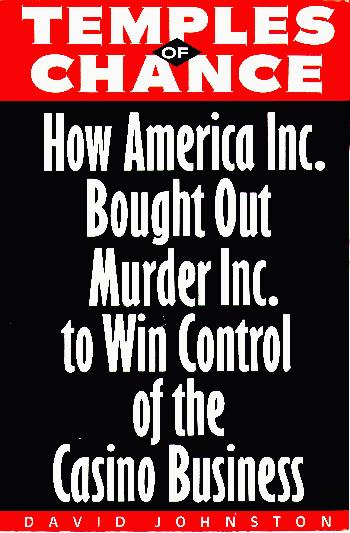
Comments worth reading, but even more so a great book entitled "Temples of Chance How America Inc. Bought Out Murder Inc. to Win Control of the Casino Business" by David Cay Johnston that explains how Wynn, Trump, Sands, and the Gambling Industry have helped destroy America.

Is it possible that American voters will stop screwing themselves by supporting wealthy investors such as these?


SEC probes Wynn Resorts Macau dealings
By Chris Sieroty
LAS VEGAS REVIEW-JOURNAL
Posted: Feb. 13, 2012


The U.S. Securities and Exchange Commission is investigating Wynn Resorts Ltd's business practices in Macau, the company disclosed in SEC filings Monday.

The SEC's probe relates to a dispute between Wynn Resorts and its largest shareholder, Kazuo Okada, which includes Okada's demand for release of company records related to a $135 million donation pledged by Wynn Resorts to a foundation run by the University of Macau.

Okada is a Wynn Resorts director and owns almost 20 percent of the Las Vegas-based company through his Universal Entertainment Inc. He sued the company in Clark County District Court, seeking access to company financial records.

In a regulatory filing Monday, Wynn Resorts said that after a Feb. 8 hearing on Okada's lawsuit, "the company received a letter from the Salt Lake City regional office of the (SEC) requesting that, in connection with a informal inquiry by the SEC, the company preserve information relating to the donation to the University of Macau."

The SEC also requested documents related to any other donations to educational charitable institutions, including the University of Macau Development Foundation, and documents related to "the company's casino or concession gaming license or renewal in Macau."

"The pledge was made following an extensive analysis which concluded that the gift was made in accordance with all applicable laws," Wynn Resorts said in the disclosure. "The company intends to fully comply with the SEC's request."

Wynn Resorts is the second Las Vegas-based casino operator to face an SEC probe of business operations in Macau.

On March 1, Las Vegas Sands Corp., which has long had a casino in Macau and will soon open a much larger resort there, revealed that the SEC and Justice Department are investigating possible violations of the Foreign Corrupt Practices Act. The 1977 federal law prohibits U.S. citizens from offering bribes to a foreign official to obtain or retain business advantage.

Wynn Resorts did not disclose what, if any alleged violations the SEC is investigating. The agency declined comment. Wynn operates Wynn Macau and Encore at Wynn Macau and is waiting for the Chinese government to approve a major new resort planned for the Cotai Strip area of the former Portuguese colony.

Deutsche Bank analyst Carlos Santarelli dismissed the impact of the SEC's Wynn Resort probe. "We believe this will ultimately prove to be a largely inconsequential investigation, though we do wonder whether the investigation deters potential new investors ... who currently view Wynn as a reasonable relative value at current levels," Santarelli said in a note to clients Monday.

Santarelli said the investigation can go one of two directions, with the SEC dropping the matter with a declaration of "no findings" or instituting a formal investigation, "in which case the SEC would likely subpoena documents."

Shares of Wynn Resorts dropped $2.64, 2.33 percent, to close Monday at $110.56 on heavy volume of 3.72 million shares traded on the Nasdaq Global Select Market.

Wynn Resorts founder and CEO Steve Wynn addressed the investigation in a letter Monday to all employees.

"In light of the media attention that Mr. Okada has recently generated, it is not surprising that his disagreements with the company have caught the attention of regulators," Wynn wrote. "As you know, Macau is a critical market for both Wynn companies. Unfortunately, the donation to the university is not the only disagreement the board of directors has had with Mr. Okada.''

Wynn also repeated earlier comments about Okada's development of a $2 billion resort in Manila that makes him "a significant new competitor" to Wynn's resorts in Asia. Wynn has indicated that he believes the Manila development, which Wynn Resorts rejected, is driving Okada's lawsuit.

While Wynn Resorts has argued that Okada does not have the right to inspect company records, Clark County District Judge Elizabeth Gonzalez on Feb. 8 gave the company two weeks to review Okada's list and either allow him access or deny it. She will then decide at a Feb. 23 hearing whether Okada has the right to see any documents the company denies.

In its SEC filing Monday, Wynn Resorts disclosed more details about its donation to the University of Macau, which is sanctioned by the governments of Macau and China.

"As previously disclosed in May 2011, Wynn Macau, a majority-owned subsidiary of Wynn Resorts Ltd, made a commitment to the University of Macau Development Foundation in support of the new Asia-Pacific Academy of Economics and Management. This contribution consists of a $25 million payment made in May 2011 and a commitment for additional donations of $10 million each year for the calendar years 2012 through 2022 inclusive," the regulatory filing said.

"The pledge was considered by the boards of directors of both (Wynn Resorts) and Wynn Macau and approved by 15 of the 16 directors who serve on those boards," the filing said. "The sole dissenting vote was Mr. Kazuo Okada whose stated objection was to the length of time over which the donation would occur, not its propriety."