Meetings & Information


*****************************
****************************************************
MUST READ:
GET THE FACTS!


Showing posts with label Tim Cahill. Show all posts

Wednesday, July 18, 2012

Public Perception is Everything


Out-of-touch "Racino" DeLeo finally worried about public perception???? 

After cramming through flawed Predatory Gambling legislation behind closed doors, secret meetings, Gambling Lobbyists' access and passing legislation that short-changes citizens and rewards vested interests, the man has become a pathetic joke.

The legislation was passed with NO SINGLE INDEPENDENT COST ANALYSIS ever conducted.

And much else has been accomplished on this Speaker's watch.


Stop behaving like a clown if you don't want the public to believe you're one.


DeLeo worries about public perception in probation inquiry

House Speaker not asked to testify


Jul 16, 2012
DeLeo worries about public perception in probation inquiry
BOSTON -
As Beacon Hill tries to wind up business by the end of this month, House Speaker Robert DeLeo said he is concerned about the perception of corruption at the Statehouse.

"I think, especially in my position with the history this office has had, I think I'm concerned, very concerned about public perception," he said.

The Boston Globe reported that federal prosecutors investigating the scandal-plagued Probation Department are focusing on Democratic legislators who may have benefited from the agency’s allegedly rigged hiring system. Those lawmakers include DeLeo and Rep. John Rogers.
According to the paper, Rogers’s supporters suspect that Probation Commissioner John O'Brien allegedly gave jobs to friends and family of key legislators in return for a bigger budget, or they agreed to vote for DeLeo as speaker in 2009. Both men deny the charge.

“I guess that I can tell you that any member who would testify that there was any agreement that if they voted for me there would be a job down the road in probation is being untruthful,” DeLeo said.

Much speculation focuses on Rep. Thomas Petrolatti, who reportedly testified to the grand jury. Senate President Therese Murray and DeLeo said Monday they have not been asked to testify.
If there are no more indictments before the election, incumbents like the speaker and the senate president fear the alleged corruption could cast a pall over all Democrats.


Read more: http://www.wcvb.com/news/politics/DeLeo-worries-about-public-perception-in-probation-inquiry/-/9848766/15565928/-/x1ydgy/-/index.html#ixzz20zPhcWYs


‘Feds not letting up’

Pols say Probation probe sowing fear

By Laurel J. Sweet and Chris Cassidy
Wednesday, July 18, 2012
 
News that two trusted lieutenants to disgraced former Probation Commissioner John “Jack” O’Brien were granted immunity in exchange for their testimony has reignited fear and anxiety on Beacon Hill over the ongoing investigation into the patronage scandal.

“This is certainly an indication that the feds are not letting up,” said one Democratic legislator, speaking on condition of anonymity about the highly sensitive subject. “They’re moving forward aggressively. This isn’t over by a long shot, and there’s more to come.”

“I would assume it’s making everybody nervous,” said another Democratic lawmaker. “Especially these two guys so high up in the hierarchy, it can’t help but make everybody nervous. ... Who knows where it’s gonna lead?”

As first reported by boston herald.com, Edward P. Ryan, O’Brien’s $93,000-a-year legislative liaison, and Francis Wall, his $119,500-a-year deputy commissioner, have both struck deals with prosecutors, assistant Attorney General Peter Mullin told a Suffolk Superior Court judge yesterday.

“My understanding from the U.S. Attorney’s Office is Mr. Ryan has testified twice before a federal grand jury,” Mullin said.

Now defense attorneys for O’Brien, 55, and co-defendant Scott Campbell, 47, former campaign manager to ex-Treasurer Timothy Cahill, are demanding to know what promises may have been made to Ryan and Wall by prosecutors and police to persuade them to testify.

In a potentially damaging disclosure, Campbell’s lawyer Charles Rankin told MacLeod he has seen Ryan’s state grand jury testimony. He said he expects “Ryan will testify that O’Brien asked him to call the Lottery and see if his wife Laurie could get a job there.

“He’ll say, ‘O’Brien asked me to call the Lottery. I called Scott Campbell, who I’ve known for years, and he said Tim Cahill wants to see about you putting on a little fundraiser,’ ” Rankin said.

But Rankin pointed out that’s not the story Ryan told independent counsel Paul F. Ware Jr., whose 2010 investigation for the Supreme Judicial Court blew the lid off the Probation Department’s alleged quid-pro-quo hiring and promotion practices with direct links to the commonwealth’s most influential Beacon Hill pols.

Mullin conceded yesterday that Ryan “did deny before Mr. Ware there was (any) connection between the fundraiser and the hiring of Laurie O’Brien.”

He later told MacLeod, “The explanation is he went to the independent counsel without a lawyer. He said some things that were inaccurate. He acknowledged in his state grand jury testimony they were wrong.”

Neither Ryan nor Wall could be reached for comment.

http://www.bostonherald.com/news/politics/view.bg?articleid=1061146613&srvc=rss

Saturday, May 12, 2012

Governor Slot Barns Endorses Corruption


Candidate "Slot Barns" offered the meaningless promise to end the 'Big Dig Culture,' even as he schmoozed with Big Dig lobbyists.

Governor Slot Barns then conducted back room meetings and made secret promises about Gambling Legislation - one in particular benefited his generous supporter, Bob Kraft by moving the line on the map to include the recently defeated Foxboro Kraft/Wynn Folly.

Governor Slot Barns agreed to support an INDEPENDENT COST ANALYSIS of Predatory Gambling and developed amnesia after re-election [by a plurality, thanks to Tim Cahill]. It is unclear whether the amnesia struck before or after he met with the Pokassets and promises them a Slot Barn in Freetown, even denying it in an email.

And now this????  Endorsing corruption? Maybe Governor Slot Barns hasn't figured out the uproar regarding a campaigner he reinstated without investigating charges in Florida.

But then he profited from Predatory Lending, why not profit from Predatory Gambling? As long as you suck money from the poor, it's OK with Slot Barns Patrick!


Deval Patrick vetoes mandated background checks for future Massachusetts gaming employees

http://www.masslive.com/news/index.ssf/2012/05/deval_patrick_vetoes_mandated.html
Published: Friday, May 11, 2012, 10:31 PM
By State House News Service
By MATT MURPHY
BOSTON — Gov. Deval Patrick on Friday vetoed portions of a spending bill sent to him this week by the House and Senate requiring the Gaming Commission to conduct full criminal background checks and drug screenings on future employees.

A day after it arrived on his desk, Patrick signed a $72 million mid-year spending bill that included additional funding for public assistance for low-income disabled residents, family shelters, legal aid and youth jobs accounts that were in danger of running out of money before the fiscal year ends on June 30.

The governor, however, rejected amendments to the bill that were added during floor debate in the House and Senate this week in response to an outcry over the attempted hiring of C. Stanley McGee as the interim executive director of the Gaming Commission.

McGee, who works as an assistant economic development secretary in the Patrick administration, turned down the job after some lawmakers, child advocates and Treasurer Steven Grossman raised questions about his suitability for the post due to previously disclosed allegations that he sexually abused a teenaged boy in Florida in 2007. McGee was never charged, and settled a civil lawsuit with the boy’s family out of court.


Patrick struck the two sections of the bill that would have made criminal history checks, urine screenings and state police approved fingerprints and photographs a prerequisite for employment at the Gaming Commission. The bill also would have required background and credit checks.

“While the importance of thorough background investigations is unquestioned and already provided for the by the recently enacted legislation establishing the Gaming Commission, the highest levels of background checks and screening may not be necessary nor appropriate for every employee,” Patrick wrote in his veto letter to the House and Senate.

“Under the current law, the Gaming Commission has the discretion to make those decisions,” Patrick continued.  NOT ACCEPTABLE!


House Minority Leader Brad Jones, who offered the amendment in the House to require the background checks, said by vetoing provisions in the bill that had broad support among Democrats and Republicans, the governor was taking full responsibility for the commission’s future hires.

“I think it’s disappointing. Even the governor has acknowledged the commission suffers from a lack of focus and I think that’s why we put this forth. Now he says they have all the tools they need, but they haven’t done the job even though they have the tools. Any missteps going forward fall on the doorstep of the governor,” Jones said.

Rep. Daniel Winslow, a Norfolk Republican, went further warning that the governor’s veto could open the door to corruption. Winslow announced this week that he had hired a private investigator with his own campaign funds to look into the McGee case, but dropped that pursuit when McGee stepped down from the director’s position.

“Given the recent history of corruption on Beacon Hill, the House and Senate were clearly concerned that we need to have the highest degree of integrity for all employees of the Gaming Commission. Leaving weak links in the chain is an invitation for criminal interests to take advantage of every opportunity,” Winslow said Friday, citing the past hiring of reputed mobster James “Whitey” Bulger as a custodian in Suffolk Superior Court as an example of what could go wrong.

Patrick on Thursday lamented what he described as distractions that have taken the focus of the Gaming Commission off the main task of implementing expanded casino gambling in Massachusetts. He urged the commission to refocus itself “promptly.”

The governor’s communications director Brendan Ryan, however, said requiring all employees, even secretaries, to undergo drug and police background checks was unnecessary.

“The administration agrees that every hire needs to be of the highest integrity, but mandating urine test for every potential receptionist seems like an overreach. The commission has the tools it needs to do the job it needs to do,” Ryan said.

Asked whether receptionist should be put through the same screening process as high-level employees, Jones said, “Conceivably no, but it doesn’t seem to this point that their high level employees had gone through that either. We want to create a scenario that’s above reproach, and so far they haven’t acted above reproach so that’s why we have to act.”

According to the Gaming Commission, McGee was already undergoing a State Police background check as a condition of his employment before he formally withdrew from the position on Wednesday.

“The commission appreciates that the governor recognized that provisions of this law as passed by the Legislature are already both comprehensive and effective,” said Karen Schwartzman, a spokeswoman for the Gaming Commission.


Thursday, April 12, 2012

Our View: Corruption thrives with state secrets

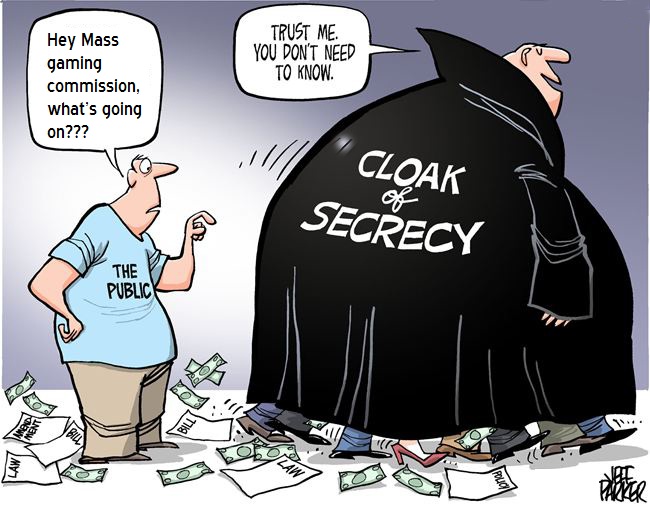
The candidate who ran for Governor on a platform of reform has sorely disappointed his supporters by negotiating Expanded Gambling behind closed doors.

So much for leadership!

Our View: Corruption thrives with state secrets
April 12, 2012 12:00 AM

In a state where public corruption cases seem as common as seashells on a beach, it came as somewhat of a surprise that Massachusetts received the 10th highest score, among 50 states, in the "State Integrity Investigation." Conducted by the Center for Public Policy, Global Integrity and Public Radio International, the investigation was designed to measure the risk for public corruption.

Massachusetts received a grade of "C" and a numerical score of 74, garnering the highest scores for its approach to redistricting, its transparency of political and campaign finance records, and lobbying disclosure rules. While there is reason to feel good on these fronts, the news on other fronts is dismal.

The state received an "F" for public access to government information, an "F" for public access to the state budget process, and a "D+" for legislative accountability.

In the last 15 years, three consecutive state Speakers of the House have been convicted on federal corruption charges, several state contractor employees were convicted for fraud, false billing and shoddy work related to the financially bloated Big Dig project, and a Boston state senator was convicted on bribery charges after she was photographed stuffing the ill-gotten money into her bra.

The latest barrage of public corruption cases involved six former state officials who were indicted over the last two weeks.

On March 24, former state Probation Commissioner John J. O'Brien and two of his former deputies, Elizabeth V. Tavares and William H. Burke III, were indicted on charges that they gave job applicants, who were sponsored by powerful lawmakers, including Senate President Therese Murray, D-Plymouth, and House Speaker Robert DeLeo, D-Winthrop, hiring preference over more qualified candidates. O'Brien, Tavares and Burke are accused of maintaining "sponsor lists" to ensure that sponsored candidates were hired. Their motive, say prosecutors, was to curry favor with the Legislature, which controls the agency's budget.

On April 3, former state Treasurer Timothy Cahill and his former chief of staff Scott S. Campbell were indicted for allegedly orchestrating a state lottery television advertising campaign, funded with $1.6 million in taxpayer money, which prosecutors say was intended to boost Cahill's failing 2010 gubernatorial campaign. Cahill's former lottery chief of staff Alfred J. Grazioso was also indicted on two counts of obstruction of justice.

That these cases involve legislators, a statewide office holder and public agency leaders comes as little surprise when looking at the weaknesses pointed out by the integrity investigation.

Most of the wrangling over the state budget, as well as major legislative actions, happens behind closed doors, and the public has no legal access to records from these meetings. The 2011 casino gambling bill, arguably the most transformational bill in the last decade, was negotiated by the Governor, Senate President and House Speaker before it was sent to the Legislature, where it was approved with relatively little debate.

History shows us that corruption flourishes when the press and the public are not given the opportunity to see how and why public officials make decisions, how and why taxpayer money is spent and which special interests are influencing the actions of public officials.


Monday, August 8, 2011

Remember Poor Tim?

It is customary for the Gambling Industry to overstate jobs and revenues to convince leaders to follow their "Something for Nothing" Scheme.

Many actually believe them! Take for instance House Speaker "Racino" DeLeo said, adding that casino resorts would add 15,000 to 18,000 construction NOT!

Not content to repeat the grossly inflated numbers, mathematically challenged State Treasurer Tim Cahill embellished further during his campaign for Governor:


...Cahill estimated Massachusetts

could generate $2 billion to $3 billion in up-front licensing fees from slot parlors,

plus up to $250 million annually in tax revenues.


Timmy's figures were so extremely flawed that perennial casino cheerleader and gambling industry lackey, Clyde Barrow said:

Cahill’s plan overestimates the amount of money that could be earned through up-front licensing fees....


Sources:

Tim Cahill

Tim Cahill

Now Tim's got himself in a whole bunch of scandal and corruption that only further erodes voter confidence.


7 on lottery staff face questions from AG team
Inquiry on ads, Cahill may be in final phase
By Frank Phillips
Globe Staff

Investigators from Attorney General Martha Coakley’s office are scheduled to converge on the Massachusetts State Lottery office today to interview top agency executives and staff, a signal that prosecutors are entering the final stages of their review of the $1.65 million lottery advertising blitz that former treasurer Timothy P. Cahill ran last year during his gubernatorial campaign.

Coakley’s office - which is examining whether Cahill used the ad campaign to boost his campaign profile - contacted lottery officials late last week to inform them that the investigators would spend a good part of the day at the lottery’s Braintree headquarters. They will interview seven agency employees, including its chief financial officer and its budget director, according to sources with direct knowledge of the prosecution’s plans.

The attorney general’s office has not explained exactly what its prosecutors are seeking, the sources said, but all seven people on the list would have had knowledge of or been directly involved in the launch of radio and television advertisements last September. Documents have shown that although the ads were billed as promoting the lottery and paid for with taxpayer money, they were written by Cahill’s gubernatorial campaign staff. The treasurer’s office oversees the lottery.

Among those to be interviewed at the agency’s office today are CFO Ed Bartley, budget director Lisa Perna, and assistant legal counsel Beth Day, according to the sources. Bartley and Perna would have been responsible for signing off on the ad purchases. Neither they nor the others being interviewed are implicated in any wrongdoing, the sources said.

Investigators also want to talk to Kerri Coyne, who is the assistant to chief of staff Alfred J. Grazioso Jr., a close Cahill ally from Quincy who has been held over by state Treasurer Steve Grossman. Grazioso was summoned in June to testify before a grand jury, as part of what is now a nearly yearlong investigation into Cahill’s actions.

Another person on the list is Mary Beth O’Brien, the assistant to former lottery director Mark Cavanagh, whom Cahill chose to run the agency. Cavanagh, once part of Cahill’s inner circle, was at the helm last fall when the ads were run.

Cahill’s attorney said yesterday that he and the former treasurer are convinced that the investigation will not find any wrongdoing.

“The lottery ads that ran during the campaign were legal, ethical, and appropriate,’’ said Joseph L. Demeo. “We are confident that the attorney general’s office will agree once they finish their investigation.’’

Beth Bresnahan, the communications director for the lottery, referred all questions to the attorney general’s office. Coakley’s press office said it would not comment.

The attorney general began her investigation shortly after internal campaign e-mails emerged in a civil court case last October indicating that Cahill’s political staff had consulted with him and had gotten his approval to use the lottery ads to boost his candidacy.

State law prohibits public officials from using their position or public resources to advance their political careers. Those found guilty face heavy fines and up to five years in prison.

Internal lottery e-mails obtained by the Globe in June confirmed that Cahill was directly involved in the decision last year to switch the ad campaign from one that would promote specific lottery games to one that touted the successful management of the lottery’s operations.

It came at a critical time in Cahill’s independent campaign for governor, a race in which he would ultimately garner only 8 percent of the vote, far behind Republican Charles D. Baker and Governor Deval L. Patrick, who won reelection.

Cahill, through his attorney, has not denied he was involved in ordering the new strategy for the ads. But he said he was compelled to do so because the agency’s image was badly tarnished - and the sale of tickets threatened - when the Republican Governors Association ran ads attacking him for playing politics with the lottery.

“If the lottery did not respond, the treasurer would be criticized for falling revenues,’’ Demeo said in June. “The treasurer would have been remiss if the lottery did not act to protect crucial state revenues. The decision to run the ads was both sound business judgment and completely legal.’’

It is not clear from last year’s sales figures, however, that the ticket purchases declined because of the GOP attacks, according to lottery officials who have reviewed the figures.

The ads were scheduled to end in late November, consuming more than 80 percent of the lottery’s annual advertising budget less than halfway through the fiscal year. But Cahill pulled the campaign in mid-October under pressure from Coakley, as she launched her investigation.


A reasonable person might question if these people are capable of managing anything.

They sure did a Bang Up job on the
Big Dig!

Monday, August 2, 2010

Now, Now Little Timmy!

Not content to be ignored amid the hubbub, Little Timmy, the arithmetically challenged State Treasurer and Guv wannabe, is throwing another one of those temper tantrums, stomping his feet and demanding that the fiscal follies of Beacon Hill be approved, consequences be damned!


Does anyone remember this --

...Cahill estimated Massachusetts
.
could generate $2 billion to $3 billion in up-front licensing fees from slot parlors,
.
plus up to $250 million annually in tax revenues.


Go back to sleep Timmy!

Mission Creep and Poor Timmy!

You might find some more here: Cahill

Thursday, September 17, 2009

Mission Creep and Poor Timmy!

In March 2009 --
.
Cahill proposed licensing three slot machine parlors, including one in southeastern Massachusetts, as a way to raise quick revenue for the financially-impaired state. They might not be located at existing tracks, under his proposal.
.
...Cahill estimated Massachusetts
.
could generate $2 billion to $3 billion in up-front licensing fees from slot parlors,
.
plus up to $250 million annually in tax revenues.
.
Timmy's figures so were extremely flawed that perennial casino cheerleader and gambling industry lackey, Clyde Barrow said:
.
Cahill’s plan overestimates the amount of money that could be earned through up-front licensing fees....
.
When that article appeared, along with several others that GROSSLY overstated revenues and ignored expenses and impacts, I emailed State Treasurer Cahill's Office and this is the response --
.
Thank you for your correspondence regarding Treasurer Cahill’s
proposal to introduce Video Lottery Terminals in the Commonwealth. The
Treasury welcomes your feedback and appreciates your shared desire to
enhance the Massachusetts economy.
.
Under the proposal, the state would enter into a Public-Private
Partnership that would lease the right to operate VLTs to the highest
qualified bidder for a span of 15 to 20 years. The leasing of these
operating rights could bring in between $2 billion and $3.3 billion in
up-front payments, as well up to $244 million annually by collecting a
27 percent tax on revenue. Further, we are looking to capture a revenue
stream currently leaving the state, and this plan would allow money
currently being spent in Connecticut or Rhode Island to remain in
Massachusetts.
.
Given the ongoing economic crisis that our state and nation are faced
with, the Treasurer is convinced it is a necessary strategy that will
provide a vital revenue source for our state and will help our taxpayers
keep money in their pockets. Again, thanks for your correspondence and
your desire to help make Massachusetts stronger for our fellow
citizens.
Sincerely,
Gregory Gatsogiannis
cc. Scott Campbell
.
The email can't be dismissed as a staff member speaking out of turn because Timmy was quoted in the Boston Globe during a luncheon forum at Locke Ober as saying: selling slot parlor licenses could immediately raise as much as $3.3 billion.
.
Speaking at a business forum yesterday at the Seaport Hotel, Timmy said:
.
State Treasurer Timothy Cahill reaffirmed his support for bringing slot machines to the state’s racetracks, despite dwindling revenues at Connecticut’s Indian casinos.
.
In response to a question about expanded gambling, Cahill said the Legislature should approve
.
slots at racetracks at Suffolk Downs, Wonderland Greyhound Park and Raynham Park,
.
where they could later be expanded to full-scale casinos.
.

Now, Timmy, Dear, Let me point out that you're the first politician honest enough to tell folks that the future plan is to expand those race tracks to full fledged casinos.

That's a No! No!

Timmy, It's supposed to be part of the "Mission Creep" of Predatory Gambling. You need to pretend that a few slot machines, like, oh! maybe 1500 or so will do to save those jobs.

.

And then, when you find out that the gambling revenues don't cover the costs, you beg for more slots on the same pretext -- more revenue, more jobs, blah! blah! blah!

You know the routine!

You simply can't tell people that those few measley slot machines placed in numerous locations are going to become casinos everywhere!

And Timmy, maybe it was just an oversight, and I really hate to mention it, but you seemed to have forgotten Plainridge on your list. Now, Plainridge was losing money when it was sold and only purchased with the promise of Casino Gold in the future. How could you forget?

You did good just commenting about "declining revenues" and not mentioning that Foxwoods is imploding or those other bankruptcies.

Now, Timmy, I really hate to mention this also, but here's what the story said:
.
Cahill, who is running for governor as an independent, also said when and if casinos come to the Bay State, the Massachusetts State Lottery should be privatized as a way to get an infusion of quick cash into the state’s coffers.
.
“We should consider privatizing the lottery to even the playing field,” Cahill said at a business forum yesterday at the Seaport Hotel. “It would be hard for the lottery to compete against the private gambling industry that has more bells and whistles.

.
“If we expand gambling, we can’t just leave the lottery as the poor step child, because revenues could fall because everyone wants to do the new thing.”

.

Timmy,

You may be cute, but you need to stop inserting your foot in your mouth when you speak! You can't privatize the lottery!

.


Monday, August 24, 2009

Follow the losers

Indiana added slot machines to race tracks because --

Track officials said revenue from the slots was needed to keep their tracks and the horse racing in Indiana viable

This is the claim made around the country. Frequently, it works.

Of the Raynham Dog Track --

“It’s not doing as well as it once did, but that’s only because we haven’t allowed them to compete,” said state Sen. Marc R. Pacheco, D-Taunton.

[Rep. Slots] Flynn has estimated the state would reap $700 million from slots in their first year and $400 million annually thereafter, but since the economy has continued slumping, he has backed off any firm figure.


Wow! Such revenue! Except it wasn't true then and isn't true now.


And NOW ?

The discussion [by the Indiana state Senate Committee on Gaming] is expected to include tax breaks for so-called "racinos" and whether to allow table games....

That's the way it works! Promise anything and push for expansion when reality sets in!


Of the most recent push, for slots at race tracks or racinos, Raynham Selectman Joseph Pacheco repeated the oft-heard and untrue refrains --
.
'This will not only create revenue, but also create and maintain jobs.”
.
Wow! Mr. Pacheco has got the canned casino rhetoric down pat!

Let's copy the recipe of failure offered by others --
.
The study, appearing in the latest issue of "The Journal of Economics," found that
.
the average salary of racino employee is less than $14,000 annually.

From Treasurer Cahill's Suicide Pact? --
Slot parlors around the country are collapsing; Rhode Island may have to use PUBLIC money to buy out their own racetrack slot parlor


In a speech by State Treasurer Timothy Cahill to the Greater Boston Chamber of Commerce, he offered --
...licensing fees for 15- to 20-year operating rights could bring in between $2 billion and $3.3 billion in up-front payments, ....up to $244 million annually by collecting a 27 percent tax on revenue from the slot machines...

...the governor's 2007 estimate, which was $600 million to $900 million. (which was an overestimate at the time)

Twin River in Rhode Island has about 4,000 slot machines; in Connecticut, Foxwoods Resort and Casino has more than 7,000 and Mohegan Sun has 6,600.


Thursday, August 20, 2009

When Investors Look Bad, Just Lie

Indiana Racino tries to look good in spite of evidence to the contrary --

Researchers looked at so-called 'racinos' in West Virginia over a 26-year period and found that they do not provide an economic boom, but instead depress local incomes with low-paying jobs, 6News' Norman Cox reported.

The study showed that the businesses increased employment in communities by 1.1 percent, but decreased overall salaries 2.9 percent.
6News asked to talk to Hoosier Park employees, but were only allowed to interview hand-picked individuals, while managers looked on.
.
That sure sounds legit!
.
Mr. Speaker, Are you watching? How 'bout you, Mr. "Slot Parlor" Cahill?
.
When employees are intimidated, what does that mean?

Wednesday, August 19, 2009

Speaking of Gambling Lobbyists ...

In Campaign Contributions, the following were included --

In the McDermott search, the following cropped up --
Timothy Cahill Deposited 11/26/07
McDermott, Terence P. 21 Custom House Street, #300 Boston, MA 02110 Attorney McDermott, Quilty & Miller $200.00McDermott, William P. 21 Custom House Street, Suite #300 Boston, MA 02110 Attorney McDermott, Quilty & Miller $200.00Miller, Stephen McDermott, Quilty, & Miller Boston, MA 02110 Attorney McDermott, Quilty & Miller $200.00

Coakley, Martha 5/16/08 - 5/31/08 for 13182 Coakley, Martha
5/16/2008 McDermott, William c/o McDermott Quilty and Miller, 21 Custom House Street, Suite 300 Boston, MA 02110 Attorney McDermott Quilty and Miller $200.00
5/16/2008 Miller, Stephen c/o McDermott Quilty & Miller, 21 Custom House Street, Suite 300 Boston, MA 02110 Attorney McDermott Quilty & Miller

This is by no means a thorough search, but it raises concerns about elected officials who have received campaign contributions from gambling interests, the access that is granted and their votes. Does it raise concerns about the impartiality of the Attorney General?

In the seat of Wampanoags' power
Lawyer a strong force in tribe's bid for casino