Meetings & Information


*****************************
****************************************************
MUST READ:
GET THE FACTS!


Showing posts with label Tribal Casinos. Show all posts

Friday, May 21, 2021

Mashpee Wampanoag Tribe elects Brian Weeden as new tribal council leader


MIDDLEBORO REMEMBERS


Mashpee Wampanoag Tribe elects Brian Weeden as new tribal council leader


Jessica Hill Cape Cod Times 
Published May 18, 2021 

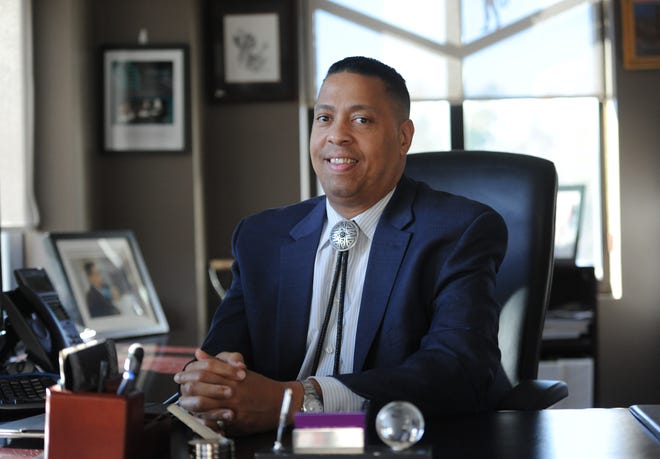
MASHPEE — The Mashpee Wampanoag Tribe has a new chairman who aims to unite tribal members, promote economic development and preserve the tribe’s culture. 

In its May 16 election, members of the Mashpee Wampanoag Tribe elected 28-year-old Brian Weeden as chairman of the Mashpee Wampanoag Tribal Council.

“I feel ready to get to work,” Weeden said. “There’s a lot of things that need to be done for the tribe and the community.” 

Brian Weeden has been elected tribal council chairman of the Mashpee Wampanoag Tribe. He said he wants to improve the tribe’s finances and increase transparency in how the tribe operates.


Weeden won by 20 votes, garnering a total of 241 votes to 221 for Nelson Andrews Jr.. Aaron Tobey Jr. received 167 votes, and Robert “Kyle” Bassett had 20. Carlton Hendricks Jr. was elected vice-chairman, Marie Stone elected treasurer and Cassie Jackson elected secretary. 

“I hope the tribe’s future is bright with the newly elected leadership,” Bassett said. “I know everybody that got elected, and I hope that they’re up for the challenge.” 

Weeden is the youngest person to serve as Tribal Council chairman, the head of the tribe’s executive and legislative government branch.

Weeden graduated from Mashpee High School in 2011 and attended Cape Cod Community College. He works for the Mashpee Department of Public Works as a custodian at the K.C. Coombs School. 

For years, Weeden has been involved in both tribal and town organizations, such as the Mashpee Conservation Commission and the Mashpee Historical Commission. He was most recently elected to the Mashpee School Committee. He is also on Mashpee’s Town Seal Design Committee, and is representing the Mashpee Wampanoag Tribe on the state seal commission.  

In 2009, Weeden founded the Youth Council, and created the Mashpee Youth Commission in 2019 to give young people a voice and experience in tribal and local politics. 

Weeden said his main priority is to restore unity in the tribal community by talking with members and listening to them, he said. He said he plans to organize more unity conferences and ceremonial gatherings. Hendricks, the vice-chairman, also wants to have an open, transparent government where members are aware of what is going on, he said.

Weeden said another goal is to preserve and emphasize the tribe’s culture through more language classes and cultural programming, such as summer camps and Quahog Day for children. He said the tribe used to have a toddler hour at the tribal museum, where day care providers would come in with their children, and a member of the Mashpee Wampanoag Tribe would host a cultural activity. 

Weeden and Hendricks say they also want to find ways to improve the tribe’s financial status through the implementation of a finance committee as well as find new streams of revenue.  

The tribe has been in a dire financial situation for years, and with the plans to build a Taunton casino halted, there is a serious need for economic development.

Weeden’s past two predecessors, Cedric Cromwell and Glenn Marshall, were both indicted on felony charges while in office. Cromwell is currently facing bribery and extortion charges, and Marshall pleaded guilty to several charges in 2009, including embezzling nearly $400,000 from the tribe.

Weeden said he hopes to turn the tide and restore the tribe’s integrity.

“The Cromwell administration left the tribe devastated,” said Hendricks, who has a couple of plans to bring economic development to the tribe, although he declined to provide specifics until he shares them with tribal members and the Tribal Council. He hopes to see two viable economic plans bringing in revenue to the tribe within two years. 

One of Weeden’s ideas is to create a deer farm in Mashpee. The tribe could replenish the woods and restock the Cape’s game, he said, as there are a lot of tribal members who still hunt. The tribe could sell venison to local distributors, tan the deer hide and make traditional clothing. Another idea is to do canoe tours along Mashpee’s rivers and waterways, Weeden said. 

Now also president of the Mashpee Wampanoag Tribe’s Gaming Authority, Weeden plans to get input from members of the tribe and the Tribal Council about what route the tribe plans to take with its casino projects. 

Weeden said he plans to put policies and procedures in place so the tribe “can never be in this situation again.”

“I think people that do wrong by the tribe should not be allowed to receive services” or be a part of the tribal government, he said. 

As someone who attended White House gatherings as a tribal youth delegate, Weeden said he plans to continue making sure the tribe is represented on a national level and build relationships with potential economic partners, he said. 

And at a local level, Weeden said he will also negotiate with the Town of Mashpee and review their intergovernmental agreement, and make sure the town is consulting with the tribe on matters such as development projects. 

Tribal members continue to get harassed for practicing their aboriginal rights to fish and hunt, Weeden said. Members have been arrested for trespassing while trying to access waterways. The Mashpee Pond, for instance, is locked, and Weeden plans on working with the Town of Mashpee to improve treatment and access to waterways. 

He also wants to work on the tribe’s land-in-trust status and continue land and restitution negotiations with the commonwealth. The tribe’s constitution also needs to be reformed, he said. Certain clauses about Tribal Council requirements and tribal enrollment should be amended to give more power to tribal members, he said.

“The constitution took away the voice of the people and gave a lot of power and authority to the chairman and the council,” Weeden said. 

“This administration is going to lead the way for future generations and get everything back in order around here, culturally, spiritually, physically, mentally,” Weeden said. “And do what’s right by our people.


Saturday, March 27, 2021

Indictment: Cedric Cromwell failed to report alleged bribes as income


Indictment: Cedric Cromwell failed to report alleged bribes as income


Jessica Hill Cape Cod Times
Published Mar 24, 2021 

BOSTON — Cedric Cromwell, former tribal council chairman of the Mashpee Wampanoag Tribe, has been charged with filing false tax returns on top of pending bribery and extortion charges. 

A federal grand jury in Boston returned a superseding indictment Monday with the new charges, acting U.S. Attorney Nathaniel R. Mendell announced in a statement Tuesday night, along with the Federal Bureau of Investigation and Internal Revenue Service criminal investigation divisions in Boston.

Cromwell, an Attleboro resident, was charged with four counts of filing a false tax return, bringing the total number of charges he faces to12. He is scheduled to be arraigned on the new charges on April 1 before Magistrate Judge Marianne B. Bowler in federal court in Boston. 

The superseding indictment alleges that between 2014 and 2017 Cromwell failed to report a total of $177,392 on his tax returns. That includes $39,000 of personal income in 2014; $57,374 in 2015; $26,884 in 2016; and $54,134 in 2017.

Cedric Cromwell

Cromwell's attorney, Tim Flaherty, said Wednesday that the "recent indictment relates to tax irregularities that have no overlap and no connection to the early allegations."

“Chairman Cromwell looks forward to presenting a vigorous defense to the extortion and bribery claims and continues to state his innocence," Flaherty said.

Cromwell was charged with bribery and extortion in November along with David DeQuattro, 54, the owner of a Rhode Island architecture firm, in connection with the tribe’s plans to build a resort and casino in Taunton. 

Cromwell, 55, and DeQuattro were each indicted on two counts of accepting or paying bribes as an agent of an Indian tribal government and one count of conspiring to commit bribery, according to Mendell's statement. Cromwell was also indicted on four counts of extortion under color of official right and one count of conspiring to commit extortion.

When Cromwell filed his personal income tax returns for tax years 2014 through 2017, he failed to report bribes that he allegedly received from DeQuattro’s company, Robinson Green Beretta Corp., which was contracted to serve as the tribe’s “owner’s representative” for the casino project, according to the superseding indictment. 

The indictment alleged that DeQuattro provided Cromwell with a stream of payments and benefits valued at about $57,549.37. In exchange, DeQuattro’s company was paid approximately $4,966,287.16 under the contract between July 2014 and February 2018. 

Cromwell did report receiving $180,377 in salary from the tribe in 2017 in his federal personal income tax returns, which he filed jointly with his wife, the indictment states. 

Cromwell is accused of failing to report payments for consulting services he performed for a company that developed and supplied forest carbon offsets. 

While being questioned in a civil lawsuit in 2018, Cromwell said he was a consultant/owner for three limited liability companies, and more specifically a “consultant on carbon sequestration and an Indian Country liaison to Tribal Carbon Forestry Markets,” according to the indictment. 

Cromwell was paid the consulting income through an intermediary identified as “P-Co.”, which was formed by a lawyer who was one of Cromwell’s business associates, the statement says. That associate was the only authorized signatory on a bank account identified as the “P-Co. Shell Company Account,” according to the indictment.

Cromwell also failed to report income made by his company, One Nation Development, which was paid through the P-Co. account and the bank account of a Florida limited partnership that originated with an investment holding company in Las Vegas, the indictment said.

On multiple occasions between December 2014 and January 2016, the Las Vegas investment holding company wired money to the Florida limited partnership, which wired money to the P-Co. Shell Company Account. P-Co. then wired money to the One Nation Development account controlled by Cromwell, the indictment alleges.

The only authorized signatory on the investment holding company’s bank account was the CEO of a Las Vegas-based architecture firm hired to be the architect for the tribe’s casino project, the indictment says. 

If found guilty, Cromwell could face up to three years in prison, one year of supervised release and a fine of $100,000,according to the statement. Cromwell and DeQuattro could have to forfeit any property constituting or derived from proceeds traceable to the offenses. 

Cromwell was first elected to the tribal council in 2009 and was reelected in 2013 and 2017.

When Cromwell was initially charged with extortion and bribery, the council voted to remove him from his post as chairman. But some tribe members had already been pressuring the tribal council for the previous few years to remove Cromwell.

Petitions bearing the signatures of 100 registered tribal voters were certified April 2019 calling for Cromwell’s resignation or removal, along with the removal of Treasurer Gordon Harris.

For several months before the indictment was returned, a grand jury subpoenaed the tribe multiple times for records from 2013 to 2020. Those records include Cromwell’s personnel records, the tribe’s financial records and expenditures, election records and internal communications between the tribe's Gaming Authority and its partners, including the Robinson Green Beretta Corp. and Genting Malaysia, the tribe’s financial backer that invested $440 million into the casino project.

In October 2020, another petition signed by 35 tribe members requested Cromwell's removal. 

"Cromwell’s conduct is a breach of public tribal trust and an abuse of authority," the petition stated. "Cromwell has been dishonest and exercises a lack of integrity by his unwillingness to be transparent about the $500 million dollars that was borrowed from the investors. He is and has been a target of a federal investigation and has not been transparent about it either."

Cromwell would not be the first tribal council chairman to be convicted of filing false tax returns if he is found guilty. The council's prior chairman, Glenn Marshall, was sentenced to 3½ years in federal prison after pleading guilty to embezzling nearly $400,000 from the tribe to pay his own bills, making illegal campaign contributions, filing false tax returns and fraudulently receiving Social Security benefits while holding a full-time job. 

“The new charges are extremely serious, and we are watching the proceedings closely,” Tribal Council Vice Chair Jessie “Little Doe” Baird said in a statement. “Of course, we will continue to work with the U.S. attorney’s office.” 


MIDDLEBORO REMEMBERS

Saturday, December 26, 2020

Former Mashpee Chairman Indicted on Federal Charges, Asks Tribe for Legal Costs


Former Mashpee Chairman Indicted on Federal Charges, Asks Tribe for Legal Costs

Posted on: December 25, 2020

Devon O'Connor

Cedric Cromwell, the former chairman of the Mashpee Wampanoag Tribe in Massachusetts, has asked his Native American community to cover his legal costs.

Mashpee Wampanoag Massachusetts casino tribe
Cedric Cromwell, seen here in 2017 while serving as chairman of the Mashpee Wampanoag Tribe, will soon defend himself against allegations that he engaged in a bribery scheme. (Image: AP)

Cromwell was indicted on federal bribery and extortion charges last month. A grand jury found credible evidence that the then-tribal chairman received unlawful kickbacks in relation to the tribe’s efforts to build a $1 billion casino resort in Taunton.

The Mashpee Wampanoag Tribe has received a request from Cromwell for the tribe to compensate him during his legal fight. The 55-year-old has denied the allegations that he acted wrongly as chairman.

“Mr. Cromwell vigorously denies these allegations and looks forward to presenting an aggressive defense,” his attorney Tim Flaherty told the Cape Cod Times.

Cromwell’s case is set to begin on February 4.

Tribal Resort Background

The Mashpees have been trying to become a gaming tribe for more than half of a decade.

It acquired 151 acres of land in Taunton that it believes has ancestral ties, and therefore the property qualifies to be deemed sovereign. The Interior Department agreed in 2015, and took the land into federal trust.

The federal agency, however, reversed its own decision three years later and removed the land from the registrar. The case has since been tangled up in courts, and has caught the attention of lawmakers in DC, who believe the matter has become political.

Sen. Elizabeth Warren (D-Massachusetts) and outgoing Rep. Joe Kennedy III (D-Massachusetts) have supported federal legislation that would sidestep the Interior Department under the Trump administration and deem the land sovereign.

But President Donald Trump successfully urged Senate Republicans to reject the bill after it passed the House.

Casino Scheme

Adding to the chaos surrounding the Mashpee Wampanoag Tribe’s mission to build a casino are the Cromwell accusations. The Department of Justice alleges that Cromwell was paid $57,549 in cash and in-kind benefits from David DeQuattro, a businessman who runs an architectural firm in Rhode Island.

Prosecutors say DeQuattro provided Cromwell with the money and free trips in exchange for a $5 million design contract.

Instead of working honestly on behalf of the Mashpee Wampanoags as their duly elected representative, Cedric Cromwell is accused of using his position as chairman of the tribe to enrich himself by extorting tens of thousands of dollars in bribes and engaging in a conspiracy with David DeQuattro to commit bribery,” said Joseph Bonavolonta, special agent in charge of the FBI Boston Division.

DeQuattro last month entered into a not-guilty plea after he, too, was charged in the alleged bribery and extortion plot. He is facing two federal charges of accepting or paying bribes to an Indian tribal government or agent, and one count of conspiring to commit bribery.

Cromwell is facing the same charges, as well as four additional counts of extortion and another count of conspiring to commit extortion.

If found guilty, Cromwell could spend upwards of 35 years in prison and be on the hook for $750,000 in fines.

LINK


Sunday, May 24, 2020

Tribe argues land case in U.S. District Court


Image result for REEL WAMPS


Tribe argues land case in U.S. District Court

By Jessica Hill

Posted May20, 2020


A U.S. District judge said Wednesday he could rule in a week to 10 days on the Mashpee Wampanoag Tribe’s latest attempt to salvage a $1 billion casino deal with the city of Taunton.
Judge Paul Friedman heard the Mashpee Wampanoag Tribe v. Zinke case via teleconference, in which the plaintiff and defendant gave arguments centering on whether the tribe’s land should be removed from trust status, based on whether the tribe was under federal jurisdiction prior to the establishment of the Indian Reorganization Act of 1934.
The tribe, the Department of the Interior and the Littlefields, along with other Taunton neighbors, have been the key players in this yearslong battle over whether the government had the authority to take the land into trust in the first place.
The plaintiff argued that Interior Secretary David Bernhardt’s order in March to remove the tribe’s land from trust was arbitrary and capricious because he had rejected evidence that other tribes have used to obtain trust land in the past. The defense said the Interior Department’s 2018 decision was thoroughly evaluated and consistent with prior decisions.
The tribe had plans to build a $1 billion casino in Taunton that would bring economic aid to the tribe and the city of Taunton through an intergovernmental agreement. Neighbors of the proposed casino were opposed, however, and filed a lawsuit, arguing that the Interior Department had no authority to take the tribe’s land into trust.
In 2015, the Interior Department took 321 acres in Mashpee and Taunton into trust for the tribe, but under a new administration reversed itself in 2018. The tribe had appealed a district court judge’s ruling in favor of the reversal and lost, and in a separate action it challenged the Interior Department’s reversal.
In late March, the Interior Department informed the tribe it would remove its land from trust status. The tribe asked for the federal court to issue an emergency order that would postpone Bernhardt’s decision. The tribe and the Department of the Interior agreed to a 45-day pause period.
Wednesday’s hearing could determine the future of the tribe’s lands as well as its financial future. Depending on what the judge decides, the Interior Department might have to take a second look at the tribe’s qualification for land-in-trust status. A ruling in favor of the defendant might mean the tribe would lose some of its land or the tax relief that comes with it.
The plaintiff argued that several pieces of evidence show the tribe was clearly under federal authority before 1934, while the defense argued that those pieces of evidence are not explicit or show only state jurisdiction.
The tribe’s lawyer, Tami Lyn Azorsky of Dentons LLP, offered examples such as old census reports to show the tribe was under federal jurisdiction. One element of her argument concerned a federal school in Pennsylvania attended by children of the Mashpee Wampanoag Tribe.
From 1879 to 1918, the United States Carlisle Indian Industrial School operated a boarding school that hosted Native American children from around the country, with the goal of assimilating Native Americans into mainstream American culture.
Azorsky said the school took responsibility for every asset of the children’s lives, including medical decisions, without parents’ consent. Because the school was run by the federal government, and members of the Mashpee Wampanoag Tribe attended, this demonstrates the exercise of federal authority, Azorsky argued.
The defendant argued that this evidence was not affirmative of federal jurisdiction. It showed, at most, that the tribe was “under Congress’s linear authority” and was not sufficient, said Sara Costello, federal attorney for the defense.
Azorsky also brought up reports in which the federal government considered taking an action regarding the Mashpee Wampanoag Tribe and then ultimately decided against it. Because no action was taken, the Interior Department dismissed those reports as evidence.
Azorsky emphasized that action does not determine jurisdiction. She said acknowledgment of responsibility is the standard.
“Isn’t a decision not to do something just as much an action as a decision to do something?” Judge Friedman asked the defense.
“The decision to do nothing does not show that the tribe is under federal jurisdiction,” Costello said.
The plaintiff argued the Bernhardt’s order to remove the tribe’s land from trust was arbitrary and capricious because he had rejected evidence that other tribes have used to obtain trust land in the past. The defense said the Interior Department’s 2018 decision was thoroughly evaluated and consistent with prior decisions.
“The Interior Department thoroughly discussed each piece of evidence and thoroughly explained why it chose to do what it did,” Costello said. “The Interior applied the correct standard for determining the federal jurisdiction, set forth in the M-Opinion.”
The “M-Opinion” is a legal opinion the Department of the Interior had been using to determine whether a tribe was under federal jurisdiction at the time of the Indian Reorganization Act. In March, Deputy Solicitor for Indian Affairs Daniel H. Jorjani withdrew the opinion, concluding in a March 5 document that the interpretation of the first definition of “Indian” is not consistent with the “ordinary meaning, statutory context, legislative history, or contemporary administrative understanding” of the phrase ’recognized Indian tribe now under federal jurisdiction.”
Jorjani had issued another memorandum that provided a four-step procedure for determining tribal eligibility that would be “more consistent with how Congress and the Department would have understood them” in 1934.
Judge Friedman criticized that change, calling the March 5 document a “joke” and “incomprehensible.”
If the current matter is remanded, Costello said, the tribe’s case will be a pending application, and so the new guidance would apply, Costello said.
“Basically you’re saying, ‘Heads I win, tails you lose,’” Friedman said. “If I remanded to Interior, you want to apply a new guidance to them which makes it harder for them to succeed.”
The new guidelines would not make it harder for the tribe to succeed in keeping its land in trust, Costello argued.
Costello emphasized that if the tribe’s land is taken out of trust, it will still have access to different funding because of its status as a federally recognized tribe. It is still entitled to COVID-19 aid under the CARES Act, as well as other funds regarding social services and transportation.
“That’s not dependent on having land under trust,” Costello said.
If Friedman he were to rule in favor of the Department of the Interior, and the tribe’s land were taken out of trust, the land would return to the previous deed holder, Azorsky said.
The Taunton land would be lost because of the mortgages, she said, and because the tribe has an intergovernmental agreement with the city of Taunton, the city also would be hurt.
“Interior is the federal trustee for the tribe, and Interior has an obligation to protect the tribe,” Azorsky said. “It doesn’t make sense that there is a rush to take this land out of trust. There still has to be an orderly process, and the tribe’s federal trustee rushing to judgment to disestablish this reservation when no procedure has been figured out yet, it doesn’t make sense.”
While the teleconference dropped for listeners near the end of the plaintiff’s rebuttal, the public was able to listen in for most of the hearing.


Thursday, May 14, 2020

Mashpee Wampanoag behind on payments to Taunton


Mashpee Wampanoag behind on payments to Taunton


By Jessica Hill
Posted May 13, 2020 


Tribal leader denies report that arrears would be made up through bingo hall.
TAUNTON — The Mashpee Wampanoag Tribe is late with its annual payment of more than $500,000 to the city of Taunton in accordance with the two entities’ intergovernmental agreement, and there is some confusion as to how that payment will be made.
Taunton city councilors were surprised Tuesday night to learn in a letter from the city’s legal department that the tribe planned to pay through revenue it would receive from establishment of a “tribal bingo hall.”
A leader of the Mashpee Wampanoag Tribe said he also was surprised.
“There are no plans for a bingo hall or any other financing strategies at this point because the tribe is too busy fighting to protect our ancestral lands against attacks from the Department of Interior during the global COVID-19 pandemic,” Tribal Council Chairman Cedric Cromwell said in a statement. “We look forward to continuing to work closely with the City of Taunton and the town of Mashpee and finding ways to support each other.”
The tribe, which owns 150 acres of reservation land close to the intersections of routes 24 and 140 in Taunton, made an agreement with the city in 2012 based on expected revenue from its proposed $1 billion First Light Resort and Casino. The tribe was to pay the city at least $8 million every year once the casino was operating or 2.05% of its net slot revenue.
The casino and resort were projected to bring more than $50 million in revenue to the state and create more than 1,000 permanent jobs as well as 1,000 construction jobs.
As the tribe has been stuck in a legal tug-of-war with neighbors of the proposed casino who oppose the project and with the Interior Department over its land-in-trust status, that casino has yet to come to fruition.
The tribe has been paying Taunton a rate of $27.62 per $1,000 of assessed valuation every year instead of property taxes because of the land’s tax-exempt status, usually totaling a little more than $500,000.
In the past few years the tribe has been sending those payments through a wire transfer from a New York bank. Taunton Treasurer-Collector Barbara Auger previously commended the tribe on its continued commitment to make the payments.
Matthew J. Costa, first assistant city solicitor, wrote in a May 8 letter to the Taunton City Council that payment was due from the tribe in November. The Law Department issued a formal notice March 31 disputing the nonpayment, and the tribe asked for an extension.
That extension was agreed to based on the expectation the tribe would raise revenue through establishment of a tribal bingo hall, according to the letter.
“However, the establishment of a tribal bingo hall has not been realized due to the COVID-19 pandemic,” Costa wrote in the letter.
If the tribe does not pay, the city would take action in Superior Court.
Cromwell said he had no idea how the city got the impression the tribe would establish a bingo hall. He also said the tribe would make its payment as part of the agreement, although he would not specify when or how that payment would be made.
“We’re going to pay it,” Cromwell said. “We’re working through it.”
Costa and City Solicitor David Gay could not be reached for additional comment on where they heard about plans for a bingo hall.
“This is the first I heard the possibility of a bingo parlor being on that site,” Taunton City Councilor David Pottier said at Tuesday’s meeting.
“Secondly, I find it somewhat incredulous that they’re blaming COVID for not being able to make a payment ... that was due in November when COVID only really took the scene in the last month or so,” Pottier said. “I find their excuse totally inadequate.”