Felix Rappaport doesn't even like to say it.
"I try not to use the word," Foxwoods Resort Casino’s top executive admitted in an interview this past week. "No sense cursing the darkness."
Nevertheless, most discussions of the state of gaming in the Northeast center on “saturation,” the point, theoretically, where supply equals demand.
Rappaport prefers the term “competitive landscape.”
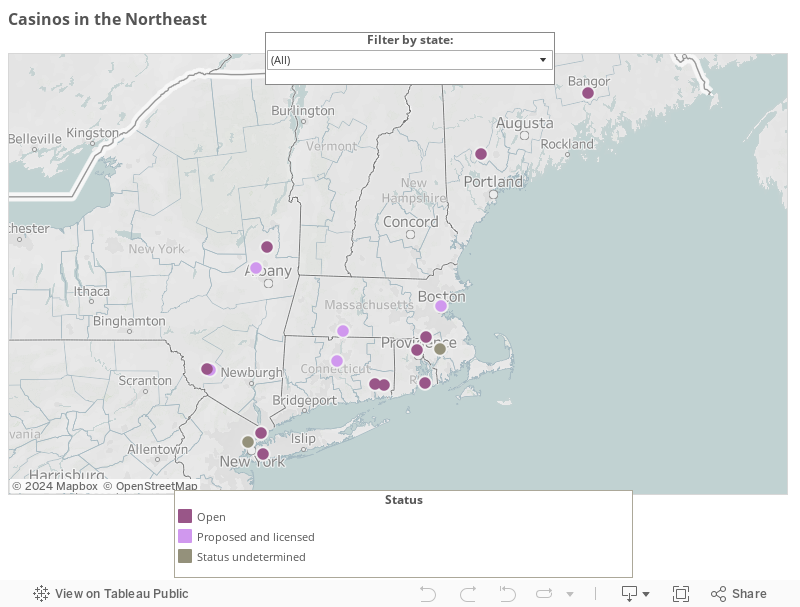
In New England alone, seven facilities operate in four states.
Foxwoods and Mohegan Sun are the reigning heavyweights. Rhode Island’s Twin River Casino in Lincoln and Maine’s Hollywood Casino & Raceway in Bangor and Oxford Casino in Oxford also qualify as full-fledged casinos, offering table games as well as slot machines.
Two of the facilities — Newport Grand in Newport, R.I., and Plainridge Park Casino in Plainville, Mass. — offer only slots and electronic versions of table games. Plainridge additionally offers harness racing.
Four more casinos have been licensed or proposed in the region, while Newport Grand could be shuttered in favor of a full-fledged casino in Tiverton, R.I., depending on the outcome of an Election Day referendum in November.
If everything that’s been proposed materializes — and that’s a sizable “if” — New England’s four gaming states could be home to 10 casinos and a slots parlor by, say, 2020.
West of New England, two upstate New York casinos are scheduled to open next year in Schenectady and Thompson.
To the south, slots-only racetrack casinos in and near New York City already cut into the Connecticut casinos’ share of the slots market.
One of them, Resorts World Casino at the Aqueduct track in Queens, has been talking about expansion.
And then there’s the prospect of a casino or two in northern New Jersey, if that state’s voters approve gaming outside Atlantic City in another Election Day referendum.
“Overall, the market in New England is continuing to grow,” Clyde Barrow, a gaming expert, said in an interview. “But there will be a saturation point.”
Barrow, a professor and chairman of the political science department at the University of Texas Rio Grande Valley in Edinburg, Texas, previously served as director of the Center for Policy Analysis at UMass Dartmouth.
He has studied Northeast gaming for decades and continues to do so.
Hired by the casino-owning Mashantucket Pequot and Mohegan tribes, Barrow analyzed the impact that the casinos proposed in Massachusetts and New York would have on jobs and revenues at Foxwoods and Mohegan Sun.
His 2015 report fueled the tribes’ campaign to win state authorization for up to three commercial casinos in Connecticut.
Eventually, the legislature approved a bill that allowed the tribes to form a partnership and jointly seek site proposals from Hartford-area municipalities willing to host a single “satellite” casino.
The facility would target
MGM Springfield, the $950 million resort casino now under construction in Massachusetts.
So, how do you know when supply and demand are in balance?
Barrow and two colleagues, David Borges and Alan Meister, recently published a paper on the subject, calling attention to a metric involving slot-machine revenues.
Fitch Ratings, a credit-rating agency, considers a “win” per machine per day of $200 to be an important threshold, Barrow said, with win being the amount of slots wagers a casino keeps after paying out prizes.
When the average daily win per machine in a market sinks below $200, it becomes difficult for casinos to cover their overhead, Barrow said.
In June, Mohegan Sun’s average win per machine per day was nearly $300. Foxwoods’ was about $260.
If MGM Springfield and
Wynn Boston Harbor, a $2.1 billion project underway in Everett, Mass., open as projected in 2018 and 2019, respectively, and Rivers Casino and Montreign Resort Casino open next year in Schenectady and Thompson, N.Y., the saturation point might be reached, Barrow said.
And that would be before any resolution of the Mashpee Wampanoag Tribe’s $1 billion project in Taunton, Mass. — halted weeks ago by a court ruling that overturned a federal land-into-trust decision — or the Mashantucket-Mohegan partnership’s bid to win the Connecticut legislature's approval of a Hartford-area casino.
They are expected to appeal the court ruling.
“I could easily envision that if things go well with MGM Springfield and Wynn, and Taunton’s not happening, they could make the decision to expand Plainridge by simply allowing table games there,” Barrow said, referring to the Massachusetts Gaming Commission.
Felix Rappaport doesn't even like to say it.
"I try not to use the word," Foxwoods Resort Casino’s top executive admitted in an interview this past week. "No sense cursing the darkness."
Nevertheless, most discussions of the state of gaming in the Northeast center on “saturation,” the point, theoretically, where supply equals demand.
Rappaport prefers the term “competitive landscape.”
In New England alone, seven facilities operate in four states.
Foxwoods and Mohegan Sun are the reigning heavyweights. Rhode Island’s Twin River Casino in Lincoln and Maine’s Hollywood Casino & Raceway in Bangor and Oxford Casino in Oxford also qualify as full-fledged casinos, offering table games as well as slot machines.
Two of the facilities — Newport Grand in Newport, R.I., and Plainridge Park Casino in Plainville, Mass. — offer only slots and electronic versions of table games. Plainridge additionally offers harness racing.
Four more casinos have been licensed or proposed in the region, while Newport Grand could be shuttered in favor of a full-fledged casino in Tiverton, R.I., depending on the outcome of an Election Day referendum in November.
If everything that’s been proposed materializes — and that’s a sizable “if” — New England’s four gaming states could be home to 10 casinos and a slots parlor by, say, 2020.
West of New England, two upstate New York casinos are scheduled to open next year in Schenectady and Thompson.
To the south, slots-only racetrack casinos in and near New York City already cut into the Connecticut casinos’ share of the slots market.
One of them, Resorts World Casino at the Aqueduct track in Queens, has been talking about expansion.
And then there’s the prospect of a casino or two in northern New Jersey, if that state’s voters approve gaming outside Atlantic City in another Election Day referendum.
“Overall, the market in New England is continuing to grow,” Clyde Barrow, a gaming expert, said in an interview. “But there will be a saturation point.”
Barrow, a professor and chairman of the political science department at the University of Texas Rio Grande Valley in Edinburg, Texas, previously served as director of the Center for Policy Analysis at UMass Dartmouth.
He has studied Northeast gaming for decades and continues to do so.
Hired by the casino-owning Mashantucket Pequot and Mohegan tribes, Barrow analyzed the impact that the casinos proposed in Massachusetts and New York would have on jobs and revenues at Foxwoods and Mohegan Sun.
His 2015 report fueled the tribes’ campaign to win state authorization for up to three commercial casinos in Connecticut.
Eventually, the legislature approved a bill that allowed the tribes to form a partnership and jointly seek site proposals from Hartford-area municipalities willing to host a single “satellite” casino.
The facility would target
MGM Springfield, the $950 million resort casino now under construction in Massachusetts.
So, how do you know when supply and demand are in balance?
Barrow and two colleagues, David Borges and Alan Meister, recently published a paper on the subject, calling attention to a metric involving slot-machine revenues.
Fitch Ratings, a credit-rating agency, considers a “win” per machine per day of $200 to be an important threshold, Barrow said, with win being the amount of slots wagers a casino keeps after paying out prizes.
When the average daily win per machine in a market sinks below $200, it becomes difficult for casinos to cover their overhead, Barrow said.
In June, Mohegan Sun’s average win per machine per day was nearly $300. Foxwoods’ was about $260.
If MGM Springfield and
Wynn Boston Harbor, a $2.1 billion project underway in Everett, Mass., open as projected in 2018 and 2019, respectively, and Rivers Casino and Montreign Resort Casino open next year in Schenectady and Thompson, N.Y., the saturation point might be reached, Barrow said.
And that would be before any resolution of the Mashpee Wampanoag Tribe’s $1 billion project in Taunton, Mass. — halted weeks ago by a court ruling that overturned a federal land-into-trust decision — or the Mashantucket-Mohegan partnership’s bid to win the Connecticut legislature's approval of a Hartford-area casino.
They are expected to appeal the court ruling.
“I could easily envision that if things go well with MGM Springfield and Wynn, and Taunton’s not happening, they could make the decision to expand Plainridge by simply allowing table games there,” Barrow said, referring to the Massachusetts Gaming Commission.




 Posts
Posts


