Meetings & Information


*****************************
****************************************************
MUST READ:
GET THE FACTS!


Showing posts with label children and gambling. Show all posts

Friday, August 17, 2018

Yarmouth woman charged with leaving baby outside casino


Gambling Addicts loose all sense of responsibility.

Gambling Addicts leaving children in vehicles has been widely reported - that's why casinos and slot barns patrol their parking lots.

Yarmouth woman charged 


with leaving baby outside casino

Image result for HALSTON BORGLUND


LINCOLN, R.I. — A South Yarmouth woman left her 3-month-old baby alone in a running vehicle outside a Rhode Island casino for about 90 minutes Wednesday while she was inside, according to police.

Lincoln police charged Halston Borglund, 26, with cruelty or neglect of a child.

A warrant also was issued for Borglund out of Barnstable District Court on Thursday for an alleged probation violation in a 2015 case, where she pleaded guilty to a charge of larceny of a drug.

An officer at Twin River Casino was informed by security at around 10 a.m. Wednesday that a child had been left alone in a parked vehicle.

Authorities found the girl inside a running sport utility vehicle with a window down. 

Borglund came out of the casino and allegedly said she left the baby alone for just a few minutes while she ran inside to retrieve keys.

Casino security said she actually had entered at around 8:30 a.m.

The baby was evaluated at a hospital and taken into state care.

It was not clear from online Rhode Island court records if Borglund was released on bail or was still in custody. Lincoln police did not respond to multiple voicemails Thursday seeking more information.

According to the Barnstable docket, a notice of probation violation was filed July 30 and Borglund’s probation officers requested the warrant Thursday.

In the 2015 case, she stole fentanyl, an extremely powerful opiate, from an unconscious patient who was receiving the medication through an intravenous line, according to police reports.

Borglund has a total of six cases in the Barnstable court dating back to 2010, excluding traffic violations, court records show.

Three cases were filed in 2010 and two cases in 2012, and all are closed, leaving the 2015 case.

In January 2010, she was charged with assault and battery. The charge was dismissed the following month at the request of the victim, according to the docket from the case.

In May 2010, Borglund was charged with assault and battery and malicious destruction of property. That case was dismissed in June of that year because the victim failed to cooperate, according to the docket.

In July of that year, she was charged with receiving stolen property. She pleaded guilty in January 2011, according to the docket. Although the terms of the plea are not in the file, it states that the case was “continued without a finding” and a probation order was entered. She was “discharged on all counts” and the case was closed on Oct. 25, 2015, according to the docket.

On Aug. 16, 2012, she was charged with 18 counts, including identity fraud, writing bad checks, theft and vandalization. She pleaded guilty to 10 counts in April 2013, which was followed by a probation violation and the termination of her probation in June 2014, according to the docket.

On Aug. 28, 2012, she was charged with larceny and breaking and entering in the daytime. She pleaded guilty in April 2013 and, after violating her probation, was sentenced to jail on June 10, 2014. The docket does not state what sentence she received.


http://www.capecodtimes.com/news/20180816/yarmouth-woman-charged-with-leaving-baby-outside-casino

Sunday, August 21, 2016

N.J. couple admits leaving 3 kids in freezing car while gambling at casino in cold


Couple Left Young Kids in Car to Gamble at Pa. Casino: Police

A New Jersey couple is behind bars after police say they left three young children in a cold SUV while they hit a Pennsylvania casino.
Police were called to the Parx Casino parking lot in Bensalem Saturday for a report of three children — ages 8, 3 and 1 — inside a vehicle, said Bensalem Police. Temperatures were hovering near freezing at the time.
Court records show 39-year-old Jarrett Evan Nelson and 30-year-old Ebony Walker, both of Newark, face charges including endangering the welfare of children.
Surveillance video showed the two entered the casino at 7:33 p.m. and returned to the SUV around 9:11 p.m.  The children weren't harmed and were released to other family members.
Walker and Nelson were sent to Bucks County prison after they were unable to post bail.
Online court documents don't list attorneys for Nelson or Walker.


N.J. couple admits leaving 3 kids in freezing car while gambling at casino in cold

By Kevin Shea | For NJ.com 
on August 19, 2016


BENSALEM, Pa. — A Newark, N.J. couple was sentenced to probation Friday for leaving their three children in a car in sub-freezing temperatures while they gambled at Parx Casino in January.
Jarrett Nelson, 40, and Ebony Walker, 31, pleaded guilty to misdemeanor endangering the welfare of children and recklessly endangering another person in in Bucks County Common Pleas Court in Dyolestown [sic].
Nelson, who spent two months in prison after his arrest, was sentenced to time served and 34 months probation. Walker was sentenced to 36 months of probation before Judge Rea B. Boylan, the Bucks County District Attorney's Office said in a statement.
The children, ages 8, 3 and 18 months, were not injured during the Jan. 2 incident.
They were unattended in 31-degree weather for more than 90 minutes, the office said.
Walker told the judge she was struggling for money, had recently been robbed and was desperate for rent money, the office said. 
She and Nelson, who was unemployed, said they won more than $700 playing the slots at Parx, which they put toward their rent.
But both admitted that leaving the children alone was wrong and dangerous, although Walker said she was in constant contact with the 8-year-old via cell phone.
"It happened, and it's the worst mistake I ever made," Walker said in court, the office said. "I made the money I needed, but I got incarcerated."
"No excuse at all," Nelson said. "It will never happen again, because I love my kids so much."
The district attorney's office said New Jersey child protective officials placed the children in Walker's mother's custody following the couple's arrests.
Walker suffers from bipolar disorder. She said in court she placed herself into an intensive counseling program in New Jersey following her arrest, which she still attends.
Nelson said in court the couple hopes to marry after they recover financially and regain custody of the children.
Boylan, the judge, told the couple the cold weather was not the only danger the children faced by being alone in a casino parking lot. They could have been abducted.
Surveillance video showed the couple entering the casino at 7:33 p.m. and returning to their vehicle at 9:11 p.m.
"There's so many things that could have happened to your children, not just being cold and scared," Boylan told the couple.


Thursday, October 2, 2014

The severe impact of casinos on Massachusetts kids


Massachusetts kids will feel the biggest impact of the state's effort to bring in casinos. Through no choice of their own, they will bear the brunt of the financial and social harm of government-sponsored casinos.

To help highlight how casinos impact kids, we joined this week with the Public Health Advocacy Institiute at Northeastern School of Law to issue a demand letter of a Mass Lottery retailer to remove free standing lottery scratch ticket vending machines from its stores. The demand letter came after a 14-year old boy bought lottery tickets at two different supermarkets which was copied on video.

Northeastern University Professor Richard Daynard, President of PHAI, addressed the implications for casinos: “If a basic protection like age restrictions on the sale of state lottery tickets is not being enforced, what can we expect if casinos and slot parlors are actually allowed to open in Massachusetts?”

According to the demand letter, state law expressly prohibits the sale of lottery tickets to “any person under age eighteen” (G.L. c. 10, sec. 29). Yet, the Massachusetts Council on Compulsive Gambling reports that over two-thirds of teenage boys (aged 14-17) have gambled in the past year, and over half of teenage girls have done so. About a third of these children gambled by playing lottery games.

In testimony before Congress as part of the National Gambling Impact Study Commission, the head of the New Jersey’s Council on Compulsive Gambling said 38,000 juveniles were escorted off the state’s casino floors in just one year; 445 were taken into custody by the state.

The future of casinos and lotteries, both of which only operate in partnership with state government, hinges on luring kids to develop a gambling habit. Please share this truth with your friends, co-workers and social networks as you educate them about why regional casinos are financially and socially harmful, especially for the state's kids.

Thanks for your work.


Best,

Les

____________

Les Bernal

National Director

Stop Predatory Gambling

"End the unfairness and inequality created by government-sponsorship of casinos and lotteries."

If you support our mission and work, please participate by contributing $10 or more today to help sustain it.


logo

Quick Links

An American Declaration on Government and Gambling

Online Store

SPG in the Media

Take Action

A Failed Government Policy

Lies vs. Facts

Background Reading

Share Your Story

Donate To The Mission


Thursday, August 21, 2014

Police: Man left three children alone inside vehicle while gambling at Sands


The threat to children because of GAMBLING ADDICTION.....


...WHO'S THE SIMPLETON?


Police: Man left three children alone inside vehicle while gambling at Sands

By Pamela Lehman, Of The Morning Call
August 20, 2014

An Easton man allegedly left his three young children alone in his vehicle Wednesday morning while he gambled at the Sands casino.


Maurice Cook, 30, of the 600 block of Wolf Avenue, is charged with reckless endangerment and endangering the welfare of a child. He was sent to County Prison under $30,000 bail.


Bethlehem police said Cook's three children — ages 1, 5 and 8 — were in the vehicle for 45 minutes with the doors locked until they were freed by police. Cook admitted he has a gambling addiction and was in the casino playing blackjack, police said.

"A concrete parking garage is not a baby sitter," Chief Mark DiLuzio said. "This is totally unacceptable."

According to court records:
Sands security officers patrolling the garage around 10:15 a.m. found the children in the vehicle on the first deck.

Video surveillance showed Cook going into the casino around 9:30 a.m.

Cook admitted to police that he has a gambling addiction and said he left the children in the car.

"I am sorry for what I did," Cook told police.

DiLuzio said Sands security officers bought pizza and juice for the children. The children were examined by paramedics and released to a relative.

DiLuzio said the case will be referred to Northampton County District Attorney John Morganelli's office. In 2011, Morganelli said he would seek "severe sanctions" on parents who left their children alone while gambling and would not allow any of those charged to participate in a program for first-time offenders.

DiLuzio said the casino includes a supervised children's entertainment center for children ages 6 weeks to 12 years that parents may use.

— Pamela Lehman


Read more: http://www.mcall.com/news/breaking/mc-bethlehem-sands-gamble-children-alone-vehicle-20140820,0,7803053.story#ixzz3B1dTSLAw
Follow us: @mcall on Twitter | mcall.lv on Facebook

Thursday, July 10, 2014

Police: Couple arrested after leaving children in car while gambling


Police: Couple arrested after leaving children in car while gambling

Friday, June 27, 2014

Fitzgerald: Gambling bets on neglecting children


Fitzgerald: Gambling bets on neglecting children


Monday, May 26, 2014

Ball and chain: gambling’s darker side


Wrecking balls: An estimated 1 in 10 people in Japan play pachinko, according to a 2012 report compiled by the Japan Productivity Center. | “CR PACHINKO AKB48” BY DICK JOHNSON, USED UNDER CC BY 2.0 / PERSPECTIVE ALTERED AND LOGO REMOVED FROM ORIGINAL

Ball and chain: gambling’s darker side


With lawmakers debating whether to legalize gambling in time for the 2020 Olympics, we look at the other side of the coin — addiction


by Simon Scott
Special To The Japan Times

Unable to overcome his compulsion to play pachinko, long-time Tokyo expat Wayne Smith created an unconventional strategy to limit his ability to gamble away his hard-earned money — keep all his cash in rolls of ¥500 coins.

“¥500 coins cannot be used in pachinko (machines) and cannot be changed at the weekend, as banks are closed, or after 6 p.m. weekdays,” he says. “Also, coins will survive a fire at home and are more cumbersome for burglars to steal.”

Smith, who spoke under a pseudonym due to concerns that public knowledge of his addiction could have negative ramifications on his job, says he used to go to the bank every weekday after pay day and withdraw the maximum limit of a ¥25,000 roll (50 x ¥500) until he had emptied his bank account. That way, he was never short of spending money, but wouldn’t blow it all on the machines.

“At one time I had almost ¥2 million in rolls of ¥500 coins,” he says. “It is a good chunk of metal to have.”

Smith’s strategy of turning all his cash into metal may appear to be somewhat eccentric, but it illustrates the ends to which problem gamblers will go. “It’s not ideal but short of cutting off my right hand, it was the best method I found for controlling my gambling addiction,” he says.

Smith eventually quit pachinko altogether for six months using this method, although he acknowledges he has relapsed on numerous occasions and still plays the machines today, although not as much as he used to.

At root of his addiction to pachinko, he says, is a longing for the rush of positive feeling that follows a big win.

“It is addiction and it is euphoria,” he says. “Addiction is euphoria, really.

Etsuko Sato, a 43-year-old resident of Tokyo who also spoke under a pseudonym because of job recrimination concerns, says she was initially attracted to pachinko by the relatively small amounts she could gamble with upfront. Most machines in parlors in Tokyo, she says, start from as little as ¥1,000.

“The excitement sucks you in,” she says, “but the longer you keep winning, the more boring it becomes. For me, it’s less about the high as it is about the transition of emotions you get in the process — from simply playing to winning.”

Smith says pachinko machines are set up so that players constantly think they’re on the edge of a sizeable pay out that, most of the time, doesn’t eventuate.

“Pachinko is all about cliffhangers,” he says. “You go in there thinking ‘I am going to win’ and the initial ¥5,000 is all adrenalin — and you come so close. Then after two hours of losing, you become just cold. There is a bad taste in your mouth and the euphoria is gone.”

Smith says a sense of unreality typically consumes him while playing the game regarding the large volume of money being spent.

“You go in there and you put 20 grand or 30 grand into the machine and it is like just credits. It feels like nothing,” he says. “And then you go into a store and you see a broccoli for ¥250 and you think, ‘That is expensive, I’m not buying that.’ And you have just blown 400 bucks on pachinko.”

Despite spending a considerable amount of money on pachinko, Smith’s addiction has never caused him serious financial difficulty, something he puts down to the fact he has a high income. Yet he still regrets spending the money in such a wasteful fashion. “If I could get all the money back I have spent at pachinko, it would be well over ¥10 million,” he says. “I could have bought a house by now.”

For some compulsive gamblers, however, the habit is much more costly than mere lost opportunity.

Naoko Takiguchi, a professor of sociology at Otani University, says she has seen first-hand the damage that can be done to someone’s life.

In addition to her academic work, Takiguchi also runs rehabilitation and education programs for problem gamblers and their families in the Kansai area, and works with first-time offenders in domestic prisons who have gambling problems.

“It leads to debt, poverty, crime, suicide, loss of employment, parents fighting about money, arrest and the shame that it brings to the family, divorce, and children developing gambling and other addiction(-related) problems such as eating disorders,” Takiguchi says.

“It is not just the gambler who suffers, but the whole family, especially the children,” Takiguchi says, adding that others affected by gambling typically include “friends and colleagues, and even society at large.”

Although the problem of gambling addiction in Japan is “very serious,” Takiguchi says a lack of government acknowledgement makes it difficult to gauge its true depth. “We do not have a national prevalence rate (for gambling addiction),” she says. “This shows the government does not care about gambling problems.”

Yet data for the size and scale of the pachinko industry itself is available, and Takiguchi believes this suggests a massive population of unrecognized problem gamblers potentially exists in Japan.

“Japan has by far the largest number of gaming machines in the world,” Takiguchi wrote in a 2011 report titled “Electronic Journal of Contemporary Japanese Studies” that she co-authored with Richard Rosenthal. “In 2006, there were 4.9 million pachinko and pachi-slot machines in the country, which equates to one machine for every 26 people. By way of comparison, the United States has the largest number of machines outside of Japan, a total of 740,475 gaming machines in 2006, or one machine for every 404 people.”

Yet it is not just the number of pachinko machines in the country that is astounding — the money the industry generates is even more mind-boggling.

Pachinko is estimated to be worth around ¥20 trillion annually — about half the revenue generated each year by the top three Japanese automakers.

Pachinko also accounts for a significant chunk of the country’s leisure market as a whole. While expenditure on sports-related activities accounted for just 6 percent of the leisure industry in 2012, pachinko accounted for almost 30 percent, according to a report compiled by the Japan Productivity Center.

Remarkably, despite the gargantuan size of the pachinko industry, gambling is still technically illegal in Japan.

The 2007 Penal Code states that a person who gambles habitually shall be punished by a fine of up to ¥500,000 or imprisonment with labor for up to three years.

Yet this same law also provides an exception, stating that the prohibition doesn’t apply “when the bet of a thing is made only for momentary amusement.”

It is through the manipulation of this legal loophole in domestic gambling law that the pachinko industry has been able to prosper — officially, it is defined as gaming, not gambling.

In order to maintain this false front, no cash winnings are paid out inside the parlor itself. Instead winners receive “special prizes” — usually plastic tokens of an agreed monetary value containing a sliver of gold — and these are exchanged for cash at a window adjacent to the parlor.

By locating the booth where the prize money is handed over off the premises, the pretence that pachinko is a game, and not real gambling, is maintained.

Takiguchi says pachinko’s legal status as gaming rather than gambling means the industry remains largely unregulated, and also allows the government to turn a blind eye to the issue of addiction.

“Although 61 percent of electronic gaming machines in the world are in Japan, our government has done almost nothing to respond to gambling-related problems,” Takiguchi says. “What can we expect? Virtually no responsible gambling policies are in place, nor any training system to train gambling-addiction treatment experts. No ethical code has ever been established.”

Although pachinko is very much a Japanese invention, the inspiration for it came from the Corinth Game, a children’s game based on bagatelle that was developed in the United States and imported to Japan in 1924.

The Corinth Game, or korinto gēmu, which is also believed to be the inspiration for pinball, became hugely popular. It was a common sight on the counters of candy stores at the time and children would win candy or pieces of fruit if they managed to attain a high score. Soon adults began to take interest and pledge money for prizes such as a cigarettes or soap.

The Corinth Game, or pachi-pachi as it came to be known due to the clicking sounds the balls made, then morphed with the British wall game Circle of Pleasure. It incorporated many of the game’s features — in particular, the vertical rather than horizontal alignment (a space-saving bonus in crowded Japan) — and pachinko was born.

Nagoya is credited as being the home of pachinko, with the first license for a “gachinko hall” issued there in 1930.

Yet the nascent life of the game was to be short-lived and all pachinko parlors were closed by the government in 1938 in a bid to aid the “war effort.”

It wasn’t until 1946 that pachinko had its second birth, once again in Nagoya.

According to Sung-Yoon Lee, professor of Korean studies at the Fletcher School at Tufts University and a pachinko historian, the game’s genesis in Nagoya may also explain its often-talked-about Korean connection. Lee says Nagoya was heavily bombed during World War II because it was a major industrial city and the largest manufacturer of combat aircraft in the country.

“At the end of the war, the damaged factories had a surplus of ball bearings, which were turned into the small metal balls for pachinko machines,” Lee says. “Hundreds of thousands of Koreans were taken from the Korean Peninsula in the 1930s and ’40s by force to work in factories and mines in Japan. The end of the war created natural conditions for a large Korean population in a major industrial city to go into this industry.”

Lee says the 600,000 Koreans who remained in Japan after World War II — 1.5 million returned home to the Korean Peninsula — were stripped of their Japanese citizenship. He says this, accompanied by a climate of prejudice, meant job opportunities for them were scarce.

“The Koreans in Japan faced discrimination and had few avenues for accruing wealth,” Lee says.

“Although the (beginnings of the) pachinko industry had been around since the 1920s, it offered an unconventional and potentially lucrative means to a livelihood for Koreans,” he says. “Its links to organized crime, shady cash transactions and the social stigma of shame associated with gambling made it a very unattractive industry to mainstream Japanese.”

According to Lee, an estimated 80 percent of pachinko parlors in Japan are currently owned by ethnic Koreans, 10 percent by Taiwanese and the rest by Japanese. Taiwan is the only country other than Japan where pachinko is popular, a fact often attributed to the legacy of Japanese colonialism.

The most well-known and powerful of these Koreans is Han Chang-woo, who illegally entered Japan in 1947 and is the owner of the pachinko management company Maruhan, which controls an estimated 10 percent of the industry.

Han has a current personal net worth of ¥276 billion and is ranked by Forbes as the 12th richest person in Japan.

A persistent and popular myth in Japan is that much of the money generated from the pachinko industry is funneled to North Korea. Lee says it is impossible to know exactly how much money coming directly from the pachinko industry has made its way into Pyongyang coffers, but in the 1990s several hundreds of millions of U.S. dollars purportedly flowed into North Korea each year from ethnic Korean businessmen in Japan, and it is likely some of this came from pachinko.

“However, the Japanese government has cracked down on such remittances since the spotlight fell on the abduction issue in the early 2000s,” Lee says.

U.S. citizen Mark Jones, who asked that his real name not be used due to fears about his existing employer knowing about his past gambling problems, says he was already a problem gambler long before he even came to Japan, let alone set foot in a pachinko parlor.

He says he gambled heavily at casinos, mainly playing blackjack, in the 1980s in Las Vegas and Atlantic City but managed to stop with the help of the Twelve Step Program in 1987.

Fifty-year-old Jones, who now lives in Nagoya, first came to Japan in 1993 to work as an English teacher in the Kansai area. By this point in his life, Jones thought he had left his gambling addiction long behind him and says he first went into a pachinko parlor just to use the toilet.

“Eventually I got curious and I stuck ¥500 into a machine,” he says. “Within a year … I was blowing half of my salary. It was gambling and I got caught.”

Jones says he would finish teaching his last class and then head straight to a pachinko parlor to play for the last hour or so it was open. “On other days I didn’t have classes until the late afternoon, so I would play all morning and on the weekends I would play all day,” he says.

This pattern continued for about 18 months until Jones decided to do something about his problem.

However, he says there were few options available to seek treatment. “I already knew I had a problem,” he says. “I had been in the Twelve Step Program in the States but there were no meetings, no way to get help at that time in Osaka in 1993. That is why I helped set up meetings with some Japanese people in 1994.”

Jones called the Yokohama branch of Gamblers Anonymous — one of the few in existence in the country at the time — and a member there put him in contact with a couple of local people who wanted to form a support group.

Together, they started the first Gamblers Anonymous branch in the Kansai region. Only three regular members attended the early meetings, although the numbers increased after Mainichi Shimbun published an article about the group in 1996. Despite a couple of relapses, Jones says he hasn’t gambled for more than four years. However, he still goes to meetings once a week because it “maintains the abstinence.”

“Any program someone goes to, they don’t just go and clean up and stop,” he says. “The problem with this kind of addiction is that it is progressive — that particular aspect of it never changes. It is not a curable thing. It is something you have all the time.”

Jones says he no longer regularly feels the urge to gamble but is always on guard in case something sets it off. Just walking past a pachinko parlor, he says, can sometimes be difficult. “I just try and ignore them [the urges] and I try and do other things with my life,” he says. “I have hobbies and other interests now, whereas back then, gambling was all I wanted to do.”


http://www.japantimes.co.jp/life/2014/05/24/lifestyle/ball-chain-gamblings-darker-side/#.U4NAXKzD-P8

Thursday, April 10, 2014

State should take action to fight gambling addiction


Featured letter: State should take action to fight gambling addiction

ONLINE GAMBLING
This artwork by Mark Weber relates to online gambling. / Mark Weber


I am a compulsive gambler and have abstained from gambling for over 47 years. This addiction is an insidious disease, and many people are in denial of what serious destruction it can lead to. Slowly but surely, gambling is infiltrating our society and being detrimental to us and our children.

I have been fighting the governors and politicians for 15 years to reach out and help warn the people about this addiction, and nothing has been done about it. I am not against gambling — some people can gamble socially and some become compulsive, not knowing the destruction it can cause — but the state keeps promoting gambling.

We will never stop gambling because the state makes billions of dollars every year from it. Nothing is being done to combat this addiction with the money the state is making from gambling. From my own experience and from speaking to hundreds of people, the pain and suffering gambling can cause ranges from bankruptcy, embezzlement, prison, home foreclosure and suicide.

Now the state has approved Internet gambling. This will lead to millions more people gambling at home. It provides easy access for adults and children to gamble, and it can cause them to become addicted.

It’s a shame that our government has to push gambling, disregarding the destruction it can cause to families. The state wants to help compulsive gamblers, so they should put up billboards warning of the dangers, as with drugs and alcohol. Also, those who abuse drugs and alcohol have treatment centers that are covered by insurance, but compulsive gamblers do not have that.

Dominick Magliaro
Toms River


http://www.app.com/article/20140409/NJOPINION02/304090019/State-should-take-action-fight-gambling-addiction?nclick_check=1

Thursday, March 27, 2014

This is why you should talk to your kids about gambling addiction


This is why you should talk to your kids about gambling addiction


452198753
Thinkstock


Wednesday, March 26, 2014

Compulsive gambling gets short shrift in big debate

It is disappointing, but not unexpected that Spectrum would downplay and minimize the INCREASED CRIME and INCREASED GAMBLING ADDICTION associated with the expansion of GAMBLING.


Compulsive gambling gets short shrift in big debate


March 25, 2014
The Spectrum Gaming Group's report was limited due to the areas requested for examination by the Florida Legislature. As such, there are aspects relating to problem and compulsive gambling that were either not addressed or were reviewed on a limited basis.

Although research is fairly consistent in supporting the position that when gambling opportunities are nearby, gambling-related problems are likely to be evident, Spectrum concluded that new gambling venues would be related to a temporary increase in prevalence and the effect could be minimal in areas that have existing gambling venues.

There is considerable research available in Florida and elsewhere, including a 1999 national study, which documents that accessibility to gambling venues results in a rise in gambling participation, problem gambling prevalence, and related impacts. And that the presence of a gambling facility within 50 miles roughly doubles the prevalence of problem and pathological gambling. Other prevalence research has also confirmed this finding.
 
Spectrum concluded that given the best available evidence, it seems unlikely that the existence of casinos causes an increase in crime rates. Further, while there may be a relationship between casinos and crime, according to Spectrum, there is a lack of good evidence, as yet, to support such claims.

Nevertheless, the literature seems to confirm that problem gamblers are more likely to engage in crimes than non-problem gamblers.

Without question, independent research conducted in Florida and elsewhere, as well as FCCG HelpLine data compiled for well over a decade, has firmly documented the relationship between problem gambling and crime.

In fact, 35 percent of all HelpLine callers admit that the gambler has committed illegal acts to fund their gambling addiction. As for nationally, the most recent national prevalence study also confirmed that pathological gamblers had higher arrest and imprisonment rates than their non-problem gambling counterparts.

In particular, one-third of problem and pathological gamblers reported to have been previously arrested, and 23 percent of pathological gamblers, and 10 percent of problem gamblers, acknowledged being incarcerated.

Similarly, a 2004 study by the National Institute of Justice explored the link between gambling and crime and found significantly more problem gambling among arrestees than in the general population. The percentage of problem gamblers was two to five times higher than in the general population.

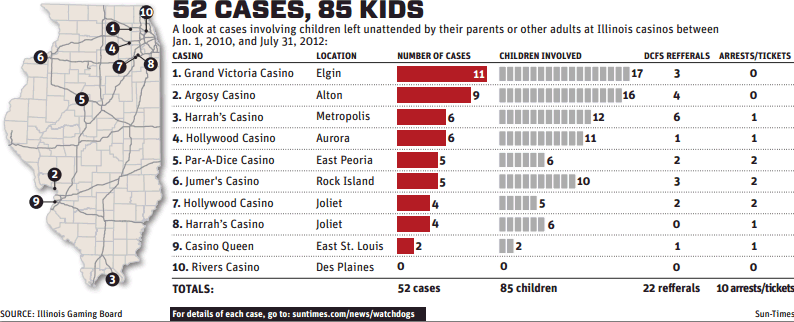
Keep in mind that characteristic crimes also include leaving children at home or in cars without supervision while gambling, handling or receiving stolen goods, participating in donation and insurance scams, among other unlawful acts. Yet, crime rates over the past decade have not examined these areas. Perhaps the best way to measure the true social impacts of gambling would be by first conducting an independent social impact study as some other states are doing.

Presently, gambling addiction is costing Florida money in many forms, including public and financial assistance, unemployment, homelessness, mental health and addiction services, and criminal justice supports.

Regardless of whether the Legislature ultimately approves to expand gambling does not negate the fact that increased venues will have an impact on gambling participation and problem gambling prevalence.

That said, any additional efforts to expand gambling options would need to be accompanied by provisions to assure appropriate usage of responsible gaming program options, funding and related program supports.

Pat Fowler is the executive director of the Florida Council on Compulsive Gambling, Inc.
Editor's Note: Broward County remains Florida's epicenter for gaming. To learn more and see other views on the topic, go to http://www.SunSentinel.com/Floridasgamble

http://www.sun-sentinel.com/news/opinion/fl-gambling-oped-jennifer-campbell-20140325,0,4911763.story


Tuesday, March 25, 2014

Hikind says ‘don’t put casinos near kids!’


Hikind says ‘don’t put casinos near kids!’

Wants gambling facilities built away from Catskills

Brooklyn Daily Eagle

The state’s voters approved the expansion of casino gambling in New York in November and with the state’s Gaming Commission mulling where to build the new gambling facilities, one Brooklyn lawmaker has been outspoken as to where he doesn’t want to see the slot machines, blackjack tables and roulette wheels.

Assemblyman Dov Hikind (D-Borough Park-Midwood) is urging the New York State Gaming Commission to steer clear of the Catskills.

Hikind said the commission should take into consideration that thousands of families and children spend summers in the Catskills at long-established camps, bungalows and summer homes.

The Gaming Commission will decide who gets licenses to open gambling casinos. The commission regulates all aspects of gaming and gambling activity in the state, including horse racing, pari-mutuel wagering, the state lottery (including video lottery terminals) and charitable gaming.

“Before licenses are awarded, I am calling on the Gaming Commission to take certain factors into account,” Hikind said. “Primary among those considerations should be keeping casinos away from children.”

The proposal to expand the state’s gambling footprint was supported by 57 percent of the state’s voters in the most recent election.

Governor Andrew Cuomo supported the idea of building more casinos, The New York Times reported.

New York State currently has five casinos operated by Indian reservations, all of them located on upstate, as well as nine slot machine parlors located inside racetracks.

The State Legislature voted to require that, for now, only four new casinos be allowed. All of those casinos are to be built upstate: in the Albany area; the Catskills-Hudson Valley region; and part of the Southern Tier, a region that runs along the New York-Pennsylvania border.

Supporters said the casinos will create much-needed jobs, attract tourism and boost the economy in some of the state’s hardest hit regions.


Hikind, who voted against the proposal to build more casinos, acknowledged that casinos will become a reality in upstate New York. He said the state needs to be careful where to put them.

“I have no problem with people gambling if they want to, and let the state earn revenue from these establishments; create jobs and stimulate the economy. But in the name of decency, let’s attempt to keep casinos away from children,” he said.

Hikind said his biggest concern is minimizing exposure to casinos from the thousands of children who attend camp in the Catskills during the summer.

“Adding five or ten miles to someone’s drive to a casino would hardly inconvenience them when, in comparison, putting a casino in the backyard of thousands of teenagers will certainly expose their risk to things that most parents work hard to protect their children from,” Hikind said.

“I am asking that the casinos be placed closest to the city so the vast numbers of their potential customers have the easiest access, anyway. This will keep families who don’t want easy access for their children farther away from gambling. Anyone who wants to drive to the casinos can certainly do so, but teenagers and young adults won’t be walking in from town.”


http://brooklyneagle.com/articles/hikind-says-%E2%80%98don%E2%80%99t-put-casinos-near-kids%E2%80%99-2014-03-25-130000