Meetings & Information


*****************************
****************************************************
MUST READ:
GET THE FACTS!


Showing posts with label animal cruelty. Show all posts

Monday, March 31, 2014

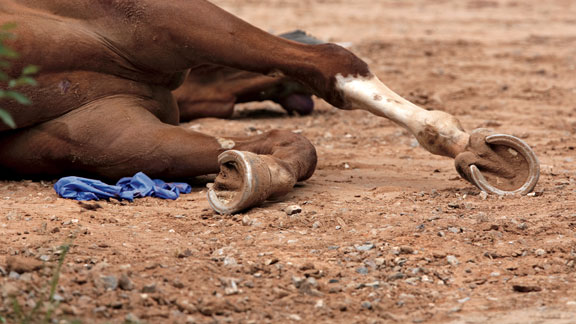
Horse Racing Exposed: Drugs and Death

The failure of racing commissions to protect horses from this level of abuse has been noted elsewhere.

Attendance at Horse Races is declining and this explains part of the reason. Who wants to witness cruelty?


Published on Mar 19, 2014
A PETA undercover investigation of leading thoroughbred trainer Steve Asmussen reveals chronic misuse of drugs, reportedly to enhance horses' performance and mask their injuries.


PETA Accuses Top Horse Trainer Of Animal Cruelty Following Undercover Investigation

Posted:


After a four-month undercover investigation, an animal rights group has accused a prominent horse trainer of giving his horses unnecessary amounts of performance-enhancing drugs and using illegal electric shock devices to make them run faster.

The investigation, conducted by People for the Ethical Treatment of Animals (PETA), used hidden cameras and microphones to document the staff of Steve Asmussen, a top thoroughbred racehorse trainer who holds multiple horse racing records and has won millions of dollars in horse race purses.

The probe took place at both Churchill Downs in Kentucky and Saratoga Race Track in New York from April through August of last year.

Released on Thursday, the video appears to show Asmussen's workers discussing a top-performing horse's feet being worn down to "nubs." One says they had to use superglue to keep its hooves together.

That horse, who was named Nehro, died of colic -- "a term used to describe a symptom of abdominal (belly) pain" -- in the back of a van on the day of the 2013 Kentucky Derby.

The man can also be heard discussing how he had a jockey use an illegal shocking tool on a horse. ("I'd tell [jockey Ricardo Santana Jr.], 'You got the máquina?'" he says.) He's also heard talking about employing undocumented workers and having them lie to the IRS.

PETA's video also purports to show prominent veterinarian Dr. James Hunt Jr. saying all of Asmussen's horses are given Lasix, or furosemide, a controversial drug that's banned in many countries but legal in the United States.

"They basically all run on it. It makes them lighter," the man PETA identifies as Hunt says in the clip.

Hunt did not immediately respond to request for comment from The Huffington Post.
Asmussen's lawyer, Clark Brewster, told HuffPost that electric shock devices were

After a four-month undercover investigation, an animal rights group has accused a prominent horse trainer of giving his horses unnecessary amounts of performance-enhancing drugs and using illegal electric shock devices to make them run faster.

The investigation, conducted by People for the Ethical Treatment of Animals (PETA), used hidden cameras and microphones to document the staff of Steve Asmussen, a top thoroughbred racehorse trainer who holds multiple horse racing records and has won millions of dollars in horse race purses.

The probe took place at both Churchill Downs in Kentucky and Saratoga Race Track in New York from April through August of last year.

Released on Thursday, the video appears to show Asmussen's workers discussing a top-performing horse's feet being worn down to "nubs." One says they had to use superglue to keep its hooves together.

That horse, who was named Nehro, died of colic -- "a term used to describe a symptom of abdominal (belly) pain" -- in the back of a van on the day of the 2013 Kentucky Derby.

The man can also be heard discussing how he had a jockey use an illegal shocking tool on a horse. ("I'd tell [jockey Ricardo Santana Jr.], 'You got the máquina?'" he says.) He's also heard talking about employing undocumented workers and having them lie to the IRS.

PETA's video also purports to show prominent veterinarian Dr. James Hunt Jr. saying all of Asmussen's horses are given Lasix, or furosemide, a controversial drug that's banned in many countries but legal in the United States.

"They basically all run on it. It makes them lighter," the man PETA identifies as Hunt says in the clip.

Hunt did not immediately respond to request for comment from The Huffington Post.
Asmussen's lawyer, Clark Brewster, told HuffPost that electric shock devices were never used. He said the recorded dialogue in the video was just table talk about the use of buzzers "historically" and not specifically on his client's horses.

"We are reserving comment until we get specific allegations from PETA," Brewster said. "At this point it's just been a media blitz by PETA rather than any substance or information for us to respond to. I think ultimately people will see what this is, an effort by this organization to grandstand because they disapprove of horse racing."

Brewster said he's spent the past two days trying to get PETA to send him complaints but that PETA has declined to do so. PETA, however, says it had offered to provide Brewster with the complaints.

The animal rights group filed complaints with federal and state officials in Kentucky and New York after completing its investigation. The Kentucky Horse Racing Commission, a state agency that regulates horse racing in Kentucky, confirmed to HuffPost that it had received documents from PETA alleging animal cruelty "by two trainers working at Churchill Downs."

The Commission said it has not reviewed the information yet but that it plans to conduct a thorough investigation.

Churchill Downs could not be reached for comment. The Saratoga Race Track did not immediately respond to a request for comment from HuffPost.


http://www.huffingtonpost.com/2014/03/21/peta-steve-asmussen-animal-cruelty-investigation_n_5001756.html


Monday, January 20, 2014

Horse Slaughter Blocked by Federal Law (For Now)


Wild horses are shownn at the Pryor Mountain National Wild Horse Range in south-central Montana. (photo: AP/Bureau of Land Management/Ann Boucher)

Horse Slaughter Blocked by Federal Law (For Now)

By Barry Massey, Associated Press
19 January 14

he resumption of commercial horse slaughter in the U.S. was blocked Friday as President Barack Obama signed a budget measure that withholds money for required federal inspections of the slaughtering process.

Although the measure provides temporary funding for the federal government, it stops the Agriculture Department from spending money for inspections necessary for slaughterhouses to ship horse meat interstate and eventually export it to overseas consumers.
 
"This clear message from Washington echoes the opinions of an overwhelming number of Americans from coast to coast: horse slaughter is abhorrent and unacceptable," said Matt Bershadker, president and CEO of the American Society for the Prevention of Cruelty to Animals.
 
The president's action came as a New Mexico judge granted a preliminary injunction against a Roswell company from moving forward with its plans to start slaughtering horses.
 
The ruling by state District Judge Matthew Wilson will keep alive a lawsuit by Attorney General Gary King, who's seeking to permanently block horse slaughter in New Mexico. The lawsuit could serve as a possible insurance plan in case the federal government provides inspection funding in the future.
 
Blair Dunn, a lawyer for Valley Meat, said the company will continue to wage a legal fight to convert its cattle processing plant to the slaughtering of horses. He contended that the federal move to withhold money for meat inspections could cause U.S. trade violations.
 
"I don't see them opening now. No matter what, they are not going to violate the law," said Dunn, who also represents a plant in Missouri that wants to produce horse meat.
 
The last domestic horse slaughterhouses closed in 2007, a year after Congress initially withheld inspection funding. After federal money was restored in 2011, plants in New Mexico, Missouri and Iowa began trying to start horse slaughtering.
 
King's lawsuit contends that the Roswell company's operations would violate New Mexico's environmental and food safety laws.
 
Valley Meat is trying to disqualify the judge who's handling the case because of comments posted by horse slaughter opponents on a Facebook page for the judge's election campaign. Wilson issued an order Friday saying he would consider setting a hearing on the company's request.

Friday, January 11, 2013

Horse deaths, injuries, druggings: No One Cares


And no one cares!

Massachusetts has NOT adopted regulations to prevent the injuries, drugging and deaths of horses.


Aqueduct Breakdowns Lead to Order for Necropsies

By JOE DRAPE
Published: January 12, 2013
 
The New York State Racing and Wagering Board announced Friday that it would order necropsies for all horses that sustain deadly racing injuries at Aqueduct after four fatalities at the track's meet, which opened Dec. 12.
 
On Thursday, Pleasantfriday broke her right front leg while turning for home, sending jockey Cornelio Velasquez to the ground. Pleasantfriday, a 5-year-old mare, was taken away in a van and later euthanized.
 
Necropsies of horses that are fatally injured were among the recommendations of a task force requested by Gov. Andrew M. Cuomo to investigate the increase of fatal breakdowns at Aqueduct Racetrack last year.
 
The four-member panel concluded that more than half of the 21 racehorses that died might have been saved had racing authorities more closely monitored their health and the liberal use of prescription drugs used to keep them racing for purses inflated with money from the track's adjacent casino.
 
"Necropsies for two horses that have died at Aqueduct - Pleasantfriday and Gulltopper - were ordered by the board because circumstances of those incidents raised red flags with investigators and required more information," Lee Park, a spokesman for the board, wrote in an e-mail. "Going forward, the board is ordering necropsies for all horses that are fatally injured while racing on the inner track at Aqueduct."
 
New York racing authorities have also enacted a series of rules - among the most aggressive in the nation - to restrict the use of legal drugs on horses and require trainers to disclose what treatments their horses have received.
 
"The Racing and Wagering Board continues to closely monitor and investigate the circumstances of every breakdown at Aqueduct," Park said. "Comprehensive investigative reports for the four equine fatalities from the inner track meet are being completed by board staff."
 
The rules come as racing wrestles with a drug culture that many of its most experienced officials contend is diminishing the sport. There have been Congressional hearings, stricter drug rules in several states and calls for an outright ban of drugs.
 
The breakdowns also offer the first test of a new New York Racing Association board that was handpicked by Cuomo. He appointed David Skorton, president of Cornell, as chairman, completing his takeover of racing in the hope of ending decades of scandal and mismanagement in an industry important to the state.
 
"NYRA is very concerned with any equine breakdown during a race or training, and we are constantly examining our procedures," the association said in a statement. "We have been aided in this by the recent New York Task Force Report on Racehorse Health and Safety, which was very clear on the safety of NYRA's inner track racing surface."
 
It says it is continuing to put into effect new safety policies recommended by the task force.
"NYRA is working to enhance preventative measures, monitoring and reporting with respect to breakdowns; and we are working with Chairman Skorton and our regulators to prevent future fatalities as much as we possibly can," it said.
 

Saturday, October 27, 2012

an inhumane atrocity


Killing N.Y.’s horses for an extra buck

The shame of Aqueduct

A horse dies after finishing a race at Aqueduct.

A horse dies after finishing a race at Aqueduct.

With the appointment of Cornell President David Skorton to head a new board that is intended to steer the troubled New York Racing Association into calmer waters, Gov. Cuomo has a chance to reform the shameful manner in which racehorses are treated right here in New York City.

The deaths of 21 racehorses at the Aqueduct Racetrack in South Ozone Park, Queens, last season is an inhumane atrocity. Bad management and disempowered veterinarians are to blame, according to a new report issued by a task force formed at Cuomo’s behest.

In May, the state seized control of the track from NYRA — and the governor is rightly promising radical changes. But Skorton has his work cut out for him.

He should not ignore an important culprit: The track’s new gambling profits fueled these senseless deaths. Last year, the race track became a “racino” — a race track with a casino inside. At the Resorts World Casino, operated by Malaysian gambling giant Genting, bettors play the slots on video and wager in video games such as poker and roulette. Stakes are high, with casino profits reaching into the hundreds of millions.

The racino channels 6.5% of those profits to purses — winnings awarded to horse owners and trainers — which added up to $14.8 million during the 2011-12 racing season. Purses for certain types of races rose to multiples of what the horses were worth on the market. These included “claiming races” for less competitive horses, where all entered horses can be bought (i.e., “claimed”) for a given price.

For example, horses that could be claimed for as little as $7,500 were run in races where the purse had been inflated, thanks to incoming gambling funds, to be as high as $30,000 and $40,000. That radically devalued the horses: Those that win but die from running too hard are worth vastly more than those that live but lose. Consequently, horses are run harder than they should be, causing broken legs that lead to death.

Of the 21 horses killed last season, 17 were running in claiming races. The recent task force report concluded that “inadequate protection was afforded to this class of horse.”

The purse-to-claim multiple should never approach 2 to 1, the report said. The actual multiples — more than 5 to 1 — contributed to an attitude of anything-for-victory that now requires reform.

Debate over this subject stretches back a decade, when New York politicians began a push to expand the kinds of gambling that are legal in the state, starting with gaming machines at horse race tracks.
Some of the pressure that led to the installation of the racino at Aqueduct came from a surprising source that should have no place in the debate: federal prosecutors.

NYRA had been accused of tax fraud in 2003; a settlement required that NYRA continue its efforts to open a racino at the track.

Prosecutors never explained their reasoning when inking the settlement, but clearly, politics were in play. NYRA worked earnestly to move its gambling program along amid growing agitation and pressure.

It finally prevailed — Genting opened its doors at Aqueduct in 2011 — and the tragic results are in, with gambling money going to inflate race purses, which has in turn led to the irresponsible treatment of horses.

We can’t necessarily blame federal prosecutors or say what effect their deal had on NYRA’s quest to deliver a racino and related revenues to the track. The deadly results arose from naked greed.

The lesson, though, is important: Politicians and prosecutors should not direct business changes without understanding their significance. What’s happening to the horses at Aqueduct could have been prevented.

The lesson for Skorton is clear as well. He should exercise independent business judgment about the proper operation of horse tracks, putting the humane treatment of the horses over money.

Cunningham is a professor at George Washington University Law School and visiting professor at Fordham University School of Law. His latest book, written with Maurice (Hank) Greenberg, is “The AIG Story,” to be published this winter.

Monday, October 15, 2012

Exotic Bird Decapitated at Las Vegas Casino; Law Students Charged


Oct 14, 2012

Exotic Bird Decapitated at Las Vegas Casino; Law Students Charged

By Alyssa Newcomb


ht cuellar eric teixeira justin jt 121014 wblog Exotic Bird Decapitated at Las Vegas Casino; Law Students Charged
                                                          (Image Credit: Las Vegas Metropolitan Police Dept.)


Two University of California-Berkeley students are accused of decapitating an exotic 14-year-old bird at the Flamingo Hotel and Casino’s wildlife habitat in Las Vegas.

Eric Cuellar and Justin Teixeira, both 24, were captured on surveillance video Friday morning chasing the helmeted guinea fowl into some trees and then emerging carrying its severed body, according to a statement from the Las Vegas Metropolitan Police Department.

The two men, who said they are law students at the school, then laughed about the killing and threw the body of the bird, witnesses told police.

They were booked into the Clark County Detention Center and face felony charges of conspiracy and the willful and malicious torture or killing of wildlife.

The Flamingo’s Wildlife Habitat is home to hundreds of animals, including swans, ducks, turtles and of course, flamingos.

It was not clear whether Cuellar and Teixeira had hired an attorney.


http://abcnews.go.com/blogs/headlines/2012/10/exotic-bird-decapitated-at-las-vegas-casino-law-students-charged/

Saturday, October 6, 2012

Plainridge: Gagging the Opposition


In an effort to prevent the Plainridge folks from suffering boredom [since they crawl all over this blog numerous times each day, not having discovered google alerts or anxious to slap a lawsuit on this blog as well], there is additional information below regarding the attempt to silence the Slot Barn Opposition in Plainville.

Plainridge, it would seem, has an elevated opinion of its business that is not universal. Surely, they are entitled to their opinion, but not when it contradicts facts and statistics.

Is Plainridge afraid of the TRUTH?

Horse racing is a DEAD Industry, declining in attendance and purses around the nation.

Without the salvation of Slot Machines [taxpayer subsidies], horse racing would die.

Experts speaking at the Massachusetts Gambling Commission Edumacational Forum were forced to acknowledge that there is NO indication that Slot Machines increase racing attendance. To the contrary, Aqueduct and other race tracks have proven that the drugging and deaths of horses increased.

The previous Massachusetts Racing Commission web site was so lacking in disclosure, discerning the cause or location of 53 horses' deaths of Massachusetts horses was impossible.

Animal Cruelty
Horse Deaths
Horse Racing


From: No Plainville Racino --

Plainridge sues No Plainville Racino supporters
 
ACLU says lawsuit against Plainville racetrack gambling critic should be thrown out
Lawsuit tries to silence petitioning activity protected by the First Amendment
 
 
One of the founders of No Plainville Racino was recently sued by Plainridge Racecourse for allegedly defaming them through his opposition to the addition of slot machines to the racetrack's facilities. The ACLU of Massachusetts has risen to his defense, calling the action an unjustified "SLAPP suit"--i.e., a strategic lawsuit against public participation--that should immediately be dismissed.

"Residents of Plainville need to know that they have a lot of protection for their participation in important debates, for example, whether casinos and gambling have harmful effects on their community and neighborhoods," said ACLU cooperating attorney Jeffrey Pyle. "They should not be scared off by lawsuits like this, which have no merit and often are aimed at making people too afraid to get involved in local issues."

Read the full ACLU Press Release

In the spirit of transparency, below is what was filed with the Norfolk Superior Court:
No Plainville Racino would like to sincerely thank the American Civil Liberties Union of Massachusetts and their cooperating attorneys for representing us in this matter. Whether you are pro- or anti-racino, ensuring open and free public debate is important as this decision may affect the character of Plainville forever.


Saturday, September 8, 2012

Horses under attack?


Interesting video worth watching about the abuse of horses and the declining
horse racing industry [link below].

Horses under attack?

Saturday, September 1, 2012

Ann Romney's Abuse of Horse


Taken from face book ---
http://www.dogsagainstromney.com/2012/06/romneys-appalling-record-of-animal.html


The Official Site of Dogs Against Romney founded 2007. Hi, I'm Rusty. Mitt Romney is mean to dogs. Help me get my message out about the Mitt Romney dog on roof story. Putting a dog on the car roof is abuse. Remember Crate-Gate. I ride inside. Mitt is Mean. Contribute to DogPAC.Dog on the Roof book.

The Romneys Appalling Record of Animal Abuse


First there was Seamus, the poor Irish Setter the Romney's strapped to the roof of their car (at least once) for a 12-hour drive to Canada - leaving him up there after he became ill and soiled himself and the car. Mitt Romney admits to merely hosing poor Seamus down and continuing the trip for hours more.

Now, its horses. A dressage horse named Super Hit, in particular, had the misfortune of falling into the cold, cruel hands of the Romneys. Super Hit, used by Ann Romney for her "therapeutic" hobby of performing dressage (horse ballet), was sold by the Romneys for $125,000 in 2008.

After the sale of Super Hit, the new owners soon discovered he was physically incapable of performing dressage. They consulted Dr. Stephen Soule, veterinarian for the United States Equestrian Team since 1978. Dr. Soule found that Super Hit, at the time he was sold by the Romneys, had a staggering amount of painkillers in his system.

"In my 38-years of practice, " Dr. Soule wrote, "I have never come across a drug screen such as this where the horse has been administered so many different medications at the same time."

The new owners sued Ann Romney and her trainers in 2010, claiming that Super Hit had a defect in one of his feet and that the horse had been drugged with the massive amount of painkillers so that he could continue to perform, hiding his condition.

The Romneys settled the case against Ann last September.

One thing you DON'T EVER want to be is an animal in the care of the Romneys. Another thing you DON'T EVER want to be is a human under the rule of the Romneys.

For complete details about this story, see Buzzfeed's article, "Ann Romney's High Horse."

Thursday, August 30, 2012

Not known for 'heavy lifting,' Boston Herald uninformed!

Dave Wedge, in the article below, quoted Chip Tuttle, failing to ask about the statistics.

Dave, Could you do your homework, please?

Where did the positive drug tests and horse deaths originate?

Commissioners mum on visit to Suffolk Downs


By Dave Wedge

http://www.bostonherald.com/news/regional/view.bg?articleid=1061156782

The current lab is not accredited, officials said.

Suffolk Downs’ chief operating officer welcomed the new oversight and said horse doping — which was recently the subject of congressional hearings — has not been an issue at the East Boston track.

“We’re very proud of our safety record here,” Chip Tuttle told the commission. “We take great pride in that.”


Chart below indicates 14 Drug Positive, 53 HORSES DEAD in Massachusetts!


Mangled Horses, Maimed Jockeys

The new economics of horse racing are making an always-dangerous game even more so, as lax oversight puts animal and rider at risk.


Tracks and Incident Rates

Five of the seven tracks with the nation's highest rates of breakdown and injury are in New Mexico. Four tracks are unaccredited, and enforcement of drug violations is relatively lenient.

Incidents per 1,000 starts
Albuquerque
10.0
Ruidoso Downs
13.9
Sunland Park
12.8
SunRay Park
9.8
Zia Park
12.6
Avg. of all tracks
5.2


Additional information:

chart

article:

killing horses


http://middlebororemembers.blogspot.com/2012/04/massachusetts-53-horses-dead-14-drug.html

A Survey of Horse Deaths
More than 3,000 horses died during racing or training from 2009-11 according to a New York Times survey of 29 racing states. Highlighted states do not require pre-race inspections of horses and do not perform post-mortem inspections on horses that die while racing or training.


StateDrug positivesDeaths
Arizona
107
50*
Arkansas
13
No data
California
296
635
Colorado
68
14
Delaware
53
90
Florida
366
150-160*
Idaho
No data
No data
Illinois
171
140
Indiana
58
65
Iowa
50
46
Kentucky
258
86
Louisiana
291
268
Maryland
69
79
Massachusetts
14
53
Michigan
71
14
Minnesota
222
34
Montana
5
10
Nebraska
64
47
New Jersey
105
106
New Mexico
115
349
New York
159
366
Ohio
406
122
Oklahoma
149
119
Oregon
64
45
Pennsylvania
195
243
Texas
168
108
Virginia
38
20
Washington
21
60
West Virginia
210
233
* Estimates. Actual practice and adherence to regulatory requirements varies widely from state to state.


Thursday, August 23, 2012

Bloomberg promoting MGM's animal cruelty


In a rather bizarre photo Bloomberg added to MGM's Massachusetts' Folly, they chose to add a photo of the lion display that has since been closed.

MGM places sensible animal care at the bottom of its list. See articles below.


MGM Resorts Proposes $800 Million Massachusetts Casino-Hotel

By Rob Golum and Christopher Palmeri
Aug 22, 2012


David Paul Morris/Bloomberg
Tourists view a lion on top of a glass roof inside the MGM Resorts International casino in Las Vegas.

MGM Resorts International(MGM), the largest casino operator on the Las Vegas Strip, announced plans to develop an $800 million gambling, hotel and entertainment project in Springfield, Massachusetts.


The MGM Springfield project, if approved, would be located on about 10 acres of land that were heavily damaged by a June 2011 tornado, the Las Vegas-based company said today in a statement. The plans include restaurants, movie theaters and shopping.

MGM Resorts said it submitted a $400,000 fee that will fund the official vetting and negotiating process. The project would be located on three city blocks close to Interstate 91. The company said it controls several parcels in the area and has others under contract.

Massachusetts legislators legalized gambling last year, authorizing a maximum of three casinos in three regions. MGM will be competing for a license in the western part of the state. At least five other operators are eyeing locations there, including Ameristar Casinos Inc. (ASCA, Penn National Gaming Inc. (PENN), Mohegan Tribal Gaming Authority and Seminole Hard Rock Entertainment Inc., according to an Aug. 20 analysis by the law firm Goodwin Procter LLP.

In March, MGM Resorts dropped out of a casino project in Brimfield, Massachusetts, citing the scope of infrastructure work needed in the area, and said it would seek an alternative location.


http://www.bloomberg.com/news/2012-08-22/mgm-resorts-proposes-800-million-massachusetts-casino-hotel-2-.html

Activists praise closure of MGM Grand's lion habitat


CORRECTION -- 12/31/11 -- A story and caption Friday’s Review-Journal about the lion habitat at the MGM Grand contained an error. Officials announced this week that they will be closing the free attraction Jan. 31. By Keith Rogers

LAS VEGAS REVIEW-JOURNAL Posted: Dec. 29, 2011

Plans by MGM Grand to close its lion habitat at the Strip hotel received praise Thursday by a high-profile animal rights group that also criticized the lions' owner for wanting to put them on exhibit at his 7.5-acre ranch in the south Las Vegas Valley.

A letter from People for the Ethical Treatment of Animals to Jim Murren, chairman and CEO of MGM Resorts International, thanks Murren and Chief Operating Officer Corey Sanders "for your decisions to close the lion exhibit ... and to offer our assistance in helping to relocate the lions to a reputable sanctuary."

Citing news reports, the letter said the lions' owner, Keith Evans, plans to put them on exhibit in Clark County.

"This plan is clearly not in the best interests of the animals. In their natural habitats, lions roam many miles of territory to hunt, raise their young, and avoid contact with people," according to the letter Thursday from Delcianna Winders, PETA's director of captive animal law enforcement.

The letter criticizes Evans for declawing lion cubs and for allowing trainers and handlers to have direct contact with the animals that led to two lion attacks at the MGM Grand.

Reached at his ranch southeast of the M Resort, Evans called PETA's letter "baloney" and wished PETA "good luck" in their efforts to put his 40 lions in a sanctuary.

Evans said that he has held his U.S. Department of Agriculture license for keeping lions for 40 years and that PETA has a "bad track record" in its endeavors to keep lions in sanctuaries.

Yvette Monet, corporate spokeswoman for MGM Resorts International, said the lions that Evans transports for display at the MGM Grand are owned by Evans, "and he is entirely responsible to their care."

Monet said the lions have always lived at Evans' ranch, and many of them were born there.
On Wednesday, MGM Grand announced that its lion habitat and retail shop will close Saturday . The habitat, a free attraction, opened in 1999 for $9 million.

In her letter, Winders said that MGM has maintained a $1 million fund for the care of lions at the habitat, "and we encourage you to use these funds to relocate the animals to a reputable sanctuary.

We stand ready to help coordinate such a transfer."

Reached by phone late Thursday in California, Winder said an ideal sanctuary for the lions would be one operated by the Performing Animal Welfare Society, an organization, based in Galt, Calif., for abused and abandoned wildlife.

Winder said she has never visited Evans' ranch but said the ranch doesn't have enough space to provide for lions in a natural habitat.

Evans has said he intends to make his ranch a public attraction called The Cat House. He said he has completed the zoning and permitting requirements that will allow him to host private parties and tour groups.

The exhibit also might be open to the walk-in public, but he is trying to work out logistics such as staffing.

  http://www.lvrj.com/news/animal-rights-group-praises-closure-of-mgm-s-lion-habitat-136407153.html


MGM Mirage in Vegas probing death of dolphin

Saturday, August 4, 2012

Cruelty to Horse


We've mostly ignored our care and treatment of horses. We've ignored the drugging, injuries and deaths of horses.

We pretend that taxpayer subsidies of horse racing makes sense, with no debate.

We pretend that preservation of the Dead Horse Racing Industry is justified, no questions asked.


Maybe it's time for dialog.


From face book -


Saturday, July 21, 2012

The game: What’s ‘gambling,’ what isn’t?


Horse racing is DEAD! The patrons are dying off.  Few attend. There are no crowds.


The reputation generated by the horse racing industry of drugging to mask pain, horse injuries and deaths on the tracks does nothing to enhance its reputation.


Folk: It's not coming back! Not without taxpayer subsidies. Why are we subsidizing it when 70% of the horses are Canadian slaughterhouses come from the US?


The game: What’s ‘gambling,’ what isn’t?

Published: Sat, July 21, 2012

COLUMBUS

There was a telling moment at the racing commission this month on the state of legalized gambling in Ohio.

The commission chairman and representatives from Scioto Downs were talking about the new video lottery terminals at the Columbus horse track.

The long-discussed video slots, offered as part of the state lottery, began operating in June. Since then, there’s been an 18 to 20 percent increase in attendance during live racing days, the track’s rep told the racing commission.

“It appears that the operation on the VLT side of the racetrack is being well received and there’s been an overflow,” said commission Chairman Robert Schmitz. “I’ve noticed more people on the racing side than I’ve seen in quite a few years.”

Schmitz asked about actual numbers, to which the track rep began explaining about counting people as they were coming into ... “the casino.”


In other words, this is ANECDOTAL! There are NO NUMBERS! This is sales pitch and scam.
“It is not a casino,” the chairman corrected, prompting laughter and a few knowing looks from others.
Sure it’s not. Nudge, nudge. Wink, wink.


In the truest sense, Schmitz is correct. Horse tracks offering video lottery terminals are not casinos.

There are only four voter-approved casinos in the state. Lawmakers have blocked other locations from using the word “casino” in their signage.

But make no mistake: Many gamblers who frequent these revamped horse racing tracks will find casino-like atmospheres and video slots ready to take their money.

What’s in a name?

Consider the name of the new Youngstown-area track that’s in the works: “Hollywood Slots at Mahoning Valley Race Course.” Notice the slots come first.

Look at Scioto Downs’ website, and you’ll find the title “Scioto Downs Casino and Racetrack.”

Whether they are casinos in name or not, they’re casinos in spirit. And they’re already reaping millions of d ollars in profit for the tracks.

During the first month of operation, gamblers wagered about $122 million on 1,787 VLT terminals at the Columbus-area track, according to lottery officials.

That resulted in about $7.4 million in “racino commissions” for the tracks and $3.7 million for the Ohio Lottery Commission, most of which goes to schools.

To recap: Ohio will have four casinos. Two already open, and a big chunk of the resulting gaming revenues is coming from slot machines.

Close to 700 storefront sweepstakes parlors are operating throughout the state, offering consumers the equivalent of slot machine gambling.

And the state’s seven horse tracks have been given the green light to offer lottery-controlled video slots on their premises.

For average citizens, they’re all casinos — just don’t use that word for racetracks. Because we don’t want to give the impression that Ohio is becoming a gambling-heavy state, with opportunities for residents to throw their money away around every corner.

Marc Kovac is The Vindicator’s Statehouse correpondent. Email him at mkovac@dixcom.com or on Twitter at OhioCapitalBlog.

http://www.vindy.com/news/2012/jul/21/the-game-whats-gambling-what-isnt/?newswatch

Wednesday, July 18, 2012

Greyhound racing

This comment was left on the link below and deserves its own post -- 
[A number of greyhound racetracks were preserved by slot machines employing the same phony arguments that are employed for horse racing. Greyhound racing was outlawed in Massachusetts by a statewide referendum.]


Val has left a new comment on your post "Gambling is still not the way":

One thing is certain: that animals should never be used as pawns for the gambling industry. Such is the case with dog racing.

Greyhound racing is cruel and inhumane. Greyhounds endure lives of nearly constant confinement, kept in cages barely large enough for them to stand up or turn around. While racing, many dogs suffer and die from injuries including broken legs, paralysis, and cardiac arrest. And many greyhounds are euthanized every year, as the number retired from racing exceeds the number of adoptive homes.

At racetracks across the country, greyhounds endure lives of confinement. According to industry statements, greyhounds are generally confined in their cages for approximately 20 hours per day. They live inside warehouse-style kennels in stacked cages that are barely large enough to stand up or turn around. Generally, shredded paper or carpet remnants are used as bedding.

An undercover video recently released by GREY2K USA shows the conditions in which these gentle dogs are forced to live: http://www.grey2kusa.org/azVideo.html

For more information on injuries these dogs suffer, please view:

http://www.grey2kusa.org/azInjuries.html

http://www.grey2kusa.org/eNEWS/G2K-022811Email.html

Dogs play an important role in our lives and deserve to be protected from industries and individuals that do them harm.

V Wolf Board Member, GREY2K USA

Saturday, July 14, 2012

More horses die


More Horses Die at Calgary Stampede


More Horses Die at Calgary Stampede


The deaths of three horses at the Calgary Stampede, a 10-day event where people can go to pretend that we still live in the Wild West, has spurred outrage from animal advocates and calls to ban chuckwagon races for good.

The accident that lead to the deaths happened on Thursday during the GMC Rangeland Derby when the lead horse faltered on the backstretch of the race and collapsed, taking down the three other horses and the wagon with him and causing a collision with one of the outriders.

The lead horse died on the scene, two others had to be euthanized on the track due to their injuries and a fourth will need surgery. A necropsy on the lead horse revealed the cause of death was a ruptured aortic aneurysm near the kydney, according to a press release.

“This pre-existing condition is undetectable in animals and could have ruptured at any time of exercise,” explains  Dr. Evans. “The condition is a weakening in the wall of the aorta–the major vessel leading from the heart. This area of weakened wall can rupture and the horse then bleeds out internally. The rupture occurred in the abdomen, which explains the hind limb weakness noted in the horse prior to the collapse.”

The incident has animal advocates understandably calling for a ban on chuckwagon races.
“It always shocks and infuriates me … you’d think after 100 years they’d come to realize they cannot prevent deaths,” said Michael Alvarez-Toye of the Calgary Animal Rights Coalition.

He said the group is organizing a protest on Saturday “to mark the occasion of the Calgary Stampede’s 100th Anniversary of cruel and callous acts perpetrated upon animals.”

Sadly, this tragedy comes after weeks of announcements about improvements to safety that were made after six horses died in 2010. A total of 50 have died since 1986.

The Stampede began a Fitness to Compete program, which increased veterinary inspections before and after races, breaks between events and reduced the number of outriders for each wagon from four to two to make more room on the track, but it hasn’t helped protect horses.

“Clearly, the Stampede’s much publicized safety improvements have failed to make the race any safer,” said Peter Fricker, a spokesman for the Vancouver Humane Society, which supports a ban. “Horses continue to die needlessly. This has to stop.”

According to a statement, the Stampede will be using the results of the necropsy to make further improvements.

“Nowadays, in veterinary medicine there’s very much a push on for evidence-based decision making,” said


Calgary Stampede race mishap kills 3 horses

A Canadian chuck wagon race ended tragically Thursday after a horse with a breached blood vessel collapsed and died midcompetition.

Three horses died and a fourth was injured seriously during a chuck wagon race in Calgary, Alberta on Thursday after the left lead horse suffered a ruptured aortic aneurysm. Officials euthanized the right lead horse and another that crashed into the rig.

Sun Media / Splash News/Sun Media / Splash News

Three horses died and a fourth was injured seriously during a chuck wagon race in Calgary, Alberta on Thursday after the left lead horse suffered a ruptured aortic aneurysm. Officials euthanized the right lead horse and another that crashed into the rig.


A Canadian chuck wagon race ended tragically Thursday after a horse with a breached blood vessel collapsed and died midcompetition.
The mishap occurred at the annual Calgary Stampede during the Rangeland Derby, when the horse, the left-side leader of a team of four horses that was pulling a covered wagon, went down on the backstretch, dragging the rest of the team into the dirt. An horse being ridden behind the rig slammed into it.
Officials euthanized both the right lead horse and the outrider. A horse stationed at the right wheel required surgery for its injuries but is expected to survive.
“The left lead horse experienced a ruptured aortic aneurysm, leading to sudden internal bleeding and explains why the horse faltered, weakened and then collapsed,” Dr. Greg Evans, chief veterinarian for the Calgary Stampede, said in a statement. "The condition is a weakening in the wall of the aorta - the major vessel leading from the heart."
"This pre-existing condition is undetectable in animals and could have ruptured at any time of exercise," Evans added.
STAMPEDE15N_2_WEB

Sun Media / Splash News/Sun Media / Splash News

Chuck wagon driver Chad Harden, above, reacts to the collapse of his left lead horse during a chuck wagon race at the Calgary Stampede on Thursday. The horse went down after suffering a ruptured aortic aneurysm, pulling the rest of the team into the dirt on the racetrack’s backstretch.


Officials said toxicology and drug tests will be performed on the horse and that veterinarians screen all horses upon their arrival at the park and prior to competition.

“The outriding horse is an 18-year-old horse," a tearful Chad Harden, the team's driver and owner, told CBC News. "I’ve had him for 13 years. He’s part of our family, he’s supposed to be my kid’s horse."

Some animal activists called for the suspension of chuck wagon races, which have claimed the lives 50 horses since 1986, according to the Vancouver Human Society.

"Clearly, the Stampede’s much publicized safety improvements have failed to make the race any safer,” society spokesman Peter Fricker said in a statement. “Horses continue to die needlessly. This has to stop.”


Read more: http://www.nydailynews.com/news/world/calgary-stampede-race-mishap-leaves-3-horses-dead-article-1.1114536#ixzz20cKTMqYc


Monday, June 4, 2012

Why is no one asking? Slaughtering Horses and Pretense


The greatness of a nation and its moral progress can be judged by the way its animals are treated.-Mahatma Ghandi

Horse Racing is DEAD! No one attends because the Racing audience is dying.

Yet there is pretense among politicians - even the Predatory Gambling legislation passed on Beacon Hill included taxpayer subsidies for the horse racing industry.

Gary Piontowski, small owner of Plainridge in Plainville pronounced the gazillion 1099 forms for racetrack sub-contractors.

Few noticed that those are not FULL TIME employees with benefits.

Few noticed that the track hasn't made $$$ and is subsidized, salivating for Slot Machines - taxpayer subsidies.

Horse racing should be allowed to die a peaceful death, much like the 8 track tape.


While horse slaughterhouses were banned in the U.S. in 2007, they are very much active in Canada. More than 100,000 horses, about 70% of them from the U.S., are being killed each year at Canadian slaughterhouses. Closing racetracks would push that number much higher.


Horse meat is shipped to Europe and Asia but you can find it in restaurants much closer to home.
The announcement to end the slots-at-racetracks program, which had been in place for more than a decade, came with words like “subsidy,” then “secret subsidy.” The Liberals said they were protecting health care, all-day kindergarten and care for our elderly.


It’s all a big pile of manure.


The slots program generates $1.1 billion annually for the OLG. Soon enough, there will be no money going back to the Ontario horse racing industry. It will be a bloody mess.


Years ago, on some nights the grandstand would be packed with fans watching the racing. On this night, there are maybe 100 people, clutching their racing programs, in the grandstand. They worry about things like exactors and triactors. A couple hundred more, maybe, are watching from the restaurant, digging into the $19.99 all-you-can-eat buffet.


From:

Trouble ahead for Ontario horse racing, trainer fears 

http://www.thewhig.com/2012/05/28/trouble-ahead-for-ontario-horse-racing-trainer-fears


As of December 2007, approximately 45,000 horses had been shipped to Mexico, compared to the 11,000 shipped in 2006. That’s a 310% increase in the number of horses shipped to Mexico to be slaughtered for human consumption.

The sad thing is that, not all of the horses are just old, sick or un-manageable horses. A lot of them are PMU horses and Nurse mare foals. Some of them are even back-yard pets, that have been stolen, strictly to make a buck or simply due to the over abundance of breeding horses.

There are basically two types of horse slaughter houses in Mexico. Municipal plants, that process for local consumption, and clandestine facilities. These are not regulated facilities. They are basically butcher shops with no regulation of how the horses are handled or euthanized.

IMPORTANT UPDATE! New statistics show that in 2010 there were over 112,000 horses slaughtered in North America. Approximately 53,000 in Mexico and 60,000 in Canada. For more information on this you should read this report from the Government Accountability Office.


I am going to be totally honest here. I have spent many a sleepless night, worrying about how I was going to write about the subject of horse slaughter. The thought of any animal suffering makes me sick.

I love my horses with all my heart, and I cannot imagine giving one of them up for slaughter. I would rather have them humanely euthanized, rather than to think that one of them might suffer, in order for someone overseas to dine on horse meat.


http://www.greenhorn-horse-facts.com/horse-slaughter.html