Meetings & Information


*****************************
****************************************************
MUST READ:
GET THE FACTS!


Tuesday, February 25, 2014

Casinos: America's New Senior Centers


Casinos: America's New Senior Centers

PR Newswire

NEW YORK, Feb. 24, 2014 /PRNewswire-USNewswire/ -- Older Americans, once content with church bingo, are flocking to casinos to play the slots. Since the mid-1970s, the number of seniors visiting casinos has more than doubled, a rate surpassing other age groups. In 2012, more than half of people visiting a casino were age fifty or older.

The growing popularity of casino gambling among older adults is contributing to increases in problem gambling among the nation's aging population, according to Seniors in Casino Land, a newly released report by Amy Ziettlow, an affiliate scholar at the Institute for American Values, a New York City think tank.

Problem gambling among vulnerable older women is strongly linked to the proliferation of the modern slot-machine-dominated casino.

"The new face of problem gambling in America is a senior woman," according to research cited in the report.

The report is based on Ziettlow's fieldwork and interviews with older casino gamblers.
Among its findings:
  • Slots are favored by over seventy-five percent of older Americans.
  • Slots and similar non-strategic electronic gambling devices rank as the most highly addictive and highly profitable of all gambling games.
  • Slots use light, sound, and repetitive motion to induce a hypnotic trance that makes time and money evaporate. Players talk of disappearing into the machine.
  • Slot machines are linked to severe addiction among older women gamblers. Women tend to gamble for escape from emotional pain and the burdens of caregiving rather than for the thrill of competition or the quest for big wins.
  • Slot machines are harmful to the aging brain. The overload of stimuli from the machines – pulsating light and engineered sound effects - along with the lack of natural light in the casino, can contribute to disorientation, mental confusion and diminished cognitive function. People on medication or suffering from memory problems are especially vulnerable to such harms.
  • Slot machines exploit the emotional needs of older people. For lonely, bored, and socially isolated seniors, slot machines and similar electronic devices provide a temporary form of escape.
To read the report: http://www.americanvalues.org/catalog/pdfs/seniors-in-casino-land.pdf
To read Ziettlow's op-ed in The Tampa Tribune: http://tbo.com/list/news-opinion-commentary/the-harmful-x2014-even-deadly-x2014-effects-of-casino-gambling-20140223/
About Amy Ziettlow: http://www.americanvalues.org/about/bio.php?pid=9
More on IAV at: http://www.americanvalues.org/
Amy Ziettlow will be speaking at a public forum at Stetson University College of Law on Thursday, February 27, 12:00 pm. The address: 1700 N Tampa St, Tampa, FL 33602
SOURCE Institute for American Values


Read more: http://www.digitaljournal.com/pr/1753624#ixzz2uLErTekP

Massachusetts Gaming Commission expenses 'unrivaled' among state agencies


FROM: Mimi Panitch

I'm sure it seemed like a great idea at the time, to the people drafting the casino legislation. Fund the newly-established MGC from casino licensing fees! That way it will be independently funded, and not a line-item on the state budget ...that we argue over year after year, and the cost won't come out of the taxpayers' pockets!*

Only no one considered all the possible ways that casino licensing might play out, and either no one realized the potential for perverse incentives or else whoever did realize it was ignored. The assumptions undergirding this funding mechanism are that there will be plenty of acceptable casino operators who are dying to locate in Massachusetts, and plenty of Massachusetts cities and towns that are eager to have them. So, the assumptions run, there's no issue with funding MGC with $15 million in taxpayer money, via a no-interest loan. The licenses will be awarded easily and without material controversy, and there will be enough competition for them that there will be no reason to worry about the MGC aligning itself with the casinos that are the ultimate source of its funding, to the detriment of the public interest.

Only, as we know, it didn't quite play out that way. In the western region, casinos have been rejected by the voters of Palmer, West Springfield, and Holyoke (in substance, if not formally). It was once widely thought that the MGC would be reluctant to give the regional license to Springfield because of issues with MGM and its connections, but while the issues have been acknowledged, MGM is now the only possible licensee -- unless MGC is willing to start over from the beginning. In the east, there's the ugly situation with Revere. The appetite for casino development in Massachusetts is simply not what the drafters of the legislation envisioned (or at least, the appetite isn't there under the terms set forth in the enabling legislation).

And meanwhile, the MGC has been spending money at levels that are raising a lot of eyebrows. For good reason, although it's easy to see how it happened.

But now, we come to the implications, and the ways in which the funding structure weakens the MGC, gives it perverse incentives, and undermines its appearance of integrity. They have been profligate in spending money loaned to them by the state. Their profligacy has been justified by the idea that it's all the casino operators' money, merely an advance against funds that will start flowing in as soon as the licenses are granted. Licenses that it is within the MGC's discretion to grant or not.

There is at best limited competition for those licenses. The circumstances surrounding them might make a truly neutral authority hesitate when it comes to licensing the last applicants standing, or to impose very stringent conditions on them when it comes to issues like neighboring community mitigation. And yet, the MGC is now in a position where it has personal, powerful incentives to grant those licenses -- without the licenses, the licensing feels don't come in, and scrutiny of their own expenses is much less likely to be deflected. On a personal level, they've run smack into a potential conflict of interest -- substantively, I mean, not so much in legal terms -- that runs the risk of tainting any decision they make. In the public eye, if nothing else; but that's not a negligible consideration.

All of which makes for a giant illustration of why writing legislation that works as intended is hard. Harder than it looks, and generally harder than you believed could ever be possible when you started working on it. But somehow, that's not a whole lot of consolation when you're staring down the results of a technical mistake.


*Which of course it does anyway, because if the expenses are taken out of licensing fees that would otherwise have gone to the Commonwealth . . . I mean, this isn't rocket science. But leaving that aside.


Massachusetts Gaming Commission expenses 'unrivaled' among state agencies; include luxury hotels, high-end restaurants
 
032012 massachusetts gaming commission.JPG
Members of the five-person Massachusetts Gaming Commission attend a news conference in Boston. From left the members are: Enrique Zuniga, James F. McHugh, Chairman Steve Crosby, Bruce Stebbins, and Gayle Cameron. (File photo | Associated Press)
 
Boston Business Journal By Boston Business JournalThe Republican
on February 21, 2014

By CRAIG DOUGLAS
Boston Business Journal

The Massachusetts Gaming Commission has left no stone unturned in its rigorous, years-long effort to hand pick the list of casino operators who will ultimately operate in the Bay State. Nor have the commission and its politically connected staffers spared many expenses when it comes to traveling and entertaining both near and far.

A Boston Business Journal analysis of credit card statements and reimbursement reports has spotlighted repeated instances of lavish employee spending since the commission’s inception two years ago. The expenditures, which have been criticized by a state watchdog and at least one casino-license applicant, include dozens of charges at luxury hotels and top-rated restaurants in major cities throughout the world. Other outlays include millions in payments to international gaming consultants.

Unlike other state agencies, the gaming commission has operated without formal guidelines on the amounts and types of personal spending and travel permitted among its employees. In many documented cases the commission’s employees have flouted the agency’s own $71-per-day recommendations when it comes to meals expenses incurred on the job.

Some of those same gaming officials have had tens-of-thousands in airfare, meals and hotel costs covered by the largest casino operators in the world, the same multinational companies that are vying for a select number of licenses to operate in the wealthy state of Massachusetts.

Members of the gaming commission — established by the 2011 state law that allows up to three resort casinos and one slots parlor to open here — have defended the agency’s spending as necessary and proper. In several interviews with the Boston Business Journal, MGC officials said comparisons to travel and reimbursement budgets at other state agencies are unfair given the commission’s daunting mission and tight timeline to establish a new multibillion-dollar industry for the state. They also emphasized that a considerable amount of the MGC’s costs, some $15 million to date, have been reimbursed by casino operators as part of their applications for gaming licenses in the state.

“The process has to be thorough,” said Enrique Zuniga, one of the state’s five gaming commissioners. “Cost is really a secondary factor.

Examples of the commission’s extreme spending are many, ranging from a state police officer’s one-way flight from Hong Kong to Boston for $7,257 to a $5,550-per-month housing allowance for top executives to more than $78,000 in parking benefits provided to commission employees in Boston.

That parking perk, according to state law, is prohibited at Massachusetts agencies that receive taxpayer funding.

Other charges are of a more personal nature. One commission employee used her agency-issued Bank of America credit card to order from an online wedding-goods vendor. Another employee used his card to buy a $423 iPad. Commission Chairman Stephen Crosby treated a colleague to a $110 visit to a wine bar in Singapore, while Zuniga charged $422 to Plaza Limousine, the self-proclaimed preferred car service for the Boston Red Sox and local VIPs.

The spending pattern has drawn sharp words from former state inspector general Gregory Sullivan, the man who drafted the state’s employee-spending and travel regulations a decade ago. He said the spending rules, which were updated in 2011 and are enforced by the state Executive Office of Administration & Finance, were crafted in response to recurring instances of extravagant travel and entertainment spending at many state agencies. He said there is no reason why the gaming commission should be exempt from the same spending parameters.

The BBJ asked Sullivan, who served 10 years as inspector general and now is a research director at

The Pioneer Institute in Boston, to review the MGC’s spending records as they apply to the regulations he helped establish in 2004. “As far as I am concerned, the gaming commission is a state agency. And these examples are wildly beyond what state employees are entitled to,” Sullivan said.

“These figures offend my sensibility.”

The buck stops where?

During a phone interview this month, Zuniga said the agency’s mission has been unique from the start. He said it is misguided to compare its employee expense and travel reports to those of other state departments in which less travel is required.

He said commission employees must adhere to an employee handbook, published in 2012, when it comes to travel and related expenditures made while on official gaming-commission business.

A review of the commission’s employee handbook found a single reference to travel, hotel and meals expenditures incurred by employees. The handbook recommends a daily meals cap of $71, while “reasonable charges for hotel accommodations will be allowed upon presentation of receipted bills.”

The employee pamphlet does not include guidelines on costs and usage of airline services.

The commission’s expense trail frequently blows through the official spending caps outlined for public employees traveling on behalf of state agencies. In some cases, including nine round-trip flights to Las Vegas that cost between $750 and $900 apiece, the price of airfare and hotel room rates were two to three times the typical economy rates offered by competing airlines and hotels.

Zuniga said the urgency of the commission’s mission often requires last-minute travel planning and unexpected meetings with gaming-industry stakeholders who frequently move from one exotic gaming location to the next. He said commission employees must abide by strict ethics guidelines and that there is no conflict of interest in having gaming companies reimburse the commission for any travel or consulting costs incurred during license investigations.

Of the $15 million in commission costs covered by gaming applicants, Zuniga said at least one applicant — who was not identified — has “pushed back” on the spending amounts submitted for reimbursement. The commission reported about $13 million in direct operating expenses in the fiscal year that ended June 30.

“We cannot let a plane ticket determine how we are going to feel about an investigation,” Zuniga said.

Blueprint for financial independence

Whether the state’s travel and personal spending policies apply to the gaming commission remains a foggy issue. As written, the state’s spending rules apply to “all persons employed by … commissions and other agencies receiving state appropriations.” The rules’ spending limits include, among other things, a $30 daily cap on meals reimbursements, with no more than $6 to be covered for breakfast, $8 for lunch and $16 for dinner.

On its website, the commission contends it is “not funded with taxpayer monies, or state appropriations,” a status that enables it to operate outside of public-employee spending and travel guidelines in Massachusetts. “We are not funded with a line item,” Zuniga said.

The commission was initially funded with a $15 million interest-free loan from the state’s rainy day fund, a debt that will be repaid as the state sells gaming licenses and collects operating fees from gaming companies, MGC officials said. Both revenue sources are key to the commission’s long-term plan to be self-sustained and financially independent from the state.

License fees for gaming companies in Massachusetts are either $25 million for the slot machine parlor license, or $85 million for a resort casino license. The commission is expected to award its sole $25 million slots-parlor license later this month, by picking a winner from three rival proposals.

Sullivan, the state’s former inspector general, said the reasons for such spending and how it is paid for are irrelevant, and that the commission and every other public agency has a duty to taxpayers to keep costs to a minimum whenever possible. Any other approach threatens the government’s credibility in the public’s eye, he said.

“If you have rules then nobody’s taking $900 flights to Las Vegas or a $7,000 flight to Hong Kong,” Sullivan said. “But apparently they’re claiming they don’t have any rules.”

No rules to the road

Despite two years of operations and extensive travel costs incurred in the United States and abroad, the commission has yet to formalize its own employee-travel and reimbursement policies, other than the brief mention in the employee handbook. A commission spokesman said an effort to do so started last year, but was delayed until a full-time finance and accounting chief could be hired. That person, Derek Lennon, officially joined the MGC in October as its chief finance and accounting officer.

Based on draft proposals provided to the BBJ, the commission intends to peg its travel reimbursement rates to those recommended by the U.S. General Services Administration and U.S. Secretary of State. Both federal agencies set reimbursement rates that vary by city.

But there are numerous examples of past commission expenses that dwarfed the spending caps set by the GSA and Secretary of State. For example, the GSA’s daily hotel rate for Las Vegas, $92, was approximately half the $181 daily rate paid by Zuniga during his four-night stay at The Venetian in September 2012. A BBJ review of hotel rates in Las Vegas for September of this year turned up dozens of room rates at or under the GSA spending cap. Similar discrepancies were found when comparing commission hotel rates paid in Hong Kong, Bangkok, London, Poland, Virginia Beach, New Jersey, Ohio, Philadelphia, Saratoga Springs, N.Y., and various locations throughout Massachusetts.

Dining near and far

Between May 2012 and the end of 2013, commission staffers spent approximately $85,000 on airfare, $61,000 on hotel accommodations and another $37,000 on meals. The totals were based on a BBJ review of more than 700 credit card charges and expense reimbursements.

As of Jan. 1, the commission had 43 employees, with about half of them making at least $100,000 per year in salary. Those figures do not include a handful of state police investigators assigned to support the commission’s gaming-license applicants.

MGC commissioner Stephen Crosby has been among the more frequent users of the company meal card. Room service is a particular favorite of his. On a recent trip to Asia, Crosby recorded 10 food-related room charges during a five-night stay at the Pan Pacific Hotel in Hong Kong. The total cost for those meal charges — not including nine visits to the mini bar that Crosby covered out of pocket — was $565, according to his room receipt.

Most of the commission’s larger meal tabs have been recorded in the United States. In April 2013, Crosby and three other MGC officials paid $446 — approximately $111 apiece — at Mamma Maria in Boston’s North End. Two months later he was reimbursed $432 for a dinner he hosted for two MGC director candidates at the Boston Harbor Hotel, according to receipts.

All told, Crosby has recorded at least $13,000 in meals, airfare and hotel-related expenditures and reimbursements since mid-2012. His salary this year is $154,500, the commission’s second highest behind MGC Executive Director Rick Day’s $185,000 annual pay. Day was among two other MGC staffers who, after joining the commission, received a temporary executive-housing benefit of $5,550-per-month.

Not included in Crosby’s meals total are about $20,000 in commission charges to the Levy Restaurant Group for meals at the Boston Exhibition and Convention Center and the Hynes Convention Center in Boston. MGC spokeswoman Elaine Driscoll said those expenditures, 12 in all for an average cost of $1,600 per event, have largely covered food and drinks supplied during the commission’s lengthy public meetings.

Zuniga said the charges paid to Levy, the convention centers’ official food-service provider, probably saved the commission time and money over the long term, as it enabled people to stay on site and largely work through lunch and other scheduled breaks. He said Levy’s prices “are not that competitive,” but that the convention centers’ physical spaces are ideal to accommodate large groups.


http://www.masslive.com/news/index.ssf/2014/02/gaming_commission_main_story.html


Monday, February 24, 2014

Disappearing emails in PA?


The curious case of Corbett's deleted emails

By Brad Bumsted
State Capitol Reporter, 717-787-1405

Published: Saturday, Feb. 22, 2014, 9:00 p.m.

HARRISBURG
Whatever you wanted to believe was reflected in the set of facts surrounding the dramatic revision of the Pennsylvania attorney general's email retention policy from five years to six months in February 2011.
It depended on your point of view and your like or dislike of Tom Corbett. He's the Republican governor who, as former AG, put corrupt lawmakers behind bars and began the investigation that led to the conviction of serial child molester Jerry Sandusky nine months after he became governor.
If you support Corbett, you saw the development, perhaps, as another annoying stage in a political move by Democrat Attorney General Kathleen Kane. She's conducting an unprecedented investigation of a highly successful criminal probe that resulted in Sandusky's conviction on 45 of 48 charges of molesting boys.
If you're against Corbett, who is seeking re-election as governor, the deletion of up to 1 million emails by Corbett's longtime top assistant Bill Ryan, as acting attorney general, was proof that a guy who convicted public officials with emails that were, in many cases, five to seven years old, caught a break with the dumping of his own emails. You would feel Kane is warranted in looking into the almost three years it took to convict Sandusky. Many of those critics see the email policy change as a cover-up to protect Corbett and other old-hand prosecutors.
In the least, it is a head-scratching and surprising development in Kane's investigation to unravel the events surrounding the Sandusky case. About the only thing you can safely conclude is that it helps explain why her investigation — a campaign promise — has taken over a year. She is reconstructing up to 1 million emails — a figure believed to be extremely conservative.
The set of facts was bad for Ryan and Corbett, though their longtime Information Technology director James Ignalzo told the Trib it was a “cost” and “management issue,” not a cover-up. And there's no proof of any wrongdoing, misconduct or bad intent.
To some, suspicion arises from facts like Ryan being awarded a plum job by Corbett, a $150,000-per-year post as chairman of the Gaming Control Board in August 2011.
And the fact is that Ryan had no way of knowing in February 2011 that a Democrat would become attorney general or that Kane would come out of nowhere to become the state's first woman AG. When Ryan made the decision, the Sandusky case was a month away from going public.
 
If the email deletions were aimed at protecting anyone, the timeline suggests it had more to do with Corbett's public corruption cases pending at the time. But even that's a big if.


Time to say ENOUGH!

The complex structure of insulin in pigs differs from humans by only 2 amino acids.
Pigs are employed in testing because they resemble humans in their metabolism of alcohol.

For those, among numerous other issues, the utmost respect for pigs is deserved.

Pigs are really pretty neat critters!


How could it fairly be said that the conduct of the Massachusetts Gam[bl]ing Commission resembles PIGS FEEDING AT A TROUGH?


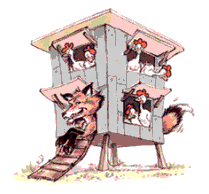
A partiality to foxes renders a similar disdain.....

How could we blame a FOX for guarding a HEN HOUSE?

...and the chickens are wide-eyed and innocent......


There seems no similar comparison to the reprehensible conduct by the Massachusetts Gam[bl]ing Commission beyond .....


They raised their hands and swore allegience to blindly FOLLOW....even they're not sure what they're following.....


From the beginning, the Political Hacks ignored common sense, ignored their own policy when they appointed and stood by Stan McGee......


Not only did it NEVER get any better......


Now they're spending TAXPAYERS' HARD-EARNED dollars to call ROOM SERVICE? ORDER + $100 MEALS? and much else.....?


The media has been more than kind and generous genuflecting to the clown car and ignoring faults....


...not only has the Clown Car taken on more passengers.....


THEY did it with your $$$$$.....


Isn't it time to say ENOUGH?


You've seen what PREDATORY GAMBLING has done.....


Let's REPEAL THE CASINO DEAL!


Revere will lose if voters bet on casino


Fitzgerald: Revere will lose if voters bet on casino


Monday, February 24, 2014

They came from Roxbury a generation ago and they’re among many who have shared their own victim impact statements here, never-forgotten tales of how gambling traumatized their childhoods.

Now here we are again, same story, different populace, with timid pols and high-rolling speculators licking their chops in anticipation of receiving a green light from the people of Revere, who’ll decide tomorrow whether to embrace casino gambling when they go to the polls.

The great majority of gamblers at a Revere casino would lose. That’s no bulletin. The house has to win, or the game is over.

And who do you think those losers might be? Sure, some players know their limits, and others can afford their losses, but here’s a truly safe bet: There’d be monies needed for family budgets squandered in those pots.

“Four of us were raised by my mother, supported by public assistance,” a woman from Mission Hill, now a successful lawyer, recalled. “She had such an addiction to gambling that most nights our supper consisted of one can of tomato soup mixed with three cans of water. To have a piece of bread for dipping was like having dessert.

“Shoes and sneakers were replaced only when the nuns complained.

“We had a bad enough time with her going to Bingo every night, or betting on the Spanish and Irish street numbers. You can imagine the impact on our family when the Lottery was born. It meant she could waste more of the little money we had with the greatest of ease, thanks to the state.”

Anecdotal? Please. What’s more anecdotal than the occasional story of someone you know hitting it big? That’s the exception, not the rule.

Another woman, who lived near old Jackson Square, shakes her head at the way gambling gets a free pass whenever public scourges are discussed.

“My father had a good job with Hood Milk, but loved to gamble. If he saw two cockroaches on the floor, he’d want to bet you which one would reach the wall first. He took money customers gave him, receipts that should have been brought to the plant, and gambled them away. When he was fired we went on welfare.

“I can still hear my mother calling out the window, crying, telling him we needed that welfare check for food, and he’d holler back, ‘Don’t worry; I’m going to double it for you.’ In the end he lost her, too. That’s what gambling does; it destroys whole families.”

Here’s hoping Revere, a city of families, will bet with its heart tomorrow, saying, “No, thanks.”


http://bostonherald.com/news_opinion/columnists/joe_fitzgerald/2014/02/fitzgerald_revere_will_lose_if_voters_bet_on_casino

They Have No Control Even Over Themselves

Massachusetts taxpayers should be outraged!

Boston Business Journal included an extensive list of expenditures that's worth reviewing. Please take the time!

The only way to assure the safety of the Commonwealth of such excesses is to REPEAL THE CASINO DEAL!


February 24, 2014 - BOSTON – Repeal the Casino Deal’s chairman, John Ribeiro, responded today to an announcement by Steve Crosby, the state’s top gaming official, that he would investigate spending by the Mass. Gaming Commission on the heels of a Boston Business Journal report of a Commission employees spending extravagant amounts of money on expenses including room service, last minute flights around the world and hotel bills, while often receiving reimbursement from casino giants.


Ribeiro noted that while the gaming commission claims to be exempt from state public employee spending and travel guidelines because the commission was created with money from a state “rainy day fund” rather than a line item appropriation, Attorney General Martha Coakley contradicted that theory in a 2011 letter to Secretary William Galvin. In that letter she wrote that the law creating the state gaming commission was not subject to a referendum vote because the law appropriates money to fund the commission.

Massachusetts law states that "[n]o law . . . that appropriates money for the current or ordinary expenses of the commonwealth or for any of its departments, boards, commissions or institutions shall be the subject of a referendum petition."

Statement of Casino repeal chairman John Ribeiro on Mass. Gaming Commission spending

“It’s about time for Crosby to look into this extravagant spending. It shouldn’t have taken a newspaper report and public outrage to highlight the need for spending controls.

It is disheartening to see that the members of the Massachusetts Gaming Commission have disrespected taxpayers with lavish spending, like one employee’s room service tab that totaled upwards of $500, a dinner bill at $111 per plate and plane tickets that rung up at three times the cost of economy flights.

Furthermore, for state commissioner Enrique Zuniga to claim that the very casino giants that the commission should be investigating and policing picking up tabs for flights, hotels and gourmet meals does not create a conflict is absurd.

This report just highlights the casino moguls’ ability to buy their way into Massachusetts communities, and the gaming commission’s disrespect for the taxpayers for whom they are supposed to be working.

These findings create a reason for the state’s voters to distrust the gaming commission and yet another reason for all residents of Massachusetts to demand the right to vote on this change to Massachusetts’ moral fabric.”


Contact: John Ribeiro -- 617-981-4177


Stop Casinos For Good!

The Massachusetts Gam[bl]ing Commission


Dear Commissioners:


From the very beginning of the process to bring expanded predatory gambling to Massachusetts, citizens who stand in opposition to casinos have been burdened with finding the money and means to make our voices heard, while casino interests are allowed to spend as much of their considerable resources as they'd like in convincing the MGC and the public to vote for them. This flaw in the casino legislation was thrown into high relief last week with a Boston Business Journal analysis of profligate spending by your commission and staff, including trips that were covered by multinational companies vying for licenses to operate in the commonwealth.

 
I only wish that the voters in Plainville had the funds to treat you to a trip, or an iPad, or some other perk. Perhaps then we would stand a chance of being taken seriously by you. Voters in Plainville had to raise funds for our own signs, pamphlets, and other costs of trying to organize an opposition against a huge casino infrastructure. Whenever we attended an MGC meeting or hearing, we had to take an unpaid day from work, provide our own transportation to Boston, and pay for our own meals and parking. Even now, some of us are putting our personal financial wellbeing in jeopardy as we face the possibility of having to mount a lawsuit against the MGC.


By your actions — forcing us to vote a mere six days after a new applicant was named; not requiring that a new Host Community Agreement be negotiated and signed; not adhering to the statutory requirement of 60-to-90 days after an HCA is signed before a referendum can be held; doing an end-around your own regulations and failing to finish investigating and finding suitability regarding Penn National before our referendum; turning around less than two months later and changing your schedule to accommodate Milford after their insistence that the Foxwoods suitability hearing happen before their referendum — you put the voters of Plainville in an inferior position and denied us our due process rights and equal protection under the statute and regulations. We were already operating at a disadvantage in that we could not possibly afford to compete against the casino interests and their vast resources; rather, we had to conduct a grassroots campaign of door knocking, telephone calls, and educational meetings — all of which take time. We had been thrown into no-man's-land when Ourway was disqualified. Then you, by ruling that the law and regulations were "technicalities" as they applied to us, denied us the only hope we had to be heard: the time provided by the statute. You made certain that voters in Plainville never had the opportunity to hear both sides of the story about Penn National. You stacked the deck. Now, looking at who was paying your way, I can't say I'm surprised.


Elections are won and lost with messaging, and messaging requires money. Voters cannot consider arguments they cannot hear. There is no provision or mechanism in the law that even attempts to level the playing field. According to the writers of the casino legislation, the citizenry is entitled to no defense at all — unless we are able to raise enough money to make a dent in what the casinos spend. Plainville could not: you were dining out quite lavishly on money from the applicants while we were trying to scrape together enough donations to pay for a small newspaper ad.

Predatory gambling sullies everything in its path. The fantasy of "free money" is an allure that's hard to resist. The money you spent on expensive dinners and luxury hotel rooms was money that had been lost in casinos by residents of other states, other countries. Rather than be circumspect about using that casino money, you spent like drunken sailors. Is this what the state has to look forward to?


The temptation to spend beyond one's means is one of the dangers we gambling opponents keep warning you about. I guess we hadn't anticipated that the problems would start right there in the gambling commission, before a single license was granted.


Sincerely,

Mary-Ann Greanier


Sunday, February 23, 2014

Gambling addiction nothing to play around with


Gambling addiction nothing to play around with

Slot machines pose the biggest danger to compulsive gamblers. A gambling addiction is a serious disease that can ruin lives and families, but attempts to tackle the problem in Germany have failed to make an impact.
 
A gambling machine

Just one more win. One more press of the button and the pictures spin round and round again. Will a winning combination appear this time? The chances are small, but that's how slot machines work.

Lulled by the games' monotone jingles and flashing lights, compulsive gamblers are drawn in again and again - some even gamble away a fortune.

An unrelenting craving

Modern slot machines, found in bars and easily accessible to anyone over 18, are perhaps the most dangerous form of gambling. Young unemployed migrants are most at risk, according to a new study on gambling addiction in Germany published by the Federal Center for Health Education.

Addiction experts estimate there are up to 300,000 pathological gamblers - serious addicts who quickly get sucked in by the thrill of winning on the machines. As well as live sports betting and online poker games, slots are particularly risky for addicts. Around 75 percent of gamblers seeking counseling help have a problem with machines.

"The shorter the time between the play and the result, the higher the chance of addiction," said Richard Stelzenmüller, a therapist who works with addicts at the LVR Clinic in Bonn. The music, the lighting effects and the quick game get young men hooked in a short space of time, Stelzenmüller said.

His first question in consulting sessions with addicts isn't how long they've been "on it," but rather:

"Have you ever stolen from anyone to get money to play?" Like crimes related to drug addiction, if the answer is yes, it's a sign of heavy dependence.

A man plays a gambling machine
Young unemployed migrants are most at risk

Addiction creates a disruption in an area known as the brain's pleasure center. People under stress usually reach for a drug. Gambling can serve as fast-acting stress relief, but the implications can be devastating if addiction ensues. Addicts often plunge into debt, lose their jobs and families, become criminals, and are at high risk of committing suicide.

In the space of a year, some gamble away the value of an apartment. A total of 4 billion euros ($5.5 billion) are gambled away at gambling halls each year.

Part of the problem is that these private, usually small, gambling venues aren't regulated by the state.

They don't fall under the German government's gambling monopoly, which includes lotteries, betting shops and casinos.

People in those forums face rigorous identity checks and can be banned - or choose to ban themselves - to keep them away from temptation. These stricter rules often end up driving addicts to slot machines in gaming arcades and bars, that are not regulated and where addicts are left to their own devices.

Profiting from lack of regulation

How is it possible that such a dangerous form of gambling isn't strictly regulated? Addiction counselors like Ilona Füchtenschnieder have long suspected that the slot machine lobby is more important to politicians than effective addiction prevention.

"They are always very lenient on the industry," said Füchtenschnieder, who works for the state gambling body in North Rhine-Westphalia. For several years she has been fighting against the trivialization of so called "small-time games."

When a new slot machine comes on the market, politicians put up with it, she says, and if that game turns out to be problematic, then there are "insanely long transitional periods" before any steps are taken.

Ilona Füchtenschnieder
Ilona Füchtenschnieder warns of the powerful gambling machine lobby

A good example of the cat and mouse game between politics and the gambling sector is the points game - one of the machine industry's tricks to bypass stricter gambling regulation. Each game must last at least six seconds, with a maximum bet of 20 cents per round, and a maximum loss of 80 euros per hour. Füchtenschnieder took a critical view: "The money that gets thrown in simply gets converted into points. You can play with much larger sums of money in a short space of time."

Who is the real winner?

Many different interests converge in Germany's gambling market. There are certainly strict rules such as the State Treaty on Gambling and the Gambling Ordinance, but there is also a powerful gambling industry. Their chief lobbyist is Paul Gauselmann, the head of a group of companies which manufacture slot machines, with an annual turnover of more than 1 billion euros.

The country also has a lot to gain from the sector. All states, with the exception of Bavaria, charge an entertainment tax, which amounts to millions in the bigger cities. For the municipalities however, gambling halls are more of a burden. The city usually pays for the costs of addiction, especially when people are unemployed.

Paul Gauselmann Paul Gauselmann has build a slot machine empire in Germany

Slot machines can guzzle away purchasing power. The devaluation of neighborhoods is another problem - who wants to buy a retail store or house in an area surrounded by dodgy gambling arcades?

Tilman Becker from the Gambling Research Center at the University of Hohenheim can't understand the fuss some local councils make over the proliferation of these types of venues. "It's a bit hypocritical when a municipality complains about the very gambling halls that they themselves allowed to be built there," he said.


Kicking the addiction
When all other avenues have been exhausted, addicts end up at the clinic with Richard Stelzenmüller. They go through a radical withdrawal process, to help them change their behavior and abstain from gambling. Like drug addicts, they suffer mood swings, insomnia and intense cravings. An in-patient treatment lasts two months, therapy for an out patient lasts one year.

It usually takes gambling addicts several attempts to regain control of their lives. Those who do manage to stay "clean" often have to grapple with a mountain of debts. Many clinics offer additional debt advice.

Ilona Füchtenschnieder said she believes banning slot machines in restaurants and bars could make a difference as it often serves as an "entry point." The state can't prevent addiction, she admitted, but there are models that can help reduce the risk. In Canada and Scandinavia for example, government-issued ID cards aim to help players stay in control.

"That would be a useful preventative measure to mitigate damage," said gambling researcher Tilman Becker. Players register for the card online, where they can set spending limits and even be blocked. If they don't have a card they can't gamble, and the game is over before it's even begun.

DW.DE

Saturday, February 22, 2014

Fred Flintstone: Degenerate Gambler


Jilted Palmer landowner suing Mohegan Sun


Jilted Palmer landowner suing Mohegan Sun

Is Grandma gambling away her retirement?


Is Grandma gambling away her retirement?

The gambling industry targets seniors, and sometimes the consequences can be devastating for their finances.


This post comes from Marilyn Lewis at partner site Money Talks News.


Money Talks News on MSN MoneyWhat the heck was up with the 73-year-old man who allegedly pulled black underwear over his face, grabbed a shotgun and held up a Fort Pierce, Fla., bank recently?


Gambling, that's what. The man told authorities he needed money "because he's on a fixed income and had gambled his money away on horses and Texas Hold 'em," says an Associated Press report.


Senior woman © CorbisHomeless and still gambling
It's terrifying to think of spending your old age in poverty because you gambled away your savings and home. But that's the reality for many seniors for whom compulsive gambling compounds the difficulties of old age.


Financially, the effects are "massive" for seniors and their families, says Keith Whyte, executive director of the National Council on Problem Gambling in Washington, D.C. "In one day you can gamble away your entire retirement."


Personal finance columnist Liz Weston wrote on MSN Money that "the explosion of legal gambling opportunities in recent decades poses a particular danger for seniors, who are often on a fixed income and don’t have future working years to make up for any losses."


Whyte tells of an older Maryland woman whose husband took out "multiple" mortgages on their home to finance his lottery habit. Her first inkling of the problem was the foreclosure notice before they lost their home. The couple's adult children took her in to live with them but not him, because he denied he had a problem. At 75 he became homeless.


"That was five years ago," Whyte says. "The last I heard he was still gambling."


Target: Seniors
Gambling -- or gaming, as casinos often call it -- is a popular recreation for older Americans. Senior centers, church groups and clubs frequently sponsor trips to casinos with their welcoming lights, activity, safety, dining, entertainment and socializing. For most, it's recreation.


But for the minority who develop an addiction, the consequences can be devastating.
Gambling helps them, momentarily, to forget the grief, losses and many difficulties that can be part of old age. But older people with dementia "are at especially high risk because they are unable to recognize limitations or use appropriate judgments," says the AARP Bulletin, adding:
The nation’s $40 billion-a-year gambling industry aggressively targets older customers, as they have accumulated wealth and are especially vulnerable, experts say, to wagering more than they can afford. The enticements range from free bus trips, meals and even discount prescription cards to "comped" hotel accommodations.
Addicted
An estimated 1 percent of Americans are addicted to gambling and another 4 million to 6 million are believed to have some symptoms.


Statistics on addiction among seniors are hard to find, however. Psychologist Robert Hunter, director of the Problem Gambling Center in Las Vegas, told AARP that about 40 percent of his center's clients are 50 or older.


"Many of them are people who got into trouble after retiring and moving to a place where casinos are a big part of social life," Hunter said.


Some 8 million to 10 million people -- at least 60 percent of them seniors -- are bused to Atlantic City casinos each year, the executive director of the Council on Compulsive Gambling of New Jersey told Philly.com. The number of older gamblers is growing faster than that of any other age group, the article says.


THE SCAM


10 signs of trouble

If you are wondering if your parent, spouse or friend is having trouble with compulsive gambling, these signals may help. Want to learn more? Read "8 Signs You’re Addicted to Gambling and 5 Tips to Stop" and take the Gamblers Anonymous quiz, "20 Questions: Are you a compulsive gambler?"


A gambler may be in trouble if he or she:

  1. Can't stop.
  2. Keeps gambling after friends go home or goes gambling alone.
  3. Gambles money the person can't afford to lose.
  4. Withdraws from relationships, hobbies and favorite pastimes.
  5. Gambles to escape depression, loss, loneliness and problems.
  6. "Chases" losses by gambling more to win the money back.
  7. Hides losses and borrows money secretly.
  8. Is on an emotional roller coaster and often feels remorseful.
  9. Is out of control, even stealing or forging checks.
  10. Overdraws accounts, has past-due bills, and money is a pressing problem.

What you can do

If you love someone whose gambling is out of control, you can't stop the gambling. But you can take care of yourself, your family and your finances. This brochure (.pdf file) from the National Endowment for Financial Education and the National Council on Problem Gambling explains how to do that in detail.


If you are faced with problem gambling in your own home, above all, stay safe. "Do not try separating gamblers from access to money if you think the gambler could become verbally abusive or violent," the brochure says.


If you're helping an elder find a retirement community or home, look for one that educates residents about safe gambling habits, Whyte says.


Treatment that works

Here is good news: Treatment is effective, with a two-thirds success rate for people who adhere to a program, according to Whyte.


Here's a short list of what works. People who successfully stop:

  • Admit the problem. Experts say nothing will stop the gambling but the gambler's own determination coupled with a recovery program.
  • Turn to family, friends and treatment groups. Support is critical to stopping successfully. Contact Gamblers Anonymous (no fees or dues) for information, hot lines and meetings. Find Gam-Anon groups for families and loved ones of gamblers.
  • Get professional help. The National Council on Problem Gambling lists certified counselors. Call the 24-hour confidential help line: (800) 522-4700.
  • Control the environment. Stay away from sources of money. Turn the family bills, bank accounts, checkbooks, PINs and credit cards over to someone trusted. Stay out of harm's way by avoiding gambling entirely. "The first bet to a problem gambler is like the first small drink to an alcoholic," says Gamblers Anonymous.
 

Gam[bl]ing Commission to award Slot Barn License next week

It's time to REPEAL THE CASINO DEAL!


Slot parlor license to be awarded next week
 
 
The state's five gaming commissioners will have their noses to the grindstone next week, with a marathon series of meetings in advance of Friday's award of the state's lone slot parlor license.
 
The license will also be the first gaming license to be issued in Massachusetts.
 
In meetings on Tuesday, Wednesday and Thursday, the commissioners will report on the results of their comprehensive evaluation of three applicants, one each in Raynham, Plainville and Leominister.
 
Each commissioner has taken the lead on overseeing a group of advisers and industry experts to evaluate each gaming proposal in key categories: overview of project, finance, economic development, building and site design and mitigation.


"This is truly the culmination of an incredible amount of hard work put forth by the commissioners, commission staff and the dedicated members of the five evaluation teams," chairman Stephen Crosby said on the commission's blog.
 
Crosby said that as a result of a "highly competitive process, the commission has had the difficult and exciting task of evaluating absolute first-rate proposals."
 
He said the commission is "eager to take this final step in bringing to bear the thousands of jobs and revenue benefits that await the citizens of the Commonwealth."
 
The applicants are:
 
Raynham Park, a partnership between Greenwood Racing Inc. and George Carney, owner of the former greyhound race track, to develop and operate a $220 million slots facility on 125 acres near both Route 495 and Route 24 in Raynham.
 
Penn National of Wyomissing, Penn., which has partnered with Plainridge Racecourse for a $225 million slots parlor near Routes 495 and 1 that the developers said would save harness racing in Masschusetts.


Cordish Companies of Baltimore, which hopes to develop the $200 million Massachusetts Live! Casino off I-190 and Route 117 in Leominister.
 
Each meeting will begin at 9:30 a.m. at the Boston Convention and Exhibition Center. A live stream will be available on the MassGaming website and live meeting updates will be provided by the commission on Twitter, @MassGamingComm.
 
In addition, the Gaming Commission will meet at 1:30 p.m. Monday to discuss surrounding community designations for Eastern Massachusetts and recent correspondence from the City of Boston relating to resort-casino applications in Everett and Revere.
 
The first resort casino licenses — in Greater Boston and Western Massachusetts — are scheduled to be awarded by May. A license for Southeastern Massachusetts will not be awarded until November.


Italy: Why ‘playing slot machines’ is no game


Why ‘playing slot machines’ is no game

Hard to Belive: Nevada actually FINED Seeno family casino $1 million!


Seeno family casino chain fined $1 million over slot machine shenanigans

FACTS: Don't Gamble Revere!


According to a recent study by the Institute for American Values, a nonprofit think tank based in New York, the casino explosion is having a profound impact on our society. Among the study’s findings:

• Casino gambling has moved from the margins to the mainstream of American life.

• The new casinos are primarily filled with modern, highly-addictive slot machines and cater overwhelmingly to middle and low rollers who live within an hour away, return frequently, and play the ...slots.

• Casinos depend on pathological and problem gamblers for their revenue base, with these troubled individuals providing 40-60 percent of slot machine profits.

• Living close to a casino increases the chances of developing a gambling addiction.

• Casinos constitute a regressive tax that hits low-income people the hardest, thereby contributing to economic inequality in America.

• The long-term costs of the new casinos exceed their benefits by as much as 3-1.

The new regional and local casinos, the study concludes, drain wealth from communities, weaken nearby businesses and reduce civic participation, family stability, and other forms of social capital that are at the heart of a successful community.