Meetings & Information


*****************************
****************************************************
MUST READ:
GET THE FACTS!


Friday, September 28, 2012

Indian tribes, with more clout and money, find ally in Obama


Published: Wednesday, September 26, 2012

Indian tribes, with more clout and money, find ally in Obama

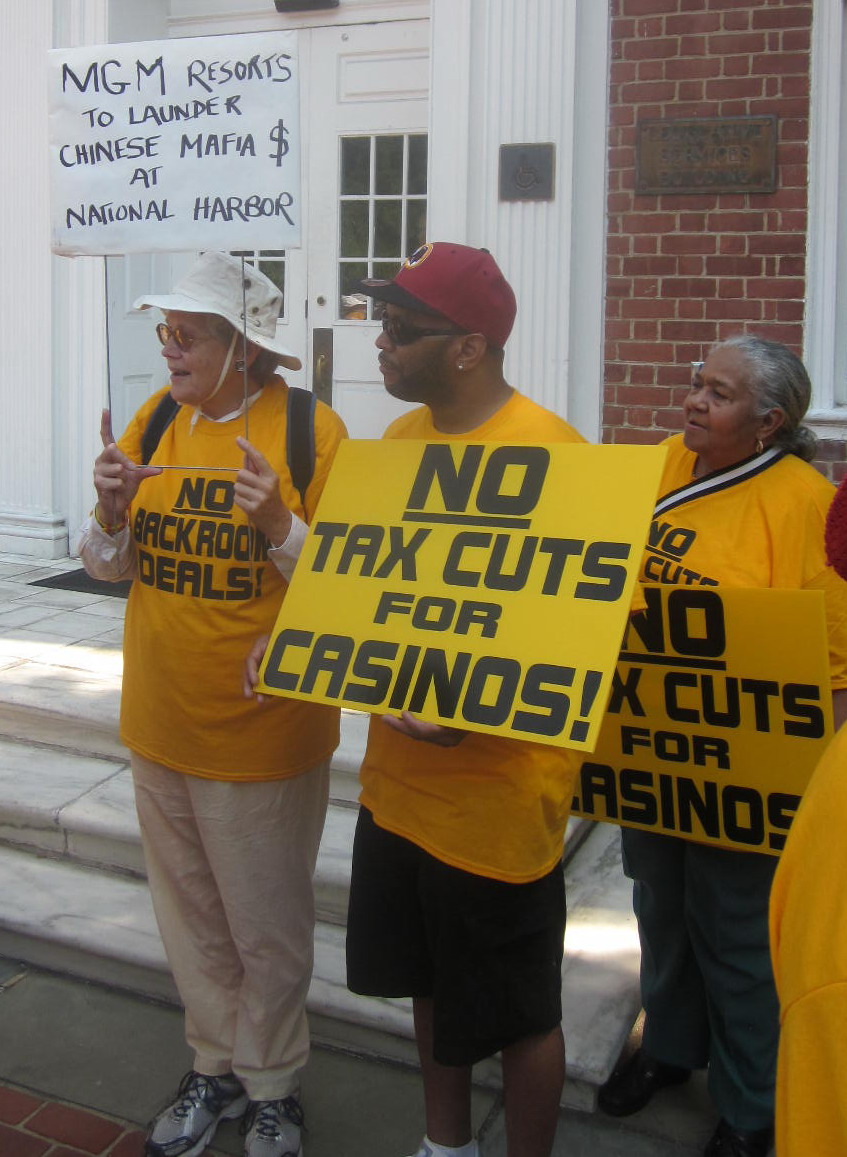
Demonstrators protest Prince George’s casino bill.


Demonstrators protect Prince Georges casino bill.

Demonstrators protest Prince George’s casino bill.

Gambling expansion
The contest to allow a sixth casino in Maryland and table games in all of them is close, with 45% of Maryland voters supporting the expansion, 46% opposed and 9% undecided. African-Americans again are the swing vote, with only 31% favoring the idea, and 64% opposed, compared to 51% of Democrats as a whole in favor of the proposition.

This divergence on the issue between white and black Democrats, Gonzales said, “could present an obstacle on Election Day for supporters of expanded gaming in Maryland.”

Gambling interests on both sides have already committed over $20 million to persuade voters, and “additional million of dollars will be spent by both sides over the next six weeks trying to get their position over the finish line first in what is a close contest,” Gonzales said.

Intensity of support

The poll also sought to gauge intensity of support for these ballot questions among people who said they were likely to get out to vote. Gonzales found that there was greater intensity among supporters of same-sex marriage and in-state tuition, but opponents of expanded gambling were more intense in their opposition than supporters.


http://baltimorepostexaminer.com/new-poll-voters-support-dream-act-close-on-gay-marriage-slightly-opposed-to-gaming-expansion/2012/09/26

Mohegan Sun: Re-Shuffling Deck Chairs on the Titanic


Just days after Palmer's leaders allowed themselves to be dazzled by Fools' Gold,
Mohegan Sun is re-shuffling because of Gambling Market Saturation, declining
revenues and excess debt.

Palmer's KoolAid Consumption


Mohegan Sun announces more than 300 layoffs, replacement of CEO
By Brian HallenbeckPublication: theday.com
Published 09/27/2012
 
Dana Jensen/The Day
Jeffrey Hartmann, chief executive officer of Mohegan Sun, walks through one of the gaming areas in February 2011. The casino announced Hartmann's departure Thursday, along with the layoffs of more than 300 casino employees.
 
Mohegan — Wracked by a revenue decline that shows no sign of abating, Mohegan Sun is laying off more than 300 employees and replacing its chief executive officer.
Jeffrey Hartmann, a Mohegan Sun executive since 1996 and the casino's president and CEO since 2011, left his job Wednesday, Mitchell Etess, CEO of the Mohegan Tribal Gaming Authority, said Thursday night.
"Jeff's no longer with the company," Etess said, declining to elaborate.
Bobby Soper, CEO of Mohegan Sun at Pocono Downs, the authority's racetrack casino in Wilkes-Barre, Pa., will replace Hartmann, Etess said. Soper is a member of the Mohegan Tribe, as is Mohegan Sun's No. 2 man, Ray Pineault, the chief operating officer.
Attempts to reach Hartmann were unsuccessful.
Etess said 282 employees were being laid off immediately and that another 46 would be let go at the end of October when the casino closes Birches, a tribe-owned restaurant that will reopen under new ownership.
The casino also will shut down its keno operation, Etess said.
The layoffs — the casino's second round in two years — will impact virtually every department and include workers at all levels, from vice president on down, he said. Managers began informing employees around 6 p.m. Thursday and hope to conclude the process within the next two days, Etess said.
"You have to put this in the context of the amazing decline in business we've experienced," Etess said. "The last thing we ever want to do is lay people off, but we had to do this to make the size of our workforce appropriate to our business volumes."
After the layoffs, Mohegan Sun's workforce, also reduced in recent years by attrition, will number about 6,400, Etess said. Prior to the recession, the casino employed more than 10,000.
Slots revenue, generally considered a reliable indicator of a casino's overall financial health, has been declining for the last five years at Mohegan Sun and Foxwoods Resort Casino, its nearby competitor.
Foxwoods has no plan to lay off employees, Scott Butera, Foxwoods' president and CEO, said Thursday night in the wake of the Mohegan Sun news.
In recent months, casino executives have attributed shrinking revenues to the economy's weak recovery and to increasing competition from Resorts World Casino at the Aqueduct racetrack in New York City, which debuted last October, and to a lesser extent Revel, a $2.4 billion casino that opened in April in Atlantic City, N.J.
Last month, Resorts World, which operates slots-like video display terminals and electronic table games, generated a $58.6 million slots "win" — the amount of wagers the casino keeps after paying out prizes. Mohegan Sun's take for the month was $56.3 million. Resorts World's "handle" — the total amount of wagers — totaled more than $1.1 billion, far outstripping Mohegan Sun's $687.2 million.
"Clearly, the competition from Resorts World has taken business away from us, but it's also had an impact on the whole region," Etess said. "It's prompted Atlantic City and Yonkers (N.Y.) to get more aggressive. It's had a tremendous effect on the dynamic in the marketplace."
For the first eight months of 2012, Mohegan Sun's slots win was down 6.7 percent over the same period in 2011. Comparing August 2012 to August 2007, the decline is a staggering 32.6 percent.
Earlier, the Mohegan Tribal Gaming Authority, the entity that operates the casino, reported that its net income, or profit, for the third quarter of its 2012 fiscal year — April, May and June — was down 4.7 percent over the same quarter the previous year.
But Etess said the economy, both nationally and in Connecticut, may be an ever bigger factor than competition from other gaming facilities.
"The unemployment rate, the price of gas, the overall economic conditions …" he said. "Connecticut is a huge part of our market. We're seeing declines among our customers in certain counties. It's not that they're going to other casinos — someone could be still be coming to Mohegan Sun and spending less."
About 53 percent of Mohegan Sun's customers are Connecticut residents, Etess said.
In the earlier round of mass layoffs, in September 2010, Mohegan Sun announced it was eliminating 475 positions, the majority of them in the casino's food and beverage department. At the time, the casino said about 120 workers whose positions were eliminated would be able to transition into other jobs at Mohegan Sun.
At the same time, the casino announced it would close one of its two buffet restaurants, the snack bar in its race book and two casino-owned outlets in its food court that later reopened under third-party operators.
Later that year, Etess, who was then CEO of both the authority and Mohegan Sun, announced that he would relinquish responsibility for Mohegan Sun's day-to-day operation to focus on authority business. Hartmann, then Mohegan Sun's executive vice president and chief operating officer, was elevated to CEO of Mohegan Sun, effective January 2011.
The Mohegan Tribal Gaming Authority refinanced $1.6 billion in long-term debt in March of this year, pushing back maturity dates to 2015 and later. Around the same time, Etess and Hartmann agreed to three-year contract extensions with the Mohegan Tribe. Under the deals, Etess and Hartmann were to be paid $1.4 million and $1.3 million in the first year. The contracts were to extend to June 30, 2015.
b.hallenbeck@theday.com
 
Mohegan Sun Lays Off 300 in CT Replaces CEO
 
3 years ago Mohegan Sun announced its proposal for a casino in Palmer.

Palmer Councilor at Large, Paul Burns, tells ABC40 News, “The announcement today that of additional layoffs at Mohegan Sun is disappointing and an indicator of the demands of an increasingly competitive gaming market in the Northeast.”

Burns went on to say, “While layoffs are never welcome I hope that the decision to make these cuts indicates a desire on the part of those at Mohegan Sun to strengthen their ability to compete successfully in Western Mass and enhance their bottom line and ultimately increase opportunities for Mohegan staff as well as additional thousands of new employees in Western Mass.”

“Now more than ever, it is incumbent on Mohegan Sun’s leadership to demonstrate their commitment to Western Mass by submitting the $400,000.00 application fee,” added Burns.


Casinos have also been proposed in Springfield and Westfield.

[Mr. Burns consistently ignores the Citizens' Casino Study that determined the annual cost of hosting Mohegan Sun would be $18 MILLION to $39 MILLION, not including the $50 MILLION to bring water from the Quabbin Reservoir.]
 

+ 50,000 Compulsive Gamblers


  • By Jeremy Grimaldi Sep 27, 2012


  • Former problem gambler condemns Vaughan's casino idea

    Former problem gambler shares spiral into addiction. When a former problem gambler heard Vaughan was considering bringing a casino here, he said he considered it one of the most “irresponsible ideas” he’d ever heard from a group of local politicians. He shares his personal journey. Illustration by Steve Somerville
    'I finally admitted it and surrendered,” he said. “I was powerless, my life had become unmanageable. I stopped the lying, the cheating. That was my first day of recovery.' Luigi, former problem gambler

    *The subject's name, age and family make-up have been altered to protect his identity.

    When Luigi first read that Vaughan was considering bringing a casino to town, he said he considered it one of the most “irresponsible ideas” he had ever heard from a group of local politicians.
    Almost instantaneously, the past 14 years of his life, during which he spent his days and nights lying and cheating his loved ones to feed his gambling addictions, came rushing back to him.
    It was during these years that the “regular” son, father and brother, who had never been addicted to anything but cigarettes, stooped to levels he never thought imaginable.

    Thankfully, he says he is now recovering and in counseling for his obsessions.
    He said he brought his story to The Citizen as a warning of the evils of gambling and casinos.
    “No amount of money could justify bringing this sort of misery to the people of Vaughan,” said the 49 year old.
    His first encounter with the one-armed bandit (slots) came very innocently, along with some friends at Mohawk casino in 1994.
    “At this point, Woodbine hadn’t opened yet,” said the local businessman.
    “It was right at the beginning of gambling in Ontario, there was a buzz, the thrills the lights, the excitement. I enjoyed it, maybe too much.”
    On that night he went home “the big winner”, claiming a prize of $1,500.
    Despite desperately wanting to return the very next day, he decided to wait one day before going back.
    The wait was excruciating.
    “It (the win) was so easy, I just wanted to try it again,” said the married father of two. “I just couldn’t stop thinking about it.”
    When he eventually did return, he lost $800.
    That same weekend he found himself in front of the flashing lights once again.
    Over time the cash he dealt with during work became his piggy bank.
    “I would stay until I had nothing left in my pockets,” he said.
    As addiction tends to do, the problem escalated until he found himself in the casino on a nightly basis.

    In the first year he estimates he lost $20,000.
    Soon after, it became a “real problem” at both his home and work, where it was becoming obvious that something was awry.
    “The bills and mortgage all started getting behind,” he admitted. “But you find a way around it, you become a genius at innovative ideas of how to acquire money.”
    By the second and third year he already owed his employer $12,000, but the problem was, the employer didn’t know this until it was too late. When they found out, he was let go.
    “It’s a progressive sickness, it gets worse little by little,” he said. “One thing it never does is get better.”
    By the end of the third year he had lost about $60,000, plus the entirety of his winnings, which included, among others, $30,000 in one sitting.

    “This is the thing with a compulsive gambler,” said the Vaughan resident. “When you’re a compulsive gambler you never have any money in your pocket. That’s the great illusion, because no one ever really wins.”
    By 1997 his family had convinced him to seek counselling.
    Problem was he hadn’t admitted to himself that he had a problem.
    After six months in the program he relapsed, and fell into a self-described “spiral” for the next 11 years.
    “Between that decade plus, I was home physically, but mentally and emotionally I was not, I was in a gambling spiral,” he said. “I abandoned family, I don’t remember any kid’s birthdays or functions from that time.”
    This time around the financial damage was so deep that he almost lost his home, family and friends, after borrowing plenty of cash and losing approximately $180,000.
    At this point he was visiting the casino every night, often returning home at 5 or 6 a.m..
    Often times he would binge, spending 3 days in a row in a 24-hour casino, only taking periodic breaks to rest in his car.
    “I have done things as an adult, a father and a spouse that would astonish people,” he added. “What was my low point? I would have to say sneaking into my kid’s room to take $20 or $30 to feed my habit.”
    He didn’t stop there he also took from his parents when they would give him money to “buy something for the kids”.
    In times of desperation he would “take from the streets”, explaining, that meant, borrowing from loan sharks, whom he thankfully always paid back on time.

    Soon his life went from one lie to the next, getting countless calls from banks, bill collectors and utilities.
    He then retold a story he said he often thinks about.
    “I remember being at the casino it was in the early morning,” he said. “I remember seeing a woman that I knew from Vaughan, sitting beside me. She was restless, nervous, sweating and wiping it away with one hand while playing slots with the other.

    “I looked at her and said ‘Signora is everything OK? She looked at me and said ‘my husband was snoring in bed when I left at 2 a.m.. I snuck out of bed put my clothes and now here I am gambling, sneaking around just trying to keep it from my husband’.
    That among other experiences scared him stiff, although the final straw came as it often does, through the long arm of the law.
    It finally came time to face the music when he was charged for theft.
    Although Luigi wouldn’t go into details it was clear it shook the decent, family man to the core.
    “I finally admitted it and surrendered,” he said. “I was powerless, my life had become unmanageable.
    I stopped the lying, the cheating. That was my first day of recovery.”
    Luckily for Luigi his wife stood by him and he was able to get his life back on track.
    Many, including people from all walks of life, lawyers, accountants, priests, teachers, have not been so lucky he said.
    Since the day he rejected gambling two years ago, he’s been clean and although he didn’t want to come forward with his cautionary tale he said he had to after reading The Citizen article on the recent talks of a casino in Vaughan.
    “Alarm bells went off, I had to come in and share my story,” he said. “I just can’t believe they’re even considering this, there are over 50,000 compulsive gamblers in Ontario. Those are the ones that have admitted it, there are thousands going through it right now. I wouldn’t wish that on my worst enemy.”

    http://www.yorkregion.com/news/article/1509720--former-problem-gambler-condemns-vaughan-s-casino-idea

    SUICIDE Caused By Online Gambling Debts


    Talented young footballer jumped to his death after racking up £10,000 of online gambling debts

    • Adam Billing, 27, from Liskeard, had been a promising youth team player with Plymouth Argyle
    By Daily Mail Reporter


    On Line Petition Accuses Mashpee Wampanoags of Reservation Shopping


    TODAY's quote: "The Mashpee Wampanoag tribe does not have historical ties to the land in East Taunton as required by federal law. The tribe's final determination has already identified Mashpee, Massachusetts, as the tribe's historical land. This tribe is clearly reservation shopping." - Online petition.

    Online petition opposes Mashpee Tribe's Land in Trust application
    Mashpees accused of "reservation shopping"
    By Walter Brooks

    An online petition addressed to the Federal Department of the Interior, the Bureau of Indian Affairs and the U.S. Senate Committee on Indian Affairs has been circulated by East Taunton casino opponent Michelle Littlefield and was posted on change.org Wednesday. It already has 130 signatures.

    It accuses the Mashpees of "reservation shopping", but its only value, however, is to gauge public opinion on the matter.

    The petition's title, Reject & Deny Land in Trust & MA State Compact with the Mashpee Wampanoag Indian Tribe, says it all.

    Supporters of the petition may add both their endorsements and signatures if the wish.

    A Pocasset RI Native American, Raymond Two Hawks writes in the comments, "Taunton is Pocasset territory. Not Mashpee. Respect the rights of all Tribes, not just the federally recognized ones. "

    Among the petition's 16 charges is that Governor Patrick is supporting the Mashpee Wampanoag Tribe’s application for trust land despite the Carcieri decision, which eliminates the possibility of trust land for this tribe. Furthermore, Governor Patrick submitted an amicus brief to the Supreme Court of the United States supporting Governor Carcieri in limiting the authority of the Secretary of the Interior to create trust land for tribes recognized after 1934, raising some serious questions about why he is now supporting the application for trust land.

    The charges also include that the Mashpee Wampanoag Tribe has submitted a grossly inadequate and incomplete application for land into trust, and that there has been a repeated, ongoing lack of transparency by numerous local and state elected officials who have sworn to uphold the constitution and protect its citizen’s rights.

    Read the Standard-Times story here. [below]

    http://www.capecodtoday.com/news/EXTRA/2012/09/28/online-petition-chllenges-tribe-s-casino


    Online petition challenges tribal casino

    Mohegan Sun Bus Crash Trial Begins


    NY prosecutors: Driver in fatal crash knew risks


    By COLLEEN LONG
    Associated Press
    September 27, 2012

    NEW YORK (AP) — The driver at the helm of a tour bus that crashed in a horrific accident last year, killing 15 passengers, knew the risks of fatigue and drove anyway despite a serious lack of sleep, prosecutors said Thursday as his manslaughter trial began.


    Ophadell Williams had years of experience driving a bus, and simply should've known better, Assistant District Attorney Gary Weil said.

    ‘‘This crime didn’t have to happen,’’ he said. ‘‘This is not a driver who maybe gets too little sleep. This is a professional, responsible bus operator.’’

    Williams, 41, dressed in a grey suit, mostly looked down and wrote on a yellow legal pad while Weil spoke. Defense attorney Patrick Bruno said outside court that Williams was not fatigued.


    ‘‘I sincerely believe that he had as much sleep as many other people routinely have,’’ he said.

    Bruno said his client was a hero, helping injured passengers from the wreck even though he was injured. He said any driver could have ended up in his position — and it was wrong to charge him criminally. He compared Williams’ job to that of a firefighter, police officer or nurse who work long, fatiguing off-hours.

    ‘‘But for the grace of God go I ... you could be in that seat,’’ he told the jury. ‘‘That’s what bothers me, and let it bother you, too.’’

    The March 12, 2011, crash happened on Interstate 95 at daybreak as Williams was ferrying a busload of gamblers to Manhattan’s Chinatown from the Mohegan Sun casino in Uncasville, Conn. The bus crashed just feet from a road sign that read: ‘‘Welcome to the Bronx.’’

    The victims were mostly Chinese men and women over the age of 40 who were regulars at casinos.

    ‘‘At the scene lay 13 people in a makeshift morgue, covered up, pulled from the wreckage,’’ Weil said. ‘‘They died instantly, in a horrific crash caused by the reckless and criminally negligent behavior of that man — Ophadell Williams.’’

    Aside from the 13 people who died at the scene, two died at a hospital and 15 others were injured, some severely. Weil catalogued how one man had his ear torn off and others suffered bone fractures.

    The bus struck a guard rail, then toppled over and hit a signpost that opened the top like a sardine can before skittering to a stop.

    One victim ‘‘put his arms over his head to protect his head, and both arms were ripped off,’’ Weil said.

    Williams pleaded not guilty to manslaughter and criminally negligent homicide. He is being held in Rikers Island because his family cannot post $250,000 bail. If convicted, he faces a maximum of 7 1/2 years to 15 years in prison. His wife didn’t speak to reporters outside court Thursday. There were few victims’ family members in the audience — but Weil planned to call many survivors as witnesses.

    The National Transportation Safety Board said in June that the accident was probably caused by driver fatigue, and a bus company that provided too little safety oversight. It stopped short of saying Williams had fallen asleep.

    ‘‘He was not intoxicated, he was not on drugs. But the sleep deprivation he had was so severe that it affected his reflexes the same as if he was intoxicated,’’ Weil said.

    Williams said a tractor-trailer cut him off, and that’s why he swerved and hit the guardrail. But investigators could find no indication that had occurred. His attorney said he was awake and alert, and he’s wracked with guilt over the crash, but not guilty of any crimes.

    Weil said witnesses will testify that there was no tractor-trailer, and that Williams was driving erratically for miles before the crash — and didn’t break when he hit the pole. The bus was traveling at speeds up to 78 mph in a 50 mph zone until seconds before it ran off the road.

    Williams worked for World Wide Tours of Greater New York. Federal regulators shut down the bus operator after the accident for safety violations. Williams had not turned in any driver’s logs while working for the company as required by federal safety regulations, yet World Wide took no action, federal investigators said.

    But the bus company won’t face any criminal charges related to the crash, Bronx District Attorney Robert T. Johnson said.

    ‘‘How is Mr. Williams any different from the bus company?’’ Bruno asked jurors. ‘‘Why is he on trial in this criminal building? I maintain folks there was no criminality here.’’

    New York state has stepped up inspections of tour buses since the crash. Dozens of buses have been taken out of service after police found problems with logbooks, licenses or equipment.

    But on July 4 this year, another casino bus went out of control 2 miles up the road from the March 2011 accident, sending 24 people to the hospital with minor injuries. The bus was on an early morning route from Foxwoods Resort Casino in Connecticut to Chinatown in Queens in the rain when it struck a center median barrier on Interstate 95 in New Rochelle, veered right over three lanes, then slid about 500 feet along an outer barrier before stopping.

    New York State Police said that it appeared the driver had been going too fast for the wet conditions.

    http://www.boston.com/business/news/2012/09/27/trial-starts-for-bus-driver-fatal-crash/CSY8nGKlYTl8xmwEeN1fQI/story.html


    "The Curse: Big-Time Gambling's Seduction of a Small New England Town


    Former Connecticut Congressman Writes Novel On Casino Gambling
     
    Posted on September 27, 2012
     
     
    Cautionary, epic tale comes as more states embrace casinos
     
    NEW LONDON, Conn., Sept. 27, 2012 /PRNewswire/ -- At a time when more and more states are rushing to legalize or expand gambling, former Connecticut Congressman Robert H. Steele has written a novel set against the explosion of casino gambling in Connecticut during the 1990s, when two Indian tribes built the world's two biggest casinos just eight miles apart in southeastern Connecticut.

    (Photo: http://photos.prnewswire.com/prnh/20120927/NE82390)

    Steele tells his story from a unique vantage point. He represented eastern Connecticut in Congress before the arrival of the two casinos (Foxwoods and Mohegan Sun) and subsequently lived on the edge of the Mashantucket Pequot Reservation, providing him with a keen appreciation of the political maneuverings that brought the casinos into being and a first-hand view of their impact.

    Available now from Levellers Press, "The Curse: Big-Time Gambling's Seduction of a Small New England Town," begins in 1637 with the massacre of the Pequot Indians and a Pequot sachem's curse aimed at the young English soldier who is about to kill him. The story then jumps 350 years as the soldier's 13th-generation descendant becomes embroiled in a battle to stop a fictional Indian tribe from building a casino that threatens his town and ancestral home.

    The lure of easy money drives everyone, from the tribe's chief to a shadowy Miami billionaire, venal politicians, and Providence mobsters, while a small Connecticut town must choose between preserving its character or accepting an extraordinary proposal that will change it forever.

    Since Foxwood's opening in 1992, the number of U.S. casinos has increased fourfold to approximately 1,000, while according to a 2009 state study, the impact of the casinos on Connecticut has ranged from the creation of thousands of jobs to a surge in gambling-related social problems. One startling example is the 400 percent rise in embezzlements in Connecticut between 1992 and 2007, a rise 10 times the national average.

    Connecticut author Martin Shapiro has described the novel as "an epic story of politics, identity and greed that will leave you wondering where America is headed."

    The book's release comes as all three of Connecticut's neighboring states—Massachusetts, New York and Rhode Island—are moving to open new casinos, and the U.S. Justice Department has taken a first step toward the legalization of Internet gambling.

    For more information please visit www.rhsteele.com.

    SOURCE Robert H. Steele

    http://finance.boston.com/boston/news/read?GUID=22361877


    Thursday, September 27, 2012

    Drug Money Laundering at Parx


    Jenna Gross
    My name is Jenna Gross, I’m the CMO at marketing company Moving Targets. I’m hoping you can help me, you have an article written about one of our employees, Brett Battle, that makes it to the top of Google searches and it’s not great for his professional reputation. The case thrown out in court and won a defamation of character suit. (Here’s a link to your article about it: http://middlebororemembers.blogspot.com/2012/09/drug-money-laundering-at-parx.html)
    The Philly Burbs article you referenced no longer works, they took down the original article because of the defamation of character suit. I hope you understand and can remove the article – he’s made poor choices in the past but is continuing to work hard to get it together. Thank you, Jenna Gross CMO 800.926.2451 x132 jenna@movingtargets.com www.movingtargets.com

    From Bill Kearney:


    Massachusetts ‘GAMING’ Future

    Bucks County Courier Times - September 27, 2012 - Two charged with trying to launder drug money at Parx slots

    Slot machines are notorious for taking people’s money, which is exactly what two Upper Bucks County men were counting on earlier this year, police said.
    ...

    Pennsylvania State Police say that John Goodenough, 27, of Doylestown, and Brett Battle, 24, of Perkasie, attempted to launder more than $23,000 in drug money at Parx Casino in Bensalem by pretending to gamble.

    Read more: http://www.phillyburbs.com/news/local/courier_times_news/two-charged-with-trying-to-launder-drug-money-at-parx/article_2de5deb7-a86f-5004-a8cc-4d81ffb8bcc9.html#user-comment-area
    See More
    Bensalem
    Two charged with trying to launder drug money at Parx slots
    Posted: Thursday, September 27, 2012
    By Jo Ciavaglia Staff writer
    Parx casino
    Slot machines are notorious for taking people’s money, which is exactly what two Upper Bucks County men were counting on earlier this year, police said.

    Pennsylvania State Police say that John Goodenough, 27, of Doylestown, and Brett Battle, 24, of Perkasie, attempted to launder more than $23,000 in drug money at Parx Casino in Bensalem by pretending to gamble.
     
    What the two were really doing, police allege, was inserting the “dirty” money into slot machines, then immediately cashing out and redeeming the vouchers for “clean” cash at the casino’s Ticket Redemption machine.

    Shortly before 8 p.m. May 27, Battle and Goodenough were spotted on video surveillance continuously inserting money into slot machines and immediately cashing out, police said.

    A state trooper observed Goodenough at the redemption cage exchanging vouchers for cash, while Battle continued to insert money into a slot machine, according to police.

    After Battle noticed state police watching him, he started playing the slots, according to a probable cause affidavit.

    The men were escorted off the gaming floor and into the state police office at the Street Road casino. Battle had $1,600 cash on him and $2,334 in vouchers, and Goodenough had $1,000 cash in $100 bills, police said. Both men claimed the money belonged to the other, police said.

    A short time later, Battle gave police consent to search his car and they said they seized a New Balance shoebox containing $18,400 in cash bundled in $20, $50 and $100 bills. Also found in the car was an eighth ounce of suspected high-grade marijuana, according to the affidavit.

    A total of $23,394 in cash and casino vouchers were taken from the men, police said.

    State police said Battle admitted that he sold high-grade marijuana and was going to be paid $500 to convert the $23,394 in “dirty” money into laundered cash. Battle claimed that the money belonged to another person, police said.

    The money was from the illegal sale of high-grade marijuana, and Battle described buying, selling and handling marijuana in detail and was “very knowledgeable” about drug trafficking, according to police.

    State troopers later conducted an ion scan on the seized cash and it tested for high levels of THC — the active ingredient in marijuana, police said. The $1,000 seized from Goodenough — which came from the casino — tested negative for the chemical, police said.

    Goodenough was arraigned Tuesday before Bensalem District Judge Joseph Falcone on a dozen first-degree felonies, including dealing in unlawful proceedings, proceedings of an unlawful act and conspiracy. He was released on $10,000 unsecured bail.

    Battle was arraigned before Falcone on identical charges Sept. 12 and also released on $10,000 unsecured bail.

    Globetrotting Gambling Commission


    Gaming panel’s off to Las Vegas, Asia

    By Dave Wedge
    Thursday, September 27, 2012
     
    ‘A LEGITIMATE THING’:...
    Photo by Nancy Lane
    ‘A LEGITIMATE THING’: Mass. Gaming Commissioner Gayle Cameron is set for a Far East junket.
     
    Three state gaming commissioners are off to Las Vegas on an estimated $10,000 junket where they’ll rub elbows with some of the top gambling industry titans now vying to build casinos in the Bay State — a trip to be followed by a trans-Pacific jaunt to Singapore and Macau.

    Officials from MGM Casinos and Caesar’s Entertainment Inc. — both of which are planning Massachusetts gaming palaces — sit on the board of the Global Gaming Expo, a five-day extravaganza at the luxurious Sands Expo & Convention Center in Sin City. Massachusetts Gaming Commission Chairman Stephen Crosby and two other commissioners are headed to the conference Sunday and will be staying at the Sands.

    The estimated $10,000 cost of the Vegas trip is being paid by the commission, which is funded by licensing fees paid by gaming developers.

    Next month, Crosby and Commissioner Gayle Cameron will head to gambling meccas in Singapore and Macau to meet with regulators and casino officials.

    A board spokeswoman had no estimated cost of the Asia trip.

    “We need to know people who have done licensing elsewhere,” Crosby said of the trips. “Meeting other regulators ... that’s really important. This is our work. It’s a legitimate thing for us to be doing.”

    But casino opponents blasted the globetrotting.

    “Time, energy and resources, at this time, should be spent on completing the commission’s work with regulations and process in Massachusetts and not junkets to worldwide casino destinations,” said Michael Kogut, chairman of Citizens Against Casino Gaming in Springfield.

    Added John Ribeiro, chairman of the anti-gambling Repeal the Casino Deal committee: “It’s inevitable that casinos are going to be a major failure for the state. These junkets are just proof of that.”

    Crosby is scheduled to sit on a panel at the Sands on Tuesday with Ohio gaming officials and Frederic Gushin, a New Jersey consultant working for the Massachusetts commission.

    Among the conference’s keynote speakers are James J. Murren, head of MGM, which is planning a Springfield casino.


    http://www.bostonherald.com/news/regional/view.bg?articleid=1061163402&srvc=rss

    Oneida Indian Land Claims Bears on Massachusetts


    This case has great bearing on Massachusetts --

    Oneida Indian Nation land intro trust dispute stalled in court again

    ALBANY — As it has been in decades of court battles between the Oneida Indian Nation and local municipalities, the status of the Nation’s reservation continued to be at the epicenter of debate in a district court decision in the land-into-trust case.

    The decision, issued Monday, combined similar lawsuits filed against the Nation and the Department of Interior by Madison and Oneida counties, the Town of Verona, City of Oneida, the Central New York Fair Business Association and Upstate Citizens for Equality over the Nation’s 2005 request to put more than 17,000 acres into federal trust for the exclusive use of the tribe. District Court Judge Lawrence Kahn ruled Monday that the DOI’s 2008 decision to accept more than 13,000 acres inadequately considered the request before its approval.

    CHECK IT OUT: Read Judge Kahn's decision here.

    Prior Supreme Court decisions have ruled that the Indian Reorganization Act of 1934, which allows tribal land to be placed into trust, limits the DOI’s ability to only accept land for tribes under federal jurisdiction in 1934 when the IRA was enacted. It was clear the DOI’s acceptance of the land into trust did not consider that requirement, Kahn says.

    “That is, the operative question for a court or the agency in determining whether trust authority may properly be exercised is whether the tribe in question was federally recognized and under federal jurisdiction in 1934 – not whether the tribe was federally recognized and under federal jurisdiction at the time of the trust decision,” Kahn says.

    Instead of issuing a decision by the court on the Nation’s status in 1934, Kahn remanded the review of the land into trust application to the DOI, defaulting to its “specific expertise that the court lacks.” Kahn recognizes his decision will result in more litigation and that the issue has “languished” in courts for “too long.” This issue must be decided before anything else in the remaining land-into-trust lawsuits can be resolved. Once the DOI extensively revisits the status and issues a revised decision for the court to review, the remaining arguments will be heard.

    Both Madison County and the Nation continue to aggressively back their respective arguments in regards to the reservation’s status. “The counties and state have presented extensive historical documents and expert reports showing that this group, the modern day ‘Oneida Indian Nation of New York,’ was not under federal jurisdiction in 1934 and are not entitled to the benefit of the Indian Reorganization Act’s land into trust provisions,” Madison County Native American Affairs Committee Chairman Rocky DiVeronica said in a statement. “This is a clear setback to the OIN’s plans to place thousands of acres of lands scattered over Central New York into a real property tax-free trust status.”

    Until the issue is resolved, land owned by the Nation continues to accrue unpaid property taxes that the county estimates to be nearly $10 million.

    Similarly, the Nation upholds its argument that its reservation was established long before 1934.

    “The action was a procedural direction by the court asking for a supplemental finding by the federal agency that has already placed 13,000 acres of Oneida Indian Nation land into federal trust,” OIN spokesman Dan Smith said in a statement. “The evidence is overwhelming that the federal government recognized the Oneida Nation in 1934 and the courts and the Department of Interior repeatedly have stated that the Oneida Indian reservation has remained intact since 1794. It is time to move beyond these legal conflicts and instead work to build a more prosperous path for the future of all of our communities.”

    The Nation’s original request included more than 17,000 acres of land to be placed into federal trust. It consisted of almost 3,500 acres in Oneida County, including the Turning Stone Casino Resort, several golf courses and convenience stores, along with 6,500 acres in both counties where the Nation has housing, government, activities, gas stations, agricultural land, marinas and hunting land, and an additional 7,500 acres of agricultural lands.

    http://oneidadispatch.com/articles/2012/09/26/news/doc5063a1e7519f8045728064.txt

    Plainridge Attack Opposition


    Defamation suit against casino opponent is outrageous

    Lobbyist sentenced to probation in Vote Buying Scandal


    Lobbyist Jennifer Pouncy gets 3 years probation in gambling corruption case

    She was the last of 3 to be sentenced in bribery case


    Sep. 27, 2012

    Judge sentences casino lobbyist: A federal judge sentenced former casino lobbyist Jennifer Pouncy on Wednesday. Her attorney discusses the sentence and her role.

    Written by Sebastian Kitchen

    Jennifer Pouncy walks from the Federal Courthouse in Montgomery, Ala. on Wednesday September 26, 2012 with her attorney Tommy Spina after Pouncy was given probation for her part in the gambling corruption trial. (Montgomery Advertiser, Mickey Welsh)
    Jennifer Pouncy walks from the Federal Courthouse in Montgomery, Ala. on Wednesday September 26, 2012 with her attorney Tommy Spina after Pouncy was given probation for her part in the gambling corruption trial. (Montgomery Advertiser, Mickey Welsh) / Mickey Welsh/Advertiser


    A federal judge sentenced Jennifer Pouncy, the last of three people who pleaded guilty to bribing state lawmakers to pass gambling legislation, to a much lighter sentence than those who worked alongside her.

    Chief Judge Keith Watkins sentenced the former casino lobbyist Wednesday to three years probation.

    The Montgomery woman, who was the first target in the investigation to cooperate and to plead guilty, could have served as much as five years in prison after pleading guilty to one count of conspiracy. Prosecutors requested a sentence of two years in prison.

    Pouncy, 36, admitted offering one state senator $2 million in exchange for his vote on pro-gambling legislation and to working with a casino developer to authorize $100,000 for another state senator in exchange for his vote.

    Watkins said her actions undermined government and people’s confidence in government in this state, and he was not minimizing the seriousness of her crimes, but he said she has suffered humiliation, lost earnings, was the first to cooperate with federal investigators, and provided substantial assistance that helped lead to the guilty pleas of two other defendants, lobbyist Jarrod Massey and Country Crossing developer Ronnie Gilley.

    Pouncy declined comment as she left the federal courthouse Wednesday.

    Pouncy, who briefly addressed the judge in the courtroom, fought back tears as she said she was sorry for her crimes and knew they were wrong when she did them. She apologized to her husband, who was in the courtroom, and her 3-year-old son for putting them through the situation.

    “I wish I was stronger,” said Pouncy, who said she wishes she had initially just told people no.

    Pouncy’s defense attorney, Tommy Spina, said Pouncy was not a ring leader in the conspiracy and acted on the orders of others.

    “She was just a puppet and an attractive young lady they used,” he said to the judge.

    Spina said she was the mother of a young son in a double-earner family where she was the “bread winner” and was trying to keep a $60,000-a-year job. She currently works for an agency that deals with veterinary products, he added.

    (Page 2 of 4)

    The attorney also said that other than those 30 days in 2010 she had lived an exemplary life.

    Spina said they were relieved she received probation, said that chapter of her life was over, and said “she’ll just go back to work being a mother and the hard-working person that she always was before this and has been since this.”

    Pouncy has not been asked for assistance in any other investigations, Spina said.

    Attorneys said during sentencing for Massey and Gilley that they had cooperated with a state investigation.

    Watkins said there was no benefit to society in sending Pouncy to prison. Spina agreed.

    “I don’t find she had any involvement in planning” the corrupt activities, Watkins said and added that she had a minor role in the activities. Pouncy said on the witness stand during one of the trials that she did not have the authority to approve campaign contributions.

    Federal prosecutor Emily Rae Woods of the U.S. Department of Justice’s Public Integrity Section said it is clear Pouncy regrets her crimes, but the punishment must reflect the seriousness of her crimes. She said Pouncy’s actions undermined the system of government in Alabama and said she offered bribes of more than $1 million.

    The judge also ordered Pouncy to pay a $4,000 fine, but did not order her to pay restitution, saying no one suffered a financial loss because of her crimes.

    He also ordered her to perform 100 hours of community service.

    Pouncy pleaded guilty in September 2010, days before federal agents arrested 11 other people including VictoryLand owner Milton McGregor, Gilley, Massey, other lobbyists, and four state senators for their alleged role in a conspiracy in which, according to federal authorities, casino interests offered millions in bribes to lawmakers in exchange for their votes on pro-gambling legislation.

    Other than those who pleaded guilty, none of the other defendants were found guilty in the two federal corruption trials related to gambling in the state.

    Massey, who was Pouncy’s boss and the chief lobbyist for Country Crossing, and Gilley were among those arrested in October 2010 and they later pleaded guilty. Pouncy testified that, as a young mother, she acted on their orders out of fear she could lose her job.

    (Page 3 of 4)

    Spina said that there was “not one act Jennifer committed that she initiated.”

    Prosecutors credited Pouncy with being responsible for Massey pleading guilty and partially responsible for Gilley pleading guilty.

    Another federal judge sentenced Massey to five years and five months in prison and Gilley to more than six and a half years in prison. Massey is serving his sentence and Gilley is scheduled to begin his early next month after his term was delayed so he could undergo surgery and recovery.

    Pouncy testified that she offered then-state Sen. Jim Preuitt, R-Talladega, $2 million in exchange for his vote on the gambling legislation being considered by the Senate in the 2010 legislative session. Preuitt was a defendant in the case, but was found not guilty of all of the charges.

    She also said that then-state Sen. Larry Means, D-Attalla, told her at that time that he was going through a tough re-election fight and needed $100,000.

    Pouncy testified that she went to Massey, who called Gilley and told the developer they were getting a “shakedown” from Means. Gilley approved contributing the money to Means, although there was never any transfer of money to either senator. Means, also a defendant, was found not guilty of the charges against him.

    Prosecutors portrayed the gambling interests as desperate as they tried to pass the gambling legislation in 2009 and 2010 to try to protect their financial future and keep their casinos open.

    “She stood to gain nothing financially,” Spina said.

    Pouncy, whose first job in lobbying was working for McGregor lobbyist Milo Dakin, said on the witness stand that in her 12 or 13 years of lobbying she had never talked before about votes in exchange for contributions.

    Defense attorneys attacked what they said were credibility issues with Pouncy and inconsistencies in her testimony.

    Pouncy testified at both of the federal corruption trials, where she was emotional at times as she underwent heavy questioning from defense attorneys during a total of seven days on the witness stand.

    (Page 4 of 4)

    She also had to answer questions concerning demeaning conversations about her and about Massey telling her to tell Preuitt she could lose her job if the bill did not pass. She said she never told him.

    Spina said Pouncy had to endure personal attacks on her morality based on what men said behind her back while she was working. Federal agents secretly recorded phone lines used by Gilley, Massey and McGregor. The conversations about her that were played in court were between Gilley and Massey.

    Massey and Pouncy testified that he placed her on administrative leave and then fired her in 2010.

    Massey said she was often sick, was emotional and that he was concerned about her cooperating with authorities because of her behavior.

    Woods said the trial experience was a “particularly taxing one for the government witnesses,” noting the number of defendants and countless defense attorneys. She also said, because of the media attention on the case, that the witnesses were under an unusual level of exposure.

    An FBI agent and an agent with the Alabama Bureau of Investigation approached Pouncy on her way to work the day after the Senate approved the gambling legislation in 2010. She immediately went with them to an office where they began questioning her. Pouncy began cooperating in April 2010.

    “She has done everything that has been asked of her,” Woods said, adding that Pouncy’s testimony was truthful, that she was respectful on the witness stand, and that she appeared remorseful and humbled by the situation.

    Spina said the cooperation was timely and was provided as the investigation continued and as the grand jury was meeting to consider charges.

    Click on link to view video:
    http://www.montgomeryadvertiser.com/article/20120927/NEWS02/309260053/Lobbyist-Jennifer-Pouncy-gets-3-years-probation-gambling-corruption-case?odyssey=tab%7Ctopnews%7Ctext%7CFrontpage

    Aqueduct: Genting fails to keep patrons safe in parking lot


    Two mugged in casino parking lot
    Posted: Wednesday, September 26, 2012

    Two mugged in casino parking lot
    Police are searching for this man in connection with a robbery at Resorts World Casino New York City.

    by Domenick Rafter, Associate Editor
    Queens Chronicle

    The NYPD is looking for a suspect wanted in connection with a robbery that occured in the parking garage of Resorts World Casino New York City last weekend.

    On Sunday, Sept. 16 at approximately 4 a.m. the suspect approached two males, age 18 and 19, displayed a firearm and demanded property. He then emptied the pockets of the victims, obtaining an undisclosed amount of cash, and fled on foot in an unknown direction. The victims were not injured as a result of this incident.

    The suspect is described as a black male between 20 and 28 years old, around 6 feet tall and last seen wearing a white sweater with a blue and orange diamond patterns on the front, blue jeans, white sneakers with black shoe laces, and a black Phoenix Suns cap.

    Anyone with information is asked to call Crime Stoppers at 1 (800) 577-TIPS (8477). The public can also submit tips by logging onto nypdcrimestoppers.com, or by texting 274637 (CRIMES), then entering TIP577. All tips are strictly confidential.


    http://www.qchron.com/editions/south/two-mugged-in-casino-parking-lot/article_ddba7a28-0815-11e2-9350-0019bb2963f4.html

    Wednesday, September 26, 2012

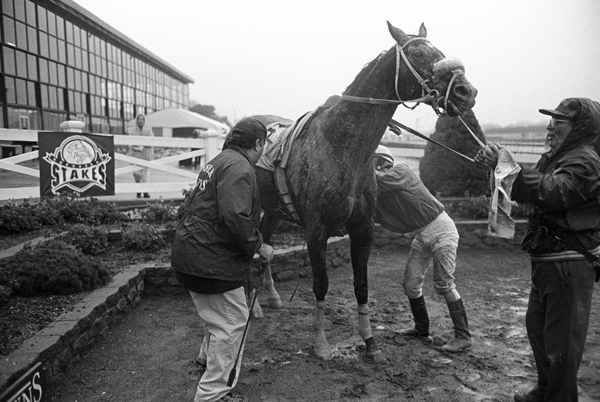
    Low Wage Jobs at Suffolk Downs


    From Celeste Ribeiro Myers:

    Gee - I wonder if these folks salaries will be bumped to $42k with the advent of a casino in East Boston. That's the word from Suffolk Downs' big wigs. 4000 jobs at $42,000 annually.


    Photos: East Boston Migrant Workers at Suffolk Downs
    Wed September 26, 2012
     
    Credit Melissa Shook
     
    A photo from Chelsea-based photographer Melissa Shook's book "My Suffolk Downs"
    Chelsea-based documentary photographer Melissa Shook has been capturing candid images of her often difficult-to-access subjects for decades. Her subjects include women who live in homeless shelters, immigrants, and the migrant workers at the shuttered Suffolk Downs in East Boston.

    Callie Crossley speaks with Melissa Shook on Boston Public Radio about her photography and her book "My Suffolk Downs"- which captures the migrant workers and immigrants who worked behind the scenes at Suffolk Downs as the racetrack was preparing to shutter its doors.

    http://www.wgbhnews.org/post/photos-east-boston-migrant-workers-suffolk-downs

    Gambling Addict leaves her 5 kids in car at Sands Bethlehem


    From Bill Kearney:

    Mom charged with leaving kids in car to gamble called 'loving and caring'


    Yulissa Troncoso is charged with leaving five kids in car while she gambled.


    By Pamela Lehman, Of The Morning Call
    September 26, 2012

    The attorney for a woman charged with leaving her five kids alone in a car on a summer night while she gambled at the Sands casino said Tuesday that his client made a mistake in judgment.

    Yulissa Troncoso, 33, of Allentown, will face Northampton County Court action on five counts of endangering the welfare of a child. In a brief appearance before District Judge Patricia Romig-Passaro, Troncoso gave up her right to a preliminary hearing. She is free after posting $10,000 bail.

    Troncoso's attorney, Glennis Clark, said afterward that Troncoso did not intend to harm her children when she allegedly left them in a car for about an hour July 26.

    Authorities said they paged Troncoso repeatedly while she played slot machines. The high temperature that day had been 91 degrees and police said the windows of the vehicle were cracked slightly open.


    "She's a loving and caring mother," Clark said. "Unfortunately, she made a mistake that day."

    Since the charges were filed in August, Troncoso's five children have been living with her and their father, Clark said. Officials with Lehigh County Children and Youth are monitoring the children to ensure their safety and well-being, Northampton County Assistant District Attorney Robert Eyer said.

    Clark asked Romig-Passaro to modify a bail condition that barred Troncoso from contact with her children. But Romig-Passaro said the bail condition would stand because she hadn't received notice from Lehigh County Children and Youth about the children being returned to Troncoso's care.

    The charges against Troncoso, of 518 N. Dauphin St., were believed to be some of the first locally of a parent allegedly leaving a child alone while gambling.

    At the time the charges were filed, police said the children's ages were 10 months, 2 years, 6, 11 and 12.


    In the past two years, 10 people have been arrested at the Parx Casino in lower Bucks County and charged with endangering the welfare of children. In other cases across the country, children died after being left alone in casino parking lots and locked in vehicles in sweltering temperatures.

    According to court records in the July 26 case:

    Security officers at the Sands Casino Resort Bethlehem were on patrol in the garage around 9:20 p.m. when they saw children in the vehicle with four slightly open windows. A security officer then called Bethlehem police.

    The oldest girl told police her mother had a cellphone and she knew the number, but Troncoso didn't have the phone with her.

    Troncoso continued to gamble in the casino for about an hour while she was repeatedly paged over the intercom. Video surveillance showed her playing slot machines, according to the court records.

    Police said the children were not injured.

    See link for video:
    http://www.mcall.com/news/breaking/mc-bethelhem-sands-casino-mom-kids-alone-car-20120925,0,7726082.story