Meetings & Information


*****************************
****************************************************
MUST READ:
GET THE FACTS!


Thursday, June 28, 2012

Chinese Limits Macau Gambling


Macau gaming stocks fall after reports of visa, Chinese credit card restrictions

27 June 2012

By Howard Stutz

Worries that China will limit the number of times citizens from the mainland can visit Macau, coupled with new government restrictions on credit card spending, caused gaming stocks to nosedive on the Hong Kong Stock Exchange Tuesday.

Macau-based subsidiaries of Las Vegas Sands Corp. and Wynn Resorts Holdings, LLC declined sharply in value on the Hong Kong Stock Exchange.

Wall Street tried, with some success, to defuse speculation before American markets opened. Las Vegas Sands, Wynn Resorts and MGM Resorts International - all of which have Macau subsidiaries listed on the Hong Kong Stock Exchange - ended trading in New York Tuesday with relatively little change from Monday's closing prices.

"We don't think there was a great deal of logic behind the stocks' decline yesterday," Nomura Securities gaming analyst Harry Curtis told U.S. investors.

On the New York Stock Exchange, Las Vegas Sands rose 9 cents, or 0.21 percent, to close at $42.99, MGM Resorts was also up 9 cents, or 0.86 percent, to close at $10.58. Wynn fell 2 cents, or 0.02 percent, to close at $102.04 on the Nasdaq Global Select Market.

"If there is any impact, it is likely to be temporary rather than have a deep impact on the sector's longer term fundamentals," JP Morgan gaming analyst Joe Greff told investors.

Media in Macau and Hong Kong this week reported that the Guangdong provincial government might limit its residents to three visas to visit Macau per year, down from four. Macau is the only legal gaming area in China.

China has at various times restricted travel to Macau, a former Portuguese colony now operated separately from Beijing as a special administrative region.

In 2008, China put visa restrictions in place, citing concerns of a rapid increase in the Macau gaming market. The restrictions immediately led to a slowdown in gaming revenues. Macau casinos saw just a 10 percent growth in revenues that year, down from 28 percent the year before.

It was also reported that China UnionPay, China's bankcard system, lowered its daily foreign transaction limit by a undisclosed figure. That would limit the amount customers can charge while overseas or in Macau.

Macau is the world's largest gaming market, producing more than $33.5 billion in gaming revenues in 2011, more than five times the gaming revenues produced last year on the Strip.

In May, Macau gaming revenues of $3.26 billion - the second-largest single-month revenue total ever recorded - was considered a disappointment. Gaming revenues grew 7.3 percent compared with May 2011. It was the first time since July 2009 that the gaming revenue increase failed to hit a double-digit percentage.

Based on news of the visa restrictions and credit card limits, analysts warned investors that Macau's gaming revenue growth in June could again fall short of a double-digit percentage increase.

Deutsche Bank gaming analyst Andrew Zarnett said visa restrictions would likely slow the volume of mass market visitation into Macau, rather than high-end customers who travel primarily on business visas.

"Although there is no official statement pertaining to changes, the visa restriction may be put in place temporarily to slow down the frequency of visitations from mainland China," Zarnett told investors. "If this policy is enforced through the second half of 2012, we view this event as a negative for the mass market, which comprises approximately 40 percent of the Macau gaming market."

Union Gaming Group principal Grant Govertsen, who is based in Macau, said it is often impossible to separate fact from speculation in the Chinese media. Shares of gaming companies listed on both U.S. and Hong Kong markets are sensitive to "unverifiable" headlines.

"When taken in the context of the decline in visitation in May, it might appear that there could be some substance to the speculation," Govertsen said. "However, we believe that operators are generally experiencing year-over-year increases in visitor volumes in June, while gross gaming revenue growth is trending up nicely."

http://www.casinocitytimes.com/article/macau-gaming-stocks-fall-after-reports-of-visa-chinese-credit-card-restrictions-60999

Residents' concerns spur meeting with casino panel

Residents' concerns spur meeting with casino panel


The Massachusetts Gaming Commission has agreed to meet with officials from Lakeville, Berkley and Middleboro about a proposed Mashpee Wampanoag casino in Taunton.

During the meeting Tuesday, broadcast by live stream on the commission's website, Chairman Stephen Crosby said state Rep. Keiko Orrall, R-Lakeville, had requested the meeting because of her constituents' concerns.

Compact negotiations with the Wampanoag tribe are being handled by Gov. Deval Patrick's office, however, and there is little input provided for the commission in the state law that authorizes three casinos and a single slot parlor in Massachusetts.

"I'm not sure that we can give any substantive answers to questions that are likely to arise," commissioner James McHugh said. "On the other hand, it doesn't hurt to talk to people as long as they understand we don't have the power at the moment."

Crosby said he will call Orrall and explain the situation and make sure expectations are clear.

"If they are and it will still be constructive to talk, then we'd be happy to do that," he said.

Orrall, who also represents part of Taunton, could not be reached for comment Tuesday.

Meanwhile, consultants for the commission have recommended paying an executive director close to $180,000 per year. The consultants provided a report on what executive directors earn in four other states with legalized casinos, ranging from $134,000 in New Jersey to $180,000 paid by Pennsylvania.

Consultant Robert Carroll of Michael & Carroll recommended paying near the higher end of the scale because of the responsibility given to the state commission.

Pennsylvania has 11 gambling facilities, which range from so-called racinos — slots at race tracks — to full-scale casinos.

Crosby requested more background information from the consultants to justify the salary. Crosby earns $150,000 as the commission's chairman and the other four commissioners are paid $112,500 per year.

Meanwhile, the commission is interviewing four firms that want to conduct the search for a full-time executive director. Commissioner Enrique Zuniga, who is overseeing the procurement process, said he hopes to recommend a firm to the commission at its meeting Monday.

That meeting is a day earlier than the commission's typical weekly meetings because of the Fourth of July holiday. The commission voted unanimously to allow Crosby, who will be away next week, to participate in the meeting by telephone.

McHugh will serve as chairman for that meeting.

In other business, the commission also discussed the possibility of hiring an ombudsman to help both developers and town governments through the process with the commission, as well as with other state regulatory agencies. Though Crosby talked about hiring a consultant for the position, other commissioners appeared to be leaning toward hiring a commission employee but not before a job description is in place for the role.


Attack Raises Fears of a New Gang War in Macau


Attack Raises Fears of a New Gang War in Macau

Dennis Owen/Bloomberg News
Ng Man-sun, a Macau casino investor, in 2005. He was attacked by six men over the weekend.

It was a brazen act recalling the rampant gang warfare that gripped Macau in the late 1990s — before the more recent arrival of Las Vegas casino developers like Sheldon G. Adelson and Steve Wynn and their billions of dollars in investments. The weekend assault against the gambling industry figure, Ng Man-sun, a casino hotel investor, bore the signs of a textbook attack by triads, or Chinese criminal societies, experts and analysts said on Wednesday.
      
The episode serves as a reminder that Macau’s bad old days are not so far behind it. The Las Vegas Sands, owned by Mr. Adelson; Wynn Resorts; and MGM Resorts International have poured more than $10 billion into building Las Vegas-style resorts here in recent years, helping its economy more than triple in size since 2004, when the first foreign-owned property was opened. By last year, Macau’s casino revenue had soared to almost $34 billion, more than five times that of the Las Vegas Strip.

But little more than a decade ago — when the city’s casinos were still under the four-decade monopoly of the gambling magnate Stanley Ho — triad murders, bombings and other attacks were so common that a senior police official once tried to reassure tourists by announcing that Macau had “professional killers who don’t miss their targets.”

That violent period resonated this week with the attack on Mr. Ng, who is widely known in Macau and Hong Kong as Ng Wai and Street Market Wai. Mr. Ng has been an investor in the Greek Mythology Casino, which is part of the New Century Hotel on Taipa Island in Macau, through his controlling stake in Amax Holdings, a firm listed in Hong Kong.
      
Mr. Ng, 65, was having dinner in a restaurant of the hotel late on Sunday night with an unidentified woman in her 30s when six men rushed in and proceeded to beat the couple with hammers and sticks, according to news reports in Macau on Tuesday. The reports said that Mr. Ng’s arms and legs were badly hurt but that the attackers had avoided hitting him on the head.

Suen Kam-fai, the chief of the Judiciary Police’s anti-money-laundering division, said Wednesday that a man with the surname Ng had been attacked and wounded on Taipa Island on Sunday, adding that the case had been referred to the police agency’s investigations unit. Associates confirmed Wednesday that the victim was Ng Man-sun, and said he was recovering in a hospital in Macau.

The woman was not badly hurt and was treated at a hospital and released.

A spokeswoman for Amax, Mr. Ng’s firm, declined to comment on Wednesday.

The New Century Hotel was the target of an attack in July 1997, during the years of gang warfare in Macau. Unidentified assailants sprayed the facade of the hotel with gunfire and wounded several security guards. No arrests were made.
      
At the time, Mr. Ng was in a public rivalry with one of Macau’s most notorious gangsters, Wan Kuok-koi, widely known as Broken Tooth. In a rare interview with Time magazine in April 1998, Mr. Wan spoke extensively of that rivalry, saying of Mr. Ng that “fate will not be kind to him” and pledging a “beautiful war.”
      
“I’m going to wipe him out,” Mr. Wan said, according to the magazine.

Mr. Wan was arrested in 1998 and convicted of triad gang membership, money laundering and loan sharking, among other crimes. Mr. Wan is scheduled to be released in December.
      
Mr. Ng, and previously Mr. Wan, are among thousands of gambling junket agents and so-called V.I.P. room operators in Macau. Junket agents bring high rollers to casino V.I.P. rooms, issue them credit and collect their gambling debts in exchange for a commission from the casino operator.

Their services are popular among Macau’s casino operators because the city relies heavily on players from mainland China, where gambling is illegal and the courts do not recognize casino debts. So these debts are often collected by extrajudicial means.

“The junket operators operate on a knife edge, and any ‘disturbance’ in the daily course of business can set off a war between them,” said Steve Vickers, a former commander of the Royal Hong Kong Police Criminal Intelligence Bureau who now runs a business intelligence and risk organization in Hong Kong.

Others said the attack against Mr. Ng could catch the attention of foreign gambling regulators, including those in Nevada, who are charged with monitoring the overseas casino operations of their licensees.

Analysts say that junket operators are responsible for most of the activity in the Macau’s gambling industry’s high-roller segment, which accounted for $25 billion in casino revenue last year. But the market has cooled recently.

“If you add everything up — a slowing market, Broken Tooth possibly coming back in — people may be scared there could be another round of violence,” one gambling analyst said of the attack on Mr. Ng, speaking on the condition of anonymity because he was not authorized to comment publicly on the matter. “But I don’t think the Chinese government would let that kind of thing happen. They will make sure everyone has enough business and stays cool.”
      
Since the attack was carried out by several assailants who did not use knives and did not appear to be trying to kill the victim, it bore the classic marks of a triad warning, experts said.
      
“An attack like this may be designed to send a message and do violence to his reputation,” said Roderic Broadhurst, a professor and criminology expert at Australian National University. “The fact that it took place in his own property is highly symbolic.”

Mr. Ng was involved in a number of recent financial disputes in Macau’s gambling industry, according to one associate who requested anonymity because of the sensitivity of the matter. The associate said they included a falling out with a former girlfriend and business partner, Chen Mei Huan, over control of the casino business.

“He has so many opponents and enemies that you don’t know who could be behind this, and I don’t want to guess,” the associate said.

Keith Bradsher reported from Macau, and Neil Gough from Hong Kong. Hilda Wang contributed reporting from Hong Kong.

http://www.nytimes.com/2012/06/28/world/asia/macaus-ng-man-sun-is-beaten-in-his-own-casino.html?pagewanted=all


Cheerleading to Doom!

There is no greater Casino Cheerleader than Paul Bruns who ignored the citizens' study report indicating the annual cost to host Mohegan Sun would be $18 million to $39 million.

Never Let The Facts Inform Your Decision, Mr. Burns!

And who will pay the cost of ~ $50 million to bring water from the Quabbin? Massachusetts taxpayers?

Mohegan Sun's revenues are declining even as they are surrounded by debt.


Mass. council invited to forum in Palmer

By JAMES MOSHER
Posted Jun 27, 2012

 
Palmer, Mass., Town Council President Paul Burns, who is working with Mohegan Sun to bring a resort casino to his town, has invited the Massachusetts Gaming Commission to conduct a “community mitigation” forum related to the casino project.

A June 25 letter from Burns to the commission asks for a forum similar to a recent one held in Worcester, Mass.

A Mohegan Sun spokeswoman couldn’t be reached for comment.


Read more: Mass. council invited to forum in Palmer - Norwich, CT - The Bulletin http://www.norwichbulletin.com/news/x448230489/Mass-council-invited-to-forum-in-Palmer#ixzz1z5AFFND1


Too much Casino KoolAid consumption!


Caution: 'Sluggish' U.S. gaming worries Moody's


The downturn in the economy witnessed countless Casino Bankruptcies, real estate tax reductions, bailouts, with states reducing their gaming taxes and genuflecting before the 'Too Important To Fail' notion.

A word of caution that the Gambling Industry is ignoring --

'Sluggish' U.S. gaming worries Moody's Investor Service
By Howard Stutz
LAS VEGAS REVIEW-JOURNAL
Posted: Jun. 27, 2012 
Moody's Investors Service expressed a cautious view of the U.S. casino market Wednesday, warning that weak gaming revenues and downward consumer trends could place several companies, including Caesars Entertainment Corp. and CityCenter Holdings, "at great risk."

Officials from the companies didn't dispute Moody's assessment that the U.S. gaming market has stalled but rejected notions the businesses are in trouble.

"Our debt is old news," Caesars Entertainment Senior Vice President Jan Jones said of the company's nearly $20 billion in long-term debt, an industry high. "It's the same debt we've had for the last five years, and we don't have any maturities coming due any time soon. The disappointment about the report is that Moody's is correct, the market is sluggish right now."

Moody's said consumer confidence has weakened, payroll expansion has slowed, and retail sales have softened, slowing the improvements in U.S. gaming revenues.

"The improving trend in gaming revenues in place since the middle of last year appears to be stalling," Moody's gaming analyst Peggy Holloway said. "Momentum started slowing in March, and then in May gaming jurisdictions reported outright declines in gaming revenue."

Falling gasoline prices and low interest rates have increased consumers' disposable income, which could boost gaming demand, Holloway said.

But Moody's pointed toward a decline in consumer sentiment with chronic high unemployment and "fear of contagion from the European debt crisis" as troubling signs.

"I think they make some great points," said David Schwartz, director of University of Nevada, Las Vegas Center for Gaming Research. "(There are) a lot of potential negatives, particularly nationally. And debt continues to be a concern."

Holloway expressed concern for industry giant Caesars Entertainment, which operates 10 Strip resorts, including Caesars Palace, Harrah's Las Vegas, Bally's and Planet Hollywood; and the joint venture between MGM Resorts International and Dubai World that operates CityCenter, which includes nongaming hotels, residential, retail, dining and the centerpiece Aria hotel-casino.

In the report, Moody's said "significant near-term maturities or highly leveraged capital structures" could be challenged "if declines in gaming demand accelerate."

Moody's also cited the recently opened Revel Atlantic City and Cannery Casino Resorts, which operates the two Cannery casinos in suburban Las Vegas, as companies that could be at risk.

"Although we expect most companies to have a reasonable chance of refinancing their debt when they need to, the cost is likely to rise," Holloway wrote.

Jones said Caesars Entertainment took steps to refinance portions of its debt by extending maturities past 2015. A cost-cutting effort that began in 2011 is also expected to slice more than $400 million from the books by year's end.

Caesars has been able to manage the debt load since the company's $29 billion private equity buyout in 2008.

"It's always an easy target," Jones said.

MGM Resorts Senior Vice President Alan Feldman said the company's investor's relations division "didn't have much to say" about the Moody's report because it is an analyst's judgment call.

"There were some nice things said about Nevada, and we're Nevada-centric," Feldman said. MGM Resorts operates 10 Strip properties, including Bellagio, MGM Grand and The Mirage.

Feldman called CityCenter's debt, "minimal." In January, CityCenter reduced the balance of its debt from $1.85 billion to $500 million and extended the due date to 2015. MGM Resorts as a company has long term debt of $13.4 billion.

Some U.S. gaming markets were viewed as doing better than others.

The Moody's report said regional challenges in the Northeast and central United States include potential oversupply and negative growth. But the Southeast saw gaming revenues increase in relation to last year, when many casinos were closed by flooding.

In Las Vegas, gaming revenues have increased three out of the four months in 2012 that have been reported by the Gaming Control Board, including an 18.37 percent increase in January, the state's first $1 billion month since 2008.

There is a difficulty in absorbing new supply in some markets, Moody's said. Revel in Atlantic City, Resorts World in New York and Rivers Casino in suburban Chicago "do not appear to be boosting gaming demand in their markets," Holloway wrote.

Caesars and MGM Resorts are seeking casino expansion in emerging gaming jurisdictions. Caesars recently opened the first of two casinos in Ohio.

"There is no way anyone would say Ohio, Massachusetts, or Maryland are oversaturated gaming markets," Jones said. "They are underserved."


http://www.lvrj.com/business/moody-s-says-improvement-in-u-s-gaming-has-stalled-160515395.html

Tuesday, June 26, 2012

Gambling addicts warn state gaming panel about predatory casinos


Gambling addicts warn state gaming panel about predatory casinos


Top Photo
Gamblers shoot craps at a casino in Atlantic City, N.J. Testimony from recovering gamblers was a highlight of a forum on Monday sponsored by the Massachusetts Gaming Commission to address potential negative effects of the state's newly expanded gaming law.AP

Quinlan found guilty


Andrew Quinlan found guilty of gambling charge

Children as young as 10 are battling serious gambling problems


From Stop Predatory Gambling:


Children as young as 10 are battling serious gambling problems, a major study has revealed

While the United States continues to ignore its public health problem of gambling addiction, the first national study of the gambling habits of Australia’s youth has found a tenth of kids aged 10-14 fit definitions of ‘‘at-risk’’ or ‘‘problem’’ gamblers. And a third have adults willing to place bets on their behalf. Almost a third of kids aged 10-14 said they had played electronic gambling machines in the previous year, more than half had purchased scratch tickets.
2012 Junior gamblers battle addiction


Monday, June 25, 2012

Romney: The Get-Out-Of-Jail-Free Candidate


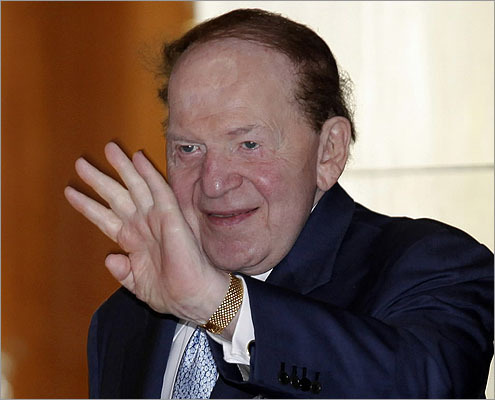
What Sheldon Adelson Wants

By The New York Time | Editorial
24 June 12

o American is dedicating as much of his money to defeat President Obama as Sheldon Adelson, the casino magnate who also happens to have made more money in the last three years than any other American. He is the perfect illustration of the squalid state of political money, spending sums greater than any political donation in history to advance his personal, ideological and financial agenda, which is wildly at odds with the nation's needs.

Mr. Adelson spent $20 million to prop up Newt Gingrich's failed candidacy for the Republican nomination. Now, he has given $10 million to a Mitt Romney super PAC, and has pledged at least $10 million to Crossroads GPS, the advocacy group founded by Karl Rove that is running attack ads against Mr. Obama and other Democrats. Another $10 million will probably go to a similar group founded by the Koch brothers, and $10 million more to Republican Congressional super PACs.

That's $60 million we know of (other huge donations may be secret), and it may be only a down payment. Mr. Adelson has made it clear he will fully exploit the anything-goes world created by the federal courts to donate a "limitless" portion of his $25 billion fortune to defeat the president and as many Democrats as he can take down.


One man cannot spend enough to ensure the election of an unpopular candidate, as Mr. Gingrich's collapse showed, but he can buy enough ads to help push a candidate over the top in a close race like this year's. Given that Mr. Romney was not his first choice, why is Mr. Adelson writing these huge checks?

The first answer is clearly his disgust for a two-state solution to the Israeli-Palestinian conflict, supported by President Obama and most Israelis. He considers a Palestinian state "a steppingstone for the destruction of Israel and the Jewish people," and has called the Palestinian prime minister a terrorist. He is even further to the right than the main pro-Israeli lobbying group, the American Israel Public Affairs Committee, which he broke with in 2007 when it supported economic aid to the Palestinians.

Mr. Romney is only slightly better, saying the Israelis want a two-state solution but the Palestinians do not, accusing them of wanting to eliminate Israel. The eight-figure checks are not paying for a more enlightened answer.

Mr. Adelson's other overriding interest is his own wallet. He rails against the president's "socialist-style economy" and redistribution of wealth, but what he really fears is Mr. Obama's proposal to raise taxes on companies like his that make a huge amount of money overseas. Ninety percent of the earnings of his company, the Las Vegas Sands Corporation, come from hotel and casino properties in Singapore and Macau. (The latter is located, by the way, in China, a socialist country the last time we checked.)

Because of the lower tax rate in those countries (currently zero in Macau), the company now has a United States corporate tax rate of 9.8 percent, compared with the statutory rate of 35 percent. President Obama has repeatedly proposed ending the deductions and credits that allow corporations like Las Vegas Sands to shelter billions in income overseas, but has been blocked by Republicans.


Mr. Obama's Justice Department is also investigating whether Mr. Adelson's Macau operations violated the Foreign Corrupt Practices Act, an inquiry that Mr. Adelson undoubtedly hopes will go away in a Romney administration. For such a man, at a time when there are no legal or moral limits to the purchase of influence, spending tens of millions is a pittance to elect Republicans who promise to keep his billions intact.

http://readersupportednews.org/opinion2/277-75/12078-focus-what-sheldon-adelson-wants


Martin Bashir | Aired on June 18, 2012

Sheldon Adelson: GOP’s million dollar man

Bloomberg View columnist William Cohan joins MSNBC’s Martin Bashir to discuss Sheldon Adelson, the man who reportedly has spent or pledged $71 million to Republican candidates and causes, and where his money and interests lie.


http://video.msnbc.msn.com/martin-bashir/47864344#47864344

KG Urban believe they will prevail


Lawyers for developer KG Urban believe they will prevail in bid to throw out state's casino guidelines

Top Photo
JOHN SLADEWSKI/The Standard-Times A photograph of a sketch provided by KG Urban Associates showing their plan for a casino at the former Cannon Street power plant in New Bedford.Contributed
 
As the Mashpee Wampanoag methodically cross items off the checklist they hope will lead to state sanction for an Indian casino in East Taunton, a time bomb ticks ominously in the background.
Acquire property? Done.

Conduct a referendum vote in the host community? Accomplished.

Negotiate a compact with the governor? On track, according to the state officials.

Convince the state Gaming Commission that land on which the casino would operate will be taken into trust by the federal Department of the Interior's Bureau of Indian Affairs? Not so fast.

That's where the process breaks down, according to a team of legal experts pulled together by KG Urban Enterprises of New York, which hopes to develop a casino at the site of the abandoned Cannon Street power plant in New Bedford. KG Urban brought its legal team to the SouthCoast last week, meeting with The Standard-Times Editorial Board.

"You can go through the whole process, but when you get to the end of it, the law of the land says they cannot" take land into trust, said Marsha Sajer, a lawyer who specializes in Indian gaming. "It's all going to come down to land-into-trust and will that land be approved for gaming, which is not going to happen under Carcieri."

The Carcieri ruling handed down by the U.S. Supreme Court in March 2009 determined that land could no longer be taken into trust for any tribe recognized by the federal government after 1934. The Mashpee tribe gained recognition in 2007.

KG filed suit immediately after the governor signed the state's Expanded Gaming Act in November, claiming the preference given to federally recognized tribes for the Southeastern Massachusetts casino license was a "race-based set-aside" that violated the Equal Protection Clause of the Constitution.

On Feb. 17, U.S. District Court Judge Nathaniel M. Gorton ruled that, "Unfortunately, governing caselaw is to the contrary," and dismissed the case. KG appealed and arguments were heard by a three-judge panel in the Court of Appeals of the First Circuit in Boston on June 7.

Gorton's decision "was not a bad opinion for us," said Paul Clement, KG's high-powered, high-profile lead counsel. "It cleared a lot of the underbrush away. In many ways he ruled in our favor, but he's a district court judge and he has to follow the (precedent-setting) Supreme Court decision.

"Gorton found for us on a factual basis," said Andrew Stern, KG's managing director and principal. "He agreed that we suffered from and continue to suffer from hardship. He agreed that the balance of hardship tilted toward us. But his hands were tied by one legal precedent."

Based on the questions asked at the June 7 hearing by Chief Judge Sandra Lynch — who, ironically, was the judge the Supreme Court overruled in its Carcieri decision — KG's legal experts feel they've got a good shot at prevailing in their appeal.

"This is just a guess ... but I think it's tempting on their part to wait and see what happens on July 31, then act sometime soon after," Clement said.

"The best outcome for us is a preliminary injunction against Section 91 of the act so the Southeast would be treated like anyone else," Clement said. "That would give us the opportunity to compete for a commercial license in the Southeast on its merits. If you knock (Section 91) out, the rest of the bill still works."

And if the appeal fails?

"I would strongly recommend to my client that, if we lost, we ought to file a petition to be heard by the Supreme Court," Clement said. "I believe we would have some very sympathetic ears there."

Clement has argued more than 60 cases in front of the Supreme Court and served as lead counsel in the high-profile hearing opposing the federal health care plan, known as Obamacare, earlier this year.

"I think we could take it up to the Supreme Court relatively quickly," possibly as soon as the next session, which begins in October, Clement said.

A head start

The expanded gaming law allows up to three casinos in three distinct areas of the state, plus a slots parlor, and gives federally recognized tribes a head start on the process for obtaining the Southeastern Massachusetts license. A tribe has until July 31 to acquire property for its casino, to schedule a referendum vote in the host community, to negotiate a gaming compact with the governor and convince the state gaming commission that its property would be taken into federal trust. Only if it fails would commercial applicants be allowed to seek a license for the area.

KG, which has been laying the groundwork for a casino development in New Bedford for four years, has argued that that's both unfair and illegal.

"Southeastern Massachusetts is essentially being left behind," Stern said.

While five major players are angling for the casino license set aside for Western Massachusetts, no one, outside of KG and the two federally recognized tribes, has expressed any interest in the Southeast. For years, a number of potential developers held options for land and expressed interest in developing a casino in the Hicks-Logan neighborhood off Interstate 195, but those options have been allowed to lapse.

We're being told that this is rigged, that the fix is in, Stern said. "Nobody will return my phone calls.
"I spent $5 million and no one will spend even a couple of hundred thousand dollars now."

"There's only one explanation for it," Clement said. The Indian preference "absolutely freezes out a whole section of the state. Not only do we lose a head start, but once casinos are established in the other two sections of the state, it's over."

"A place like Suffolk Downs could snap up a customer base with a mass marketing campaign," Stern said. "We'd be left at the bottom of a 50-foot pit looking for investors."

Kevin Considine, local counsel for KG, said he fears, "It's about to get worse for the Southeast. The governor and tribe are negotiating a compact in which the tribe will agree to pay the state some percentage of its gaming revenues. The quid pro quo for that is that the tribe will be given exclusive gaming rights in the Southeast."

The problem with that, Stern argued, is "if (the tribe) can't get land forever and the governor gives them exclusive gaming rights forever, everyone else is locked out forever."

Even if the Mashpee Wampanoag don't qualify under the Indian process set up by the law, they still could compete for a commercial license. In that scenario, the tribe would have the advantage of already having negotiated with the state.

"There's certainly no guarantee that there isn't going to be some residual effect from what's been happening," Clement said, but KG won't quit.

"I'm not going home," Stern said. "I'm committed to it. If I wasn't ready to compete with Mashpee on the merits of a project, then I never would have begun."

The Indian dilemma

"There's always been this general notion on Beacon Hill that you need to take care of the Indians," said Bill Bernstein, KG's lead lobbyist. "It's ingrained itself in the mentality up there. So when we had the gaming discussion with that ingrained notion, they decided to do something to take care of the Indians as opposed to once we do what we want to do, then the Indians can do what's available to them."

An earlier version of the state's gaming legislation would have reserved a commercial license for a tribe, but that did not pass and the accommodation was removed from subsequent bills.

Still, "It's very difficult to shake the notion loose that Indians are the magic bullet," Stern said. "It's in the head of the (SouthCoast) delegation that (partnering with a tribe is) the shortcut to getting a gaming license. You had members of this delegation saying that you have to appease the Indians," Stern said, although it was the sense of local legislators that the Indian preference in the law would never really matter because they could never get land taken into trust.

"I had discussions with (local legislators)" that confirmed that belief, said Lou Cabral, KG's local liaison.

The Bureau of Indian Affairs has continued to do the spade work for taking land into trust, including a hearing last week on the Masphee's petition, but has acted only once since the Carcieri decision.

The Cowlitz tribe of Washington had land taken into trust, but multiple lawsuits immediately were filed that could tie up the case for years, Sajer said.

Another Supreme Court ruling last week interjected yet another roadblock in the land-into-trust process. That ruling, which expanded the number of people who may sue to block the taking of land into trust and gave them six years in which to do so instead of the previous 30 days, could cause years of delay and may spook potential developers and investors.

"That's really significant," Clement said. "It takes a process that's already very challenging and makes it that much harder."

Stephen Crosby, chairman of the Massachusetts Gaming Commission, recently said he'd be willing to wait for years if necessary, for the Mashpee to have land taken into trust, which incensed Stern.

"Where do these guys get the nerve to say they're willing to wait years, because it's just the Southeast?" he asked.

The state's only other federally recognized tribe, the Wampanoag of Gay Head (Aquinnah) face the same hurdles as the Mashpee Wampanoag — plus a few more.

The Aquinnah also were recognized after 1934, making them similarly ineligible to get land into trust under Carcieri. Additionally, the tribe has suffered overwhelming defeats when it asked voters in Freetown and Lakeville to host and Indian casino and was rebuffed by governor when it asked to open compact negotiations.

The state maintains that the Aquinnah gave up their gaming rights in a 1987 land deal, so it won't talk to the tribe about a casino in Freetown and Lakeville or even on its already recognized sovereign land on Martha's Vineyard.

The Aquinnah claim they never gave up their gaming rights and would pursue legal action to exercise them.

$5 million spent
KG already has spent more than $5 million on its proposed casino and has projected total spending of more than $1 billion if the group is ultimately awarded a casino license. And it would be far more beneficial to the area than a sprawling Indian casino build in an industrial park, Stern argued.

First, it would clean up a contaminated urban brownfields area at an expected cost of $50 million, something he said the government would be hard-pressed to do itself. And second, it would provide an economic engine to revitalize a struggling downtown and replace long-gone manufacturing jobs.

"All we've ever wanted is to get up to the plate and take a few swings," Stern said. "We'll compete with anybody.

"I have to count on my product being the best one. We're ready to rock here."

Sunday, June 24, 2012

Downtown Springfield casino


Just one day, I'm going to be surprised when an elected official indicates he/she has done their homework.


The Massachusetts Gam[bl]ing Commission is seeking input to adopt a 2-step approval process.

The first step in that process would be to consider financial and background information.

How much experience does Picknelly have? Bus Company, Gambling....Oh! Yeah! I get the connection!  Who will run this Urban Slot Barn? There are a host of other questions that can be asked along similar lines - you get the point. The politicians don't.

These are the same deadheads who refused to conduct an Independent Cost Analysis because they 'know it all' from having their undeserved over-sized egos stroked by Gambling Lobbyists.

Facts and information were silenced with campaign contributions.

For information about urban slot barns, look at  Niagara or Atlantic City [there are 186 articles in the category, at the bottom of the page, click "Older Posts"]


Of Atlantic City -
By comparison, Toronto has more than 2.5 million citizens and saw just 45 murders in 2011.

Atlantic City officials are quick to point out close to 30 million people visit the resort town annually.

But a recent study found Atlantic City had a higher rate of violent crimes per capita than any other casino city in the U.S.

In 2010 there close to 900 violent crimes — murders, rapes, robberies and aggravated assaults — in Atlantic City.

That’s a violent crime rate of 20.7 crimes per 1,000 people.

Another study concluded Atlantic City’s violent crime rate in 2009 was 388.9% higher than the national average.

Recently, 2 Canadian Tourists were stabbed to death in Atlantic City.


From the parking garage of the Taj Mahal where the casino refused to protect patrons, there were 2 fatal carjackings.


Has a single Bobble Headed politician who supported this legislation examined the rates of increased crime, poverty, foreclosures, personal bankruptcies, homelessness, divorces or increased SUICIDES? The Gambling Industry's DIRTY LITTLE SECRET!


Life is so much easier when you don't have to THINK!

Downtown Springfield casino could revitalize city with jobs, tourism, observers say

Friday, June 22, 2012

The Republican building 62112.jpgThe Republican building at 1860 Main St., in downtown Springfield is being eyed by developers as the possible site of a casino.
A downtown casino in Springfield might help revitalize the city if planners can devise ways to smoothly control traffic and link the casino to existing attractions such as the Naismith Memorial Basketball Hall of Fame and the MassMutual Center, observers said Thursday.

A casino could attract people to Springfield who otherwise would not visit the city, they said. While crime would be an issue and bankruptcies and divorce rates might increase, a casino could also improve the city if designed carefully with enough parking and traffic improvements, said the Rev. Richard McGowan, an adjunct associate professor at Boston College and author of books on gambling.

McGowan said the industry is moving to locate more casinos in downtowns such as a casino that opened in May in Cleveland and one planned to open next year in Cincinnati. Detroit and New Orleans also have downtown casinos.

"That seems to be the trend," he said.

Richard McGowan 62112.jpgRichard McGowan

The MGM Grand Detroit bills itself as "the first-ever Las Vegas-style destination to open in a major metropolitan core."

The dynamics of licensing a casino in Western Massachusetts may have changed on Wednesday when The Republican reported that Peter A. Picknelly, chairman and CEO of Peter Pan Bus Lines, is proposing a casino for the North End of Springfield. The publisher of The Republican confirmed that two companies associated with Picknelly -- aiming to build a casino -- submitted an offer for an option to buy The Republican's Main Street building and property, as well as the newspaper's eight vacant acres on the Connecticut River.

George Arwady, Publisher and CEO of The Republican, said by e-mail on Thursday that there is no timeframe for the newspaper to respond to the offer by the companies associated with Peter Picknelly.

"We still are considering how to respond," Arwady said in the e-mail.

George Arwady 2011.jpgGeorge Arwady

"Employees of The Republican are surprised and intrigued, but they clearly understand that there is nothing in this for them to worry about," he added.

The option offer includes proposals for funds for The Republican to re-locate its offices and build a new production facility.

Peter Picknelly's brother, Paul C. Picknelly, president of Monarch Enterprises in Springfield and a hotel owner and operator, has met with several city councilors in Springfield to discuss a proposal to develop a casino in the South End of the city.

A downtown casino for Springfield might pick up more traction if one or both of the brothers announces that he has teamed up with a casino operator.

Kevin E. Kennedy, chief development officer for the city of Springfield, has said it's logical that MGM and Hard Rock International would look at Springfield for a possible casino resort. Hard Rock planned a casino for Holyoke but after being rebuffed by the mayor, said it would consider other locations in the region. MGM said it is "100 percent" committed to bringing a world-class casino to Western Massachusetts.

herb.jpgHeriberto Flores
Kennedy said the downtown would be "a good place" for a casino and a "game changer" for the downtown.

Opinion on a urban casino for Springfield is sharply divided, judging by comments on Masslive.com attached to the story that ran Wednesday. Many people are skeptical that it would be approved.

"If a casino is going to be built in Springfield, the newspaper and Peter Pan Bus properties are a terrific location for it. Highly visible from I-91 and I-291, in a commercial area that won't have a negative impact on neighborhoods. This would be a major tourist draw for a city that has few, and it would help boost businesses in the downtown area," said a post by spfldr99.

"To put a casino smack dab in the middle of the inner city is NOT a good move. Do we want to be another Atlantic City where the perimeter of the casino is a real populated poor area? Does Picknelly think the current problems in the North End are going to be solved with a big fancy casino?" added a post by realyst.

rivera.jpgCheryl Coakley-Rivera
A plan for a downtown casino in Springfield would compete for a Western Massachusetts license with the Mohegan Sun, which is planning a casino in Palmer, and Ameristar Casinos, which is planning a casino off Page Boulevard in East Springfield, outside the downtown area.

The state's casino law authorizes up to three casino resorts including one for anywhere in Western Massachusetts.

The five-member Massachusetts Gaming Commission was created to license and regulate casinos.
Heriberto Flores, president of the New England Farm Workers Council in Springfield, which he said owns seven buildings in the area of Main, Hampden and Fort streets in downtown Springfield, said he is considering proposals for a downtown casino. Flores said he wants to make sure that any proposal makes sense to the council and is in the best interests of residents.

Flores said he would like to put the agency's downtown contiguous buildings into the casino mix.
Flores said it's a good sign when a company wants to invest hundreds of millions of dollars in Springfield.

"It's another industry," he said. "It will create jobs."

Supporters are generally optimistic about a casino in the commercial heart of Springfield, saying it could boost tourism, provide thousands of jobs and millions of dollars in taxes.

If a casino is going to be in Springfield, there's no question "the strongest location" is the downtown, said Rep. Sean F. Curran, a Springfield Democrat whose district includes the site for a casino off Page Boulevard. "If you put $500 million into downtown Springfield, it could go a long way to bring more vibrancy to the area,' said Curran.

But Rep. Angelo J. Puppolo, a Springfield Democrat,said an inner-city casino would be more vulnerable to problems such as crime. Puppolo said he doubts that people would feel comfortable going to a casino in downtown Springfield.

"I'd certainly be very, very cautious about putting a casino in a downtown urban setting," said Puppolo, who is supporting the Mohegan Sun's plans for a casino on 150 acres on a hill off Exit 8 of the Massachusetts Turnpike because he said it would be more a destination resort.

Puppolo said the city of Springfield could work out an agreement with Palmer and the Mohegan Sun to assure that the city benefits with jobs and economic development from a casino in Palmer.
Rep. Cheryl Coakley-Rivera, a Springfield Democrat whose district includes the North and South ends of Springfield, said she is going to reserve her opinion on a downtown casino. She said she has seen no concrete plans.


Coakley-Rivera said the residential areas in the north and south ends have some of the highest rates of poverty in the state.

"It's exciting that people are looking into purchasing land and developing land in Springfield," she said. "It's all about making Springfield a better place to live, a more viable place to live and putting people who live there to work."

City Councilor Kateri B. Walsh said she believed a referendum for a casino would be approved in Springfield.

She said she likes the idea of a downtown casino depending on how it is done.

http://www.masslive.com/politics/index.ssf/2012/06/a_downtown_casino_in_springfie.html

The Myth of Indian Casino Riches


The Myth of Indian Casino Riches